
Verwandte Artikel zu St. Peter's Bones: How the Relics of the First...
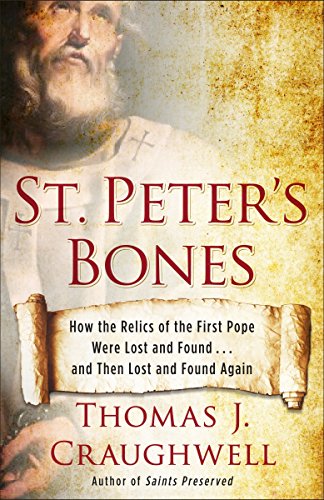
St. Peter's Bones: How the Relics of the First Pope Were Lost and Found . . . and Then Lost and Found Again - Softcover
Inhaltsangabe
In this fascinating account of the search for the remains of the world's first pope, none other than Peter, the chief apostle of Jesus, Thomas J. Craughwell takes us on one of the most exciting archaeological finds of the twentieth century.
In 1448 a team of architects and engineers brought Pope Nicholas V unhappy news: the 1,100-year-old Basilica of St. Peter suffered from so many structural defects that it was beyond repair. The only solution was to pull down the old church--one of the most venerable churches in all of Christiandom--and erect a new basilica on the site. Incredibly, one of the tombs the builders paved over was the resting place of St. Peter.
Then in 1939, while reconstructing the grottoes below St. Peter's Basilica, a workman's shovel struck not dirt or rock but open air. After inspecting what could be seen through the hole they'd made in the mausoleum's roof, Pope Pius XII secretly authorized a full-scale excavation. What lay beneath? The answer and the adventure await. In this riveting history, facts, traditions, and faith collide to reveal the investigation, betrayals, and mystery behind St. Peter's burial place.
Die Inhaltsangabe kann sich auf eine andere Ausgabe dieses Titels beziehen.
Über die Autorin bzw. den Autor
THOMAS J. CRAUGHWELL was the author of Saints Behaving Badly, Urban Legends, Alligators in the Sewer and 222 Other Urban Legends, Saints for Every Occasion: 101 of Heaven's Most Powerful Patrons, and Do Blue Bedsheets Bring Babies? He wrote about saints for the the Wall Street Journal, St. Anthony Messenger, and Catholic Digest, and discussed saints on CNN and EWTN. His book Stealing Lincoln's Body was made into a two-hour documentary on the History Channel. He passed away in 2018.
Auszug. © Genehmigter Nachdruck. Alle Rechte vorbehalten.
Chapter 1
An Elderly but Powerful Man
In 1940, Pope Pius XII authorized a thorough reconstruction of the Vatican Grottoes, the undercroft of the Basilica of St. Peter, transforming it from a cramped burial chamber into a series of crypt chapels. To accomplish this, the floor of the Grottoes would be lowered by two-and-a-half feet. Everyone in the Vatican knew that there were Roman remains under the basilica, but no one had any idea what type—no one had seen them in sixteen hundred years. Then, in January 1941, workmen uncovered an elegant mausoleum that, based on inscriptions found in the tomb, had belonged to the Cetenni family. The archaeologists who were called in to examine the find declared that it was a discovery of genuine importance. On their recommendation, Pius XII gave permission for a full-scale excavation of the area beneath the Grottoes.
Pius’s decision was daring. Other popes had expressed an interest in excavating beneath St. Peter’s but had always held back out of reverent awe. Rome’s Christians had buried the earliest popes and countless forgotten martyrs in the vicinity of St. Peter’s tomb; it would be sacrilege to disturb the graves of so many saints. So Pius settled on a compromise. The archaeologists could excavate everywhere beneath the Grottoes with one exception: the area below the high altar and in the immediate surrounding area. The place where St. Peter was presumed to be buried was deemed off-limits.
To supervise and direct the project, the pope created a commission and named to it a group of expert scholars, as well as a team of sampietrini. Traditionally, the sampietrini are an elite corps of men trained in every trade and craft. These electricians, stonemasons, plasterers, and plumbers are responsible for the maintenance of St. Peter’s Basilica, and they take this trust very seriously. The sampietrini are so defensive of the responsibilities placed upon them, that in most cases the job is passed down from father to son for generations.
The scholars included Professor Enrico Josi, a leading expert on the catacombs; Antonio Ferrua, S.J., considered the foremost scholar of epigraphy, the study of ancient Christian inscriptions; Engelbert Kirschbaum, S.J., a professor of Christian archaeology; and three architects, Bruno Maria Apollonj Ghetti, Gustavo Giovannoni, and Giuseppe Nicolosi. The manager of the project was Monsignor Ludwig Kaas, one of Pius XII’s closest advisers, especially on Church-state affairs in Nazi Germany. Msgr. Kaas also was administrator of the Basilica of St. Peter.
This work crew assigned to lower the floor of the Grottoes had been laboring for about three weeks when on January 18, 1941, one of the men digging at a spot in the south aisle uncovered the top of a brick wall. The crew had been turning up sarcophagi almost from their first day on the job—that had been expected, as the Grottoes had been a burial place for sixteen hundred years. But finding evidence of a structure beneath St. Peter’s had not been expected. The foreman sent for one of the Vatican archaeologists.
By carefully clearing away more soil, a portion of the wall was revealed: one side was plain, unadorned brick, and judging from its style, undoubtedly ancient; the other side of the wall had been plastered and painted a vivid shade of greenish blue. Gradually the sampietrini uncovered the top of a rectangular building, measuring twenty-two by twenty feet. Its roof was gone, deliberately removed, and the interior of the building had been filled with soil. But why? At this stage, the Vatican archaeologists could only speculate. In the meantime, they ordered the work crew to remove all the soil from the interior of the little building.
Once the building had been cleared and the soil brushed from the interior walls, the diggers and archaeologists found themselves standing in the middle of a beautifully decorated tomb. One fresco depicted swans bearing garlands in their beaks, another pictured birds amid roses and violets. The most elaborate scene portrayed Venus, the Roman goddess of love, supported by two tritons, or sea gods, as she rose above the waves. Carved into the walls were many niches, some of which held marble cremation urns, still in their original places, untouched since another work crew had packed the tomb with earth centuries earlier.
The floor was paved with a mosaic of black and white tiles. In the center of the chamber stood an altar that revealed the identity of the owners of this tomb: Marcus Caetennius Antigonus and his wife, Tullia Secunda.
In addition to the urns, there were also terra-cotta sar- cophagi sealed with marble slabs. These sarcophagi had been slipped into arched niches in the bottom half of the chamber’s walls. One of these slabs marked the grave of a member of the Caetennius family (or Caetenni, as they would have been known in ancient Rome) who had been a Christian. The inscription reads:
Anima Dulcis Gorgonia
Mir(a)e i(n) Specie Et
Castitati Eivs Ameli(a)e
Gorgoniae Qvi(a)e vixit
Ann(is) XXVIII Mens(ibus) II
D(iebus) XXVIII
Dormit in Pace Co(n)ivgi
Dulcissime Feci
Gorgonia, sweet soul.
to the wondrous beauty and chastity of
Aemilia Gorgonia, who lived 28 years, 2
months and 28 days.
sleep in peace. I gave this burial to my darling
wife.
Two Christian emblems were incised into the marble: two doves bearing olive branches, the symbol of peace, flanked by the phrase “Sleep in peace.” To the left of the inscription is a woman drawing water from a well, an early Christian sign of eternal life. Vatican archaeologists estimated that the Caetenni had erected their family tomb sometime between AD 130 and 170, and that it had been in use for approximately two hundred years.
The archaeologists ordered the sampietrini to clear away the dirt that sealed the tomb door and to excavate outside the chamber. Soon they uncovered another treasure: an elaborately carved white marble sarcophagus. An inscription identified the deceased as Ostoria Chelidon, the daughter of a senator and the wife of a member of the emperor’s staff. The lid was ajar, so the workmen lifted it. Inside they found the remains of Ostoria Chelidon. On her skull rested a hair net of golden threads. Shreds of purple cloth—a color reserved for members of the highest rank of Roman society—still clung to her bones. On her left wrist, a heavy bracelet of solid gold flashed in the dim light.
Either find, the Caetenni tomb or Ostoria Chelidon’s sarcophagus, would crown the career of any archaeologist. Yet this was only the beginning of the excavation.
Directed by the Vatican archaeologists, the work crew began to scrape and prod the soil on either side of the Caetennius tomb, and very soon they found more mausoleums—each one stripped of its roof and its chamber filled with packed earth. They had stumbled upon a little village of the dead.
On an autumn day in the year AD 64, Roman guards led an elderly prisoner into a long, oval-shaped arena. There, before the eyes of a jeering crowd, the condemned man—a Galilean fisherman-turned-preacher called Simon Peter—was to be crucified. Very likely he entered the arena carrying across his shoulders the crossbeam to which he would be nailed (the upright post of the cross would have been waiting for him on the sand). He would have been naked, or perhaps wearing a loincloth. The crowd would have been able to see on his bare back and broad shoulders the bleeding marks of the flagellum, a multitailed whip embedded with sharp bits of bone or metal to tear open the prisoner’s flesh. A man would have walked before the prisoner carrying the titulus, a wooden board inscribed with his crime:...
„Über diesen Titel“ kann sich auf eine andere Ausgabe dieses Titels beziehen.
Suchergebnisse für St. Peter's Bones: How the Relics of the First...

Beispielbild für diese ISBN
St. Peter's Bones: How the Relics of the First Pope Were Lost and Found . . . and Then Lost and Found Again
Anbieter: World of Books (was SecondSale), Montgomery, IL, USA
Verkäuferbewertung 5 von 5 Sternen

Paperback. Zustand: Good. In this fascinating account of the search for the remains of the world's first pope, none other than Peter, the chief apostle of Jesus, Thomas J. Craughwell takes us on one of the most excitingarchaeological finds of the twentieth century. In 1448 a team of architects and engineers brought Pope Nicholas V unhappy news: the 1,100-year-old Basilica of St. Peter suffered from so many structural defects that it was beyond repair. The only solution was to pull down the old church--one of the most venerable churches in all of Christiandom--and erect a new basilica on the site. Incredibly, one of the tombs the builders paved over was the resting place of St. Peter. Then in 1939, while reconstructing the grottoes below St. Peter's Basilica, a workman's shovel struck not dirt or rock but open air. After inspecting what could be seen through the hole they'd made in the mausoleum's roof, Pope Pius XII secretly authorized a full-scale excavation. What lay beneath? The answer and the adventure await. In this riveting history, facts, traditions, and faith collide to reveal the investigation, betrayals, and mystery behind St. Peter's burial place. Artikel-Nr. CIN0307985091G
Gebraucht kaufen
EUR 4,11
Versand gratis
Versand innerhalb von USA
Versand innerhalb von USA
Anzahl: 1 verfügbar
Beispielbild für diese ISBN
St. Peter's Bones: How the Relics of the First Pope Were Lost and Found . . . and Then Lost and Found Again
Verlag:
PRH Christian Publishing (edition ), 2014
ISBN 10: 0307985091
ISBN 13: 9780307985095
Gebraucht
Paperback
Anbieter: BooksRun, Philadelphia, PA, USA
Verkäuferbewertung 5 von 5 Sternen
Paperback. Zustand: Very Good. It's a well-cared-for item that has seen limited use. The item may show minor signs of wear. All the text is legible, with all pages included. It may have slight markings and/or highlighting. Artikel-Nr. 0307985091-8-1
Gebraucht kaufen
EUR 6,33
Versand gratis
Versand innerhalb von USA
Versand innerhalb von USA
Anzahl: 1 verfügbar
Beispielbild für diese ISBN
St. Peter's Bones: How the Relics of the First Pope Were Lost and Found. and Then Lost and Found Again
Verlag:
Prh Christian Publishing, 2014
ISBN 10: 0307985091
ISBN 13: 9780307985095
Gebraucht
Paperback
Anbieter: ThriftBooks-Reno, Reno, NV, USA
Verkäuferbewertung 5 von 5 Sternen
Paperback. Zustand: Very Good. No Jacket. May have limited writing in cover pages. Pages are unmarked. ~ ThriftBooks: Read More, Spend Less. Artikel-Nr. G0307985091I4N00
Gebraucht kaufen
EUR 7,11
Versand gratis
Versand innerhalb von USA
Versand innerhalb von USA
Anzahl: 1 verfügbar
Beispielbild für diese ISBN
St. Peter's Bones: How the Relics of the First Pope Were Lost and Found. and Then Lost and Found Again
Verlag:
Prh Christian Publishing, 2014
ISBN 10: 0307985091
ISBN 13: 9780307985095
Gebraucht
Paperback
Anbieter: ThriftBooks-Dallas, Dallas, TX, USA
Verkäuferbewertung 5 von 5 Sternen
Paperback. Zustand: Very Good. No Jacket. May have limited writing in cover pages. Pages are unmarked. ~ ThriftBooks: Read More, Spend Less. Artikel-Nr. G0307985091I4N00
Gebraucht kaufen
EUR 7,13
Versand gratis
Versand innerhalb von USA
Versand innerhalb von USA
Anzahl: 1 verfügbar
Beispielbild für diese ISBN
St. Peter's Bones: How the Relics of the First Pope Were Lost and Found. and Then Lost and Found Again
Verlag:
Prh Christian Publishing, 2014
ISBN 10: 0307985091
ISBN 13: 9780307985095
Gebraucht
Paperback
Anbieter: ThriftBooks-Dallas, Dallas, TX, USA
Verkäuferbewertung 5 von 5 Sternen
Paperback. Zustand: Good. No Jacket. Pages can have notes/highlighting. Spine may show signs of wear. ~ ThriftBooks: Read More, Spend Less. Artikel-Nr. G0307985091I3N00
Gebraucht kaufen
EUR 7,13
Versand gratis
Versand innerhalb von USA
Versand innerhalb von USA
Anzahl: 1 verfügbar
Beispielbild für diese ISBN
St. Peter's Bones: How the Relics of the First Pope Were Lost and Found. and Then Lost and Found Again
Verlag:
Prh Christian Publishing, 2014
ISBN 10: 0307985091
ISBN 13: 9780307985095
Gebraucht
Paperback
Anbieter: ThriftBooks-Atlanta, AUSTELL, GA, USA
Verkäuferbewertung 5 von 5 Sternen
Paperback. Zustand: Very Good. No Jacket. May have limited writing in cover pages. Pages are unmarked. ~ ThriftBooks: Read More, Spend Less. Artikel-Nr. G0307985091I4N00
Gebraucht kaufen
EUR 7,15
Versand gratis
Versand innerhalb von USA
Versand innerhalb von USA
Anzahl: 1 verfügbar
Beispielbild für diese ISBN
St. Peter's Bones: How the Relics of the First Pope Were Lost and Found . . . and Then Lost and Found Again
Anbieter: Revaluation Books, Exeter, Vereinigtes Königreich
Verkäuferbewertung 5 von 5 Sternen
Paperback. Zustand: Brand New. 256 pages. 8.00x5.00x0.50 inches. In Stock. Artikel-Nr. x-0307985091
Neu kaufen
EUR 17,46
EUR 11,86 Versand
Versand von Vereinigtes Königreich nach USA
Versand von Vereinigtes Königreich nach USA
Anzahl: 2 verfügbar