
Verwandte Artikel zu The Baroness: The Search for Nica, the Rebellious Rothschild
Inhaltsangabe
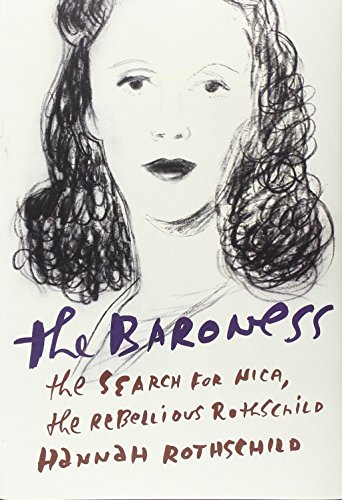
Beautiful, romantic and spirited, Pannonica, known as Nica, named after her father’s favorite moth, was born in 1913 to extraordinary, eccentric privilege and a storied history. The Rothschild family had, in only five generations, risen from the ghetto in Frankfurt to stately homes in England. As a child, Nica took her daily walks, dressed in white, with her two sisters and governess around the parkland of the vast house at Tring, Hertfordshire, among kangaroos, giant tortoises, emus and zebras, all part of the exotic menagerie collected by her uncle Walter. As a debutante, she was taught to fly by a saxophonist and introduced to jazz by her brother Victor; she married Baron Jules de Koenigswarter, settled in a château in France and had five children. When World War II broke out, Nica and her five children narrowly escaped back to England, but soon after, she set out to find her husband who was fighting with the Free French Army in Africa, where she helped the war effort by being a decoder, a driver and organizing supplies and equipment.
In the early 1950s Nica heard “’Round Midnight” by the jazz pianist and composer Thelonious Monk and, as if under a powerful spell, abandoned her marriage and moved to New York to find him. She devoted herself to helping Monk and other musicians: she bailed them out of jail, paid their bills, took them to the hospital, even drove them to their gigs, and her convertible Bentley could always be seen parked outside downtown clubs or up in Harlem. Charlie Parker would notoriously die in her apartment in the Stanhope Hotel. But it was Monk who was the love of her life and whom she cared for until his death in 1982.
Hannah Rothschild has drawn on archival material and her own interviews in this quest to find out who her great-aunt really was and how she fit into a family that, although passionate about music and entomology, was reactionary in always favoring men over women. Part musical odyssey, part love story, The Baroness is a fascinating portrait of a modern figure ahead of her time who dared to live as she wanted, finally, at the very center of New York’s jazz scene.
Die Inhaltsangabe kann sich auf eine andere Ausgabe dieses Titels beziehen.
Über die Autorin bzw. den Autor
Hannah Rothschild is a writer and director whose documentaries have appeared at film festivals including Telluride and Tribeca. She conceived and directedThe Jazz Baroness, a film about her great-aunt and Thelonious Monk, which was broadcast by BBC and HBO in 2009. She has written for BritishVanity Fair, Vogue, The Independent and The Spectator. She is vice president of the Hay Literary Festival and trustee of the National Gallery and Waddesdon Manor.
Auszug. © Genehmigter Nachdruck. Alle Rechte vorbehalten.
1. The Other One
My grandfather Victor was the first person to mention her. He was trying to teach me a simple twelve-bar blues chord but my eleven-year-old hands were leaden and too small.
“You’re like my sister,” he said. “You love jazz but can’t be arsed to learn to play it.”
“Which sister? Miriam or Liberty?” I asked, trying to ignore the barb.
“No, the other one.”
What other one?
Later that day I found her in the Rothschild family tree: Pannonica.
“Who is Pannonica?” I asked my father, Jacob, her nephew.
“She is always called Nica but beyond that I don’t really know,” he said. “No one ever talks about her.” Our family is so large and scattered that he did not seem surprised to have mislaid a near relation.
I was not put off. I pestered another great-aunt, Nica’s sister Miriam, the renowned scientist, who divulged, “She lives in New York,” but would not offer any further information. Another -relation told me, “She’s a great patron, the Peggy Guggenheim or Medici of jazz.”
Then there were the whispers:
She’s known as “the Jazz Baroness.” She lives with a black man, a pianist. She flew Lancaster bombers in the war. That junkie saxophonist Charlie Parker died in her apartment. She had five children and lived with 306 cats. The family cut her off (no they didn’t, someone countered). Twenty songs were written for her (no, it was twenty-four). She raced Miles Davis down Fifth Avenue. Did you hear about the drugs? She went to prison so he wouldn’t have to. Who’s he? Thelonious Monk. It was a true love story, one of the -greatest.
“So what is Nica like?” I asked Miriam again.
“Vulgar. She is vulgar,” Miriam said crossly.
“What does that mean?” I persisted.
Miriam would not elaborate but she did give me her sister’s number. When I went to New York for the first time in 1984 I rang Nica within hours of arriving.
“Would you like to meet up?” I asked nervously.
“Wild,” she answered in a decidedly un-great-aunt, un-seventy-one-year-old way. “Come to the club downtown after midnight.”
This area had yet to be gentrified and was known for its crack dens and muggings.
“How will I find it?” I asked.
Nica laughed. “Look out for the car,” and hung up.
The car was impossible to miss. The large, pale-blue Bentley was badly parked and inside it two drunks lolled around on the leather seats.
“It’s good they’re in there—it means no one will steal the car,” she explained later.
Set back from the street was a small door leading down to a basement. I knocked loudly. Minutes later a hatch opened in the upper door and a dark face appeared behind a grille.
“What?” he said.
“I’m looking for Pannonica,” I said.
“Who?”
“Pannonica!” I repeated in slightly desperate English tones. “They call her Nica.”
“You mean the Baroness! Why didn’t you say so?”
The door swung open to reveal a tiny basement room, shabby, smoky and cramped, where several people sat listening to a pianist.
“She’s at her table.”
Nica, the only white person, was easy to spot, sitting nearest the stage.
She hardly resembled the woman I had studied in our family photograph albums. That Nica was a ravishing debutante, her raven hair tamed and dressed, her eyebrows plucked into fashionable arches and her mouth painted to form a perfect bee-stung pout. In another portrait, a less soignée Nica, her hair loose and face free of make-up, seemed more like a Hollywood version of a Second World War double agent. The Nica before me looked -nothing like her younger self; her astonishing beauty had since waned and now those once-delicate features bordered on the -masculine. Her voice will always stay with me, a voice that had been pummelled like a shoreline by waves of whisky, cigarettes and late nights, a voice that was part rumble, part growl, and was -frequently punctuated by wheezy bursts of laughter.
Smoking a cigarette in a long black filter, her fur coat draped over the back of a spindly chair, Nica gestured to an empty seat and, picking up a teapot from the table, poured something into two chipped china cups. We toasted each other silently. I’d been expecting tea. Whisky bit into my throat; I choked and my eyes watered. Nica threw back her head and laughed.
“Thanks,” I croaked.
She put her finger to her lips and, nodding at the stage, said, “Sssh, just listen to the music, Hannah, just listen.”
At the time, I was twenty-two and failing to live up to the expectations, real or imagined, of my distinguished family. I felt inadequate, incapable of making it in my own right, yet unable to make the most of the privilege and opportunity available to me. Like Nica, I was barred from working in the family bank; the founding father N. M. Rothschild had decreed that Rothschild women were only allowed to act as bookkeepers or archivists. Caught in a holding pattern between university and employment, I was keen to work at the BBC but I managed only to collect letters of rejection. Although my father, who had followed in the family tradition of banking, found me jobs through various contacts, I was hopeless at running a bookshop, property development or cataloguing artworks. Depressed and disheartened, I was not trying to find a role model, but I was looking for options. At the heart of my search was a question. Is it possible to escape from one’s past or are we forever trapped in layers of inherited attitudes and ancient expectation?
I gazed across the table at this newly discovered great-aunt and felt a sudden, inexplicable surge of hope. A stranger walking into the club would merely have seen an old lady sucking on a cigarette, listening to a pianist. They might have wondered what this furcoated, pearl-wearing dame was doing, swaying to the music, nodding appreciatively at a particular solo. I saw a woman who seemed at home and who knew where she belonged. She gave me this piece of advice: “Remember, there is only one life.”
Shortly after our first meeting I went back to England, where I finally got a job at the BBC and began making documentaries. Again and again my thoughts turned to Nica. In those days, before the Internet and cheap transatlantic airfares, travelling to America and maintaining friendships across continents were difficult. We met at her sister Miriam’s house at Ashton Wold in England as well as once more on my next trip to New York. I sent Nica postcards; she sent me records, including one called Thelonica: an album by Tommy Flanagan and a musical tribute to her friendship with the jazz pianist Thelonious Monk. One of the album tracks was “Pannonica.” On the back she’d written: “To dear Hannah, Lots of love, Pannonica.” I wondered about Thelonious and Pannonica. How had two such strangely named people with disparate pasts ever come to meet? What could they have had in common?
She asked me to play the record for my grandfather Victor, who only commented that he quite liked it. “He didn’t really get Monk...
„Über diesen Titel“ kann sich auf eine andere Ausgabe dieses Titels beziehen.
Suchergebnisse für The Baroness: The Search for Nica, the Rebellious Rothschild

Beispielbild für diese ISBN
The Baroness: The Search for N
Anbieter: World of Books (was SecondSale), Montgomery, IL, USA
Verkäuferbewertung 5 von 5 Sternen

Zustand: Very Good. Item in very good condition! Textbooks may not include supplemental items i.e. CDs, access codes etc. Artikel-Nr. 00110953457
Gebraucht kaufen
EUR 3,99
Versand gratis
Versand innerhalb von USA
Versand innerhalb von USA
Anzahl: 1 verfügbar
Beispielbild für diese ISBN
The Baroness: The Search for N
Anbieter: World of Books (was SecondSale), Montgomery, IL, USA
Verkäuferbewertung 5 von 5 Sternen
Zustand: Good. Item in good condition. Textbooks may not include supplemental items i.e. CDs, access codes etc. Artikel-Nr. 00102771165
Gebraucht kaufen
EUR 3,99
Versand gratis
Versand innerhalb von USA
Versand innerhalb von USA
Anzahl: 2 verfügbar
Beispielbild für diese ISBN
The Baroness : The Search for Nica, the Rebellious Rothschild
Verlag:
Knopf Doubleday Publishing Group, 2013
ISBN 10: 0307961982
ISBN 13: 9780307961983
Gebraucht
Hardcover
Erstausgabe
Anbieter: Better World Books: West, Reno, NV, USA
Verkäuferbewertung 5 von 5 Sternen
Zustand: Good. 1st. Pages intact with minimal writing/highlighting. The binding may be loose and creased. Dust jackets/supplements are not included. Stock photo provided. Product includes identifying sticker. Better World Books: Buy Books. Do Good. Artikel-Nr. 4200310-6
Gebraucht kaufen
EUR 6,64
Versand gratis
Versand innerhalb von USA
Versand innerhalb von USA
Anzahl: 1 verfügbar
Beispielbild für diese ISBN
The Baroness : The Search for Nica, the Rebellious Rothschild
Verlag:
Knopf Doubleday Publishing Group, 2013
ISBN 10: 0307961982
ISBN 13: 9780307961983
Gebraucht
Hardcover
Erstausgabe
Anbieter: Better World Books, Mishawaka, IN, USA
Verkäuferbewertung 5 von 5 Sternen
Zustand: Very Good. 1st. Former library copy. Pages intact with possible writing/highlighting. Binding strong with minor wear. Dust jackets/supplements may not be included. Includes library markings. Stock photo provided. Product includes identifying sticker. Better World Books: Buy Books. Do Good. Artikel-Nr. 391090-6
Gebraucht kaufen
EUR 6,64
Versand gratis
Versand innerhalb von USA
Versand innerhalb von USA
Anzahl: 1 verfügbar
Beispielbild für diese ISBN
The Baroness : The Search for Nica, the Rebellious Rothschild
Verlag:
Knopf Doubleday Publishing Group, 2013
ISBN 10: 0307961982
ISBN 13: 9780307961983
Gebraucht
Hardcover
Erstausgabe
Anbieter: Better World Books, Mishawaka, IN, USA
Verkäuferbewertung 5 von 5 Sternen
Zustand: Good. 1st. Former library copy. Pages intact with minimal writing/highlighting. The binding may be loose and creased. Dust jackets/supplements are not included. Includes library markings. Stock photo provided. Product includes identifying sticker. Better World Books: Buy Books. Do Good. Artikel-Nr. 4200311-6
Gebraucht kaufen
EUR 6,64
Versand gratis
Versand innerhalb von USA
Versand innerhalb von USA
Anzahl: 1 verfügbar
Beispielbild für diese ISBN
The Baroness : The Search for Nica, the Rebellious Rothschild
Verlag:
Knopf Doubleday Publishing Group, 2013
ISBN 10: 0307961982
ISBN 13: 9780307961983
Gebraucht
Hardcover
Erstausgabe
Anbieter: Better World Books, Mishawaka, IN, USA
Verkäuferbewertung 5 von 5 Sternen
Zustand: Good. 1st. Pages intact with minimal writing/highlighting. The binding may be loose and creased. Dust jackets/supplements are not included. Stock photo provided. Product includes identifying sticker. Better World Books: Buy Books. Do Good. Artikel-Nr. 4200310-6
Gebraucht kaufen
EUR 6,64
Versand gratis
Versand innerhalb von USA
Versand innerhalb von USA
Anzahl: 1 verfügbar
Beispielbild für diese ISBN
The Baroness: The Search for Nica, the Rebellious Rothschild
Anbieter: ThriftBooks-Reno, Reno, NV, USA
Verkäuferbewertung 5 von 5 Sternen
Hardcover. Zustand: Fair. No Jacket. Former library book; Readable copy. Pages may have considerable notes/highlighting. ~ ThriftBooks: Read More, Spend Less. Artikel-Nr. G0307961982I5N10
Gebraucht kaufen
EUR 6,88
Versand gratis
Versand innerhalb von USA
Versand innerhalb von USA
Anzahl: 1 verfügbar
Beispielbild für diese ISBN
The Baroness: The Search for Nica, the Rebellious Rothschild
Anbieter: ThriftBooks-Atlanta, AUSTELL, GA, USA
Verkäuferbewertung 5 von 5 Sternen
Hardcover. Zustand: Very Good. No Jacket. Missing dust jacket; May have limited writing in cover pages. Pages are unmarked. ~ ThriftBooks: Read More, Spend Less. Artikel-Nr. G0307961982I4N01
Gebraucht kaufen
EUR 6,88
Versand gratis
Versand innerhalb von USA
Versand innerhalb von USA
Anzahl: 1 verfügbar
Beispielbild für diese ISBN
The Baroness: The Search for Nica, the Rebellious Rothschild
Anbieter: ThriftBooks-Dallas, Dallas, TX, USA
Verkäuferbewertung 5 von 5 Sternen
Hardcover. Zustand: Good. No Jacket. Former library book; Pages can have notes/highlighting. Spine may show signs of wear. ~ ThriftBooks: Read More, Spend Less. Artikel-Nr. G0307961982I3N10
Gebraucht kaufen
EUR 6,88
Versand gratis
Versand innerhalb von USA
Versand innerhalb von USA
Anzahl: 1 verfügbar
Beispielbild für diese ISBN
The Baroness: The Search for Nica, the Rebellious Rothschild
Anbieter: ThriftBooks-Dallas, Dallas, TX, USA
Verkäuferbewertung 5 von 5 Sternen
Hardcover. Zustand: Very Good. No Jacket. May have limited writing in cover pages. Pages are unmarked. ~ ThriftBooks: Read More, Spend Less. Artikel-Nr. G0307961982I4N00
Gebraucht kaufen
EUR 6,88
Versand gratis
Versand innerhalb von USA
Versand innerhalb von USA
Anzahl: 1 verfügbar