
Verwandte Artikel zu A Passion for Leadership: Lessons on Change and Reform...
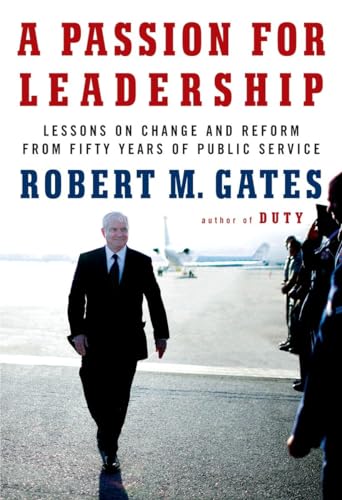
A Passion for Leadership: Lessons on Change and Reform from Fifty Years of Public Service - Hardcover
Inhaltsangabe
From the former secretary of defense and author of the acclaimed #1 best-selling memoir Duty, a characteristically direct, informed, and urgent assessment of why big institutions are failing us and how smart, committed leadership can effect real improvement regardless of scale.
Across the realms of civic and private enterprise alike, bureaucracies vitally impact our security, freedoms, and everyday life. With so much at stake, competence, efficiency, and fiscal prudence are essential, yet Americans know these institutions fall short. Many despair that they are too big and too hard to reform.
Robert Gates disagrees. Having led change successfully at three monumental organizations—the CIA, Texas A&M University, and the Department of Defense—he offers us the ultimate insider’s look at how major bureaus, organizations, and companies can be transformed, which is by turns heartening and inspiring and always instructive.
With practical, nuanced advice on tailoring reform to the operative culture (we see how Gates worked within the system to increase diversity at Texas A&M); effecting change within committees; engaging the power of compromise (“In the real world of bureaucratic institutions, you almost never get all you want when you want it”); and listening and responding to your team, Gates brings the full weight of his wisdom, candor, and devotion to civic duty to inspire others to lead desperately needed change.
Die Inhaltsangabe kann sich auf eine andere Ausgabe dieses Titels beziehen.
Über die Autorin bzw. den Autor
ROBERT M. GATES served as secretary of defense under both President George W. Bush and President Barack Obama. He was also an officer in the United States Air Force and worked for the CIA before being appointed director of the agency. A member of the National Security Council staff in four administrations, he served eight presidents of both political parties. He was president of Texas A&M University from 2002 to 2006, is currently chancellor of the College of William & Mary, was named president of the Boy Scouts of America in 2013, and has served on several corporate boards of directors.
Auszug. © Genehmigter Nachdruck. Alle Rechte vorbehalten.
1
Why Bureaucracies So Often Fail Us
Everybody hates bureaucracies, even those who work in them. Yet in twenty-first-century America, apart from a handful of hermits and survivalists living off the grid, dealing with impenetrable, impersonal, infinitely complex, obdurate, arrogant, and often stupefyingly incompetent bureaucracies is an everyday travail for everyone. Think about it: Social Security. Medicare. Local, state, and federal taxing agencies. Getting a driver’s license. Obtaining documents for business, remodeling your house, or getting a building permit. Any federal department or agency. Dealing with the phone company, your credit card issuer, a credit bureau, a billing error by a big chain store. Navigating airport security, health-care insurance, university and public school administrations.
Hardly a day passes in the life of any American without his or her having to confront one or another bureaucracy, standing in line, dialing a telephone number, only to enter an automated labyrinth seemingly devoid of humans and humanity, being placed on indefinite hold, trying to access a bad government or business Web site, or being shuffled from one office to the next to find that one person, the anomaly, who can fix a problem. Encounters with a bureaucracy almost always have stress and frustration as by-products. And finding someone in a bureaucracy who is pleasant and can solve one’s problem quickly is so unusual as to be very nearly a life-altering experience. President Lyndon Johnson once said, “If the first person who answers the phone cannot answer your question, it is a bureaucracy.” Don’t we all know it.
Despite political paralysis in Washington and elsewhere, bureaucracies inexorably—day by day, year by year—intrude ever more pervasively into our daily lives. They influence our health, our safety, our economic well-being, our children, what we eat, what we drive, and every business, farm, and educational institution in the land.
Yet even as bureaucratic tentacles extend their reach into every nook and cranny of America, the litany of their incompetence and arrogance grows exponentially. Many of these institutions are now indispensable, but their repeated and highly publicized sins of omission and commission have shaken the public’s confidence that they—that government in particular—can do anything right. Just a sampling of lapses and failures in recent years regardless of who was minding the store in Congress or the White House is profoundly disturbing: 9/11 itself, a failure of intelligence and law enforcement of monumental consequence; the failure of virtually all our financial regulatory and administrative bodies to anticipate and prevent the abuses that led to the financial meltdown in 2008–9; the Federal Emergency Management Agency’s handling of the aftermath of Hurricane Katrina and other disasters; the lack of planning for post-invasion Iraq in 2003; the scandalous treatment of outpatient wounded warriors at Walter Reed Army Medical Center; the multiple failures of the Veterans Affairs Department; challenges to the integrity of the Internal Revenue Service; lapses and scandals of the Secret Service; the initial handling of the Ebola crisis by the Centers for Disease Control; the botched rollout of the Affordable Care Act (ObamaCare); the ever-changing and inconsistent rules relating to airport security; the extraordinary waste of development dollars in Iraq and Afghanistan; underperforming public schools; the inability to control our southern border; and so much more. The institutions—the bureaucracies—responsible for these disasters and embarrassments are crucial to us. Some of them have previously been among our most respected organizations. Now they are failing us.
One of my favorite sayings about government—attributed to Napoleon Bonaparte, of all people—is “Never mistake for malice that which is easily explained by stupidity or incompetence.” No one set out to make bureaucracies the enemy of ordinary people, resistant to change, impervious to new realities, and incompetent. Few if any individuals choose public service as a career because they want to make life miserable for people or to work for some hapless bureaucracy. Indeed, I can attest from decades of working with talented and dedicated public servants, the opposite is often true. And yet the humorist Will Rogers could say decades ago, “I don’t make jokes. I just watch the government and report the facts.”
The world of business—the private sector—as I have observed it both as a customer and from the corporate boardroom has its own issues with bureaucracy. While the obstacles to cutting costs and becoming more efficient are more onerous for the public sector—local, state, and federal—leaders in both the public and the private sectors face multiple barriers to innovation and reform to cope with new and changing circumstances. For example, leaders in both sectors often encounter entrenched cultures that make real change difficult, as well as lower-level organizations resistant to guidance from the top, determined to preserve their piece of the cake and their status. Trimming organizational deadwood can be as challenging in the business world as in public institutions. It is a rare soul who has not been frustrated and maddened by multiple business bureaucracies—not to mention disastrous business decisions that cost jobs and create economic turmoil and heartache.
But for most businesses, success and self-preservation require that leaders and employees work hard every day to innovate and change with (or before) the times, to overcome sluggishness, poor customer service, and the stifling effect of layer upon layer of management that inevitably delays and complicates decision making. As a rule, companies that do not promote innovation, strive to reduce overhead costs and managerial layering, and become more customer-friendly don’t do well in the long term.
The public sector, however, faces multiple unique obstacles to reform, whether it’s cutting costs, becoming more efficient, encouraging innovation, or changing to cope with new challenges or changed circumstances. And no matter how different in purpose or size, for nearly all public bureaucracies those obstacles are the same.
The everyday experiences of Americans make a compelling case that bureaucracies do not work and cannot be reformed, that we are stuck. After so many highly visible failures, public opinion polls show that, as I’ve said, a majority of our citizens have lost confidence in our institutions and in government itself. The political Left is too often indifferent to obvious bureaucratic incompetence and failure because it believes that whatever the problem, government is the solution. It’s tough making the case for more government when what we have works so poorly. The political Right welcomes bureaucratic incompetence as proof that government rarely does anything well, and thus it reinforces its belief that whatever the problem, government involvement will probably only make things worse.
We can—and will—continue to argue endlessly about the proper role of government in the United States, but the fact is we have a bunch of it and most of it doesn’t work very well. Because we actually do need government, failure to fix it imposes huge financial costs in terms of incompetence, time wasted, and inefficiency, not to mention the cost in public cynicism and the loss of credibility of both government and those who lead it.
In truth, virtually every bureaucracy...
„Über diesen Titel“ kann sich auf eine andere Ausgabe dieses Titels beziehen.
Suchergebnisse für A Passion for Leadership: Lessons on Change and Reform...

Beispielbild für diese ISBN
A Passion for Leadership Lesso
Anbieter: World of Books (was SecondSale), Montgomery, IL, USA
Verkäuferbewertung 5 von 5 Sternen

Zustand: Good. Item in good condition. Textbooks may not include supplemental items i.e. CDs, access codes etc. Artikel-Nr. 00065667123
Gebraucht kaufen
EUR 3,15
Versand gratis
Versand innerhalb von USA
Versand innerhalb von USA
Anzahl: 10 verfügbar
Beispielbild für diese ISBN
A Passion for Leadership Lesso
Anbieter: World of Books (was SecondSale), Montgomery, IL, USA
Verkäuferbewertung 5 von 5 Sternen
Zustand: Acceptable. Item in acceptable condition! Textbooks may not include supplemental items i.e. CDs, access codes etc. Artikel-Nr. 00080342244
Gebraucht kaufen
EUR 3,15
Versand gratis
Versand innerhalb von USA
Versand innerhalb von USA
Anzahl: 1 verfügbar
Beispielbild für diese ISBN
A Passion for Leadership: Lessons on Change and Reform from Fifty Years of Public Service
Anbieter: BooksRun, Philadelphia, PA, USA
Verkäuferbewertung 5 von 5 Sternen
Hardcover. Zustand: Very Good. 1. With dust jacket. It's a well-cared-for item that has seen limited use. The item may show minor signs of wear. All the text is legible, with all pages included. It may have slight markings and/or highlighting. Artikel-Nr. 030795949X-8-1-29
Gebraucht kaufen
EUR 5,32
Versand gratis
Versand innerhalb von USA
Versand innerhalb von USA
Anzahl: 1 verfügbar
Beispielbild für diese ISBN
A Passion for Leadership: Lessons on Change and Reform from Fifty Years of Public Service
Anbieter: ThriftBooks-Dallas, Dallas, TX, USA
Verkäuferbewertung 5 von 5 Sternen
Hardcover. Zustand: Very Good. No Jacket. Missing dust jacket; May have limited writing in cover pages. Pages are unmarked. ~ ThriftBooks: Read More, Spend Less. Artikel-Nr. G030795949XI4N01
Gebraucht kaufen
EUR 5,85
Versand gratis
Versand innerhalb von USA
Versand innerhalb von USA
Anzahl: 1 verfügbar
Beispielbild für diese ISBN
A Passion for Leadership: Lessons on Change and Reform from Fifty Years of Public Service
Anbieter: ThriftBooks-Atlanta, AUSTELL, GA, USA
Verkäuferbewertung 5 von 5 Sternen
Hardcover. Zustand: Very Good. No Jacket. Missing dust jacket; May have limited writing in cover pages. Pages are unmarked. ~ ThriftBooks: Read More, Spend Less. Artikel-Nr. G030795949XI4N01
Gebraucht kaufen
EUR 5,85
Versand gratis
Versand innerhalb von USA
Versand innerhalb von USA
Anzahl: 1 verfügbar
Beispielbild für diese ISBN
A Passion for Leadership: Lessons on Change and Reform from Fifty Years of Public Service
Anbieter: ThriftBooks-Atlanta, AUSTELL, GA, USA
Verkäuferbewertung 5 von 5 Sternen
Hardcover. Zustand: Very Good. No Jacket. May have limited writing in cover pages. Pages are unmarked. ~ ThriftBooks: Read More, Spend Less. Artikel-Nr. G030795949XI4N00
Gebraucht kaufen
EUR 5,85
Versand gratis
Versand innerhalb von USA
Versand innerhalb von USA
Anzahl: 1 verfügbar
Beispielbild für diese ISBN
A Passion for Leadership : Lessons on Change and Reform from Fifty Years of Public Service
Verlag:
Knopf Doubleday Publishing Group, 2016
ISBN 10: 030795949X
ISBN 13: 9780307959492
Gebraucht
Hardcover
Erstausgabe
Anbieter: Better World Books, Mishawaka, IN, USA
Verkäuferbewertung 5 von 5 Sternen
Zustand: Good. 1st Edition. Former library copy. Pages intact with minimal writing/highlighting. The binding may be loose and creased. Dust jackets/supplements are not included. Includes library markings. Stock photo provided. Product includes identifying sticker. Better World Books: Buy Books. Do Good. Artikel-Nr. 8496605-6
Gebraucht kaufen
EUR 6,21
Versand gratis
Versand innerhalb von USA
Versand innerhalb von USA
Anzahl: 2 verfügbar
Beispielbild für diese ISBN
A Passion for Leadership : Lessons on Change and Reform from Fifty Years of Public Service
Verlag:
Knopf Doubleday Publishing Group, 2016
ISBN 10: 030795949X
ISBN 13: 9780307959492
Gebraucht
Hardcover
Erstausgabe
Anbieter: Better World Books, Mishawaka, IN, USA
Verkäuferbewertung 5 von 5 Sternen
Zustand: Very Good. 1st Edition. Former library copy. Pages intact with possible writing/highlighting. Binding strong with minor wear. Dust jackets/supplements may not be included. Includes library markings. Stock photo provided. Product includes identifying sticker. Better World Books: Buy Books. Do Good. Artikel-Nr. GRP96110775
Gebraucht kaufen
EUR 6,21
Versand gratis
Versand innerhalb von USA
Versand innerhalb von USA
Anzahl: 1 verfügbar
Beispielbild für diese ISBN
A Passion for Leadership : Lessons on Change and Reform from Fifty Years of Public Service
Verlag:
Knopf Doubleday Publishing Group, 2016
ISBN 10: 030795949X
ISBN 13: 9780307959492
Gebraucht
Hardcover
Erstausgabe
Anbieter: Better World Books, Mishawaka, IN, USA
Verkäuferbewertung 5 von 5 Sternen
Zustand: Very Good. 1st Edition. Pages intact with possible writing/highlighting. Binding strong with minor wear. Dust jackets/supplements may not be included. Stock photo provided. Product includes identifying sticker. Better World Books: Buy Books. Do Good. Artikel-Nr. GRP95774398
Gebraucht kaufen
EUR 6,21
Versand gratis
Versand innerhalb von USA
Versand innerhalb von USA
Anzahl: 1 verfügbar
Beispielbild für diese ISBN
A Passion for Leadership : Lessons on Change and Reform from Fifty Years of Public Service
Verlag:
Knopf Doubleday Publishing Group, 2016
ISBN 10: 030795949X
ISBN 13: 9780307959492
Gebraucht
Hardcover
Erstausgabe
Anbieter: Better World Books: West, Reno, NV, USA
Verkäuferbewertung 5 von 5 Sternen
Zustand: Very Good. 1st Edition. Pages intact with possible writing/highlighting. Binding strong with minor wear. Dust jackets/supplements may not be included. Stock photo provided. Product includes identifying sticker. Better World Books: Buy Books. Do Good. Artikel-Nr. GRP95774398
Gebraucht kaufen
EUR 6,21
Versand gratis
Versand innerhalb von USA
Versand innerhalb von USA
Anzahl: 1 verfügbar