
Verwandte Artikel zu Dictator (Ancient Rome Trilogy, 3, Band 3)
Inhaltsangabe
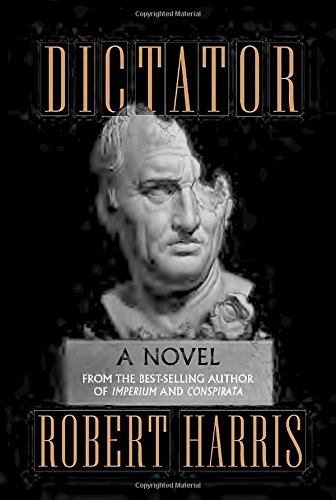
Imperium . . . Conspirata . . . and now Dictator—the long-awaited final volume of Robert Harris’s magnificent Ancient Rome Trilogy
At the age of forty-eight, Cicero—the greatest orator of his time—is in exile, separated from his wife and children, tormented by his sense of failure, his great power sacrificed on the altar of his principles. And yet, in the words of one of his most famous aphorisms, “While there is life, there is hope.”
By promising to support Caesar—his political enemy—he is granted return to Rome. There, he fights his way back to prominence: first in the law courts, then in the Senate, and finally by the power of his pen, until at last, for one brief and glorious period, he is again the preeminent statesman in the city. Even so, no public figure, however brilliant and cunning, is completely safeguarded against the unscrupulous ambition and corruption of others.
Riveting and tumultuous, Dictator encompasses some of the most epic events in ancient history—the collapse of the Roman Republic and the subsequent civil war, the murder of Pompey, the assassination of Julius Caesar. But the central problem it presents is a timeless one: how to keep political freedom unsullied by personal ambition, vested interests, and the erosive effects of ceaseless, senseless foreign wars. In Robert Harris’s indelible portrait, Cicero attempts to answer this question with both his thoughts and his deeds, becoming a hero—brilliant, flawed, frequently fearful yet ultimately brave—both for his own time and for ours.
Die Inhaltsangabe kann sich auf eine andere Ausgabe dieses Titels beziehen.
Über die Autorin bzw. den Autor
ROBERT HARRIS is the author of nine best-selling novels: Fatherland, Enigma, Archangel, Pompeii, Imperium, The Ghost Writer, Conspirata, The Fear Index, and An Officer and a Spy. Several of his books have been adapted to film, most recently The Ghost Writer, directed by Roman Polanski. His work has been translated into thirty-seven languages. He lives in the village of Kintbury, England, with his wife, Gill Hornby.
Auszug. © Genehmigter Nachdruck. Alle Rechte vorbehalten.
I
I remember the cries of caesar’s war-horns chasing us over the darkened fields of Latium—their yearning, keening howls, like animals in heat—and how when they stopped there was only the slither of our shoes on the icy road and the urgent panting of our breath.
It was not enough for the immortal gods that Cicero should be spat at and reviled by his fellow citizens; not enough that in the middle of the night he be driven from the hearths and altars of his family and ancestors; not enough even that as we fled from Rome on foot he should look back and see his house in flames. To all these torments they deemed it necessary to add one further refinement: that he should be forced to hear his enemy’s army striking camp on the Field of Mars.
Even though he was the oldest of our party Cicero kept up the same fast pace as the rest of us. Not long ago he had held Caesar’s life in the palm of his hand. He could have crushed it as easily as an egg. Now their fortunes led them in entirely opposite directions. While Cicero hurried south to escape his enemies, the architect of his destruction marched north to take command of both provinces of Gaul.
He walked with his head down, not uttering a word and I imagined it was because he was too full of despair to speak. Only at dawn, when we rendezvoused with our horses at Bovillae and were about to embark on the second stage of our escape, did he pause with his foot in the doorway of his carriage and say suddenly, “Do you think we should turn back?”
The question caught me by surprise. “I don’t know,” I said. “I hadn’t considered it.”
“Well, consider it now. Tell me: why are we fleeing Rome?”
“Because of Clodius and his mob.”
“And why is Clodius so powerful?”
“Because he’s a tribune and can pass laws against you.”
“And who made it possible for him to become a tribune?”
I hesitated. “Caesar.”
“Exactly. Caesar. Do you imagine that man’s departure for Gaul at that precise hour was a coincidence? Of course not! He waited till his spies had reported I’d left the city before ordering his army to move. Why? I’d always assumed his advancement of Clodius was to punish me for speaking out against him. But what if his real aim all along was to drive me out of Rome? What scheme requires him to be certain I’ve gone before he can leave too?”
I should have grasped the logic of what he was saying. I should have urged him to turn back. But I was too exhausted to reason clearly. And if I am honest there was more to it than that. I was too afraid of what Clodius’s thugs might do to us if they caught us re-entering the city.
So instead I said, “It’s a good question, and I can’t pretend I have the answer. But wouldn’t it look indecisive, after bidding goodbye to everyone, suddenly to reappear? In any case, Clodius has burned your house down now—where would we return to? Who would take us in? I think you’d be wiser to stick to your original plan and get as far away from Rome as you can.”
He rested his head against the side of the carriage and closed his eyes. In the pale grey light I was shocked by how haggard he appeared after his night on the road. His hair and beard had not been cut for weeks. He was wearing a toga dyed black. Although he was only in his forty-ninth year, these public signs of mourning made him look much older—like some ancient, mendicant holy man. After a while he sighed. “I don’t know, Tiro. Perhaps you’re right. It’s so long since I slept I’m too tired to think any more.”
And so the fatal error was made—more through indecision than decision—and we continued to press on southwards for the remainder of that day and for the twelve days that followed, putting what we thought was a safe distance between ourselves and danger.
We travelled with a minimal entourage to avoid attracting attention—just the carriage driver and three armed slaves on horseback, one in front and two behind. A small chest of gold and silver coins that Atticus, Cicero’s oldest and closest friend, had provided to pay for our journey was hidden under our seat. We stayed only in the houses of men we trusted, no more than a night in each, and steered clear of those places where Cicero might have been expected to stop—for example at his seaside villa at Formiae, the first place any pursuers would look for him, and along the Bay of Naples, already filling with the annual exodus from Rome in search of winter sun and warm springs. Instead we headed as fast as we could towards the toe of Italy.
Cicero’s plan, conceived on the move, was to make for Sicily and stay there until the political agitation against him in Rome subsided. “The mob will turn on Clodius eventually,” he predicted. “Such is the unalterable nature of the mob. He will always be my mortal enemy but he won’t always be tribune—we must never forget that. In nine months his term of office will expire and then we can go back.”
He was confident of a friendly reception from the Sicilians, if only because of his successful prosecution of the island’s tyrannical governor, Verres—even though that brilliant victory, which launched his political career, was now twelve years in the past and Clodius had more recently been a magistrate in the province. I sent letters ahead giving notice of his intention to seek sanctuary, and when we reached the harbour at Regium we hired a little six-oared boat to row us across the straits to Messina.
We left the harbour on a clear cold winter morning of searing blues—the sea and the sky; one light, one dark; the line dividing them as sharp as a blade; the distance to Messina a mere three miles. It took us less than an hour. We drew so close we could see Cicero’s supporters lined up on the rocks to welcome him. But stationed between us and the entrance to the port was a warship flying the red and green colours of the governor of Sicily, Gaius Vergilius, and as we approached the lighthouse it slipped its anchor and moved slowly forwards to intercept us. Vergilius stood at the rail surrounded by his lictors and, after visibly recoiling at Cicero’s dishevelled appearance, shouted down a greeting, to which Cicero replied in friendly terms. They had known one another in the Senate for many years.
Vergilius asked him his intentions.
Cicero called back that naturally he intended to come ashore.
“That’s what I’d heard,” replied Vergilius. “Unhappily I can’t allow it.”
“Why not?”
“Because of Clodius’s new law.”
“And what new law would that be? There are so many, one loses count.”
Vergilius beckoned to a member of his staff who produced a document and leaned down to pass it to me and I then gave it to Cicero. To this day I can remember how it fluttered in his hands in the slight breeze as if it were a living thing; it was the only sound in the silence. He took his time and when he had finished reading it he handed it to me without comment.
Lex Clodia in Ciceronem
Whereas M. T. Cicero has put Roman citizens to death unheard and uncondemned; and to that end forged the authority and decree of the Senate; it is hereby ordained that he be interdicted from fire and water to a distance of four hundred miles from Rome; that nobody should presume to harbour or receive him, on pain of death; that all his property and possessions be forfeit; that his house in Rome be demolished and a shrine to Liberty consecrated in its place; and that...
„Über diesen Titel“ kann sich auf eine andere Ausgabe dieses Titels beziehen.
Suchergebnisse für Dictator (Ancient Rome Trilogy, 3, Band 3)

Beispielbild für diese ISBN
Dictator
Verlag:
Knopf Doubleday Publishing Group, 2016
ISBN 10: 0307957942
ISBN 13: 9780307957948
Gebraucht
Hardcover
Anbieter: Better World Books, Mishawaka, IN, USA
Verkäuferbewertung 5 von 5 Sternen

Zustand: Good. 1st U.S. Printing. Former library copy. Pages intact with minimal writing/highlighting. The binding may be loose and creased. Dust jackets/supplements are not included. Includes library markings. Stock photo provided. Product includes identifying sticker. Better World Books: Buy Books. Do Good. Artikel-Nr. GRP102395478
Gebraucht kaufen
EUR 15,62
Versand gratis
Versand innerhalb von USA
Versand innerhalb von USA
Anzahl: 2 verfügbar
Beispielbild für diese ISBN
Dictator: A novel (Ancient Rome Trilogy, 3)
Verlag:
Knopf (edition 1st U.S. Printing), 2016
ISBN 10: 0307957942
ISBN 13: 9780307957948
Gebraucht
Hardcover
Anbieter: BooksRun, Philadelphia, PA, USA
Verkäuferbewertung 5 von 5 Sternen
Hardcover. Zustand: Fair. 1st U.S. Printing. With dust jacket. The item might be beaten up but readable. May contain markings or highlighting, as well as stains, bent corners, or any other major defect, but the text is not obscured in any way. Artikel-Nr. 0307957942-7-1-29
Gebraucht kaufen
EUR 20,23
Versand gratis
Versand innerhalb von USA
Versand innerhalb von USA
Anzahl: 1 verfügbar
Foto des Verkäufers
Dictator: A novel (Ancient Rome Trilogy, 3)
Anbieter: Dream Books Co., Denver, CO, USA
Verkäuferbewertung 5 von 5 Sternen
Zustand: acceptable. This copy has clearly been enjoyedâ"expect noticeable shelf wear and some minor creases to the cover. Binding is strong, and all pages are legible. May contain previous library markings or stamps. Artikel-Nr. DBV.0307957942.A
Gebraucht kaufen
EUR 20,45
Versand gratis
Versand innerhalb von USA
Versand innerhalb von USA
Anzahl: 1 verfügbar
Foto des Verkäufers
Dictator: A novel (Ancient Rome Trilogy, 3)
Anbieter: Dream Books Co., Denver, CO, USA
Verkäuferbewertung 5 von 5 Sternen
Zustand: good. Gently used with minimal wear on the corners and cover. A few pages may contain light highlighting or writing, but the text remains fully legible. Dust jacket may be missing, and supplemental materials like CDs or codes may not be included. May be ex-library with library markings. Ships promptly! Artikel-Nr. DBV.0307957942.G
Gebraucht kaufen
EUR 21,55
Versand gratis
Versand innerhalb von USA
Versand innerhalb von USA
Anzahl: 1 verfügbar
Beispielbild für diese ISBN
Dictator
Anbieter: World of Books (was SecondSale), Montgomery, IL, USA
Verkäuferbewertung 5 von 5 Sternen
Hardback. Zustand: Good. The long-awaited final volume of the Cicero Trilogy, from a beloved bestselling author incapable of writing an unenjoyable book (The Wall Street Journal). At the age of forty-eight, Cicero--the greatest orator of his time--is in exile, his power sacrificed on the altar of his principles. The only way to return to Rome is to pledge his support to a charismatic and dangerous enemy: Julius Caesar. Harnessing his political cunning, unrivalled intellect, and the sheer brilliance of his words, Cicero fights his way back to prominence. Yet no public figure is completely safeguarded against the unscrupulous ambition of others. Riveting and tumultuous, Dictator encompasses the most epic events in ancient history, including the collapse of the Roman Republic, the murder of Pompey, and the assassination of Caesar. But its central question is a timeless one: how to keep political freedom unsullied by personal gain, vested interests, and the corrosive effects of ceaseless foreign wars. In Robert Harris's indelible portrait, Cicero is a deeply fascinating hero for his own time and for ours. Artikel-Nr. 00110233605
Gebraucht kaufen
EUR 22,39
Versand gratis
Versand innerhalb von USA
Versand innerhalb von USA
Anzahl: 2 verfügbar
Beispielbild für diese ISBN
Dictator
Anbieter: World of Books (was SecondSale), Montgomery, IL, USA
Verkäuferbewertung 5 von 5 Sternen
Hardback. Zustand: Fair. The long-awaited final volume of the Cicero Trilogy, from a beloved bestselling author incapable of writing an unenjoyable book (The Wall Street Journal). At the age of forty-eight, Cicero--the greatest orator of his time--is in exile, his power sacrificed on the altar of his principles. The only way to return to Rome is to pledge his support to a charismatic and dangerous enemy: Julius Caesar. Harnessing his political cunning, unrivalled intellect, and the sheer brilliance of his words, Cicero fights his way back to prominence. Yet no public figure is completely safeguarded against the unscrupulous ambition of others. Riveting and tumultuous, Dictator encompasses the most epic events in ancient history, including the collapse of the Roman Republic, the murder of Pompey, and the assassination of Caesar. But its central question is a timeless one: how to keep political freedom unsullied by personal gain, vested interests, and the corrosive effects of ceaseless foreign wars. In Robert Harris's indelible portrait, Cicero is a deeply fascinating hero for his own time and for ours. Artikel-Nr. 00110902942
Gebraucht kaufen
EUR 22,39
Versand gratis
Versand innerhalb von USA
Versand innerhalb von USA
Anzahl: 1 verfügbar
Beispielbild für diese ISBN
Dictator: A novel (Ancient Rome Trilogy, 3)
Anbieter: ThriftBooks-Dallas, Dallas, TX, USA
Verkäuferbewertung 5 von 5 Sternen
Hardcover. Zustand: Very Good. No Jacket. May have limited writing in cover pages. Pages are unmarked. ~ ThriftBooks: Read More, Spend Less. Artikel-Nr. G0307957942I4N00
Gebraucht kaufen
EUR 22,42
Versand gratis
Versand innerhalb von USA
Versand innerhalb von USA
Anzahl: 1 verfügbar
Beispielbild für diese ISBN
Dictator: A novel (Ancient Rome Trilogy, 3)
Anbieter: ThriftBooks-Atlanta, AUSTELL, GA, USA
Verkäuferbewertung 5 von 5 Sternen
Hardcover. Zustand: Good. No Jacket. Former library book; Pages can have notes/highlighting. Spine may show signs of wear. ~ ThriftBooks: Read More, Spend Less. Artikel-Nr. G0307957942I3N10
Gebraucht kaufen
EUR 22,42
Versand gratis
Versand innerhalb von USA
Versand innerhalb von USA
Anzahl: 1 verfügbar
Beispielbild für diese ISBN
Dictator: A novel (Ancient Rome Trilogy, 3)
Anbieter: ThriftBooks-Atlanta, AUSTELL, GA, USA
Verkäuferbewertung 5 von 5 Sternen
Hardcover. Zustand: Good. No Jacket. Missing dust jacket; Pages can have notes/highlighting. Spine may show signs of wear. ~ ThriftBooks: Read More, Spend Less. Artikel-Nr. G0307957942I3N01
Gebraucht kaufen
EUR 22,42
Versand gratis
Versand innerhalb von USA
Versand innerhalb von USA
Anzahl: 1 verfügbar
Beispielbild für diese ISBN
Dictator: A novel (Ancient Rome Trilogy, 3)
Anbieter: ThriftBooks-Dallas, Dallas, TX, USA
Verkäuferbewertung 5 von 5 Sternen
Hardcover. Zustand: Good. No Jacket. Former library book; Pages can have notes/highlighting. Spine may show signs of wear. ~ ThriftBooks: Read More, Spend Less. Artikel-Nr. G0307957942I3N10
Gebraucht kaufen
EUR 22,42
Versand gratis
Versand innerhalb von USA
Versand innerhalb von USA
Anzahl: 1 verfügbar