
Verwandte Artikel zu Super Brain: Unleashing the Explosive Power of Your...
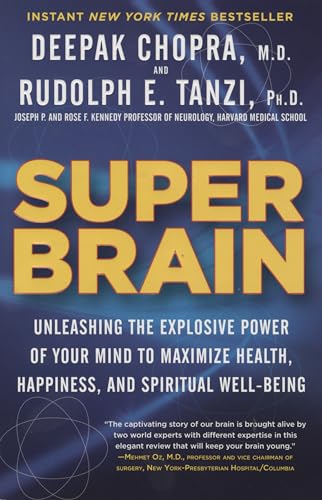
Super Brain: Unleashing the Explosive Power of Your Mind to Maximize Health, Happiness, and Spiritual Well-Being - Softcover
Inhaltsangabe
A manual for relating to the brain in a revolutionary new way, Super Brain shows you how to use your brain as a gateway for achieving health, happiness, and spiritual growth.
Two pioneers, bestselling author and physician Deepak Chopra and Harvard Medical School professor Rudolph E. Tanzi, one of the world's foremost experts on the causes of Alzheimer’s, have merged their wisdom and expertise for a bold new understanding of the “three-pound universe” and its untapped potential.
In contrast to the “baseline brain” that fulfills the tasks of everyday life, Chopra and Tanzi propose that, through a person’s increased self-awareness and conscious intention, the brain can be taught to reach far beyond its present limitations. “We are living in a golden age for brain research, but is this a golden age for your brain?” they ask.
Super Brain explains how it can be, by combining cutting-edge research and spiritual insights, demolishing the five most widespread myths about the brain that limit your potential, and then showing you methods to:
-Use your brain instead of letting it use you
-Create the ideal lifestyle for a healthy brain
-Reduce the risks of aging
-Promote happiness and well-being through the mind-body connection
-Access the enlightened brain, the gateway to freedom and bliss
-Overcome the most common challenges, such as memory loss, depression, anxiety, and obesity
Your brain is capable of incredible healing and constant reshaping. Through a new relationship with your brain you can transform your life. In Super Brain, Chopra and Tanzi guide you on a fascinating journey that envisions a leap in human evolution. The brain is not just the greatest gift that Nature has given us. It’s the gateway to an unlimited future that you can begin to live today.
Die Inhaltsangabe kann sich auf eine andere Ausgabe dieses Titels beziehen.
Über die Autorin bzw. den Autor
Deepak Chopra, MD, a member of Oprah's SuperSoul 100, is the author of more than 65 books including numerous New York Times bestsellers. His medical training is in internal medicine and endocrinology and he is a Fellow of the American College of Physicians, a member of the American Association of Clinical Endocrinologists and a Senior Scientist at the Gallup organization.
Rudolph E. Tanzi, PhD, is the Joseph P. and Rose F. Kennedy Professor of Neurology at Harvard University, and Director of the Genetics and Aging Research Unit at Massachusetts General Hospital (MGH). Dr. Tanzi co-discovered the first Alzheimer's disease gene and several others, as head of the Alzheimer's Genome Project and is the co-author of the book Decoding Darkness: The Search for the Genetic Causes of Alzheimer’s Disease.
Auszug. © Genehmigter Nachdruck. Alle Rechte vorbehalten.
A Golden Age for the Brain
What do we really know about the human brain? In the 1970s and 1980s, when the authors gained their training, the honest answer was “very little.” There was a saying circulating back then: Studying the brain was like putting a stethoscope on the outside of the Astrodome to learn the rules of football.
Your brain contains roughly 100 billion nerve cells forming anywhere from a trillion to perhaps even a quadrillion connections called synapses. These connections are in a constant, dynamic state of remodeling in response to the world around you. As a marvel of nature, this one is minuscule and yet stupendous.
Everyone stands in awe of the brain, which was once dubbed “the three-pound universe.” And rightly so. Your brain not only interprets the world, it creates it. Everything you see, hear, touch, taste, and smell would have none of those qualities without the brain. Whatever you experience today—your morning coffee, the love you feel for your family, a brilliant idea at work—has been specifically customized solely for you.
Immediately we confront a crucial issue. If your world is unique and customized for you and you alone, who is behind such remarkable creativity, you or the brain itself? If the answer is you, then the door to greater creativity is flung open. If the answer is your brain, then there may be drastic physical limitations on what you are able to achieve. Maybe your genes are holding you back, or toxic memories, or low self-
esteem. Maybe you fall short because of limited expectations that have contracted your awareness, even though you don’t see it happening.
The facts of the case could easily tell both stories, of unlimited potential or physical limitation. Compared with the past, today science is amassing new facts with astonishing speed. We have entered a golden age of brain research. New breakthroughs emerge every month, but in the midst of such exciting advances, what about the individual, the person who depends upon the brain for everything? Is this a golden age for your brain?
We detect an enormous gap between brilliant research and everyday reality. Another medical school saying from the past comes to mind: Each person typically uses only 10 percent of their brain. Speaking literally, that’s not true. In a healthy adult, the brain’s neural networks operate at full capacity all the time. Even the most sophisticated brain scans available would show no detectable difference between Shakespeare writing a soliloquy from Hamlet and an aspiring poet writing his first sonnet. But the physical brain is not nearly the whole story.
To create a golden age for your brain, you need to use the gift nature has given you in a new way. It’s not the number of neurons or some magic inside your gray matter that makes life more vital, inspiring, and successful. Genes play their part, but your genes, like the rest of the brain, are also dynamic. Every day you step into the invisible firestorm of electrical and chemical activity that is the brain’s environment. You act as leader, inventor, teacher, and user of your brain, all at once.
As leader, you hand out the day’s orders to your brain.
As inventor, you create new pathways and connections inside your brain that didn’t exist yesterday.
As teacher, you train your brain to learn new skills.
As user, you are responsible for keeping your brain in good working order.
In these four roles lies the whole difference between the everyday brain—let’s dub it the baseline brain—and what we are calling super brain. The difference is immense. Even though you have not related to the brain by thinking What orders should I give today? or What new pathways do I want to create? that’s precisely what you are doing. The customized world that you live in needs a creator. The creator isn’t your brain; it’s you.
Super brain stands for a fully aware creator using the brain to maximum advantage. Your brain is endlessly adaptable, and you could be performing your fourfold role—leader, inventor, teacher, and user—with far more fulfilling results than you now achieve.
Leader: The orders you give are not just command prompts on a computer like “delete” or “scroll to end of page.” Those are mechanical commands built into a machine. Your orders are received by a living organism that changes every time you send an instruction. If you think I want the same bacon and eggs I had yesterday, your brain doesn’t change at all. If instead you think What will I eat for breakfast today? I want something new, suddenly you are tapping into a reservoir of creativity. Creativity is a living, breathing, ever new inspiration that no computer can match. Why not take full advantage of it? For the brain has the miraculous ability to give more, the more you ask of it.
Let’s translate this idea into how you relate to your brain now and how you could be relating. Look at the lists below. Which do you identify with?
Baseline Brain
I don’t ask myself to behave very differently today than I did yesterday.
I am a creature of habit.
I don’t stimulate my mind with new things very often.
I like familiarity. It’s the most comfortable way to live.
If I’m being honest, there’s boring repetition at home, work, and in my relationships.
Super Brain
I look upon every day as a new world.
I pay attention not to fall into bad habits, and if one sets in, I can break it fairly easily.
I like to improvise.
I abhor boredom, which to me means repetition.
I gravitate to new things in many areas of my life.
Inventor: Your brain is constantly evolving. This happens individually, which is unique to the brain (and one of its deepest mysteries). The heart and liver that you were born with will be essentially the same organs when you die. Not the brain. It is capable of evolving and improving throughout your lifetime. Invent new things for it to do, and you become the source of new skills. A striking theory goes under the slogan “ten thousand hours,” the notion being that you can acquire any expert skill if you apply yourself for that length of time, even skills like painting and music that were once assigned only to the talented. If you’ve ever seen Cirque du Soleil, you might have assumed that those astonishing acrobats came from circus families or foreign troupes. In fact, every act in Cirque du Soleil, with few exceptions, is taught to ordinary people who come to a special school in Montreal. At one level, your life is a series of skills, beginning with walking, talking, and reading. The mistake we make is to limit these skills. Yet the same sense of balance that allowed you to toddle, walk, run, and ride a bicycle, given ten thousand hours (or less), can allow you to cross a tightrope strung between two skyscrapers. You are asking very little of your brain when you stop asking it to perfect new skills every day.
Which one do you identify with?
Baseline Brain
I can’t really say that I am growing as much as when I was younger.
If I learn a new skill, I take it only so far.
I am resistant to change and sometimes feel threatened
by it.
I don’t reach beyond what I am already good at.
I spend a good deal of time on passive things like watching television.
Super Brain
I will keep evolving my whole lifetime.
If I learn a new skill, I take it as far as I can.
I adapt quickly to change.
If I’m not good at something when I first try it,...
„Über diesen Titel“ kann sich auf eine andere Ausgabe dieses Titels beziehen.
Suchergebnisse für Super Brain: Unleashing the Explosive Power of Your...

Beispielbild für diese ISBN
Super Brain: Unleashing the Ex
Anbieter: World of Books (was SecondSale), Montgomery, IL, USA
Verkäuferbewertung 5 von 5 Sternen

Zustand: Very Good. Item in very good condition! Textbooks may not include supplemental items i.e. CDs, access codes etc. Artikel-Nr. 00100393692
Gebraucht kaufen
EUR 3,67
Versand gratis
Versand innerhalb von USA
Versand innerhalb von USA
Anzahl: 4 verfügbar
Beispielbild für diese ISBN
Super Brain: Unleashing the Ex
Anbieter: World of Books (was SecondSale), Montgomery, IL, USA
Verkäuferbewertung 5 von 5 Sternen
Zustand: Good. Item in good condition. Textbooks may not include supplemental items i.e. CDs, access codes etc. Artikel-Nr. 00099894275
Gebraucht kaufen
EUR 3,67
Versand gratis
Versand innerhalb von USA
Versand innerhalb von USA
Anzahl: 14 verfügbar
Beispielbild für diese ISBN
Super Brain: Unleashing the Ex
Anbieter: World of Books (was SecondSale), Montgomery, IL, USA
Verkäuferbewertung 5 von 5 Sternen
Zustand: Acceptable. Item in acceptable condition! Textbooks may not include supplemental items i.e. CDs, access codes etc. Artikel-Nr. 00093341432
Gebraucht kaufen
EUR 3,67
Versand gratis
Versand innerhalb von USA
Versand innerhalb von USA
Anzahl: 5 verfügbar
Beispielbild für diese ISBN
Super Brain: Unleashing the Explosive Power of Your Mind to Maximize Health, Happiness, and Spiritual Well-Being
Verlag:
Harmony (edition Reprint), 2013
ISBN 10: 0307956830
ISBN 13: 9780307956835
Gebraucht
Paperback
Anbieter: BooksRun, Philadelphia, PA, USA
Verkäuferbewertung 5 von 5 Sternen
Paperback. Zustand: Very Good. Reprint. It's a well-cared-for item that has seen limited use. The item may show minor signs of wear. All the text is legible, with all pages included. It may have slight markings and/or highlighting. Artikel-Nr. 0307956830-11-1
Gebraucht kaufen
EUR 4,64
Versand gratis
Versand innerhalb von USA
Versand innerhalb von USA
Anzahl: 1 verfügbar
Beispielbild für diese ISBN
Super Brain: Unleashing the Explosive Power of Your Mind to Maximize Health, Happiness, and Spiritual Well-Being
Verlag:
Harmony (edition Reprint), 2013
ISBN 10: 0307956830
ISBN 13: 9780307956835
Gebraucht
Paperback
Anbieter: BooksRun, Philadelphia, PA, USA
Verkäuferbewertung 5 von 5 Sternen
Paperback. Zustand: Very Good. Reprint. It's a well-cared-for item that has seen limited use. The item may show minor signs of wear. All the text is legible, with all pages included. It may have slight markings and/or highlighting. Artikel-Nr. 0307956830-8-1
Gebraucht kaufen
EUR 5,80
Versand gratis
Versand innerhalb von USA
Versand innerhalb von USA
Anzahl: 1 verfügbar
Beispielbild für diese ISBN
Super Brain: Unleashing the Explosive Power of Your Mind to Maximize Health, Happiness, and Spiritual Well-Being
Anbieter: ThriftBooks-Dallas, Dallas, TX, USA
Verkäuferbewertung 5 von 5 Sternen
Paperback. Zustand: Good. No Jacket. Pages can have notes/highlighting. Spine may show signs of wear. ~ ThriftBooks: Read More, Spend Less. Artikel-Nr. G0307956830I3N00
Gebraucht kaufen
EUR 5,87
Versand gratis
Versand innerhalb von USA
Versand innerhalb von USA
Anzahl: 3 verfügbar
Beispielbild für diese ISBN
Super Brain: Unleashing the Explosive Power of Your Mind to Maximize Health, Happiness, and Spiritual Well-Being
Anbieter: ThriftBooks-Phoenix, Phoenix, AZ, USA
Verkäuferbewertung 5 von 5 Sternen
Paperback. Zustand: Very Good. No Jacket. May have limited writing in cover pages. Pages are unmarked. ~ ThriftBooks: Read More, Spend Less. Artikel-Nr. G0307956830I4N00
Gebraucht kaufen
EUR 5,87
Versand gratis
Versand innerhalb von USA
Versand innerhalb von USA
Anzahl: 1 verfügbar
Beispielbild für diese ISBN
Super Brain: Unleashing the Explosive Power of Your Mind to Maximize Health, Happiness, and Spiritual Well-Being
Anbieter: ThriftBooks-Phoenix, Phoenix, AZ, USA
Verkäuferbewertung 5 von 5 Sternen
Paperback. Zustand: Good. No Jacket. Pages can have notes/highlighting. Spine may show signs of wear. ~ ThriftBooks: Read More, Spend Less. Artikel-Nr. G0307956830I3N00
Gebraucht kaufen
EUR 5,87
Versand gratis
Versand innerhalb von USA
Versand innerhalb von USA
Anzahl: 2 verfügbar
Beispielbild für diese ISBN
Super Brain: Unleashing the Explosive Power of Your Mind to Maximize Health, Happiness, and Spiritual Well-Being
Anbieter: ThriftBooks-Dallas, Dallas, TX, USA
Verkäuferbewertung 5 von 5 Sternen
Paperback. Zustand: Good. No Jacket. Missing dust jacket; Pages can have notes/highlighting. Spine may show signs of wear. ~ ThriftBooks: Read More, Spend Less. Artikel-Nr. G0307956830I3N01
Gebraucht kaufen
EUR 5,87
Versand gratis
Versand innerhalb von USA
Versand innerhalb von USA
Anzahl: 1 verfügbar
Beispielbild für diese ISBN
Super Brain: Unleashing the Explosive Power of Your Mind to Maximize Health, Happiness, and Spiritual Well-Being
Anbieter: ThriftBooks-Atlanta, AUSTELL, GA, USA
Verkäuferbewertung 5 von 5 Sternen
Paperback. Zustand: Very Good. No Jacket. May have limited writing in cover pages. Pages are unmarked. ~ ThriftBooks: Read More, Spend Less. Artikel-Nr. G0307956830I4N00
Gebraucht kaufen
EUR 5,87
Versand gratis
Versand innerhalb von USA
Versand innerhalb von USA
Anzahl: 2 verfügbar