
Verwandte Artikel zu What We Talk About When We Talk About Anne Frank: Stories
Inhaltsangabe
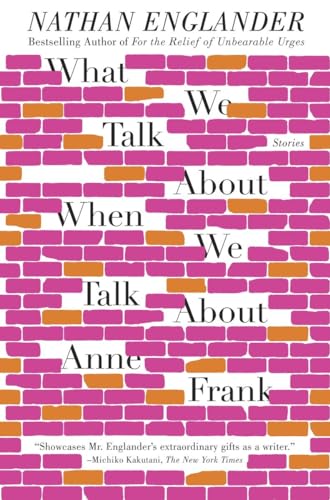
From the Pulitzer-nominated, bestselling author of For the Relief of Unbearable Urges, eight powerful stories, dazzling in their display of language and imagination.
From the title story, a provocative portrait of two marriages inspired by Raymond Carver’s masterpiece, to “Peep Show” and “How We Avenged the Blums,” two stories that return to the author’s classic themes of sexual longing and ingenuity in the face of adversity, these stories affirm Nathan Englander’s place at the very forefront of contemporary American fiction.
Die Inhaltsangabe kann sich auf eine andere Ausgabe dieses Titels beziehen.
Über die Autorin bzw. den Autor
Nathan Englander is the author of the novel The Ministry of Special Cases and the story collections For the Relief of Unbearable Urges and What We Talk About When We Talk About Anne Frank, a winner of the Frank O’Connor International Short Story Award, and a finalist for the Pulitzer Prize. He is Distinguished Writer-in-Residence at New York University and lives in Brooklyn, New York, with his wife and daughter.
Auszug. © Genehmigter Nachdruck. Alle Rechte vorbehalten.
What We Talk About When We Talk About Anne Frank
They’re in our house maybe ten minutes and already Mark’s lecturing us on the Israeli occupation. Mark and Lauren live in Jerusalem, and people from there think it gives them the right.
Mark is looking all stoic and nodding his head. “If we had what you have down here in South Florida . . . ,” he says, and trails off. “Yup,” he says, and he’s nodding again. “We’d have no troubles at all.”
“You do have what we have,” I tell him. “All of it. Sun and palm trees. Old Jews and oranges and the worst drivers around. At this point,” I say, “we’ve probably got more Israelis than you.” Debbie, my wife, she puts a hand on my arm. Her signal that I’m taking a tone, or interrupting someone’s story, sharing something private, or making an inappropriate joke. That’s my cue, and I’m surprised, considering how much I get it, that she ever lets go of my arm.
“Yes, you’ve got it all now,” Mark says. “Even terrorists.”
I look to Lauren. She’s the one my wife has the relation- ship with—the one who should take charge. But Lauren isn’t going to give her husband any signal. She and Mark ran off to Israel twenty years ago and turned Hassidic, and neither of them will put a hand on the other in public. Not for this. Not to put out a fire.
“Wasn’t Mohamed Atta living right here before 9/11?” Mark says, and now he pantomimes pointing out houses. “Goldberg, Goldberg, Goldberg—Atta. How’d you miss him in this place?”
“Other side of town,” I say.
“That’s what I’m talking about. That’s what you have that we don’t. Other sides of town. Wrong sides of the tracks. Space upon space.” And now he’s fingering a granite countertop in our kitchen, looking out into the living room and the dining room, staring through the kitchen windows out at the pool. “All this house,” he says, “and one son? Can you imagine?”
“No,” Lauren says. And then she turns to us, backing him up. “You should see how we live with ten.”
“Ten kids,” I say. “We could get you a reality show with that here in the States. Help you get a bigger place.”
The hand is back pulling at my sleeve. “Pictures,” Debbie says. “I want to see the girls.” We all follow Lauren into the den for her purse.
“Do you believe it?” Mark says. “Ten girls!” And the way it comes out of his mouth, it’s the first time I like the guy. The first time I think about giving him a chance.
...
Facebook and Skype brought Deb and Lauren back together. They were glued at the hip growing up. Went to school together their whole lives. Yeshiva school. All girls. Out in Queens through high school and then riding the subway together to one called Central in Manhattan. They stayed best friends forever until I married Deb and turned her secular, and soon after that Lauren met Mark and they went off to the Holy Land and went from Orthodox to ultra-Orthodox, which to me sounds like a repackaged detergent—ORTHODOX ULTRA®, now with more deep-healing power. Because of that, we’re sup- posed to call them Shoshana and Yerucham. Deb’s been doing it. I’m just not saying their names.
“You want some water?” I offer. “Coke in the can?” “
‘You’—which of us?” Mark says.
“You both,” I say. “I’ve got whiskey. Whiskey’s kosher, too,
right?” “If it’s not, I’ll kosher it up real fast,” he says, pretending
to be easygoing. And right then, he takes off that big black hat and plops down on the couch in the den.
Lauren’s holding the verticals aside and looking out at the yard. “Two girls from Forest Hills,” she says. “Who ever thought we’d be the mothers of grown-ups?”
“Trevor’s sixteen,” Deb says. “You may think he’s a grown-up, and he may think he’s a grown-up—but we, we are not convinced.”
“Well,” Lauren says, “then whoever thought we’d have kids raised to think it’s normal to have coconuts crashing out back and lizards climbing the walls?”
Right then is when Trev comes padding into the den, all six feet of him, plaid pajama bottoms dragging on the floor and T-shirt full of holes. He’s just woken up and you can tell he’s not sure if he’s still dreaming. We told him we had guests. But there’s Trev, staring at this man in the black suit, a beard rest- ing on the middle of his stomach. And Lauren, I’d met her once before, right when Deb and I got married, but ten girls and a thousand Shabbos dinners later—well, she’s a big woman, in a bad dress and a giant blond Marilyn Monroe wig. Seeing them at the door, I can’t say I wasn’t shocked myself. But the boy, he can’t hide it on his face.
“Hey,” he says.
And then Deb’s on him, preening and fixing his hair and hugging him. “Trevy, this is my best friend from childhood,” she says. “This is Shoshana, and this is—”
“Mark,” I say.
“Yerucham,” Mark says, and sticks out a hand. Trev shakes it. Then Trev sticks out his hand, polite, to Lauren. She looks at it, just hanging there in the air—offered.
“I don’t shake,” she says. “But I’m so happy to see you. Like meeting my own son. I mean it,” she says. And here she starts to cry, for real. And she and Deb are hugging and Deb’s crying, too. And the boys, we just stand there until Mark looks at his watch and gets himself a good manly grip on Trev’s shoulder.
“Sleeping until three on a Sunday? Man, those were the days,” Mark says. “A regular little Rumpleforeskin.” Trev looks at me, and I want to shrug, but Mark’s also looking, so I don’t move. Trev just gives us both his best teenage glare and edges out of the room. As he does, he says, “Baseball practice,” and takes my car keys off the hook by the door to the garage.
“There’s gas,” I say. “They let them drive here at sixteen?” Mark says.
“Insane.”
...
“So what brings you,” I say, “after all these years?” Deb’s too far away to grab at me, but her face says it all. “Was I sup- posed to know?” I say. “Jeez, Deb must have told me. She told me, for sure. My fault.”
“My mother,” Mark says. “She’s failing and my father’s get- ting old—and they come to us for Sukkot every year. You know?”
“I know the holidays,” I say.
“They used to fly out to us. For Sukkot and Pesach, both. But they can’t fly now, and I just wanted to get over while things are still good. We haven’t been in America—”
“Oh, gosh,” Lauren says. “I’m afraid to think how long it’s been. More than ten years. Twelve,” she says. “Twelve years ago. With the kids, it’s just impossible until enough of...
„Über diesen Titel“ kann sich auf eine andere Ausgabe dieses Titels beziehen.
Weitere beliebte Ausgaben desselben Titels

Suchergebnisse für What We Talk About When We Talk About Anne Frank: Stories

Beispielbild für diese ISBN
What We Talk about When We Tal
Anbieter: World of Books (was SecondSale), Montgomery, IL, USA
Verkäuferbewertung 5 von 5 Sternen

Zustand: Very Good. Item in very good condition! Textbooks may not include supplemental items i.e. CDs, access codes etc. Artikel-Nr. 00102354971
Gebraucht kaufen
EUR 3,93
Versand gratis
Versand innerhalb von USA
Versand innerhalb von USA
Anzahl: 3 verfügbar
Beispielbild für diese ISBN
What We Talk about When We Tal
Anbieter: World of Books (was SecondSale), Montgomery, IL, USA
Verkäuferbewertung 5 von 5 Sternen
Zustand: Good. Item in good condition. Textbooks may not include supplemental items i.e. CDs, access codes etc. Artikel-Nr. 00068247439
Gebraucht kaufen
EUR 3,93
Versand gratis
Versand innerhalb von USA
Versand innerhalb von USA
Anzahl: 7 verfügbar
Beispielbild für diese ISBN
What We Talk About When We Talk About Anne Frank: Stories
Verlag:
Vintage (edition Reprint), 2013
ISBN 10: 0307949605
ISBN 13: 9780307949608
Gebraucht
Paperback
Anbieter: BooksRun, Philadelphia, PA, USA
Verkäuferbewertung 5 von 5 Sternen
Paperback. Zustand: Very Good. Reprint. It's a well-cared-for item that has seen limited use. The item may show minor signs of wear. All the text is legible, with all pages included. It may have slight markings and/or highlighting. Artikel-Nr. 0307949605-11-1
Gebraucht kaufen
EUR 4,40
Versand gratis
Versand innerhalb von USA
Versand innerhalb von USA
Anzahl: 1 verfügbar
Beispielbild für diese ISBN
What We Talk About When We Talk About Anne Frank: What We Talk About When We Talk About Anne Frank: Stories
Anbieter: ThriftBooks-Phoenix, Phoenix, AZ, USA
Verkäuferbewertung 5 von 5 Sternen
Paperback. Zustand: Good. No Jacket. Pages can have notes/highlighting. Spine may show signs of wear. ~ ThriftBooks: Read More, Spend Less. Artikel-Nr. G0307949605I3N00
Gebraucht kaufen
EUR 5,78
Versand gratis
Versand innerhalb von USA
Versand innerhalb von USA
Anzahl: 1 verfügbar
Beispielbild für diese ISBN
What We Talk About When We Talk About Anne Frank: What We Talk About When We Talk About Anne Frank: Stories
Anbieter: ThriftBooks-Reno, Reno, NV, USA
Verkäuferbewertung 5 von 5 Sternen
Paperback. Zustand: Good. No Jacket. Pages can have notes/highlighting. Spine may show signs of wear. ~ ThriftBooks: Read More, Spend Less. Artikel-Nr. G0307949605I3N00
Gebraucht kaufen
EUR 5,78
Versand gratis
Versand innerhalb von USA
Versand innerhalb von USA
Anzahl: 1 verfügbar
Beispielbild für diese ISBN
What We Talk About When We Talk About Anne Frank: What We Talk About When We Talk About Anne Frank: Stories
Anbieter: ThriftBooks-Atlanta, AUSTELL, GA, USA
Verkäuferbewertung 5 von 5 Sternen
Paperback. Zustand: Good. No Jacket. Pages can have notes/highlighting. Spine may show signs of wear. ~ ThriftBooks: Read More, Spend Less. Artikel-Nr. G0307949605I3N00
Gebraucht kaufen
EUR 5,78
Versand gratis
Versand innerhalb von USA
Versand innerhalb von USA
Anzahl: 1 verfügbar
Beispielbild für diese ISBN
What We Talk About When We Talk About Anne Frank: What We Talk About When We Talk About Anne Frank: Stories
Anbieter: ThriftBooks-Atlanta, AUSTELL, GA, USA
Verkäuferbewertung 5 von 5 Sternen
Paperback. Zustand: Very Good. No Jacket. Former library book; May have limited writing in cover pages. Pages are unmarked. ~ ThriftBooks: Read More, Spend Less. Artikel-Nr. G0307949605I4N10
Gebraucht kaufen
EUR 5,78
Versand gratis
Versand innerhalb von USA
Versand innerhalb von USA
Anzahl: 1 verfügbar
Beispielbild für diese ISBN
What We Talk About When We Talk About Anne Frank: What We Talk About When We Talk About Anne Frank: Stories
Anbieter: ThriftBooks-Dallas, Dallas, TX, USA
Verkäuferbewertung 5 von 5 Sternen
Paperback. Zustand: Good. No Jacket. Pages can have notes/highlighting. Spine may show signs of wear. ~ ThriftBooks: Read More, Spend Less. Artikel-Nr. G0307949605I3N00
Gebraucht kaufen
EUR 5,78
Versand gratis
Versand innerhalb von USA
Versand innerhalb von USA
Anzahl: 2 verfügbar
Beispielbild für diese ISBN
What We Talk about When We Talk about Anne Frank : Stories
Verlag:
Knopf Doubleday Publishing Group, 2013
ISBN 10: 0307949605
ISBN 13: 9780307949608
Gebraucht
Softcover
Anbieter: Better World Books, Mishawaka, IN, USA
Verkäuferbewertung 5 von 5 Sternen
Zustand: Good. Reprint. Pages intact with minimal writing/highlighting. The binding may be loose and creased. Dust jackets/supplements are not included. Stock photo provided. Product includes identifying sticker. Better World Books: Buy Books. Do Good. Artikel-Nr. 4880180-6
Gebraucht kaufen
EUR 6,00
Versand gratis
Versand innerhalb von USA
Versand innerhalb von USA
Anzahl: 2 verfügbar
Beispielbild für diese ISBN
What We Talk about When We Talk about Anne Frank : Stories
Verlag:
Knopf Doubleday Publishing Group, 2013
ISBN 10: 0307949605
ISBN 13: 9780307949608
Gebraucht
Softcover
Anbieter: Better World Books, Mishawaka, IN, USA
Verkäuferbewertung 5 von 5 Sternen
Zustand: Good. Reprint. Former library copy. Pages intact with minimal writing/highlighting. The binding may be loose and creased. Dust jackets/supplements are not included. Includes library markings. Stock photo provided. Product includes identifying sticker. Better World Books: Buy Books. Do Good. Artikel-Nr. 4441331-6
Gebraucht kaufen
EUR 6,00
Versand gratis
Versand innerhalb von USA
Versand innerhalb von USA
Anzahl: 2 verfügbar