
Verwandte Artikel zu Titanic: The Death and Life of a Legend
Inhaltsangabe
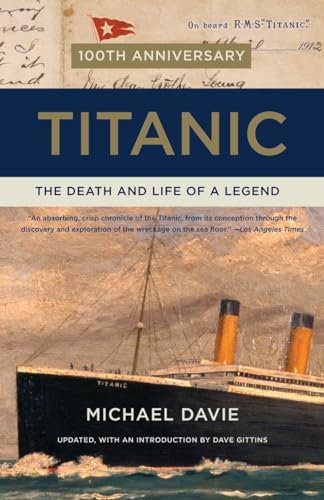
Newly updated on the hundredth anniversary of the tragedy by Titanic expert Dave Gittins to reflect the latest facts and theories about the ship's sinking, Titanic: The Death and Life of a Legend will fascinate Titanic experts, amateurs, and newcomers alike.
In this gripping, deeply researched exploration of the Titanic's tragic sinking, journalist Michael Davie investigates the events, controversies, and legends that have surrounded the disaster. Sifting through historical documents and survivors' accounts, Davie details the nineteenth-century origins of the White Star Line, narrates the story of the "unsinkable" ship's deadly voyage, and describes the dramatic discovery of the Titanic's wreckage in 1985. Davie offers insightful portraits of the protagonists and dramatizes the confusing and terrifying hours that passed from the moment the ship hit the iceberg until its survivors were picked up by the USS Carpathia a full day later.
Die Inhaltsangabe kann sich auf eine andere Ausgabe dieses Titels beziehen.
Über die Autorin bzw. den Autor
Michael Davie was a leading British journalist. He was a reporter, columnist, and editor for the London Observer and the Melbourne (Australia) Age, and wrote books on topics as varied as Lyndon B. Johnson, California, and cricket. He died in 2005.
Dave Gittins lives in Adelaide, South Australia. He is the author of Titanic: Monument and Warning and co-author of Report into the Loss of the SS Titanic: A Centennial Reappraisal.
Auszug. © Genehmigter Nachdruck. Alle Rechte vorbehalten.
1
The Evil Dream
In the 1860s, British industry was entering the most expansive and prosperous era it has ever known or is ever likely to know. In particular, shipbuilding and transatlantic traffic were growing in volume year by year. It is impossible to understand the genesis of the Titanic without looking at the men who conceived the idea of a giant ship; and impossible to understand them, and the reasons why they ever imagined such an extraordinary vessel, without some notion of the tortuous and ruthlessly competitive international shipping business—British, German, American—of which they were part.
The man behind the Titanic, as it happens, was Canadian. He was born in Quebec in 1847 as William James Pirrie, the son of A. J. Pirrie, an Ulsterman of Scottish descent. His mother was also from Ulster, a member of the Montgomery family. After the father died, mother and son returned to Ireland, where the boy was apprenticed at the age of fifteen to the shipbuilding and engineering firm of Harland & Wolff. Pirrie was a partner in Harland & Wolff by the time he was twenty-seven. During the next half century, largely thanks to his leadership, it became the greatest shipyard in the world and the birthplace of the Titanic.
People these days are inclined to think that the Titanic was a freak, a huge ship of unique size and luxury. This misunderstanding underrates the scale of the enterprise. Pirrie’s idea, conceived in 1907, was that his firm, in partnership with the White Star Line, would build not one but three monster transatlantic liners. They would sweep the opposition off the seas. The first would be named the Olympic; the second the Titanic; and the third—the Britannic.
All three were built. The Olympic had an illustrious career, carrying more troops than any other vessel in World War I. The Britannic was sunk by a German mine in 1916 while serving as a hospital ship. Nowadays, nobody outside the passionate fraternity of lovers of old ships remembers this useful pair. But the Titanic became, as she has remained, the best known of all ships to the man in the street, her name springing to mind more readily than the Golden Hind, the USS Arizona, or HMS Victory.
It is odd that Pirrie, the bold prime mover, has disappeared so completely from the story. Had he sailed in the Titanic on her maiden voyage, as he fully intended, he would have been better known. He would either have drowned, in which case he would have been as closely associated with the ship as her skipper, Captain Smith, and her richest passenger, Colonel J. J. Astor; or he would have escaped, in which case he would have been as universally reviled as the chairman of White Star who got away in one of the last lifeboats, J. Bruce Ismay. As it was, his doctor forbade Pirrie to take the trip because of prostate trouble; he did not testify in the much-publicized official inquiries that followed though by June his health was much improved; and after their reports came out it was too late for anyone to ask him awkward questions. His role receded into the past. His hair turned white during his illness, but he remained the great shipbuilder. Indeed the business done by his world-beating yards actually boomed, because they reconstructed many ships after the disaster to make them conform to the new rules officially imposed as a result of the defects exposed in their prize product. In World War I, Lord Pirrie was in charge of all British merchant shipbuilding. He was made a baron in 1909 and became a viscount in 1921. He died at sea in 1924 from pneumonia in the Panama Canal, returning with his wife from a voyage on Harland & Wolff business to South America.
To find the source of Pirrie’s grand ideas and confidence, we need to look back at the atmosphere of those early years. Belfast had a long shipbuilding tradition, but it was only around the time Pirrie became an apprentice that Harland & Wolff started on its rapid rise to world dominance. The founding father was a restless engineering genius from Yorkshire, Edward Harland, who in 1858 bought a small boatbuilding business on Queen’s Island, which is still part of the Harland & Wolff site today. Harland was no traditionalist. His main reforms, according to his successors in Belfast, were two: he replaced wooden upper decks with iron decks, thus in effect turning the hull into a box girder of immensely greater strength; and he changed the shape of the hulls by giving them a flat bottom and square bilges, thus increasing their capacity. He also did away with the relics of sailing-ship days, bowsprits and figureheads, although his steamships were still carrying sails until nearly the end of the century.
The stroke of luck in Harland’s career was to catch the eye, early on, of Hamburg Jews. One of them, a financier named Gustavus Schwabe, came to Liverpool and put money into a rising local shipping firm, the Bibby Line, and gave repair and building contracts to Harland. Schwabe’s nephew, an engineer like Harland, became Harland’s partner. His name was Gustav Wolff. In Harland & Wolff’s present-day order book, which lists in numerical order the 1,700 ships they have built in their hundred-and-fifty-year history, numbers one, two, and three are Bibby Line ships.
Harland and Wolff joined forces just before Pirrie arrived in their yards as an apprentice. With every year that passed, their business expanded. In 1864 the gross tonnage of the ships they built was 30,000 tons. In 1884 the figure was 104,000. Pirrie’s career was contemporaneous with the development of steel shipbuilding, and he himself was in the forefront of all the important advances in naval architecture and marine engineering. He took over as chairman when Harland died in 1894; so he was thirty years under Harland, and thirty years on his own as chairman.
He was more than chairman: he was a dictator. Physically, he was small and ferociously energetic. He craved public recognition. He stood out from his rivals because he was not only a master-technocrat but a master-businessman. The members of his board were ciphers. He secured the orders for ships himself, built them to his own designs with little more than a general specification from the clients, and charged them the building costs plus a 4 percent commission for Harland & Wolff—a highly satisfactory way of doing business. (It was when the firm built the Canberra for P&O on a fixed-price contract that it lost millions and nearly went broke.) Apart from Pirrie, nobody knew or was even allowed to discuss his firm’s finances; one of the ship architects who inadvertently became involved in financial talks with a shipowner “stood down,” supposedly due to bad health. When Pirrie was away from Belfast, meetings were chaired by his wife.
Though forgotten now, Pirrie was lauded in his own day, when engineers were national figures. The celebrated journalist W. T. Stead, who was drowned in the Titanic, praised Pirrie’s “foresight, optimism, incessant industry and selection of able lieutenants (a sure sign of superior ability)” and proclaimed that he had developed “the greatest business of the kind that has existed in the world since men first began to go down to the seas in ships.” The verdict of the Dictionary of National Biography is that he was “the creator of the big ship.”
How did this happen The starting point may be said to have been the alliance between Harland & Wolff and White Star.
The important new figure who enters the story here is the formidable T. H. Ismay. His father had been a boatbuilder in a small way in Maryport, Cumberland. In 1869—not long after Pirrie joined Harland & Wolff—T. H. Ismay bought, with Schwabe’s financial backing, the flag of White...
„Über diesen Titel“ kann sich auf eine andere Ausgabe dieses Titels beziehen.
Suchergebnisse für Titanic: The Death and Life of a Legend

Beispielbild für diese ISBN
Titanic The Death and Life of
Anbieter: World of Books (was SecondSale), Montgomery, IL, USA
Verkäuferbewertung 5 von 5 Sternen

Zustand: Very Good. Item in very good condition! Textbooks may not include supplemental items i.e. CDs, access codes etc. Artikel-Nr. 00110075231
Gebraucht kaufen
EUR 5,32
Versand gratis
Versand innerhalb von USA
Versand innerhalb von USA
Anzahl: 1 verfügbar
Beispielbild für diese ISBN
Titanic The Death and Life of
Anbieter: World of Books (was SecondSale), Montgomery, IL, USA
Verkäuferbewertung 5 von 5 Sternen
Zustand: Good. Item in good condition. Textbooks may not include supplemental items i.e. CDs, access codes etc. Artikel-Nr. 00108187296
Gebraucht kaufen
EUR 5,32
Versand gratis
Versand innerhalb von USA
Versand innerhalb von USA
Anzahl: 1 verfügbar
Beispielbild für diese ISBN
Titanic: The Death and Life of a Legend
Anbieter: ThriftBooks-Dallas, Dallas, TX, USA
Verkäuferbewertung 5 von 5 Sternen
Paperback. Zustand: Good. No Jacket. Pages can have notes/highlighting. Spine may show signs of wear. ~ ThriftBooks: Read More, Spend Less. Artikel-Nr. G0307948390I3N00
Gebraucht kaufen
EUR 5,93
Versand gratis
Versand innerhalb von USA
Versand innerhalb von USA
Anzahl: 1 verfügbar
Beispielbild für diese ISBN
Titanic: The Death and Life of a Legend
Anbieter: ThriftBooks-Atlanta, AUSTELL, GA, USA
Verkäuferbewertung 5 von 5 Sternen
Paperback. Zustand: Fair. No Jacket. Readable copy. Pages may have considerable notes/highlighting. ~ ThriftBooks: Read More, Spend Less. Artikel-Nr. G0307948390I5N00
Gebraucht kaufen
EUR 5,93
Versand gratis
Versand innerhalb von USA
Versand innerhalb von USA
Anzahl: 1 verfügbar
Beispielbild für diese ISBN
Titanic : The Death and Life of a Legend
Verlag:
Knopf Doubleday Publishing Group, 2012
ISBN 10: 0307948390
ISBN 13: 9780307948397
Gebraucht
Softcover
Anbieter: Better World Books, Mishawaka, IN, USA
Verkäuferbewertung 5 von 5 Sternen
Zustand: Good. Updated, Revised. Pages intact with minimal writing/highlighting. The binding may be loose and creased. Dust jackets/supplements are not included. Stock photo provided. Product includes identifying sticker. Better World Books: Buy Books. Do Good. Artikel-Nr. GRP76548225
Gebraucht kaufen
EUR 5,98
Versand gratis
Versand innerhalb von USA
Versand innerhalb von USA
Anzahl: 2 verfügbar
Beispielbild für diese ISBN
Titanic : The Death and Life of a Legend
Verlag:
Knopf Doubleday Publishing Group, 2012
ISBN 10: 0307948390
ISBN 13: 9780307948397
Gebraucht
Softcover
Anbieter: Better World Books: West, Reno, NV, USA
Verkäuferbewertung 5 von 5 Sternen
Zustand: Good. Updated, Revised. Former library copy. Pages intact with minimal writing/highlighting. The binding may be loose and creased. Dust jackets/supplements are not included. Includes library markings. Stock photo provided. Product includes identifying sticker. Better World Books: Buy Books. Do Good. Artikel-Nr. 10622055-6
Gebraucht kaufen
EUR 5,98
Versand gratis
Versand innerhalb von USA
Versand innerhalb von USA
Anzahl: 1 verfügbar
Beispielbild für diese ISBN
TITANIC : THE DEATH AND LIFE OF A LEGEND
Anbieter: Magers and Quinn Booksellers, Minneapolis, MN, USA
Verkäuferbewertung 5 von 5 Sternen
paperback. Zustand: Very Good. May have light to moderate shelf wear and/or a remainder mark. Complete. Clean pages. Artikel-Nr. 1307849
Gebraucht kaufen
EUR 5,76
EUR 3,44 Versand
Versand innerhalb von USA
Versand innerhalb von USA
Anzahl: 1 verfügbar
Beispielbild für diese ISBN
Titanic: The Death & Life of a Legend
Anbieter: Powell's Bookstores Chicago, ABAA, Chicago, IL, USA
Verkäuferbewertung 5 von 5 Sternen
Paperback. Zustand: Used-Very Good. Upd Rev. Paper. Minor shelf wear. Artikel-Nr. 1890167
Gebraucht kaufen
EUR 7,11
EUR 6,47 Versand
Versand innerhalb von USA
Versand innerhalb von USA
Anzahl: 1 verfügbar
Beispielbild für diese ISBN
Titanic: The Death and Life of a Legend
Anbieter: Revaluation Books, Exeter, Vereinigtes Königreich
Verkäuferbewertung 5 von 5 Sternen
Paperback. Zustand: Brand New. upd rev edition. 340 pages. 8.00x5.25x1.00 inches. In Stock. Artikel-Nr. 0307948390
Neu kaufen
EUR 28,93
EUR 11,67 Versand
Versand von Vereinigtes Königreich nach USA
Versand von Vereinigtes Königreich nach USA
Anzahl: 1 verfügbar
Foto des Verkäufers
Titanic : The Death and Life of a Legend
Anbieter: AHA-BUCH GmbH, Einbeck, Deutschland
Verkäuferbewertung 5 von 5 Sternen
Taschenbuch. Zustand: Neu. Neuware - Newly updated on the hundredth anniversary of the tragedy by Titanic expert Dave Gittins to reflect the latest facts and theories about the ship's sinking, Titanic: The Death and Life of a Legend will fascinate Titanic experts, amateurs, and newcomers alike. In this gripping, deeply researched exploration of the Titanic's tragic sinking, journalist Michael Davie investigates the events, controversies, and legends that have surrounded the disaster. Sifting through historical documents and survivors' accounts, Davie details the nineteenth-century origins of the White Star Line, narrates the story of the 'unsinkable' ship's deadly voyage, and describes the dramatic discovery of the Titanic's wreckage in 1985. Davie offers insightful portraits of the protagonists and dramatizes the confusing and terrifying hours that passed from the moment the ship hit the iceberg until its survivors were picked up by the USS Carpathia a full day later. Artikel-Nr. 9780307948397
Neu kaufen
EUR 25,80
EUR 30,50 Versand
Versand von Deutschland nach USA
Versand von Deutschland nach USA
Anzahl: 2 verfügbar