
Verwandte Artikel zu Hallucinations
Inhaltsangabe
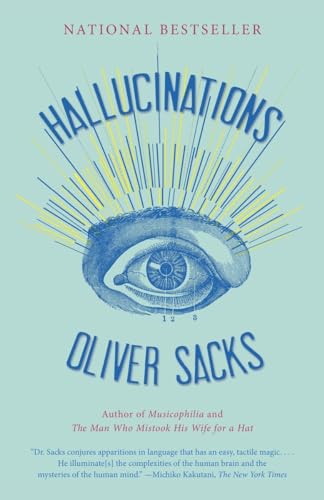
NATIONAL BESTSELLER • The "poet laureate of medicine" (The New York Times) and author of The Man Who Mistook His Wife for a Hat weaves together stories of mind-altering experiences to reveal what they tell us about our brains, our folklore and culture, and why the potential for hallucination exists in us all.
"Sacks has turned hallucinations from something bizarre and frightening into something that seems part of what it means to be a person. His book, too, is a medical and human triumph.” —The Washington Post
“An absorbing plunge into a mystery of the mind.” —Entertainment Weekly
To many people, hallucinations imply madness, but in fact they are a common part of the human experience. These sensory distortions range from the shimmering zigzags of a visual migraine to powerful visions brought on by fever, injuries, drugs, sensory deprivation, exhaustion, or even grief. Hallucinations doubtless lie behind many mythological traditions, literary inventions, and religious epiphanies.
Drawing on his own experiences, a wealth of clinical cases from among his patients, and famous historical examples ranging from Dostoevsky to Lewis Carroll, the legendary neurologist Oliver Sacks investigates the mystery of these sensory deceptions: what they say about the working of our brains, how they have influenced our folklore and culture, and why the potential for hallucination is present in all humans.
Die Inhaltsangabe kann sich auf eine andere Ausgabe dieses Titels beziehen.
Über die Autorin bzw. den Autor
OLIVER SACKS was a neurologist, writer, and professor of medicine. Born in London in 1933, he moved to New York City in 1965, where he launched his medical career and began writing case studies of his patients. Called the “poet laureate of medicine” by The New York Times, Sacks is the author of thirteen books, including The Man Who Mistook His Wife for a Hat, Musicophilia, and Awakenings, which inspired an Oscar-nominated film and a play by Harold Pinter. He was the recipient of many awards and honorary degrees, and was made a Commander of the British Empire in 2008 for services to medicine. He died in 2015.
Auszug. © Genehmigter Nachdruck. Alle Rechte vorbehalten.
Hearing Things
In 1973 the journal Science published an article that caused an immediate furor. It was entitled "On Being Sane in Insane Places," and it described how, as an experiment, eight "pseudopatients" with no history of mental illness presented themselves at a variety of hospitals across the United States. Their single complaint was that they "heard voices." They told hospital staff that they could not really make out what the voices said but that they heard the words "empty," "hollow," and "thud." Apart from this fabrication, they behaved normally and recounted their own (normal) past experiences and medical histories. Nonetheless, all of them were diagnosed as schizophrenic (except one, who was diagnosed with "manic-depressive psychosis"), hospitalized for up to two months, and prescribed antipsychotic medications (which they did not swallow). Once admitted to the mental wards, they continued to speak and behave normally; they reported to the medical staff that their hallucinated voices had disappeared and that they felt fine. They even kept notes on their experiment, quite openly (this was registered in the nursing notes for one pseudopatient as "writing behavior"), but none of the pseudopatients were identified as such by the staff. This experiment, designed by David Rosenhan, a Stanford psychologist (and himself a pseudopatient), emphasized, among other things, that the single symptom of "hearing voices" could suffice for an immediate, categorical diagnosis of schizophrenia even in the absence of any other symptoms or abnormalities of behavior. Psychiatry, and society in general, had been subverted by the almost axiomatic belief that "hearing voices" spelled madness and never occurred except in the context of severe mental disturbance.
This belief is a fairly recent one, as the careful and humane reservations of early researchers on schizophrenia made clear. But by the 1970s, antipsychotic drugs and tranquilizers had begun to replace other treatments, and careful history taking, looking at the whole life of the patient, had largely been replaced by the use of DSM criteria to make snap diagnoses.
Eugen Bleuler, who directed the huge Burghölzli asylum near Zurich from 1898 to 1927, paid close and sympathetic attention to the many hundreds of schizophrenic people under his care. He recognized that the "voices" his patients heard, however outlandish they might seem, were closely associated with their mental states and delusions. The voices, he wrote, embodied "all their strivings and fears ... their entire transformed relationship to the external world ... above all ... [to] the pathological or hostile powers" that beset them. He described these in vivid detail in his great 1911 monograph, Dementia Praecox; or, The Group of Schizophrenias:
The voices not only speak to the patient, but they pass electricity through the body, beat him, paralyse him, take his thoughts away. They are often hypostasized as people, or in other very bizarre ways. For example, a patient claims that a "voice" is perched above each of his ears. One voice is a little larger than the other but both are about the size of a walnut, and they consist of nothing but a large ugly mouth.
Threats or curses form the main and most common content of the "voices." Day and night they come from everywhere, from the walls, from above and below, from the cellar and the roof, from heaven and from hell, from near and far ... When the patient is eating, he hears a voice saying, "Each mouthful is stolen." If he drops something, he hears, "If only your foot had been chopped off."
The voices are often very contradictory. At one time they may be against the patient ... then they may contradict themselves ... The roles of pro and con are often taken over by voices of different people ... The voice of a daughter tells a patient: "He is going to be burned alive," while his mother's voice says, "He will not be burned." Besides their persecutors the patients often hear the voice of some protector.
The voices are often localized in the body ... A polyp may be the occasion for localizing the voices in the nose. An intestinal disturbance brings them into connection with the abdomen ... In cases of sexual complexes, the penis, the urine in the bladder, or the nose utter obscene words ... A really or imaginarily gravid patient will hear her child or children speaking inside her womb ...
Inanimate objects may speak. The lemonade speaks, the patient's name is heard to be coming from a glass of milk. The furniture speaks to him.
Bleuler wrote, "Almost every schizophrenic who is hospitalized hears 'voices.'" But he emphasized that the reverse did not hold — that hearing voices did not necessarily denote schizophrenia. In the popular imagination, though, hallucinatory voices are almost synonymous with schizophrenia — a great misconception, for most people who do hear voices are not schizophrenic.
Many people report hearing voices which are not particularly directed at them, as Nancy C. wrote:
I hallucinate conversations on a regular basis, often as I am falling asleep at night. It seems to me that these conversations are real and are actually taking place between real people, at the very time I'm hearing them, but are occurring somewhere else. I hear couples arguing, all kinds of things. They are not voices I can identify, they are not people I know. I feel like I'm a radio, tuned into someone else's world. (Though always an American-English-speaking world.) I can't think of any way to regard these experiences except as hallucinations. I am never a participant; I am never addressed. I am just listening in.
"Hallucinations in the sane" were well recognized in the nineteenth century, and with the rise of neurology, people sought to understand more clearly what caused them. In England in the 1880s, the Society for Psychical Research was founded to collect and investigate reports of apparitions or hallucinations, especially those of the bereaved, and many eminent scientists — physicists as well as physiologists and psychologists — joined the society (William James was active in the American branch). Telepathy, clairvoyance, communication with the dead, and the nature of a spirit world became the subjects of systematic investigation.
These early researchers found that hallucinations were not uncommon in the general population. Their 1894 "International Census of Waking Hallucinations in the Sane" examined the occurrence and nature of hallucinations experienced by normal people in normal circumstances (they took care to exclude anyone with obvious medical or psychiatric problems). Seventeen thousand people were sent a single question:
Have you ever, when believing yourself to be completely awake, had a vivid impression of seeing or being touched by a living being or inanimate object, or of hearing a voice, which impression, as far as you could discover, was not due to an external physical cause?
More than 10 percent responded in the affirmative, and of those, more than a third heard voices. As John Watkins noted in his book Hearing Voices, hallucinated voices "having some kind of religious or supernatural content represented a small but significant minority of these reports." Most of the hallucinations, however, were of a more quotidian character.
Perhaps the commonest auditory hallucination is hearing one's own name spoken — either by a familiar voice or an anonymous one. Freud, writing in The Psychopathology of Everyday Life, remarked on this:
During the days when I was living alone in a foreign city — I was a young man at the time — I quite often heard my name suddenly called by an unmistakable and beloved voice; I then noted down the exact moment of the...
„Über diesen Titel“ kann sich auf eine andere Ausgabe dieses Titels beziehen.
Suchergebnisse für Hallucinations

Foto des Verkäufers
Hallucinations
Anbieter: Dream Books Co., Denver, CO, USA
Verkäuferbewertung 5 von 5 Sternen

Zustand: acceptable. This copy has clearly been enjoyedâ"expect noticeable shelf wear and some minor creases to the cover. Binding is strong, and all pages are legible. May contain previous library markings or stamps. Artikel-Nr. DBV.0307947432.A
Gebraucht kaufen
EUR 3,84
Versand gratis
Versand innerhalb von USA
Versand innerhalb von USA
Anzahl: 2 verfügbar
Beispielbild für diese ISBN
Hallucinations
Anbieter: World of Books (was SecondSale), Montgomery, IL, USA
Verkäuferbewertung 5 von 5 Sternen
Paperback. Zustand: Good. NATIONAL BESTSELLER * The "poet laureate of medicine" (The New York Times) and author of The Man Who Mistook His Wife for a Hat weaves together stories of mind-altering experiences to reveal what they tell us about our brains, our folklore and culture, and why the potential for hallucination exists in us all. "Sacks has turned hallucinations from something bizarre and frightening into something that seems part of what it means to be a person. His book, too, is a medical and human triumph." --The Washington Post "An absorbing plunge into a mystery of the mind." --Entertainment Weekly To many people, hallucinations imply madness, but in fact they are a common part of the human experience. These sensory distortions range from the shimmering zigzags of a visual migraine to powerful visions brought on by fever, injuries, drugs, sensory deprivation, exhaustion, or even grief. Hallucinations doubtless lie behind many mythological traditions, literary inventions, and religious epiphanies. Drawing on his own experiences, a wealth of clinical cases from among his patients, and famous historical examples ranging from Dostoevsky to Lewis Carroll, the legendary neurologist Oliver Sacks investigates the mystery of these sensory deceptions: what they say about the working of our brains, how they have influenced our folklore and culture, and why the potential for hallucination is present in all humans. Artikel-Nr. 00103414520
Gebraucht kaufen
EUR 3,90
Versand gratis
Versand innerhalb von USA
Versand innerhalb von USA
Anzahl: 20 verfügbar
Beispielbild für diese ISBN
Hallucinations
Anbieter: World of Books (was SecondSale), Montgomery, IL, USA
Verkäuferbewertung 5 von 5 Sternen
Paperback. Zustand: Very Good. NATIONAL BESTSELLER * The "poet laureate of medicine" (The New York Times) and author of The Man Who Mistook His Wife for a Hat weaves together stories of mind-altering experiences to reveal what they tell us about our brains, our folklore and culture, and why the potential for hallucination exists in us all. "Sacks has turned hallucinations from something bizarre and frightening into something that seems part of what it means to be a person. His book, too, is a medical and human triumph." --The Washington Post "An absorbing plunge into a mystery of the mind." --Entertainment Weekly To many people, hallucinations imply madness, but in fact they are a common part of the human experience. These sensory distortions range from the shimmering zigzags of a visual migraine to powerful visions brought on by fever, injuries, drugs, sensory deprivation, exhaustion, or even grief. Hallucinations doubtless lie behind many mythological traditions, literary inventions, and religious epiphanies. Drawing on his own experiences, a wealth of clinical cases from among his patients, and famous historical examples ranging from Dostoevsky to Lewis Carroll, the legendary neurologist Oliver Sacks investigates the mystery of these sensory deceptions: what they say about the working of our brains, how they have influenced our folklore and culture, and why the potential for hallucination is present in all humans. Artikel-Nr. 00110169738
Gebraucht kaufen
EUR 3,90
Versand gratis
Versand innerhalb von USA
Versand innerhalb von USA
Anzahl: 2 verfügbar
Beispielbild für diese ISBN
Hallucinations
Anbieter: ThriftBooks-Dallas, Dallas, TX, USA
Verkäuferbewertung 5 von 5 Sternen
Paperback. Zustand: Good. No Jacket. Pages can have notes/highlighting. Spine may show signs of wear. ~ ThriftBooks: Read More, Spend Less. Artikel-Nr. G0307947432I3N00
Gebraucht kaufen
EUR 5,86
Versand gratis
Versand innerhalb von USA
Versand innerhalb von USA
Anzahl: 4 verfügbar
Beispielbild für diese ISBN
Hallucinations
Anbieter: ThriftBooks-Atlanta, AUSTELL, GA, USA
Verkäuferbewertung 5 von 5 Sternen
Paperback. Zustand: Fair. No Jacket. Readable copy. Pages may have considerable notes/highlighting. ~ ThriftBooks: Read More, Spend Less. Artikel-Nr. G0307947432I5N00
Gebraucht kaufen
EUR 5,86
Versand gratis
Versand innerhalb von USA
Versand innerhalb von USA
Anzahl: 2 verfügbar
Beispielbild für diese ISBN
Hallucinations
Anbieter: ThriftBooks-Phoenix, Phoenix, AZ, USA
Verkäuferbewertung 5 von 5 Sternen
Paperback. Zustand: Good. No Jacket. Pages can have notes/highlighting. Spine may show signs of wear. ~ ThriftBooks: Read More, Spend Less. Artikel-Nr. G0307947432I3N00
Gebraucht kaufen
EUR 5,86
Versand gratis
Versand innerhalb von USA
Versand innerhalb von USA
Anzahl: 3 verfügbar
Beispielbild für diese ISBN
Hallucinations
Anbieter: ThriftBooks-Dallas, Dallas, TX, USA
Verkäuferbewertung 5 von 5 Sternen
Paperback. Zustand: Good. No Jacket. Former library book; Pages can have notes/highlighting. Spine may show signs of wear. ~ ThriftBooks: Read More, Spend Less. Artikel-Nr. G0307947432I3N10
Gebraucht kaufen
EUR 5,86
Versand gratis
Versand innerhalb von USA
Versand innerhalb von USA
Anzahl: 1 verfügbar
Beispielbild für diese ISBN
Hallucinations
Anbieter: ThriftBooks-Phoenix, Phoenix, AZ, USA
Verkäuferbewertung 5 von 5 Sternen
Paperback. Zustand: Fair. No Jacket. Readable copy. Pages may have considerable notes/highlighting. ~ ThriftBooks: Read More, Spend Less. Artikel-Nr. G0307947432I5N00
Gebraucht kaufen
EUR 5,86
Versand gratis
Versand innerhalb von USA
Versand innerhalb von USA
Anzahl: 2 verfügbar
Beispielbild für diese ISBN
Hallucinations
Anbieter: ThriftBooks-Reno, Reno, NV, USA
Verkäuferbewertung 5 von 5 Sternen
Paperback. Zustand: Good. No Jacket. Pages can have notes/highlighting. Spine may show signs of wear. ~ ThriftBooks: Read More, Spend Less. Artikel-Nr. G0307947432I3N00
Gebraucht kaufen
EUR 5,86
Versand gratis
Versand innerhalb von USA
Versand innerhalb von USA
Anzahl: 3 verfügbar
Beispielbild für diese ISBN
Hallucinations
Anbieter: ThriftBooks-Reno, Reno, NV, USA
Verkäuferbewertung 5 von 5 Sternen
Paperback. Zustand: Very Good. No Jacket. May have limited writing in cover pages. Pages are unmarked. ~ ThriftBooks: Read More, Spend Less. Artikel-Nr. G0307947432I4N00
Gebraucht kaufen
EUR 5,86
Versand gratis
Versand innerhalb von USA
Versand innerhalb von USA
Anzahl: 1 verfügbar