
Verwandte Artikel zu The Fifth Woman
Inhaltsangabe
A series of seemingly unconnected murders
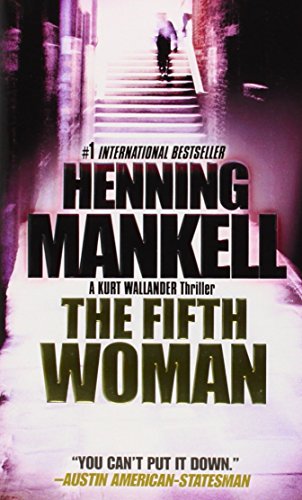
In Africa, four nuns and an unidentified fifth woman are brutally murdered--the death of the nameless woman covered up by the local police. A year later in Sweden, Inspector Kurt Wallander is baffled when a retired car dealer is found impaled and the body of a missing florist is discovered strangled. With only a skull, a diary, and a photo of three men as clues, Wallander will need all of his strength to uncover the reason behind these deaths and their elusive connection to the unsolved murder of the fifth woman.
Die Inhaltsangabe kann sich auf eine andere Ausgabe dieses Titels beziehen.
Über die Autorin bzw. den Autor
Henning Mankell’s Kurt Wallander mysteries have been published in thirty-three countries and consistently top the bestseller lists. He divides his time between Sweden and Maputo, Mozambique, where he has worked as the director of Teatro Avenida since 1985.
www.henningmankell.com
Auszug. © Genehmigter Nachdruck. Alle Rechte vorbehalten.
Chapter 1
Just after 10 p.m. he finally finished. The last stanzas had been difficult to write; they took him a long time. He had wanted to achieve a melancholy, yet beautiful expression. Several attempts were consigned to the wastepaper basket. Twice he'd been close to giving up altogether, but now the poem lay before him on the table--his lament for the middle spotted woodpecker, which had almost disappeared from Sweden. It hadn't been seen in the country since the early 1980s--one more species soon to be wiped out by humankind.
He got up from his desk and stretched. With every passing year, it was harder and harder to sit bent over his writings for hours on end.
An old man shouldn't be writing poems, he thought. When you're 78 years old, your thoughts are of little use to anyone. But at the same time, he knew this was wrong. It was only in the Western world that old people were viewed with indulgence or contemptuous sympathy. In other cultures, age was respected as the period of enlightened wisdom. He would go on writing poems as long as he could lift a pen and his mind was clear. He was not capable of much else. A long time ago he had been a car dealer, the most successful in the region. He was known as a tough negotiator. He had certainly sold a lot of cars. During the good years he had owned branches in Tomelilla and Sjöbo. He had made a fortune large enough to allow him to live in some style. But it was his poetry that really mattered to him. The verses lying on the table gave him a rare satisfaction.
He drew the curtains across the picture windows that faced the fields rolling down towards the sea, which lay out of sight. He went over to his bookshelf. He had published nine volumes of poetry. There they stood, in a row. None of them had sold more than a single, small printing. Not more than 300 copies. The unsold copies were in cardboard boxes in the basement. They were his pride and joy, although he had long ago decided to burn them one day. He would carry the cardboard boxes out to the courtyard and put a match to them. The day he received his death sentence, whether from a doctor or from a premonition that his life would soon be over, he would rid himself of the thin volumes that no-one wanted to buy. No-one would throw them onto a rubbish heap.
He looked at the books on the shelf. He had been reading poems his whole life, and he had memorised many. He had no illusions; his poems were not the best ever written, but they weren't the worst, either. In each of his volumes, published roughly every five years since the late 1940s, there were stanzas that could stand beside the best. But he had been a car dealer by profession, not a poet. His poems were not reviewed on the cultural pages. He hadn't received any literary awards. And his books had been printed at his own expense. He had sent his first collection to the big publishing houses in Stockholm. They came back with curt rejections on pre-printed forms. One editor had taken the trouble to make a personal comment. Nobody would want to read poems that were only about birds. The spiritual life of the white wagtail is of no interest, the editor had written.
After that, he wasted no more time on publishers. He paid for publication himself: simple covers, nothing lavish. The words between were what mattered. In spite of everything, many people had read his poems over the years, and many of them had expressed their appreciation to him. Now he had written a new one, about the middle spotted woodpecker, a lovely bird no longer seen in Sweden.
The bird poet, he thought. Almost everything I've written is about birds: the flapping of wings, the rushing in the night, a lone mating call somewhere in the distance. In the world of birds I have found a reflection of the innermost secrets of life.
He picked up the sheet of paper. The last stanza had worked. He put the paper back on the desk. He felt a sharp pain in his back as he crossed the large room. Was he getting sick? Every day he listened for signs that his body had begun to betray him. He had stayed in good shape throughout his life. He had never smoked, always eating and drinking in moderation. This regime had endowed him with good health. But soon he would be 80. The end of his allotted time was approaching. He went out to the kitchen and poured himself a cup of coffee from the coffee machine, which was always on.
The poem he had finished writing filled him with both sadness and joy. The autumn of my years, he thought. An apt name. Everything I write could be the last. And it's September. It's autumn. On the calendar and in my life.
He carried his coffee back to the living room. He sat down carefully in one of the brown leather armchairs that had kept him company for 40 years. He had bought them to celebrate his triumph when he was awarded the Volkswagen franchise for southern Sweden. On the table next to his armrest stood the photograph of Werner, the Alsatian that he missed more than all the other dogs that had accompanied him through life. To grow old was to grow lonely. The people who filled your life died off. Even your dogs vanished into the shadows. Soon he would be alone. At a certain point in life, everyone was. Recently he had tried to write a poem about that idea, but he could never seem to finish it. Maybe he ought to try again. But birds were what he knew how to write about. Not people. Birds he could understand. People were unfathomable. Had he ever truly known himself? Writing poems about something he didn't understand would be like trespassing.
He closed his eyes and suddenly remembered "The 10,000-krona Question" TV programme of the late 1950s, or maybe it was the early 1960s. TV was still black-and-white back then. A cross-eyed young man with slicked-back hair had chosen the topic "Birds". He answered all the questions and received his cheque for 10,000 kronor, an incredible sum in those days.
He had not been sitting in the television studio, in the booth with headphones on. He had been sitting in this very same armchair. He too had known all the answers, and not once did he even need extra time to think. But he didn't win 10,000 kronor. Nobody knew of his vast knowledge of birds. He just went on writing his poems.
A noise woke him with a start from his daydream. He listened in the darkened room. Was there someone in the courtyard? He pushed away the thought. It was his imagination. Getting old meant suffering from anxiety. He had good locks on his doors. He kept a shotgun in his bedroom upstairs, and he had a revolver close at hand in a kitchen drawer. If any intruders came to this isolated farmhouse just north of Ystad, he could defend himself. And he wouldn't hesitate to do so.
He got up from his chair. There was another sharp twinge in his back.
The pain came and went in waves. He set his coffee cup on the kitchen bench and looked at his watch. Almost 11 p.m. It was time to go. He squinted at the thermometer outside the kitchen window and saw it was 7°C. The barometer was rising. A slight breeze from the southwest was passing over Skåne. The conditions were ideal, he thought. Tonight the flight would be to the south. The migrating birds would pass overhead in their thousands, borne on invisible wings. He wouldn't be able to see them, but he'd feel them out there in the dark, high above. For more than 50 years he had spent countless autumn nights out in the fields, experiencing the sensation of the birds passing. Often it had seemed as though the whole sky was on the move.
Whole orchestras of silent songbirds would be leaving before the approaching winter, heading for warmer climes. The urge to move on was innate, and their ability to navigate by the stars and the earth's...
„Über diesen Titel“ kann sich auf eine andere Ausgabe dieses Titels beziehen.
Suchergebnisse für The Fifth Woman

Beispielbild für diese ISBN
The Fifth Woman
Anbieter: World of Books (was SecondSale), Montgomery, IL, USA
Verkäuferbewertung 5 von 5 Sternen

Zustand: Very Good. Item in very good condition! Textbooks may not include supplemental items i.e. CDs, access codes etc. Artikel-Nr. 00097290345
Gebraucht kaufen
EUR 3,48
Versand gratis
Versand innerhalb von USA
Versand innerhalb von USA
Anzahl: 1 verfügbar
Beispielbild für diese ISBN
The Fifth Woman
Anbieter: World of Books (was SecondSale), Montgomery, IL, USA
Verkäuferbewertung 5 von 5 Sternen
Zustand: Good. Item in good condition. Textbooks may not include supplemental items i.e. CDs, access codes etc. Artikel-Nr. 00084690997
Gebraucht kaufen
EUR 3,48
Versand gratis
Versand innerhalb von USA
Versand innerhalb von USA
Anzahl: 6 verfügbar
Beispielbild für diese ISBN
The Fifth Woman
Anbieter: World of Books (was SecondSale), Montgomery, IL, USA
Verkäuferbewertung 5 von 5 Sternen
Zustand: Acceptable. Item in acceptable condition! Textbooks may not include supplemental items i.e. CDs, access codes etc. Artikel-Nr. 00082932359
Gebraucht kaufen
EUR 3,48
Versand gratis
Versand innerhalb von USA
Versand innerhalb von USA
Anzahl: 2 verfügbar
Beispielbild für diese ISBN
The Fifth Woman (Vintage Crime/Black Lizard)
Verlag:
Vintage (edition First Edition), 2011
ISBN 10: 0307946665
ISBN 13: 9780307946669
Gebraucht
Mass Market Paperback
Erstausgabe
Anbieter: BooksRun, Philadelphia, PA, USA
Verkäuferbewertung 5 von 5 Sternen
Mass Market Paperback. Zustand: Fair. First Edition. The item might be beaten up but readable. May contain markings or highlighting, as well as stains, bent corners, or any other major defect, but the text is not obscured in any way. Artikel-Nr. 0307946665-7-1
Gebraucht kaufen
EUR 5,00
Versand gratis
Versand innerhalb von USA
Versand innerhalb von USA
Anzahl: 1 verfügbar
Beispielbild für diese ISBN
The Fifth Woman
Verlag:
Knopf Doubleday Publishing Group, 2011
ISBN 10: 0307946665
ISBN 13: 9780307946669
Gebraucht
Softcover
Anbieter: Better World Books, Mishawaka, IN, USA
Verkäuferbewertung 5 von 5 Sternen
Zustand: Good. Pages intact with minimal writing/highlighting. The binding may be loose and creased. Dust jackets/supplements are not included. Stock photo provided. Product includes identifying sticker. Better World Books: Buy Books. Do Good. Artikel-Nr. 3174779-75
Gebraucht kaufen
EUR 6,03
Versand gratis
Versand innerhalb von USA
Versand innerhalb von USA
Anzahl: 3 verfügbar
Beispielbild für diese ISBN
The Fifth Woman
Verlag:
Knopf Doubleday Publishing Group, 2011
ISBN 10: 0307946665
ISBN 13: 9780307946669
Gebraucht
Softcover
Anbieter: Better World Books: West, Reno, NV, USA
Verkäuferbewertung 5 von 5 Sternen
Zustand: Good. Former library copy. Pages intact with minimal writing/highlighting. The binding may be loose and creased. Dust jackets/supplements are not included. Includes library markings. Stock photo provided. Product includes identifying sticker. Better World Books: Buy Books. Do Good. Artikel-Nr. GRP80921322
Gebraucht kaufen
EUR 6,03
Versand gratis
Versand innerhalb von USA
Versand innerhalb von USA
Anzahl: 3 verfügbar
Beispielbild für diese ISBN
The Fifth Woman
Verlag:
Knopf Doubleday Publishing Group, 2011
ISBN 10: 0307946665
ISBN 13: 9780307946669
Gebraucht
Softcover
Anbieter: Better World Books: West, Reno, NV, USA
Verkäuferbewertung 5 von 5 Sternen
Zustand: Very Good. Former library copy. Pages intact with possible writing/highlighting. Binding strong with minor wear. Dust jackets/supplements may not be included. Includes library markings. Stock photo provided. Product includes identifying sticker. Better World Books: Buy Books. Do Good. Artikel-Nr. 6751737-6
Gebraucht kaufen
EUR 6,03
Versand gratis
Versand innerhalb von USA
Versand innerhalb von USA
Anzahl: 1 verfügbar
Beispielbild für diese ISBN
The Fifth Woman
Verlag:
Knopf Doubleday Publishing Group, 2011
ISBN 10: 0307946665
ISBN 13: 9780307946669
Gebraucht
Softcover
Anbieter: Better World Books: West, Reno, NV, USA
Verkäuferbewertung 5 von 5 Sternen
Zustand: Good. Pages intact with minimal writing/highlighting. The binding may be loose and creased. Dust jackets/supplements are not included. Stock photo provided. Product includes identifying sticker. Better World Books: Buy Books. Do Good. Artikel-Nr. 3174779-75
Gebraucht kaufen
EUR 6,03
Versand gratis
Versand innerhalb von USA
Versand innerhalb von USA
Anzahl: 3 verfügbar
Beispielbild für diese ISBN
The Fifth Woman (Vintage Crime/Black Lizard)
Anbieter: AwesomeBooks, Wallingford, Vereinigtes Königreich
Verkäuferbewertung 5 von 5 Sternen
Mass Market Paperback. Zustand: Very Good. The Fifth Woman (Vintage Crime/Black Lizard) This book is in very good condition and will be shipped within 24 hours of ordering. The cover may have some limited signs of wear but the pages are clean, intact and the spine remains undamaged. This book has clearly been well maintained and looked after thus far. Money back guarantee if you are not satisfied. See all our books here, order more than 1 book and get discounted shipping. Artikel-Nr. 7719-9780307946669
Gebraucht kaufen
EUR 4,16
EUR 4,80 Versand
Versand von Vereinigtes Königreich nach USA
Versand von Vereinigtes Königreich nach USA
Anzahl: 2 verfügbar
Beispielbild für diese ISBN
The Fifth Woman
Verlag:
Knopf Doubleday Publishing Group, 2011
ISBN 10: 0307946665
ISBN 13: 9780307946669
Gebraucht
Softcover
Anbieter: Better World Books Ltd, Dunfermline, Vereinigtes Königreich
Verkäuferbewertung 5 von 5 Sternen
Zustand: Good. Former library copy. Pages intact with minimal writing/highlighting. The binding may be loose and creased. Dust jackets/supplements are not included. Includes library markings. Stock photo provided. Product includes identifying sticker. Better World Books: Buy Books. Do Good. Artikel-Nr. GRP80921322
Gebraucht kaufen
EUR 5,62
EUR 5,83 Versand
Versand von Vereinigtes Königreich nach USA
Versand von Vereinigtes Königreich nach USA
Anzahl: 3 verfügbar