
Verwandte Artikel zu Be Different: Adventures of a Free-Range Aspergian...
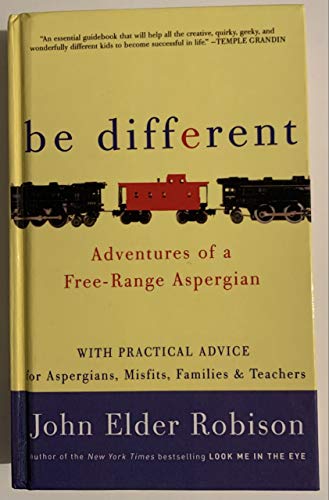
Be Different: Adventures of a Free-Range Aspergian with Practical Advice for Aspergians, Misfits, Families & Teachers - Hardcover
Inhaltsangabe
The author of Look Me in the Eye presents an anecdotal guide to individuals with Asperger's and their families that offers insight into the Aspergian mind while outlining recommendations for improving communication skills and embracing differences.
Die Inhaltsangabe kann sich auf eine andere Ausgabe dieses Titels beziehen.
Über die Autorin bzw. den Autor
JOHN ELDER ROBISON is an author and frequent lecturer about his life with Asperger’s. He blogs for Psychology Today and is an adjunct faculty member at Elms College in Chicopee, Massachusetts. John serves on committees and review boards for the Centers for Disease Control and the National Institutes of Health. He is currently involved in autism research and therapy programs at Harvard’s Beth Israel Deaconess Medical Center and Massachusetts General Hospital. John also sits on the science and treatment boards of Autism Speaks. His previous book, Look Me in the Eye, was a New York Times bestseller and has been translated into ten languages. He lives in Amherst, Massachusetts. Visit him at www.johnrobison.com.
Auszug. © Genehmigter Nachdruck. Alle Rechte vorbehalten.
Asperger’s came into my life when I was forty years old. I’m a pretty levelheaded guy, but I was totally shocked by the diagnosis. “Yep,” the doctors said, “you were born this way.” I could not believe I had reached middle age without knowing such a hugely important thing about myself. I was amazed to learn that Asperger’s is a kind of autism, because I thought everyone with autism was disabled. I’d always envisioned myself as a loner, a geek, and a misfit, but I would never have described myself as disabled. To me, being disabled meant having no legs I believe that. or being unable to talk. Yet autism, and so Asperger’s, was a disability—that’s what the books said. I’m still not sure I believe that.
The one shred of reassurance I got that first day was the knowledge that Asperger’s isn’t a terminal illness. “You’re not getting sicker,” they told me, “and it won’t kill you. You’re actually not sick at all; you’re just different.” Great, I thought. Very comforting.
All of a sudden, the concept of “people like me” took on a whole new meaning. Moments before, I’d have described myself as a middle-aged white male. I was a successful business owner, a husband, and a father. Now I was a guy with Asperger’s. I was autistic. Everything else seemed secondary to that new facet of me. This must be how it feels when you find you have cancer, I thought. I was still the same guy I had been the day before. I didn’t feel sick. Yet somehow, in a matter of seconds, my diagnosis had come to dominate my self- image.
In the weeks that followed, I read everything I could about the diagnosis, and I began to relax. When I thought back on my life, Asperger’s explained so many things. School had been hard for me, and I’d done some pretty unusual stuff after dropping out. My new knowledge of Asperger’s brought those memories into focus, and I saw how the differences in my brain had shaped the course of my life in countless subtle ways. Yet I also realized that the success I enjoyed as an adult was real, and it wasn’t going away. In fact, as I moved forward with new knowledge and confidence, I started to see my life get better every day.
Later, with the benefit of this new knowledge, I studied my Aspergian son, now twenty-one years old, and thought about how he too used to struggle in school and in social settings. He was diagnosed when he was sixteen, twenty-four years earlier than me. I look at him today, and I see how much he’s benefited from understanding how and why his brain is different from other folks’. In many ways, he’s the young man I could have been if only I had known what I had. I made it through life the hard way; he has the benefit of knowledge to rely on. That will make his path easier, and it can make yours easier, too.
Observed from the outside, Asperger’s is a series of quirks and behavioral aberrations. Aspergians are not physically disabled, though an observant person might pick us out of a crowd by our unusual gait or even by our expressions. Most Aspergians possess all the body parts and basic abilities for the full range of human functions. We’re also complete on the inside. When today’s brain scientists talk Asperger’s, there’s no mention of damage— just difference. Neurologists have not identifi ed anything that’s missing or ruined in the Asperger brain. That’s a very important fact. We are not like the unfortunate people who’ve lost millions of neurons through strokes, drinking, lead poisoning, or accidental injury. Our brains are complete; it’s just the interconnections that are different.
All people with autism have some kind of communication impairment. “Traditional” autistic people have trouble understanding or speaking language. If you can’t talk, or understand others, you are indeed going to be disabled in our society. The degree of impairment can vary greatly, with some autistic people totally devoid of speech and others affected in less substantial ways.
Autistic people can also have impairment in the ability to read nonverbal signals from others. That’s the kind of autism I have; it’s what most people with Asperger’s are touched with. The stories in this book describe the ways in which I minimized the harm my communication impairment caused me, while finding the gifts it conferred.
Autism in its many forms is not a disease. It’s a way of being that comes from this nonstandard wiring in the brain. The latest science suggests we’re most likely born different, or else we become autistic early in infancy. We don’t develop Asperger’s as teenagers; life on the autism spectrum is the only life we’ve ever known. We will always be perplexed when we gaze at people who aren’t on the spectrum, and they will always struggle to understand our unconventional way of thinking.
Subtle brain differences often cause people like me to respond differently—strangely even—to common life situations. Most of us have a hard time with social situations; some of us feel downright crippled. We get frustrated because we’re so good at some things, while being completely inept at others. There’s just no balance. It’s a very difficult way to live, because our strengths seem to contrast so sharply with our weaknesses. “You read so well, and you’re so smart! I can’t believe you can’t do what I told you. You must be faking!” I heard that a lot as a kid.
Some people with autism are noticeably disabled. A person who can’t talk, for example, cries out for compassion. Those of us with Asperger’s are tougher to pick out.
The hardest thing about having Asperger’s is that we don’t look any different from anyone else on the outside. So why would anyone suspect that we are different on the inside? When I was a kid, no one had any knowledge of how my brain was wired, including me. Consequently, society wrote me off as defective along with millions of other “different” and “difficult” children. My strange behavior was described as “bad” instead of being seen for what it was—the innocent result of neurological difference.
Today most kids are diagnosed earlier than I was, but still, for many of us, knowledge of Asperger’s starts with some kind of failure. Most kids get diagnosed with Asperger’s after failing at some aspect of school, and their behavior has brought them to the attention of the little men in suits who give tests.
I may not have been tested in school, but the differences in me were still obvious. I could not make friends, I acted strange, and I flunked all my courses. Back then, people said I was just a bad kid, but today we see problems like mine as evidence of disability, and, as a society, we supply help, not punishment. At least, that’s how it’s supposed to work.
Today, many geeks, scientists, and other creative geniuses are said to have Asperger’s. But to some of us, the phrase “have Asperger’s” is misleading because it makes Asperger’s sound like a disease or an injury. You say, “I have a cold” or “I’ve got a broken leg.” Saying you “have” something implies that it’s temporary and undesirable.
Asperger’s isn’t like that. You’ve been Aspergian as long as you can...
„Über diesen Titel“ kann sich auf eine andere Ausgabe dieses Titels beziehen.
Suchergebnisse für Be Different: Adventures of a Free-Range Aspergian...

Beispielbild für diese ISBN
Be Different: Adventures of a Free-Range Aspergian with Practical Advice for Aspergians, Misfits, Families & Teachers
Anbieter: World of Books (was SecondSale), Montgomery, IL, USA
Verkäuferbewertung 5 von 5 Sternen

Zustand: Good. Good condition ex-library book with usual library markings and stickers. Artikel-Nr. 00093936169
Gebraucht kaufen
EUR 4,13
Versand gratis
Versand innerhalb von USA
Versand innerhalb von USA
Anzahl: 2 verfügbar
Beispielbild für diese ISBN
Be Different: Adventures of a Free-Range Aspergian with Practical Advice for Aspergians, Misfits, Families & Teachers
Anbieter: World of Books (was SecondSale), Montgomery, IL, USA
Verkäuferbewertung 5 von 5 Sternen
Zustand: Very Good. Item in very good condition! Textbooks may not include supplemental items i.e. CDs, access codes etc. Artikel-Nr. 00096585435
Gebraucht kaufen
EUR 4,13
Versand gratis
Versand innerhalb von USA
Versand innerhalb von USA
Anzahl: 1 verfügbar
Beispielbild für diese ISBN
Be Different: Adventures of a Free-Range Aspergian with Practical Advice for Aspergians, Misfits, Families & Teachers
Verlag:
Crown (edition First Edition), 2011
ISBN 10: 0307884813
ISBN 13: 9780307884817
Gebraucht
Hardcover
Erstausgabe
Anbieter: BooksRun, Philadelphia, PA, USA
Verkäuferbewertung 5 von 5 Sternen
Hardcover. Zustand: Very Good. First Edition. With dust jacket. It's a well-cared-for item that has seen limited use. The item may show minor signs of wear. All the text is legible, with all pages included. It may have slight markings and/or highlighting. Artikel-Nr. 0307884813-11-1-29
Gebraucht kaufen
EUR 5,23
Versand gratis
Versand innerhalb von USA
Versand innerhalb von USA
Anzahl: 1 verfügbar
Beispielbild für diese ISBN
Be Different : Adventures of a Free-Range Aspergian with Practical Advice for Aspergians, Misfits, Families and Teachers
Verlag:
Crown Publishing Group, The, 2011
ISBN 10: 0307884813
ISBN 13: 9780307884817
Gebraucht
Hardcover
Erstausgabe
Anbieter: Better World Books, Mishawaka, IN, USA
Verkäuferbewertung 5 von 5 Sternen
Zustand: Very Good. 1ST. Pages intact with possible writing/highlighting. Binding strong with minor wear. Dust jackets/supplements may not be included. Stock photo provided. Product includes identifying sticker. Better World Books: Buy Books. Do Good. Artikel-Nr. 4229536-6
Gebraucht kaufen
EUR 6,04
Versand gratis
Versand innerhalb von USA
Versand innerhalb von USA
Anzahl: 1 verfügbar
Beispielbild für diese ISBN
Be Different : Adventures of a Free-Range Aspergian with Practical Advice for Aspergians, Misfits, Families and Teachers
Verlag:
Crown Publishing Group, The, 2011
ISBN 10: 0307884813
ISBN 13: 9780307884817
Gebraucht
Hardcover
Erstausgabe
Anbieter: Better World Books, Mishawaka, IN, USA
Verkäuferbewertung 5 von 5 Sternen
Zustand: Very Good. 1ST. Former library copy. Pages intact with possible writing/highlighting. Binding strong with minor wear. Dust jackets/supplements may not be included. Includes library markings. Stock photo provided. Product includes identifying sticker. Better World Books: Buy Books. Do Good. Artikel-Nr. 4994655-6
Gebraucht kaufen
EUR 6,04
Versand gratis
Versand innerhalb von USA
Versand innerhalb von USA
Anzahl: 1 verfügbar
Beispielbild für diese ISBN
Be Different : Adventures of a Free-Range Aspergian with Practical Advice for Aspergians, Misfits, Families and Teachers
Verlag:
Crown Publishing Group, The, 2011
ISBN 10: 0307884813
ISBN 13: 9780307884817
Gebraucht
Hardcover
Erstausgabe
Anbieter: Better World Books, Mishawaka, IN, USA
Verkäuferbewertung 5 von 5 Sternen
Zustand: Fine. 1ST. Used book that is in almost brand-new condition. May contain a remainder mark. Better World Books: Buy Books. Do Good. Artikel-Nr. 13669184-6
Gebraucht kaufen
EUR 6,04
Versand gratis
Versand innerhalb von USA
Versand innerhalb von USA
Anzahl: 1 verfügbar
Beispielbild für diese ISBN
Be Different : Adventures of a Free-Range Aspergian with Practical Advice for Aspergians, Misfits, Families and Teachers
Verlag:
Crown Publishing Group, The, 2011
ISBN 10: 0307884813
ISBN 13: 9780307884817
Gebraucht
Hardcover
Erstausgabe
Anbieter: Better World Books: West, Reno, NV, USA
Verkäuferbewertung 5 von 5 Sternen
Zustand: Very Good. 1ST. Former library copy. Pages intact with possible writing/highlighting. Binding strong with minor wear. Dust jackets/supplements may not be included. Includes library markings. Stock photo provided. Product includes identifying sticker. Better World Books: Buy Books. Do Good. Artikel-Nr. 4994655-6
Gebraucht kaufen
EUR 6,04
Versand gratis
Versand innerhalb von USA
Versand innerhalb von USA
Anzahl: 1 verfügbar
Beispielbild für diese ISBN
Be Different: Adventures of a Free-Range Aspergian with Practical Advice for Aspergians, Misfits, Families & Teachers
Anbieter: Wonder Book, Frederick, MD, USA
Verkäuferbewertung 5 von 5 Sternen
Zustand: Very Good. Very Good condition. Very Good dust jacket. A copy that may have a few cosmetic defects. May also contain light spine creasing or a few markings such as an owner's name, short gifter's inscription or light stamp. Artikel-Nr. V02A-05169
Gebraucht kaufen
EUR 6,27
Versand gratis
Versand innerhalb von USA
Versand innerhalb von USA
Anzahl: 1 verfügbar
Beispielbild für diese ISBN
Be Different: Adventures of a Free-Range Aspergian with Practical Advice for Aspergians, Misfits, Families & Teachers
Anbieter: Wonder Book, Frederick, MD, USA
Verkäuferbewertung 5 von 5 Sternen
Zustand: As New. Like New condition. Like New dust jacket. A near perfect copy that may have very minor cosmetic defects. Artikel-Nr. I02A-02584
Gebraucht kaufen
EUR 6,27
Versand gratis
Versand innerhalb von USA
Versand innerhalb von USA
Anzahl: 1 verfügbar
Beispielbild für diese ISBN
Be Different: Adventures of a Free-Range Aspergian with Practical Advice for Aspergians, Misfits, Families & Teachers
Anbieter: ThriftBooks-Atlanta, AUSTELL, GA, USA
Verkäuferbewertung 5 von 5 Sternen
Hardcover. Zustand: Very Good. No Jacket. May have limited writing in cover pages. Pages are unmarked. ~ ThriftBooks: Read More, Spend Less. Artikel-Nr. G0307884813I4N00
Gebraucht kaufen
EUR 6,85
Versand gratis
Versand innerhalb von USA
Versand innerhalb von USA
Anzahl: 1 verfügbar