
Verwandte Artikel zu The Wine of Solitude (Vintage International)
Inhaltsangabe
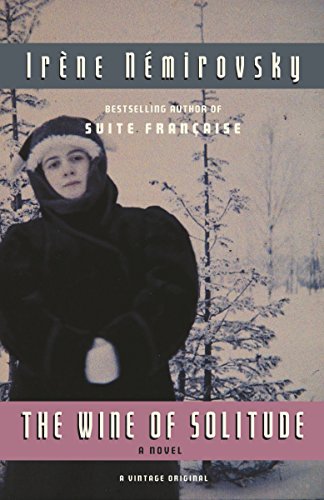
Introspective and poignant, The Wine of Solitude is the most autobiographical of all of the novels from the celebrated author of Suite Française.
Beginning in a fictionalized Kiev, The Wine of Solitude follows the Karol family through the Great War and the Russian Revolution, as the young Hélène grows from a dreamy, unhappy child into a strongwilled young woman. From the hot Kiev summers to the cruel winters of St Petersburg and eventually to springtime in Paris, the would-be writer Hélène blossoms, despite her mother’s neglect, into a clear-eyed observer of the life around her. Here is a powerful tale of disillusionment — the story of an upbringing that produces a young woman as hard as a diamond, prepared to wreak a shattering revenge on her mother.
A Vintage Paperback Original
Die Inhaltsangabe kann sich auf eine andere Ausgabe dieses Titels beziehen.
Über die Autorin bzw. den Autor
Irène Némirovsky was born in Kiev in 1903 into a wealthy banking family and immigrated to France during the Russian Revolution. After attending the Sorbonne in Paris, she began to write and swiftly achieved success with David Golder, which was followed by more than a dozen other books. Throughout her lifetime she published widely in French newspapers and literary journals. She died in Auschwitz in 1942. More than sixty years later, Suite Française was published posthumously for the first time in 2006.
Auszug. © Genehmigter Nachdruck. Alle Rechte vorbehalten.
Chapter 1.
In the part of the world where Hélène Karol was born, dusk began with a thick cloud of dust that swirled slowly in the air before drifting to the ground, bringing the damp night with it. A hazy, reddish light lingered low in the sky; the wind brought the smell of the Ukrainian plains to the city, a mild yet bitter scent of smoke, cold water and rushes that grew along the riverbanks. The wind blew in from Asia; it had pushed its way between the Ural Mountains and the Caspian Sea; it brought with it whirls of yellow dust that cracked between the teeth; it was dry and biting; it filled the air with a howl that faded as it disappeared towards the west. Then all was calm. The setting sun, pale and dull, veiled behind whitish clouds, sank deep into the river.
From the Karols’ balcony you could see the whole town, from the Dnieper River to the hills in the distance; its outline was marked out by the gaslights that lined the winding streets with their fluttering little flames, while on the opposite bank the first fires of spring smouldered in the grass.
The balcony was surrounded by boxes full of flowers that had been especially chosen because they opened at night, Nicotiana, Sweet Mignonette, Tuberoses; the balcony was so wide that it could hold the dining table and chairs, a wicker ‘love-seat’ and the armchair of Safronov, Hélène’s grandfather.
The family sat around the table, eating in silence; the flame from the gas lamp attracted delicate moths with beige wings. Leaning forward, Hélène could see the acacias in the courtyard, lit up in the moonlight. The courtyard was bare and dirty but lined with trees and flowers, like a garden. On summer evenings the servants sat down there, talking and laughing among themselves; sometimes a white skirt could be seen moving about in the darkness; they could hear an accordion playing and a muffled cry: ‘Let go of me, you devil!’
‘Well, they’re not bored down there...’ said Madame Karol, looking up.
Hélène was half asleep in her chair. At this time of year, they ate late; she could feel her legs trembling, aching from having run around the garden; her chest rose and fell quickly as she remembered the shrill cries she couldn’t help but make as she ran after the hoop, cries like the song of some bird. Her small rough hand loved touching her favourite black ball, which she had hidden in the pocket of her tartan skirt even though it left bruises as it pressed into her leg. She was eight years old; she wore a dress of broderie anglaise with a white silk belt tied below her waist in a ‘butterfly’ bow fixed in place with two pins. Bats flew by and as each one swooped down low, Mademoiselle Rose, Hélène’s French governess, let out a little cry and laughed.
Hélène half opened her tired eyes and looked at her family. Her father’s face was surrounded by a sort of yellowish haze that shimmered like a halo: to her weary eyes it looked as if the light from the lamp was flickering, but yes, it really was flickering. The lamp had begun to smoke; Hélène’s grandmother shouted to the servant, ‘Macha! Lower the lamp!’
Hélène’s mother sighed, yawned and flicked through Paris fashion magazines while she ate.
Hélène’s father said nothing, softly drumming his slim, delicate fingers on the table.
He was the only one whom Hélène resembled; she looked exactly like him. It was from him she had inherited her passion-ate eyes, wide mouth, curly hair and swarthy com-plexion that turned almost yellow whenever she was sad or ill. She looked at him tenderly. But he only had eyes for his wife. His loving caresses were only for her too.
She pushed away his hand. ‘Don’t, Boris,’ she said, sullen and irritable. ‘It’s hot, leave me be...’
She pulled the lamp towards her, leaving the others in darkness; she sighed with boredom and weariness, curling strands of her hair round her fingers. She was a tall, shapely woman ‘of regal bearing’ and with a tendency to plumpness, which she fought by using corsets shaped liked breastplates, as was the fashion; her breasts nestled in two satin pockets, like fruit in a basket. Her arms were white and powdered. Hélène felt a strange sensation, close to revulsion, when she saw her mother’s snow-white skin, pale, languid hands and claw-like nails. Hélène’s grandfather completed the family circle.
The moon spilled its tranquil light over the tops of the lime trees; nightingales sang beyond the hills. The Dnieper shimmered a dazzling white. The moonlight shone on the nape of Madame Karol’s neck, which was as pale and hard as marble; it reflected off Boris Karol’s silvery hair and the short, tapered beard of the elderly Safronov; it cast a dim light on the small, wrinkled, angular features of her grandmother: she was only fifty but she looked so old, so weary... The silence of this sleepy provincial town, lost deep within Russia, was intense, heavy and overwhelmingly sad. Then, suddenly, the stillness was broken by the sound of a carriage jolting along the paved street: the terrible din of a lashing whip, swearing the bump of wheels against stone, which faded and disappeared into the distance... Nothing more... silence... just the rustling of birds’ wings in the trees... the sound of a distant song from some country road, interrupted by the noise of arguments, shouting, the thud of a policeman’s boots, the screams of a drunken woman being dragged to the police station by the hair... Silence once more...
Hélène gently pinched her arms so she wouldn’t fall asleep; her cheeks burned as if they were on fire. Her dark curls kept her neck warm; she ran her fingers through her hair, lifting it up; she thought angrily that it was only her long hair that kept her from beating the boys when they raced: they grabbed it while she was running; she smiled with pride recalling how she had kept her balance on the slippery edge of the fountain. Her arms and legs were racked with agonising but exhilarating exhaustion; she secretly rubbed her painful knees, covered in scratches and bruises; her passionate blood pulsed quietly, deep within her body; she kicked the underside of the table impatiently, hammering its wood and sometimes her grandmother’s legs, who said nothing so Hélène wouldn’t be scolded.
‘Put your hands on the table,’ Madame Karol said sharply.
Then she continued reading her fashion magazine.
‘Tea-gown in lemon-yellow twilled silk with eighteen orange velvet bows to fasten the bodice...’ she said with a sigh, forming each word with longing.
She wound a curl of her shiny dark hair round her fingers and stroked it against her cheek as if in a dream. She was bored: she didn’t like meeting up with other women to smoke and play cards, as they all did as soon as they were over thirty. Looking after the house and her child filled her with horror. She was only happy in a hotel, in a room with a bed and a trunk, in Paris...
‘Ah, Paris!’ she thought, closing her eyes. ‘To eat at the bar of the Chauffeurs’ Café, to sleep in a train compartment, even if necessary on the hard benches in third class, but to be alone and free!’ Here, from every window, the women looked her up and down, glaring at her Parisian dresses, her make-up, the man she was with. Here, every married woman had a...
„Über diesen Titel“ kann sich auf eine andere Ausgabe dieses Titels beziehen.
Suchergebnisse für The Wine of Solitude (Vintage International)

Foto des Verkäufers
The Wine of Solitude
Verlag:
Knopf Doubleday Publishing Group, 2012
ISBN 10: 0307745481
ISBN 13: 9780307745484
Gebraucht
Softcover
Anbieter: Dream Books Co., Denver, CO, USA
Verkäuferbewertung 5 von 5 Sternen

Zustand: good. Gently used with minimal wear on the corners and cover. A few pages may contain light highlighting or writing, but the text remains fully legible. Dust jacket may be missing, and supplemental materials like CDs or codes may not be included. May be ex-library with library markings. Ships promptly! Artikel-Nr. DBV.0307745481.G
Gebraucht kaufen
EUR 3,80
Versand gratis
Versand innerhalb von USA
Versand innerhalb von USA
Anzahl: 1 verfügbar
Foto des Verkäufers
The Wine of Solitude
Verlag:
Knopf Doubleday Publishing Group, 2012
ISBN 10: 0307745481
ISBN 13: 9780307745484
Gebraucht
Softcover
Anbieter: Dream Books Co., Denver, CO, USA
Verkäuferbewertung 5 von 5 Sternen
Zustand: very_good. Pages are clean with no markings. May show minor signs of wear or cosmetic defects marks, cuts, bends, or scuffs on the cover, spine, pages, or dust jacket. May have remainder marks on edges. Artikel-Nr. DBV.0307745481.VG
Gebraucht kaufen
EUR 3,80
Versand gratis
Versand innerhalb von USA
Versand innerhalb von USA
Anzahl: 1 verfügbar
Beispielbild für diese ISBN
The Wine of Solitude
Anbieter: World of Books (was SecondSale), Montgomery, IL, USA
Verkäuferbewertung 5 von 5 Sternen
Paperback. Zustand: Good. Introspective and poignant, The Wine of Solitude is the most autobiographical of all of the novels from the celebrated author of Suite Française. Beginning in a fictionalized Kiev, The Wine of Solitude follows the Karol family through the Great War and the Russian Revolution, as the young Hélène grows from a dreamy, unhappy child into a strongwilled young woman. From the hot Kiev summers to the cruel winters of St Petersburg and eventually to springtime in Paris, the would-be writer Hélène blossoms, despite her mother's neglect, into a clear-eyed observer of the life around her. Here is a powerful tale of disillusionment -- the story of an upbringing that produces a young woman as hard as a diamond, prepared to wreak a shattering revenge on her mother. A Vintage Paperback Original. Artikel-Nr. 00100162532
Gebraucht kaufen
EUR 3,87
Versand gratis
Versand innerhalb von USA
Versand innerhalb von USA
Anzahl: 7 verfügbar
Beispielbild für diese ISBN
The Wine of Solitude
Anbieter: World of Books (was SecondSale), Montgomery, IL, USA
Verkäuferbewertung 5 von 5 Sternen
Paperback. Zustand: Fair. Introspective and poignant, The Wine of Solitude is the most autobiographical of all of the novels from the celebrated author of Suite Française. Beginning in a fictionalized Kiev, The Wine of Solitude follows the Karol family through the Great War and the Russian Revolution, as the young Hélène grows from a dreamy, unhappy child into a strongwilled young woman. From the hot Kiev summers to the cruel winters of St Petersburg and eventually to springtime in Paris, the would-be writer Hélène blossoms, despite her mother's neglect, into a clear-eyed observer of the life around her. Here is a powerful tale of disillusionment -- the story of an upbringing that produces a young woman as hard as a diamond, prepared to wreak a shattering revenge on her mother. A Vintage Paperback Original. Artikel-Nr. 00109987732
Gebraucht kaufen
EUR 3,87
Versand gratis
Versand innerhalb von USA
Versand innerhalb von USA
Anzahl: 1 verfügbar
Beispielbild für diese ISBN
The Wine of Solitude
Verlag:
Knopf Doubleday Publishing Group (edition ), 2012
ISBN 10: 0307745481
ISBN 13: 9780307745484
Gebraucht
Paperback
Anbieter: BooksRun, Philadelphia, PA, USA
Verkäuferbewertung 5 von 5 Sternen
Paperback. Zustand: Very Good. It's a well-cared-for item that has seen limited use. The item may show minor signs of wear. All the text is legible, with all pages included. It may have slight markings and/or highlighting. Artikel-Nr. 0307745481-8-6
Gebraucht kaufen
EUR 5,13
Versand gratis
Versand innerhalb von USA
Versand innerhalb von USA
Anzahl: 1 verfügbar
Beispielbild für diese ISBN
The Wine of Solitude
Verlag:
Knopf Doubleday Publishing Group, 2012
ISBN 10: 0307745481
ISBN 13: 9780307745484
Gebraucht
Paperback
Anbieter: ThriftBooks-Atlanta, AUSTELL, GA, USA
Verkäuferbewertung 5 von 5 Sternen
Paperback. Zustand: Very Good. No Jacket. May have limited writing in cover pages. Pages are unmarked. ~ ThriftBooks: Read More, Spend Less. Artikel-Nr. G0307745481I4N00
Gebraucht kaufen
EUR 6,11
Versand gratis
Versand innerhalb von USA
Versand innerhalb von USA
Anzahl: 1 verfügbar
Beispielbild für diese ISBN
The Wine of Solitude
Verlag:
Knopf Doubleday Publishing Group, 2012
ISBN 10: 0307745481
ISBN 13: 9780307745484
Gebraucht
Paperback
Anbieter: ThriftBooks-Dallas, Dallas, TX, USA
Verkäuferbewertung 5 von 5 Sternen
Paperback. Zustand: Very Good. No Jacket. May have limited writing in cover pages. Pages are unmarked. ~ ThriftBooks: Read More, Spend Less. Artikel-Nr. G0307745481I4N00
Gebraucht kaufen
EUR 6,11
Versand gratis
Versand innerhalb von USA
Versand innerhalb von USA
Anzahl: 1 verfügbar
Beispielbild für diese ISBN
The Wine of Solitude
Anbieter: Wonder Book, Frederick, MD, USA
Verkäuferbewertung 5 von 5 Sternen
Zustand: Very Good. Very Good condition. A copy that may have a few cosmetic defects. May also contain light spine creasing or a few markings such as an owner's name, short gifter's inscription or light stamp. Artikel-Nr. Q16P-01588
Gebraucht kaufen
EUR 6,43
Versand gratis
Versand innerhalb von USA
Versand innerhalb von USA
Anzahl: 1 verfügbar
Beispielbild für diese ISBN
The Wine of Solitude
Verlag:
Knopf Doubleday Publishing Group, 2012
ISBN 10: 0307745481
ISBN 13: 9780307745484
Gebraucht
Softcover
Anbieter: Better World Books, Mishawaka, IN, USA
Verkäuferbewertung 5 von 5 Sternen
Zustand: Good. Pages intact with minimal writing/highlighting. The binding may be loose and creased. Dust jackets/supplements are not included. Stock photo provided. Product includes identifying sticker. Better World Books: Buy Books. Do Good. Artikel-Nr. 4848424-6
Gebraucht kaufen
EUR 8,35
Versand gratis
Versand innerhalb von USA
Versand innerhalb von USA
Anzahl: 1 verfügbar
Beispielbild für diese ISBN
The Wine of Solitude (Vintage International)
Verlag:
Knopf Doubleday Publishing Group, 2012
ISBN 10: 0307745481
ISBN 13: 9780307745484
Gebraucht
Paperback
Anbieter: WorldofBooks, Goring-By-Sea, WS, Vereinigtes Königreich
Verkäuferbewertung 5 von 5 Sternen
Paperback. Zustand: Fine. Artikel-Nr. GOR014725936
Gebraucht kaufen
EUR 4,64
EUR 6,62 Versand
Versand von Vereinigtes Königreich nach USA
Versand von Vereinigtes Königreich nach USA
Anzahl: 1 verfügbar