
Verwandte Artikel zu Murder on the the Thirty-First Floor (Inspector Jensen)
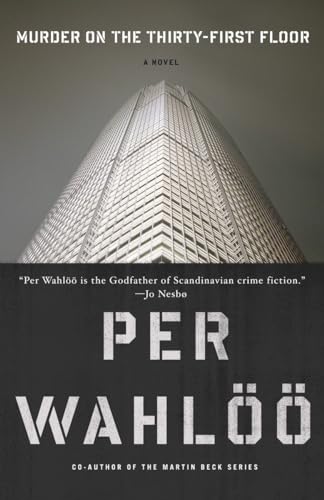
Inhaltsangabe
In an unnamed country, in an unnamed year sometime in the future, Chief Inspector Jensen of the Sixteenth Division is called in after the publishers controlling the entire country's newspapers and magazines receive a threat to blow up their building, in retaliation for a murder they are accused of committing. The building is evacuated, but the bomb fails to explode and Jensen is given seven days in which to track down the letter writer.
Jensen has never had a case he could not solve before, but as his investigation into the identity of the letter writer begins it soon becomes clear that the directors of the publishers have their own secrets, not least the identity of the 'Special Department' on the thirty first floor; the only department not permitted to be evacuated after the bomb threat.
Die Inhaltsangabe kann sich auf eine andere Ausgabe dieses Titels beziehen.
Über die Autorin bzw. den Autor
Born in 1926, Per Wahlöö was a Swedish writer and journalist who, alongside his own novels, collaborated with his wife, Maj Sjöwall, on the bestselling Martin Beck crime series which are credited as inspiring writers as varied as Agatha Christie, Henning Mankell and Jonathan Franzen. In 1971 the fourth novel in the series, The Laughing Policeman, won an Edgar Award from the Mystery Writers of America. Per Wahlöö died in 1975.
Auszug. © Genehmigter Nachdruck. Alle Rechte vorbehalten.
Chapter 1
The alarm was raised at exactly 13.02. The chief of police phoned the order through personally to the Sixteenth police District and ninety seconds later the alarm bell sounded in the oper-ational rooms and administrative offices on the ground floor. It was still ringing when Inspector Jensen got down from his room. Jensen was a middle-aged police officer of normal build, with an unlined and expressionless face. On the bottom step of the spiral staircase he stopped and let his eyes scan the reception area. He adjusted his tie and went out to his car.
The midday traffic was heavy, a mass of gleaming sheet metal, and the buildings of the city, a maze of glass and concrete pillars, rose from the stream of cars. In this world of hard surfaces, the people on the pavements looked homeless and dissatisfied. They were well dressed but strangely identical, and all of them were in a hurry. They swarmed on their way in jerky queues, clotting at red lights and fast-food outlets of shiny chrome. They looked constantly about them and fiddled with their briefcases and handbags.
Sirens wailing, the police cars bored through the crush.
Inspector Jensen was travelling in the first vehicle, a dark blue, standard-issue, PVC-panelled police car; it was followed by a van with grey bodywork, bars at the windows of the rear doors and a flashing light on the roof.
The police chief came through via the radio control room.
‘Jensen?’
‘Yes?’
‘Where are you?’
‘In front of the Trades Union Palace . . .’
‘Have you got the sirens on?’
‘Yes.’
‘Turn them off as soon as you’re through the square.’
‘The traffic’s really bad.’
‘It can’t be helped. You’ve got to avoid attracting attention.’
‘The reporters are tuned in to us all the time, anyway.’
‘You needn’t worry about them. I’m thinking about the public. The man in the street.’
‘Understood.’
‘Are you in uniform?’
‘No.’
‘Good. What manpower have you got with you?’
‘One, plus four from the plainclothes patrol. And then the police van, with an additional nine constables. In uniform.’
‘Only those in plain clothes are to show themselves inside or in the immediate vicinity of the building. Have the van set down half the men three hundred metres before you get there. Then it can drive straight past and park higher up, at a safe distance.’
‘Understood.’
‘Close off the main street and the side roads leading into it.’
‘Understood.’
‘If anyone asks, the closure’s for emergency roadworks. Something like . . .’
He tailed off.
‘A burst pipe in the district heating system?’
‘Spot on.’
There was a crackle on the line.
‘Jensen?’
‘Yes.’
‘You’ll remember about the titles business?’
‘The titles business?’
‘I thought everybody knew. You mustn’t refer to any of them as Director.’
‘Understood.’
‘They’re very sensitive on that point.’
‘I see.’
‘I’m sure I don’t need to re-emphasise the delicate nature of the operation?’
‘No.’
A mechanical rushing sound. Something that could have been a sigh, deep and metallic.
‘Where are you now?’
‘The south side of the square. In front of the workers’ monument.’
‘Turn off the sirens.’
‘Done.’
‘Space the vehicles out more.’
‘Done.’
‘I’m sending all available radio patrol cars as backup. They’ll come up to the parking area. Hold them in reserve.’
‘Understood.’
‘Where are you?’
‘The highway on the north side of the square. I can see the building.’
The road was broad and straight, with six lanes and a narrow, white-painted traffic island along the middle. Behind a tall, wire-mesh fence running along the western side there was an embankment, and at the bottom a vast long-distance lorry depot with hundreds of warehouses and white and red trucks queuing at the loading platforms. A number of people were moving about down there, mainly packers and drivers in white boiler suits and red caps.
The road ran uphill, cutting through a ridge of solid rock that had been blasted away. Its eastern side was a wall of granite, its irregularities smoothed over with concrete. It was pale blue, with rusty vertical stripes caused by the reinforcement bars, and just visible above it were the tops of a few leafless trees. From down below you couldn’t see the buildings beyond the trees, but Jensen knew they were there, and what they looked like. One of them was a mental hospital.
At its highest point, the road came level with the top of the ridge and curved slightly to the right. And that was where the Skyscraper stood; it was one of the tallest buildings in the country, its elevated position making it visible from all over the city. You could always see it there above you, and whatever direction you were coming from, it seemed to be the point towards which your approach road was leading.
The Skyscraper had a square layout and thirty floors. Each of its façades had four hundred and fifty windows and a white clock with red hands. Its exterior was of glass, the panels dark blue at ground level, fading gradually to lighter shades on the higher floors.
To Jensen, peering through the windscreen, the Skyscraper seemed to shoot up out of the ground and grow into the cold, cloudless spring sky.
Still with the radio telephone pressed to his ear, he leaned forward. The Skyscraper enlarged to fill his entire field of vision.
‘Jensen?’
‘Yes.’
‘I’m relying on you. It’s your job now to make an assessment of the situation.’
There was a brief, crackling pause. Then the police chief gave a hesitant:
‘Over and out.’
Chapter 2
The rooms on the eighteenth floor were carpeted in pale blue. There were two large model ships in display cases and a reception area with easy chairs and kidney-shaped tables.
In a room with glass walls sat three unoccupied young women. One of them glanced in the visitor’s direction and said:
‘Can I help you?’
‘My name’s Jensen. It’s urgent.’
‘Oh?’
She rose lazily, crossed the floor with light, practised nonchalance and opened a door: ‘There’s someone called Jensen here.’
Her legs were shapely and her waist slim. Her clothes displayed no taste.
Another woman appeared in the doorway. She looked a little older, though not much, and had blonde hair, distinct features and a generally antiseptic appearance.
She looked past her assistant and said:
‘Come in. You’re expected.’
The corner room had six windows and the city lay spread below them, as unreal and lifeless as a model on a topographical map. In spite of the dazzling sun, the view and visibility were superb, the daylight clear and cold. The colours in the room were clean and hard and the walls very light, as were the floor covering and the tubular steel furniture.
There was a glass-fronted cabinet between the windows, containing silver coloured cups, engraved with wreaths of oak...
„Über diesen Titel“ kann sich auf eine andere Ausgabe dieses Titels beziehen.
Suchergebnisse für Murder on the the Thirty-First Floor (Inspector Jensen)

Beispielbild für diese ISBN
Murder on the Thirty-first Floor
Verlag:
Vintage Crime/Black Lizard, 2013
ISBN 10: 0307744450
ISBN 13: 9780307744456
Gebraucht
Softcover
Anbieter: World of Books (was SecondSale), Montgomery, IL, USA
Verkäuferbewertung 5 von 5 Sternen

Zustand: Good. Item in good condition. Textbooks may not include supplemental items i.e. CDs, access codes etc. Artikel-Nr. 00097420566
Gebraucht kaufen
EUR 4,04
Versand gratis
Versand innerhalb von USA
Versand innerhalb von USA
Anzahl: 2 verfügbar
Beispielbild für diese ISBN
Murder on the Thirty-first Floor
Verlag:
Vintage Crime/Black Lizard, 2013
ISBN 10: 0307744450
ISBN 13: 9780307744456
Gebraucht
Softcover
Anbieter: World of Books (was SecondSale), Montgomery, IL, USA
Verkäuferbewertung 5 von 5 Sternen
Zustand: Very Good. Item in very good condition! Textbooks may not include supplemental items i.e. CDs, access codes etc. Artikel-Nr. 00106280122
Gebraucht kaufen
EUR 4,04
Versand gratis
Versand innerhalb von USA
Versand innerhalb von USA
Anzahl: 1 verfügbar
Beispielbild für diese ISBN
Murder on the Thirty-first Floor
Verlag:
Knopf Doubleday Publishing Group (edition Reprint), 2013
ISBN 10: 0307744450
ISBN 13: 9780307744456
Gebraucht
Paperback
Anbieter: BooksRun, Philadelphia, PA, USA
Verkäuferbewertung 5 von 5 Sternen
Paperback. Zustand: Fair. Reprint. The item might be beaten up but readable. May contain markings or highlighting, as well as stains, bent corners, or any other major defect, but the text is not obscured in any way. Artikel-Nr. 0307744450-7-1
Gebraucht kaufen
EUR 4,80
Versand gratis
Versand innerhalb von USA
Versand innerhalb von USA
Anzahl: 1 verfügbar
Beispielbild für diese ISBN
Murder on the the Thirty-First Floor
Verlag:
Knopf Doubleday Publishing Group, 2013
ISBN 10: 0307744450
ISBN 13: 9780307744456
Gebraucht
Softcover
Anbieter: Better World Books, Mishawaka, IN, USA
Verkäuferbewertung 5 von 5 Sternen
Zustand: Good. Reprint. Pages intact with minimal writing/highlighting. The binding may be loose and creased. Dust jackets/supplements are not included. Stock photo provided. Product includes identifying sticker. Better World Books: Buy Books. Do Good. Artikel-Nr. 6488294-6
Gebraucht kaufen
EUR 6,55
Versand gratis
Versand innerhalb von USA
Versand innerhalb von USA
Anzahl: 1 verfügbar
Beispielbild für diese ISBN
Murder on the the Thirty-First Floor
Verlag:
Knopf Doubleday Publishing Group, 2013
ISBN 10: 0307744450
ISBN 13: 9780307744456
Gebraucht
Softcover
Anbieter: Better World Books, Mishawaka, IN, USA
Verkäuferbewertung 5 von 5 Sternen
Zustand: Very Good. Reprint. Pages intact with possible writing/highlighting. Binding strong with minor wear. Dust jackets/supplements may not be included. Stock photo provided. Product includes identifying sticker. Better World Books: Buy Books. Do Good. Artikel-Nr. 4738273-75
Gebraucht kaufen
EUR 6,55
Versand gratis
Versand innerhalb von USA
Versand innerhalb von USA
Anzahl: 2 verfügbar
Beispielbild für diese ISBN
Murder on the the Thirty-first Floor
Anbieter: Revaluation Books, Exeter, Vereinigtes Königreich
Verkäuferbewertung 5 von 5 Sternen
Paperback. Zustand: Brand New. reprint edition. 215 pages. 7.75x5.25x1.00 inches. In Stock. Artikel-Nr. x-0307744450
Neu kaufen
EUR 20,54
EUR 11,86 Versand
Versand von Vereinigtes Königreich nach USA
Versand von Vereinigtes Königreich nach USA
Anzahl: 2 verfügbar
Foto des Verkäufers
Murder on the the Thirty-first Floor
Verlag:
Penguin Random House LLC Feb 2013, 2013
ISBN 10: 0307744450
ISBN 13: 9780307744456
Neu
Taschenbuch
Anbieter: AHA-BUCH GmbH, Einbeck, Deutschland
Verkäuferbewertung 5 von 5 Sternen
Taschenbuch. Zustand: Neu. Neuware - In an unnamed country, in an unnamed year sometime in the future, Chief Inspector Jensen of the Sixteenth Division is called in after the publishers controlling the entire country's newspapers and magazines receive a threat to blow up their building, in retaliation for a murder they are accused of committing. The building is evacuated, but the bomb fails to explode and Jensen is given seven days in which to track down the letter writer. Jensen has never had a case he could not solve before, but as his investigation into the identity of the letter writer begins it soon becomes clear that the directors of the publishers have their own secrets, not least the identity of the 'Special Department' on the thirty first floor; the only department not permitted to be evacuated after the bomb threat. Artikel-Nr. 9780307744456
Neu kaufen
EUR 25,42
EUR 35,00 Versand
Versand von Deutschland nach USA
Versand von Deutschland nach USA
Anzahl: 2 verfügbar
Foto des Verkäufers
Murder on the the Thirty-first Floor
Verlag:
Knopf Doubleday Publishing Group, 2013
ISBN 10: 0307744450
ISBN 13: 9780307744456
Neu
Softcover
Anbieter: moluna, Greven, Deutschland
Verkäuferbewertung 5 von 5 Sternen
Zustand: New. Born in 1926, Per Wahlöö was a Swedish writer and journalist who, alongside his own novels, collaborated with his wife, Maj Sjöwall, on the bestselling Martin Beck crime series which are credited as inspiring writers as varied as Agatha Chris. Artikel-Nr. 897694232
Neu kaufen
EUR 18,88
EUR 48,99 Versand
Versand von Deutschland nach USA
Versand von Deutschland nach USA
Anzahl: Mehr als 20 verfügbar