
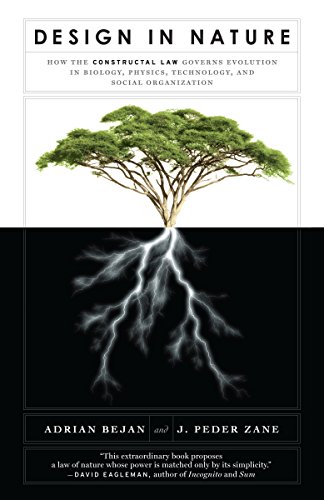
Design in Nature: How the Constructal Law Governs Evolution in Biology, Physics, Technology, and Social Organizations - Softcover
Inhaltsangabe
In this groundbreaking book, Adrian Bejan takes the recurring patterns in nature—trees, tributaries, air passages, neural networks, and lightning bolts—and reveals how a single principle of physics, the constructal law, accounts for the evolution of these and many other designs in our world.
Everything—from biological life to inanimate systems—generates shape and structure and evolves in a sequence of ever-improving designs in order to facilitate flow. River basins, cardiovascular systems, and bolts of lightning are very efficient flow systems to move a current—of water, blood, or electricity. Likewise, the more complex architecture of animals evolve to cover greater distance per unit of useful energy, or increase their flow across the land. Such designs also appear in human organizations, like the hierarchical “flowcharts” or reporting structures in corporations and political bodies. All are governed by the same principle, known as the constructal law, and configure and reconfigure themselves over time to flow more efficiently. Written in an easy style that achieves clarity without sacrificing complexity, Design in Nature is a paradigm-shifting book that will fundamentally transform our understanding of the world around us.
Die Inhaltsangabe kann sich auf eine andere Ausgabe dieses Titels beziehen.
Über die Autorin bzw. den Autor
Adrian Bejan has pioneered numerous original methods in thermodynamics, such as entropy generation minimization, scale analysis of convection, heatlines and masslines, and the constructal law of design and evolution in nature. He is ranked among the hundred most cited authors in all engineering by the Institute of Scientific Information. He is the author of more than 550 peer-reviewed journal articles and twenty-four books, including Shape and Structure, from Engineering to Nature; Constructal Theory of Social Dynamics; and Design with Constructal Theory. His treatises Advanced Engineering Thermodynamics and Convection Heat Transfer are now in their third editions and are used as graduate textbooks in universities around the world. He has been awarded sixteen honorary doctorates by universities in eleven countries, including the Swiss Federal Institute of Technology and the Sapienza University of Rome and has received numerous national and international society awards. Bejan is a graduate of MIT and was a postdoctoral fellow at the University of California, Berkeley, at the Miller Institute of Basic Research in Science. He was appointed as a full professor of mechanical engineering at Duke University in 1984, and J. A. Jones Distinguished Professor in 1989.
J. Peder Zane is an assistant professor of journalism and mass communications at St. Augustine’s College in Raleigh, North Carolina. He is an award-winning columnist who has worked for the New York Times and the News & Observer (Raleigh). He has edited and contributed to two books, Remarkable Reads: 34 Writers and Their Adventures in Reading and The Top Ten: Writers Pick Their Favorite Books.
Auszug. © Genehmigter Nachdruck. Alle Rechte vorbehalten.
Discovering a unifying law of design in nature was not on my to-do list when I traveled to Nancy, France, in late September 1995. I was a forty-seven-year-old professor of mechanical engineering at Duke University who had come to deliver a lecture at an international conference on thermodynamics. Giving you a sense of how steeped my career was in mechanical engineering, I remember that I had brought flyers announcing the publication of my seventh book, Entropy Generation Minimization.
My work took a fateful turn during the prebanquet speech delivered by the Belgian Nobel laureate Ilya Prigogine. Echoing the scientific community’s conventional wisdom, this famous man asserted that the tree-shaped structures that abound in nature—including river basins and deltas, the air passages in our lungs, and lightning bolts—were aléatoires (the result of throwing the dice). That is, there is nothing underlying their similar design. It’s just a cosmic coincidence.
When he made that statement, something clicked, the penny dropped. I knew that Prigogine, and everyone else, was wrong. They weren’t blind; the similarities among these treelike structures are clear to the naked eye. What they couldn’t see was the scientific principle that governs the design of these diverse phenomena. In a flash, I realized that the world was not formed by random accidents, chance, and fate but that behind the dizzying diversity is a seamless stream of predictable patterns.
As these thoughts began to flow, I started down a long, uncharted, and wondrously exciting path that would allow me to see the world in a new, and better, light. In the sixteen years since, I have shown how a single law of physics shapes the design of all around us. This insight would lead me to challenge many articles of faith held by my scientific colleagues, including the bedrock beliefs that biological creatures like you and me are governed by different principles from the inanimate world of winds and rivers and the engineered world of airplanes, ships, and automobiles. Over time, I would develop a new understanding of evolutionary phenomena and the oneness of nature that would reveal how design emerges without an intelligent designer. I would also offer a new theory for the history of Earth and what it means to be alive.
In addition, I and a growing number of scientists around the world would begin finding new ways to make life easier: better ways to design roads and transport systems; to predict the evolution of civilization and science, of cities, universities, sports, and the global use of energy. We would unravel the mysteries of Egypt’s Pyramids and the genius of the Eiffel Tower while demonstrating how governments are designed like river basins and how businesses are as interdependent as the trees on the forest floor.
All that lay in the future when I boarded the plane for the trip home. High over the Atlantic, I opened my notebook (the old-fashioned kind, with paper) and wrote down the constructal law:
For a finite-size flow system to persist in time (to live), its configuration must evolve
in such a way that provides easier access to the currents that flow through it.
I was writing in the language of science, but the fundamental idea is this: Everything that moves, whether animate or inanimate, is a flow system. All flow systems generate shape and structure in time in order to facilitate this movement across a landscape filled with resistance (for example, friction). The designs we see in nature are not the result of chance. They arise naturally, spontaneously, because they enhance access to flow in time.
Flow systems have two basic features (properties). There is the current that is flowing (for example, fluid, heat, mass, or information) and the design through which it flows. A lightning bolt, for example, is a flow system for discharging electricity from a cloud. In a flash it creates a brilliant branched structure because this is a very efficient way to move a current (electricity) from a volume (the cloud) to a point (the church steeple or another cloud). A river basin’s evolution produces a similar architecture because it, too, is moving a current (water) from an area (the plain) to a point (the river mouth). We also find a treelike structure in the air passages of lungs (a flow system for oxygen), in the capillaries (a flow system for blood), and the dendrites of neurons in our brains (a flow system for electrical signals and images). This treelike pattern emerges throughout nature because it is an effective design for facilitating point-to-area and area-to-point flows. Indeed, wherever you find such flows, you find a treelike structure.
Since human beings are part of nature and governed by its laws, the point-to-area and area-to-point flows we construct also tend to have treelike structures. These include the transportation routes we follow to work (a flow system for moving people and goods), which include many smaller driveways and neighborhood paths flowing into a few larger roads and highways. So, too, do the flowing networks of information, material, employees, and customers that keep those businesses afloat. The engineered world we have built so that we can move more easily does not copy any part of the natural design; it is a manifestation of it. That said, once we know the principle, we can use it to improve our designs.
Although treelike structures are a very common design in nature, they are only one manifestation of the constructal law. In a simple example, logs floating on a lake or icebergs at sea orient themselves perpendicular to the wind in order to facilitate the transfer of motion from the moving air body to the water body. A more complex example is the design of animals that have evolved to move mass better and better (to cover more distance per unit of useful energy) across the landscape. This includes the seemingly “characteristic” sizes of organs, the shape of bones, the rhythm of breathing lungs and beating hearts, of undulating tails, running legs, and flapping wings. All these designs have arisen—and work together—to allow animals, like raindrops in a river basin, to move more easily across a landscape.
The constructal law dictates that flow systems should evolve over time, acquiring better and better configurations to provide more access for the currents that flow through them. Design generation and evolution are macroscopic physics phenomena that arise naturally to provide better and better flow access to the currents that run through them. The majesty of this principle is that it occurs at every scale. Each component of an evolving flow system—each rivulet, each tree, each road—acquires evolving designs to facilitate flow access. As these elements coalesce into larger and larger structures (into evolving river basins, forests, and transport networks), the various-sized components work
together so that everything flows more easily. We see this, for example, in the shape and structure of the neural networks in the brain, of the alveoli in the lung, and the human settlements on a map. In the big picture, all the mating and morphing flows on the largest system that surrounds us, the Earth itself, evolve to enhance global flow. E pluribus unum (one out of many).
The constructal law is revolutionary because it is a law of physics—and not just of biology, hydrology, geology, geophysics, or engineering. It governs any system, any time, anywhere, encompassing inanimate (rivers and lightning bolts),...
„Über diesen Titel“ kann sich auf eine andere Ausgabe dieses Titels beziehen.
Weitere beliebte Ausgaben desselben Titels

Suchergebnisse für Design in Nature: How the Constructal Law Governs Evolution...

Beispielbild für diese ISBN
Design in Nature: How the Constructal Law Governs Evolution in Biology, Physics, Technology, and Social Organizations
Anbieter: World of Books (was SecondSale), Montgomery, IL, USA
Verkäuferbewertung 5 von 5 Sternen

Zustand: Acceptable. Item in acceptable condition! Textbooks may not include supplemental items i.e. CDs, access codes etc. Artikel-Nr. 00097868984
Gebraucht kaufen
EUR 5,69
Versand gratis
Versand innerhalb von USA
Versand innerhalb von USA
Anzahl: 1 verfügbar
Beispielbild für diese ISBN
Design in Nature: How the Constructal Law Governs Evolution in Biology, Physics, Technology, and Social Organizations
Anbieter: World of Books (was SecondSale), Montgomery, IL, USA
Verkäuferbewertung 5 von 5 Sternen
Zustand: Good. Item in good condition. Textbooks may not include supplemental items i.e. CDs, access codes etc. Artikel-Nr. 00095734854
Gebraucht kaufen
EUR 5,69
Versand gratis
Versand innerhalb von USA
Versand innerhalb von USA
Anzahl: 2 verfügbar
Beispielbild für diese ISBN
Design in Nature : How the Constructal Law Governs Evolution in Biology, Physics, Technology, and Social Organizations
Verlag:
Knopf Doubleday Publishing Group, 2013
ISBN 10: 0307744345
ISBN 13: 9780307744340
Gebraucht
Softcover
Anbieter: Better World Books, Mishawaka, IN, USA
Verkäuferbewertung 5 von 5 Sternen
Zustand: Good. Pages intact with minimal writing/highlighting. The binding may be loose and creased. Dust jackets/supplements are not included. Stock photo provided. Product includes identifying sticker. Better World Books: Buy Books. Do Good. Artikel-Nr. 9024531-6
Gebraucht kaufen
EUR 6,03
Versand gratis
Versand innerhalb von USA
Versand innerhalb von USA
Anzahl: 1 verfügbar
Beispielbild für diese ISBN
Design in Nature : How the Constructal Law Governs Evolution in Biology, Physics, Technology, and Social Organizations
Verlag:
Knopf Doubleday Publishing Group, 2013
ISBN 10: 0307744345
ISBN 13: 9780307744340
Gebraucht
Softcover
Anbieter: Better World Books, Mishawaka, IN, USA
Verkäuferbewertung 5 von 5 Sternen
Zustand: Very Good. Former library copy. Pages intact with possible writing/highlighting. Binding strong with minor wear. Dust jackets/supplements may not be included. Includes library markings. Stock photo provided. Product includes identifying sticker. Better World Books: Buy Books. Do Good. Artikel-Nr. 13553779-75
Gebraucht kaufen
EUR 6,03
Versand gratis
Versand innerhalb von USA
Versand innerhalb von USA
Anzahl: 1 verfügbar
Beispielbild für diese ISBN
Design in Nature : How the Constructal Law Governs Evolution in Biology, Physics, Technology, and Social Organizations
Verlag:
Knopf Doubleday Publishing Group, 2013
ISBN 10: 0307744345
ISBN 13: 9780307744340
Gebraucht
Softcover
Anbieter: Better World Books, Mishawaka, IN, USA
Verkäuferbewertung 5 von 5 Sternen
Zustand: Very Good. Pages intact with possible writing/highlighting. Binding strong with minor wear. Dust jackets/supplements may not be included. Stock photo provided. Product includes identifying sticker. Better World Books: Buy Books. Do Good. Artikel-Nr. GRP102732317
Gebraucht kaufen
EUR 6,03
Versand gratis
Versand innerhalb von USA
Versand innerhalb von USA
Anzahl: 2 verfügbar
Beispielbild für diese ISBN
Design in Nature: How the Constructal Law Governs Evolution in Biology, Physics, Technology, and Social Organizations
Anbieter: ThriftBooks-Dallas, Dallas, TX, USA
Verkäuferbewertung 5 von 5 Sternen
Paperback. Zustand: Good. No Jacket. Pages can have notes/highlighting. Spine may show signs of wear. ~ ThriftBooks: Read More, Spend Less. Artikel-Nr. G0307744345I3N00
Gebraucht kaufen
EUR 7,60
Versand gratis
Versand innerhalb von USA
Versand innerhalb von USA
Anzahl: 1 verfügbar
Beispielbild für diese ISBN
Design in Nature: How the Constructal Law Governs Evolution in Biology, Physics, Technology, and Social Organizations
Anbieter: ThriftBooks-Atlanta, AUSTELL, GA, USA
Verkäuferbewertung 5 von 5 Sternen
Paperback. Zustand: Very Good. No Jacket. May have limited writing in cover pages. Pages are unmarked. ~ ThriftBooks: Read More, Spend Less. Artikel-Nr. G0307744345I4N00
Gebraucht kaufen
EUR 7,60
Versand gratis
Versand innerhalb von USA
Versand innerhalb von USA
Anzahl: 1 verfügbar
Beispielbild für diese ISBN
Design in Nature: How the Constructal Law Governs Evolution in Biology, Physics, Technology, and Social Organizations
Anbieter: ThriftBooks-Dallas, Dallas, TX, USA
Verkäuferbewertung 5 von 5 Sternen
Paperback. Zustand: Very Good. No Jacket. May have limited writing in cover pages. Pages are unmarked. ~ ThriftBooks: Read More, Spend Less. Artikel-Nr. G0307744345I4N00
Gebraucht kaufen
EUR 7,60
Versand gratis
Versand innerhalb von USA
Versand innerhalb von USA
Anzahl: 1 verfügbar
Beispielbild für diese ISBN
Design in Nature: How the Constructal Law Governs Evolution in Biology, Physics, Technology, and Social Organizations
Anbieter: ThriftBooks-Atlanta, AUSTELL, GA, USA
Verkäuferbewertung 5 von 5 Sternen
Paperback. Zustand: Good. No Jacket. Pages can have notes/highlighting. Spine may show signs of wear. ~ ThriftBooks: Read More, Spend Less. Artikel-Nr. G0307744345I3N00
Gebraucht kaufen
EUR 7,60
Versand gratis
Versand innerhalb von USA
Versand innerhalb von USA
Anzahl: 1 verfügbar
Beispielbild für diese ISBN
Design in Nature: How the Constructal Law Governs Evolution in Biology, Physics, Technology, and Social Organizations
Anbieter: ThriftBooks-Phoenix, Phoenix, AZ, USA
Verkäuferbewertung 5 von 5 Sternen
Paperback. Zustand: Good. No Jacket. Pages can have notes/highlighting. Spine may show signs of wear. ~ ThriftBooks: Read More, Spend Less. Artikel-Nr. G0307744345I3N00
Gebraucht kaufen
EUR 7,60
Versand gratis
Versand innerhalb von USA
Versand innerhalb von USA
Anzahl: 1 verfügbar