
Verwandte Artikel zu All Our Worldly Goods (Vintage International Original)
Inhaltsangabe
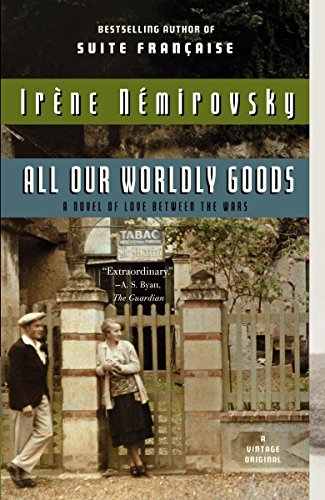
In haunting ways, this gorgeous novel prefigures Irène Némirovsky’s masterpiece Suite Française. Set in France between 1910 and 1940 and first published in France in 1947, five years after the author’s death, All Our Worldly Goods is a gripping story of war, family life and star-crossed lovers. Pierre and Agnes marry for love against the wishes of his parents and his grandfather, the tyrannical family patriarch. Their marriage provokes a family feud that cascades down the generations. This brilliant novel is full of drama, heartbreak, and the telling observations that have made Némirovsky’s work so beloved and admired.
Die Inhaltsangabe kann sich auf eine andere Ausgabe dieses Titels beziehen.
Über die Autorin bzw. den Autor
Irène Némirovsky was born in Kiev in 1903 into a wealthy banking family and immigrated to France during the Russian Revolution. After attending the Sorbonne in Paris, she began to write and swiftly achieved success with David Golder, which was followed by more than a dozen other books. Throughout her lifetime she published widely in French newspapers and literary journals. She died in Auschwitz in 1942. More than sixty years later, Suite Française was published posthumously for the first time in 2006.
Auszug. © Genehmigter Nachdruck. Alle Rechte vorbehalten.
1
They were together, so they were happy. Even though the watchful family slipped between them, separating them gently but firmly, the young man and woman knew they were near one another; nothing else mattered. It was the beginning of the century – an autumn evening at the seaside, overlooking the English Channel. Pierre and Agnès, their parents and Pierre’s fiancée had all gathered to watch the last firework display of summer. On the fine sand of the dunes, the inhabitants of Wimereux-Plage formed dark little groups, barely visible in the starlight. The moist sea air drifted around them. A profound sense of tranquillity reigned over them, and over the sea, and over the world.
The families were not very friendly to each other, for they belonged to different social classes: the bourgeoisie didn’t mingle with the lower middle classes. Each kept its place and its distance with modesty, steadfastness and dignity. Each built itself a fortress out of spades and folding chairs. Each scrupulously respected the possessions of its neighbours and defended its own courteously but resolutely, just as a well-tempered sword bends but does not break. The mothers would murmur, ‘Don’t touch that, it doesn’t belong to you . . . Excuse me, Madame, this is my son’s seat and this one is mine . . . Watch your toys or someone will take them.’
Heavy storm clouds had been gathering all day, but it hadn’t rained. Agnès thought how wonderful it would be to dip her bare feet in the water. But it wasn’t done to go into the sea, except at midday and amid a crowd of people, thus somehow preserving a young girl’s modesty. She could hear Pierre sighing. He didn’t like the heat. He was wearing a dark jacket with a stiff collar; its pale white glow allowed her to make him out in the darkness. He was lying in the hollow of a sand dune, impatiently waving his arms. ‘Pierre, come now, sit still,’ his mother said, as if he were twelve years old. In fact he was twenty-four, but her tender, authoritarian voice held such power over him that he obeyed her still. Simone, Pierre’s fiancée, sat between him and Agnès; he turned away to avoid looking at the pale folds of flesh round Simone’s waist and her milky-white round arms. This girl looks as if she’s made of milk, and butter, and cream, he mused. It was strange; he had often looked with pleasure at her fresh, plump body, her thick, soft waist and red hair. But, for some time now, the sight of her made him feel nauseous, like a meal that is too heavy, too sweet. Nevertheless, they were engaged. The following week, a grand engagement dinner would make it official, uniting the two families. There was no hope for him and Agnès. So little hope that they hadn’t even confessed their love to each other. It was pointless. Pierre Hardelot came from the Hardelot Paper Mills family of Saint-Elme. Agnès’s family were brewers. Only a foreigner, someone from outside, would have thought a marriage between them possible. The people of Saint-Elme had no such illusions; theyunderstood, with infallible, subtle tact, how the two young people’s different social standing was a barrier. The brewers were from the lower classes and, even worse, they weren’t from the region but from Flanders. The Hardelots were from Saint-Elme. There were plenty more obstacles. Pierre should have felt despair, but in spite of everything he was happy. Agnès was here. They were together.
The fireworks still hadn’t started. The men allowed themselves to relax a little; they stretched out their legs, propped themselves up on their elbows. ‘No one else is lolling about like you,’ Pierre’s mother whispered in his ear. ‘It isn’t done.’ The women sat on the beach as if they were in drawing-room armchairs, backs straight, skirts modestly covering their ankles. If a blade of pale dune grass bent in the wind to tickle their calves, they closed their legs tight, as if ashamed. Their dresses were long and black; their starched linen collars, stiffened with whalebone, restricted their necks, forcing them to turn their heads from side to side with sudden, staccato movements, like hens pecking at worms. When the lighthouse beacon passed you could see their hats, a veritable garden of chiffon and velvet flowers quivering on wire stems. Here and there a stuffed seagull with a pointy beak stood perched on a straw boater. This was the height of fashion, the favourite adornment of the season, though some people found it somewhat daring. There was something unsubtle about that bird, with its little glass eye and extended wings, Pierre’s mother thought, as she looked at Agnès’s mother, comparing her neighbour’s grey-feathered hat to her own with its decoration of daisies. But Agnès’s mother was from Paris. There were niceties she couldn’t sense, couldn’t understand.
Nevertheless, she seemed very anxious to please. ‘Yes,’ she would say, ‘I do agree’, or ‘That’s what I think as well’. But even her humility did not inspire confidence. Everyone knew that, before her marriage, Gabrielle Florent had been forced to work for a living. She herself admitted that she’d given singing lessons. Anything was possible. A singing teacher might have socialised with actresses. In spite of everything, she was accepted in Saint-Elme, for, as far as her present conduct was concerned, there was nothing to be said. Yet even though she was accepted, people remained on the defensive.
It would have been better for Agnès, for Agnès’s future, if there had been some precise accusation regarding her mother’s past,
rather than these vague insinuations, people whispering, nodding or sighing as she passed by. ‘Do they have family in Paris? I think this Madame Florent had a bad reputation when she was young. Her daughter will not find a husband so easily. I can’t see her getting married. Can you?’ Monsieur Florent had died three years before. Everyone was surprised that his widow had remained in Saint-Elme. ‘She must have no family left,’ people said, slightly maliciously; in the eyes of Saint-Elme, the absence of numerous relatives was suspicious. ‘She says she’s lost everyone.’ That was no excuse. A good middle-class family should be large, and hardy enough to stand up to death.
‘The fireworks,’ shouted the children, ‘the fireworks are starting.’
A golden swirl burst forth from behind the sand dunes and spun over the waves. Everyone stood up in curiosity and pleasure. The inhabitants of Wimereux-Plage rarely indulged in entertainments; they played Ludo in the Casino and, sometimes, touring theatre companies came from Paris. They didn’t have to pay to see the fireworks. Sound economic principles reigned supreme here.
‘Come over here, Agnès,’ said Pierre. ‘Come and stand in front of me, so you can see better . . .’
But when Agnès went over to him, she found him flanked by his mother and fiancée. He held out his hand to help her climb on to the sand dune and Madame Hardelot immediately called out to her husband, ‘Charles, stand behind Agnès. You’re so tall! She can’t see a thing, can you, darling?’
And so, protected on three sides, Pierre was as defended as a fortress. He pushed the women away rather briskly. ‘It’s too hot. I prefer lying in the sand.’
Agnès didn’t dare move. She lowered her head and choked back the tears.
During the winter the Hardelots and Florents rarely saw each other, even though they were neighbours. The...
„Über diesen Titel“ kann sich auf eine andere Ausgabe dieses Titels beziehen.
Suchergebnisse für All Our Worldly Goods (Vintage International Original)

Beispielbild für diese ISBN
All Our Worldly Goods
Anbieter: World of Books (was SecondSale), Montgomery, IL, USA
Verkäuferbewertung 5 von 5 Sternen

Zustand: Acceptable. Item in good condition. Textbooks may not include supplemental items i.e. CDs, access codes etc. Artikel-Nr. 00063156214
Gebraucht kaufen
EUR 3,63
Versand gratis
Versand innerhalb von USA
Versand innerhalb von USA
Anzahl: 1 verfügbar
Beispielbild für diese ISBN
All Our Worldly Goods
Anbieter: World of Books (was SecondSale), Montgomery, IL, USA
Verkäuferbewertung 5 von 5 Sternen
Zustand: Very Good. Item in very good condition! Textbooks may not include supplemental items i.e. CDs, access codes etc. Artikel-Nr. 00100846914
Gebraucht kaufen
EUR 3,63
Versand gratis
Versand innerhalb von USA
Versand innerhalb von USA
Anzahl: 3 verfügbar
Beispielbild für diese ISBN
All Our Worldly Goods
Anbieter: World of Books (was SecondSale), Montgomery, IL, USA
Verkäuferbewertung 5 von 5 Sternen
Zustand: Good. Item in good condition. Textbooks may not include supplemental items i.e. CDs, access codes etc. Artikel-Nr. 00091079891
Gebraucht kaufen
EUR 3,63
Versand gratis
Versand innerhalb von USA
Versand innerhalb von USA
Anzahl: 7 verfügbar
Beispielbild für diese ISBN
All Our Worldly Goods
Verlag:
Vintage (edition First Edition), 2011
ISBN 10: 0307743292
ISBN 13: 9780307743299
Gebraucht
Paperback
Erstausgabe
Anbieter: BooksRun, Philadelphia, PA, USA
Verkäuferbewertung 5 von 5 Sternen
Paperback. Zustand: Fair. First Edition. The item might be beaten up but readable. May contain markings or highlighting, as well as stains, bent corners, or any other major defect, but the text is not obscured in any way. Artikel-Nr. 0307743292-7-1
Gebraucht kaufen
EUR 4,40
Versand gratis
Versand innerhalb von USA
Versand innerhalb von USA
Anzahl: 1 verfügbar
Beispielbild für diese ISBN
All Our Worldly Goods
Verlag:
Knopf Doubleday Publishing Group (edition First Edition), 2011
ISBN 10: 0307743292
ISBN 13: 9780307743299
Gebraucht
Paperback
Erstausgabe
Anbieter: BooksRun, Philadelphia, PA, USA
Verkäuferbewertung 5 von 5 Sternen
Paperback. Zustand: Very Good. First Edition. It's a well-cared-for item that has seen limited use. The item may show minor signs of wear. All the text is legible, with all pages included. It may have slight markings and/or highlighting. Artikel-Nr. 0307743292-11-1
Gebraucht kaufen
EUR 4,59
Versand gratis
Versand innerhalb von USA
Versand innerhalb von USA
Anzahl: 1 verfügbar
Beispielbild für diese ISBN
All Our Worldly Goods
Verlag:
Knopf Doubleday Publishing Group, 2011
ISBN 10: 0307743292
ISBN 13: 9780307743299
Gebraucht
Softcover
Anbieter: Better World Books, Mishawaka, IN, USA
Verkäuferbewertung 5 von 5 Sternen
Zustand: Good. Trade Paperback Edition. Former library copy. Pages intact with minimal writing/highlighting. The binding may be loose and creased. Dust jackets/supplements are not included. Includes library markings. Stock photo provided. Product includes identifying sticker. Better World Books: Buy Books. Do Good. Artikel-Nr. GRP89080607
Gebraucht kaufen
EUR 6,04
Versand gratis
Versand innerhalb von USA
Versand innerhalb von USA
Anzahl: 2 verfügbar
Beispielbild für diese ISBN
All Our Worldly Goods
Verlag:
Knopf Doubleday Publishing Group, 2011
ISBN 10: 0307743292
ISBN 13: 9780307743299
Gebraucht
Paperback
Anbieter: ThriftBooks-Phoenix, Phoenix, AZ, USA
Verkäuferbewertung 5 von 5 Sternen
Paperback. Zustand: Very Good. No Jacket. May have limited writing in cover pages. Pages are unmarked. ~ ThriftBooks: Read More, Spend Less. Artikel-Nr. G0307743292I4N00
Gebraucht kaufen
EUR 6,16
Versand gratis
Versand innerhalb von USA
Versand innerhalb von USA
Anzahl: 1 verfügbar
Beispielbild für diese ISBN
All Our Worldly Goods
Verlag:
Knopf Doubleday Publishing Group, 2011
ISBN 10: 0307743292
ISBN 13: 9780307743299
Gebraucht
Paperback
Anbieter: ThriftBooks-Atlanta, AUSTELL, GA, USA
Verkäuferbewertung 5 von 5 Sternen
Paperback. Zustand: Very Good. No Jacket. Former library book; May have limited writing in cover pages. Pages are unmarked. ~ ThriftBooks: Read More, Spend Less. Artikel-Nr. G0307743292I4N10
Gebraucht kaufen
EUR 6,16
Versand gratis
Versand innerhalb von USA
Versand innerhalb von USA
Anzahl: 1 verfügbar
Beispielbild für diese ISBN
All Our Worldly Goods
Verlag:
Knopf Doubleday Publishing Group, 2011
ISBN 10: 0307743292
ISBN 13: 9780307743299
Gebraucht
Paperback
Anbieter: ThriftBooks-Dallas, Dallas, TX, USA
Verkäuferbewertung 5 von 5 Sternen
Paperback. Zustand: Very Good. No Jacket. May have limited writing in cover pages. Pages are unmarked. ~ ThriftBooks: Read More, Spend Less. Artikel-Nr. G0307743292I4N00
Gebraucht kaufen
EUR 6,16
Versand gratis
Versand innerhalb von USA
Versand innerhalb von USA
Anzahl: 1 verfügbar
Beispielbild für diese ISBN
All Our Worldly Goods
Anbieter: Wonder Book, Frederick, MD, USA
Verkäuferbewertung 5 von 5 Sternen
Zustand: As New. Like New condition. A near perfect copy that may have very minor cosmetic defects. Artikel-Nr. F13F-03439
Gebraucht kaufen
EUR 6,27
Versand gratis
Versand innerhalb von USA
Versand innerhalb von USA
Anzahl: 1 verfügbar