
Verwandte Artikel zu Provence, 1970: M.F.K. Fisher, Julia Child, James Beard,...
Provence, 1970: M.F.K. Fisher, Julia Child, James Beard, and the Reinvention of American Taste - Hardcover
Inhaltsangabe
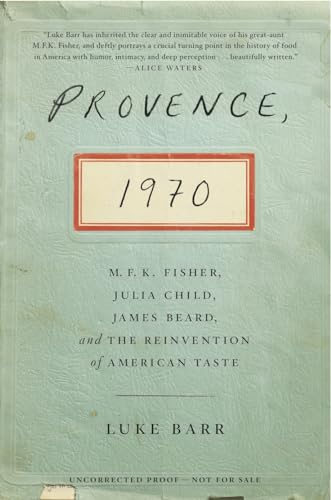
Provence, 1970 is about a singular historic moment. In the winter of that year, more or less coincidentally, the iconic culinary figures James Beard, M.F.K. Fisher, Julia Child, Richard Olney, Simone Beck, and Judith Jones found themselves together in the South of France. They cooked and ate, talked and argued, about the future of food in America, the meaning of taste, and the limits of snobbery. Without quite realizing it, they were shaping today’s tastes and culture, the way we eat now. The conversations among this group were chronicled by M.F.K. Fisher in journals and letters—some of which were later discovered by Luke Barr, her great-nephew. InProvence, 1970, he captures this seminal season, set against a stunning backdrop in cinematic scope—complete with gossip, drama, and contemporary relevance.
Die Inhaltsangabe kann sich auf eine andere Ausgabe dieses Titels beziehen.
Über die Autorin bzw. den Autor
Luke Barr is an editor at Travel + Leisure magazine. A great-nephew of M.F.K. Fisher, he was raised in the San Francisco Bay Area and in Switzerland, and graduated from Harvard. He lives in Brooklyn with his wife and their two daughters.
Auszug. © Genehmigter Nachdruck. Alle Rechte vorbehalten.
1
All Alone
December 20, 1970
m. f. k. fisher walked into the lobby at the Hotel Nord-Pinus in Arles trailed by a bellhop.
Famously beautiful in her youth—she’d been photographed by Man Ray, and peered out glamorously from her book jackets—M.F. was still a striking woman. Her long gray hair was pinned up in an elegant twist at the back of her head, her eyebrows were pencil thin, and she was dressed in a tailored Marchesa di Grésy suit and a wool overcoat. She made her way to the front desk to check in. The decor was Provençal rustic, almost cliché, with tiled floors and wrought-iron chandeliers. She’d been here years ago, and it hadn’t changed a bit. Her heels made echoing noises in the empty lobby. It was the week before Christmas 1970, and the weather was unusually cold. She had the distinct impression of being the only guest at the hotel. The place was a tomb.
The tall man at the front desk was vaguely hostile. He was sullen, but, then, that seemed to be the default posture of French service personnel in general, at least when it came to Americans during the off season. Veiled contempt. He explained that the room she had written ahead to request—one facing the Place du Forum—would be too cold at this time of year. He did not apologize for the lack of heat, he simply stated it as a fact.
She asked to see for herself, and he was right: the heat was off in that part of the hotel, which was noticeably colder. And so she chose a room at the back of the building, on the first floor. It was named for Jean Cocteau (there was a small brass nameplate on the door), and inside was the largest armoire she’d ever seen. It must have been twelve feet tall. It was grotesque, she decided, but she liked it for the audacity of its scale.
The bed was comfortable, so there was that.
She unpacked her things, three suitcases’ worth, clothes for every occasion and weather, multiple pairs of shoes, books, and assorted papers, all of which fit easily in the enormous armoire. There was a writing table and a chair, and a photograph of Cocteau on the wall. She sat for a moment in the silence of the suddenly foreign room, looking at the quaint toile de Jouy wallpaper, and then withdrew from her purse a new notebook—small, pale green, spiral-bound. On the inside cover, she inscribed the words
WHERE WAS I?
in underlined capital letters. Where was she indeed? And why? She’d spent the previous weeks in the mostly pleasant company of family and friends, having traveled from Northern California to southern France with her sister Norah Barr, and then finding herself swept up in an epic social and culinary maelstrom, which seemed to involve everyone who was anyone in the American food world. Julia Child and her husband, Paul. James Beard. Simone Beck and her husband, Jean Fischbacher. Richard Olney. Judith Jones and her husband, Evan. Together they had cooked and eaten, talked and gossiped, and driven around the countryside to restaurants and museums and to the incredibly beautiful chapel that Matisse designed in the late 1940s.
She had left all that behind at the crack of dawn this morning. Raymond Gatti, the local chauffeur she knew well from a previous trip, had picked her up in his Mercedes and delivered her to the Cannes train station, telling her repeatedly that they would be far too early for the ten o’clock train. But she didn’t care. She preferred to be early: she had a great fondness for leisurely hours in train station cafés. And most of all, she was eager to get away and be on her own. She needed to write, think, and figure out what she wanted.
In her new journal, underneath WHERE WAS I?, she wrote:
I am in southern France, and it is December, 1970 and I am 62½ years old, white, female, and apparently determined to erect new altars to old gods, no matter how unimportant all of us may be.
The “old gods” were French, of course. They were the gods of food and pleasure, of style and good living, of love, taste, and even decadence. M.F. had spent the last thirty-odd years writing a kind of personal intellectual history of these ideals in her books, memoirs, and essays. These works were her “altars,” so to speak, and she was now embarked on a new one. This notebook would serve as the site of her daily communion with France.
France had long been at the center of her philosophy. She had made France a touchstone of her writing, in which she alchemized life, love, and food in a literary genre of her own invention. But she was suddenly keenly aware of the need to make new sense of the old mythologies. The events of the previous weeks had shown her the limitations of her own sentimental attachments—to the past, to la belle France—and confronted her with the too-easy seductions of nostalgia, the treacheries of snobbery.
She was alone in Arles for a reason. It was a reason she was still in the process of formulating.
•••
The next day, M.F. wandered the cold streets, pushing against the wind, looking for a place to eat. The town was closed for the season. fermeture annuelle, read the signs on every restaurant, including, most unforgivably, the restaurant and bar in her own hotel.
The tall and less-than-friendly front desk clerk told her this without looking up. “Rat bastard,” she thought. This occurred with some frequency: she would swear to herself, fuming at an irritation while outwardly maintaining an air of dignified, steely calm. There was the man at the American Express ticket office in Cannes this morning, for example, who had issued her a ticket for a nonexistent train to Arles. She’d returned to the office, and he had impassively explained that she was surely wrong, then looked at the schedule and discovered he was wrong, and blandly handed her back the ticket and said she could take the next train, in a few hours. “Too bad,” he said, diffidently. “You rat bastard,” she thought. “You damned rat bastard.”
And now the hotel clerk and his closed-for-the-season restaurant and distinctly unsympathetic attitude. She asked where she might find something to eat. She spoke excellent French, but had an American accent; he replied in French.
“Oh, a dozen places,” he said idly. “Jean will indicate them whenever you wish.”
“I am hungry now,” she replied.
“Jean!” he said. Jean turned out to be a teenager in a thin, dirty white jacket whose long blond hair whipped in his eyes as he stepped outside and pointed the way.
“Go down to the big boulevard. Turn to the right. They’re all there, quantities of them!” He ran back into the warm hotel.
The sidewalks were icy. M.F. passed by a couple of gypsies playing intense, dramatic guitar music, and eventually made her way to a brasserie on the other side of town, after a half-hour walk. She ordered mussels, followed by pieds et paquets—long-cooked stuffed and rolled lamb tripes—and sat reading Le Provençal and drinking a gin and red vermouth. She watched the room, mostly young men in groups or older men reading the local paper and eating alone. None of them seemed to notice her presence. She felt perfectly invisible.
That night, she wrote in her journal, describing the Provençal locals:
They have a haughty toughness about them, with possible anger and suspicion not far back of their outward courtesy. When I go into a restaurant or a bar, I am given a table when I ask for it, and I am brought what I order to eat and drink, and when I ask for the bill, I am given it, but there is never even a pretense of interest in whether or not I like my table, my meal,...
„Über diesen Titel“ kann sich auf eine andere Ausgabe dieses Titels beziehen.
Suchergebnisse für Provence, 1970: M.F.K. Fisher, Julia Child, James Beard,...

Beispielbild für diese ISBN
Provence, 1970
Anbieter: World of Books (was SecondSale), Montgomery, IL, USA
Verkäuferbewertung 5 von 5 Sternen

Hardback. Zustand: Good. Provence, 1970 is about a singular historic moment. In the winter of that year, more or less coincidentally, the iconic culinary figures James Beard, M.F.K. Fisher, Julia Child, Richard Olney, Simone Beck, and Judith Jones found themselves together in the South of France. They cooked and ate, talked and argued, about the future of food in America, the meaning of taste, and the limits of snobbery. Without quite realizing it, they were shaping today s tastes and culture, the way we eat now. The conversations among this group were chronicled by M.F.K. Fisher in journals and letters some of which were later discovered by Luke Barr, her great-nephew. In Provence, 1970, he captures this seminal season, set against a stunning backdrop in cinematic scope complete with gossip, drama, and contemporary relevance. Artikel-Nr. 00103990577
Gebraucht kaufen
EUR 4,08
Versand gratis
Versand innerhalb von USA
Versand innerhalb von USA
Anzahl: 8 verfügbar
Beispielbild für diese ISBN
Provence, 1970
Anbieter: World of Books (was SecondSale), Montgomery, IL, USA
Verkäuferbewertung 5 von 5 Sternen
Hardback. Zustand: Very Good. Provence, 1970 is about a singular historic moment. In the winter of that year, more or less coincidentally, the iconic culinary figures James Beard, M.F.K. Fisher, Julia Child, Richard Olney, Simone Beck, and Judith Jones found themselves together in the South of France. They cooked and ate, talked and argued, about the future of food in America, the meaning of taste, and the limits of snobbery. Without quite realizing it, they were shaping today s tastes and culture, the way we eat now. The conversations among this group were chronicled by M.F.K. Fisher in journals and letters some of which were later discovered by Luke Barr, her great-nephew. In Provence, 1970, he captures this seminal season, set against a stunning backdrop in cinematic scope complete with gossip, drama, and contemporary relevance. Artikel-Nr. CIN0307718344VG
Gebraucht kaufen
EUR 4,08
Versand gratis
Versand innerhalb von USA
Versand innerhalb von USA
Anzahl: 1 verfügbar
Beispielbild für diese ISBN
Provence, 1970
Anbieter: World of Books (was SecondSale), Montgomery, IL, USA
Verkäuferbewertung 5 von 5 Sternen
Hardback. Zustand: Fair. Provence, 1970 is about a singular historic moment. In the winter of that year, more or less coincidentally, the iconic culinary figures James Beard, M.F.K. Fisher, Julia Child, Richard Olney, Simone Beck, and Judith Jones found themselves together in the South of France. They cooked and ate, talked and argued, about the future of food in America, the meaning of taste, and the limits of snobbery. Without quite realizing it, they were shaping today s tastes and culture, the way we eat now. The conversations among this group were chronicled by M.F.K. Fisher in journals and letters some of which were later discovered by Luke Barr, her great-nephew. In Provence, 1970, he captures this seminal season, set against a stunning backdrop in cinematic scope complete with gossip, drama, and contemporary relevance. Artikel-Nr. 00097643825
Gebraucht kaufen
EUR 4,08
Versand gratis
Versand innerhalb von USA
Versand innerhalb von USA
Anzahl: 1 verfügbar
Beispielbild für diese ISBN
Provence, 1970: M.F.K. Fisher, Julia Child, James Beard, and the Reinvention of American Taste
Verlag:
Clarkson Potter (edition First Edition), 2013
ISBN 10: 0307718344
ISBN 13: 9780307718341
Gebraucht
Hardcover
Erstausgabe
Anbieter: BooksRun, Philadelphia, PA, USA
Verkäuferbewertung 5 von 5 Sternen
Hardcover. Zustand: Fair. First Edition. With dust jacket. The item might be beaten up but readable. May contain markings or highlighting, as well as stains, bent corners, or any other major defect, but the text is not obscured in any way. Artikel-Nr. 0307718344-7-1-13_29
Gebraucht kaufen
EUR 5,14
Versand gratis
Versand innerhalb von USA
Versand innerhalb von USA
Anzahl: 1 verfügbar
Beispielbild für diese ISBN
Provence, 1970: M.F.K. Fisher, Julia Child, James Beard, and the Reinvention of American Taste
Anbieter: ThriftBooks-Reno, Reno, NV, USA
Verkäuferbewertung 5 von 5 Sternen
Hardcover. Zustand: Fair. No Jacket. Former library book; Readable copy. Pages may have considerable notes/highlighting. ~ ThriftBooks: Read More, Spend Less. Artikel-Nr. G0307718344I5N10
Gebraucht kaufen
EUR 6,00
Versand gratis
Versand innerhalb von USA
Versand innerhalb von USA
Anzahl: 1 verfügbar
Beispielbild für diese ISBN
Provence, 1970: M.F.K. Fisher, Julia Child, James Beard, and the Reinvention of American Taste
Anbieter: ThriftBooks-Dallas, Dallas, TX, USA
Verkäuferbewertung 5 von 5 Sternen
Hardcover. Zustand: Fair. No Jacket. Missing dust jacket; Readable copy. Pages may have considerable notes/highlighting. ~ ThriftBooks: Read More, Spend Less. Artikel-Nr. G0307718344I5N01
Gebraucht kaufen
EUR 6,00
Versand gratis
Versand innerhalb von USA
Versand innerhalb von USA
Anzahl: 1 verfügbar
Beispielbild für diese ISBN
Provence, 1970: M.F.K. Fisher, Julia Child, James Beard, and the Reinvention of American Taste
Anbieter: ThriftBooks-Phoenix, Phoenix, AZ, USA
Verkäuferbewertung 5 von 5 Sternen
Hardcover. Zustand: Fair. No Jacket. Missing dust jacket; Readable copy. Pages may have considerable notes/highlighting. ~ ThriftBooks: Read More, Spend Less. Artikel-Nr. G0307718344I5N01
Gebraucht kaufen
EUR 6,00
Versand gratis
Versand innerhalb von USA
Versand innerhalb von USA
Anzahl: 1 verfügbar
Beispielbild für diese ISBN
Provence, 1970: M.F.K. Fisher, Julia Child, James Beard, and the Reinvention of American Taste
Anbieter: ThriftBooks-Reno, Reno, NV, USA
Verkäuferbewertung 5 von 5 Sternen
Hardcover. Zustand: Good. No Jacket. Missing dust jacket; Pages can have notes/highlighting. Spine may show signs of wear. ~ ThriftBooks: Read More, Spend Less. Artikel-Nr. G0307718344I3N01
Gebraucht kaufen
EUR 6,00
Versand gratis
Versand innerhalb von USA
Versand innerhalb von USA
Anzahl: 1 verfügbar
Beispielbild für diese ISBN
Provence, 1970: M.F.K. Fisher, Julia Child, James Beard, and the Reinvention of American Taste
Anbieter: ThriftBooks-Atlanta, AUSTELL, GA, USA
Verkäuferbewertung 5 von 5 Sternen
Hardcover. Zustand: Good. No Jacket. Missing dust jacket; Pages can have notes/highlighting. Spine may show signs of wear. ~ ThriftBooks: Read More, Spend Less. Artikel-Nr. G0307718344I3N01
Gebraucht kaufen
EUR 6,00
Versand gratis
Versand innerhalb von USA
Versand innerhalb von USA
Anzahl: 2 verfügbar
Beispielbild für diese ISBN
Provence, 1970: M.F.K. Fisher, Julia Child, James Beard, and the Reinvention of American Taste
Anbieter: ThriftBooks-Atlanta, AUSTELL, GA, USA
Verkäuferbewertung 5 von 5 Sternen
Hardcover. Zustand: Good. No Jacket. Former library book; Pages can have notes/highlighting. Spine may show signs of wear. ~ ThriftBooks: Read More, Spend Less. Artikel-Nr. G0307718344I3N10
Gebraucht kaufen
EUR 6,00
Versand gratis
Versand innerhalb von USA
Versand innerhalb von USA
Anzahl: 2 verfügbar