
Verwandte Artikel zu Crash of the Titans: Greed, Hubris, the Fall of Merrill...
Crash of the Titans: Greed, Hubris, the Fall of Merrill Lynch, and the Near-Collapse of Bank of America - Softcover
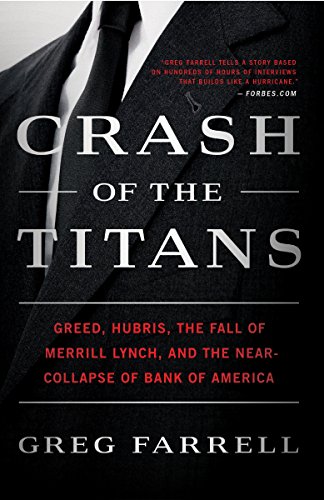
Inhaltsangabe
The intimate, fly-on-the wall tale of the decline and fall of an America icon
With one notable exception, the firms that make up what we know as Wall Street have always been part of an inbred, insular culture that most people only vaguely understand. The exception was Merrill Lynch, a firm that revolutionized the stock market by bringing Wall Street to Main Street, setting up offices in far-flung cities and towns long ignored by the giants of finance. With its “thundering herd” of financial advisers, perhaps no other business, whether in financial services or elsewhere, so epitomized the American spirit. Merrill Lynch was not only “bullish on America,” it was a big reason why so many average Americans were able to grow wealthy by investing in the stock market.
Merrill Lynch was an icon. Its sudden decline, collapse, and sale to Bank of America was a shock. How did it happen? Why did it happen? And what does this story of greed, hubris, and incompetence tell us about the culture of Wall Street that continues to this day even though it came close to destroying the American economy? A culture in which the CEO of a firm losing $28 billion pushes hard to be paid a $25 million bonus. A culture in which two Merrill Lynch executives are guaranteed bonuses of $30 million and $40 million for four months’ work, even while the firm is struggling to reduce its losses by firing thousands of employees.
Based on unparalleled sources at both Merrill Lynch and Bank of America, Greg Farrell’s Crash of the Titans is a Shakespearean saga of three flawed masters of the universe. E. Stanley O’Neal, whose inspiring rise from the segregated South to the corner office of Merrill Lynch—where he engineered a successful turnaround—was undone by his belief that a smooth-talking salesman could handle one of the most difficult jobs on Wall Street. Because he enjoyed O’Neal’s support, this executive was allowed to build up an astonishing $30 billion position in CDOs on the firm’s balance sheet, at a time when all other Wall Street firms were desperately trying to exit the business. After O’Neal comes John Thain, the cerebral, MIT-educated technocrat whose rescue of the New York Stock Exchange earned him the nickname “Super Thain.” He was hired to save Merrill Lynch in late 2007, but his belief that the markets would rebound led him to underestimate the depth of Merrill’s problems. Finally, we meet Bank of America CEO Ken Lewis, a street fighter raised barely above the poverty line in rural Georgia, whose “my way or the highway” management style suffers fools more easily than potential rivals, and who made a $50 billion commitment over a September weekend to buy a business he really didn’t understand, thus jeopardizing his own institution.
The merger itself turns out to be a bizarre combination of cultures that blend like oil and water, where slick Wall Street bankers suddenly find themselves reporting to a cast of characters straight out of the Beverly Hillbillies. BofA’s inbred culture, which perceived New York banks its enemies, was based on loyalty and a good-ol’-boy network in which competence played second fiddle to blind obedience.
Crash of the Titans is a financial thriller that puts you in the theater as the historic events of the financial crisis unfold and people responsible for billion of dollars of other people’s money gamble recklessly to enhance their power and their paychecks or to save their own skins. Its wealth of never-before-revealed information and focus on two icons of corporate America make it the book that puts together all the pieces of the Wall Street disaster.
Die Inhaltsangabe kann sich auf eine andere Ausgabe dieses Titels beziehen.
Über die Autorin bzw. den Autor
GREG FARRELL is a correspondent for the Financial Times. In January 2009, he broke the news that Merrill Lynch had paid out its 2008 bonuses a month ahead of schedule, in December, even though Merrill was in the process of losing $28 billion for the year, and Bank of America needed an extra $20 billion in taxpayer funds to complete its acquisition of the firm. That story sparked an investigation by New York attorney general Andrew Cuomo. Greg is a past winner of the American Business Press’s Jesse Neal Award for investigative reporting and a recipient of the Knight-Bagehot Fellowship for business journalism. He earned a BA from Harvard University and an MBA from the Graduate School of Business at Columbia University.
Auszug. © Genehmigter Nachdruck. Alle Rechte vorbehalten.
CHAPTER 1
THE YOUNG TURK
"My name's Tom Spinelli," said the man at the microphone. "Good morning, Mr. O'Neal, members of the board, executive committee, and fellow shareholders. I would like to apologize in advance if my voice appears to be too loud. The reason is because I have subjective tinnitus; it's a hearing disorder."
Spinelli was in the auditorium of Merrill Lynch's sprawling corporate center outside Princeton, New Jersey, on the occasion of the company's annual meeting on April 27, 2007. Merrill Lynch's chief executive, Stan O'Neal, had just reviewed the ninety-three-year-old firm's record-breaking results in 2006 for his audience. The company he had led since 2002 posted $7.3 billion in profits for the previous year, dwarfing the 2005 earnings of $5 billion, which were also a record. O'Neal could now bask in the glow of his success and soak up the praise bestowed by Spinelli and other investors.
"I would like to emphasize that I've been an employee, client, and shareholder for over thirty-five years," Spinelli continued. "I do know that during your tenure here at Merrill Lynch I have discovered a wealth of new products and services unlike anything I've ever seen in the past. As a client it has enabled me to take full advantage of so many excellent investment opportunities in the marketplace. I am now in a position to provide a much more secure financial future for members of my family and myself.
"This is a comment and a personal observation. I neither have the inclination or frame of mind to put you in an awkward position. However it should be stated that thanks to your knowledge, skills, superb leadership, and the expertise of designated members of the executive committee, Merrill is now back and in excellent competitive form."
Annual shareholder meetings, supposedly the great democratizing force of corporate America, are curious affairs, with CEOs re-elected almost by acclamation by the votes of institutional investors representing huge blocs of votes. The few individual shareholders who do attend often fall into one of two categories: activists agitating for change and well-meaning individuals entranced by the prospect of getting themselves in front of a microphone before a captive audience.
"As you know, the 2008 presidential election is starting to heat up again," Spinelli went on. "I'm convinced that the Democrats will win back the White House in the aforementioned election. Under our new presidential administration I am confident that you will be called upon [by] our president-elect to serve as his, as an elite member of his or her new cabinet.
"It would be similar to what late President Ronald Reagan did for former chairman and CEO of Merrill Lynch, Don Regan, in 1980, who quietly slipped away in 2003. If you accept to do for our country what you have done for Merrill Lynch, I would no longer just be a content American, I would be a proud American. Thank you and have a nice day."
O'Neal smiled at this bouquet of gushing praise. "Just the opposite of being too loud," the CEO said facetiously, pretending not to hear. "If you would say that again . . . I'm not sure I caught all of it." The audience broke up in laughter.
"Thank you very much for your comments," O'Neal continued. "And I have no intention of going anywhere, I'm afraid, because this is where I want to be. Thank you."
The annual meeting ended, and O'Neal exulted in his achievements. He had, single-handedly it seemed, rescued Merrill Lynch from irrelevance and established himself as one of the most successful CEOs on Wall Street and in corporate America.
Leaving the conference center, O'Neal would join his directors for a board meeting at the Nassau Inn, in Princeton, just a short drive away.
Early in 2007, problems emerged in the U.S. real estate market--the great engine of growth across the country over the previous decade. Home prices had stopped appreciating in high growth markets such as California, Nevada, Arizona, and Florida, and as a result, mortgage companies reported an alarming increase in foreclosures. The mortgage companies with the weakest credit standards, such as New Century, failed, while Countrywide, the largest mortgage originator in the country, had fallen on hard times.
While the problems of the real estate market in other parts of the country seemed distant from Wall Street, investment banks such as Merrill Lynch had derived more and more of their revenues from underwriting mortgage-backed securities--bonds which had been created by packaging large groups of mortgages together. For that reason, O'Neal thought it prudent to present his board with an overview of the market for mortgage-related products. Osman Semerci, a rising star at Merrill Lynch, would make this presentation and walk the board of directors through Merrill Lynch's fixed-income exposures.
Just nine months earlier, O'Neal had encouraged the selection of Semerci, a thirty-eight-year-old native of Turkey, to be head of Merrill Lynch's fixed-income, commodities, and currencies business, an area known on Wall Street as "FICC." The term "fixed income" had grown more important on Wall Street over the previous decade because of the proliferation of products that, like bonds, provided a steady stream of payments to the owner. When he was stationed in Tokyo and then in London, Semerci had established himself as a master in the art of selling fixed-income products to other banks and investors.
Nestled comfortably in a dining room at the Nassau Inn, the directors listened closely as Semerci outlined the successes he had engineered in less than one full year on the job: record revenues in FICC for 2006, followed by record revenues in the first quarter of 2007. In addition to the board, several other Merrill Lynch executives sat in on the presentation, including Ahmass Fakahany, the vice chairman and chief administrative officer; Jeff Edwards, the chief financial officer; Rosemary Berkery, the general counsel; and Laurence Tosi, chief operating officer of the global markets and investment banking division of Merrill Lynch.
From a competitive standpoint, Semerci explained, Merrill Lynch was trouncing its competition in year-over-year improvement in his department, with a 36 percent increase in FICC revenues for the first quarter of 2007 over the previous year's first quarter. By contrast, Morgan Stanley showed a 31 percent improvement, while mighty Goldman Sachs--the perennial leader in almost every Wall Street category--had improved by only 20 percent.
It was now clear why O'Neal had touted Semerci to the board as potential CEO material. Poised and elegant, Semerci demonstrated to the board how he had figured out the formula for maximizing the company's revenues in an overheated real estate market without exposing Merrill Lynch to any of the downside of the real estate crash. Of the company's $9.2 billion in FICC revenues for 2006, Semerci explained, only 6 percent--or some $550 million--came from U.S. mortgages. Another 15 percent, or $1.4 billion, came from securitization and foreign mortgages. Merrill's total exposure to the subprime market amounted to less than 2 percent of its revenues.
Semerci then handed the presentation over to Michael Blum, a subordinate who managed global structured finance and investments. If there was any danger on Merrill's balance sheet from mortgage-related bets, it would be in Blum's department, which securitized large pools of mortgages and then sold them to other banks and investors. In the previous two years, Merrill Lynch had generated $700 million in revenues from packaging mortgages into CDOs, large concentrations of similar-type mortgages that could either turn into bars of gold for the acquirer or radioactive bricks that disintegrated in value.
When the real estate market was strong, CDOs were enormously popular,...
„Über diesen Titel“ kann sich auf eine andere Ausgabe dieses Titels beziehen.
Suchergebnisse für Crash of the Titans: Greed, Hubris, the Fall of Merrill...

Foto des Verkäufers
Crash of the Titans: Greed, Hubris, the Fall of Merrill Lynch, and the Near-Collapse of Bank of America
Anbieter: Dream Books Co., Denver, CO, USA
Verkäuferbewertung 5 von 5 Sternen

Zustand: acceptable. This copy has clearly been enjoyedâ"expect noticeable shelf wear and some minor creases to the cover. Binding is strong, and all pages are legible. May contain previous library markings or stamps. Artikel-Nr. DBV.0307717879.A
Gebraucht kaufen
EUR 3,84
Versand gratis
Versand innerhalb von USA
Versand innerhalb von USA
Anzahl: 1 verfügbar
Beispielbild für diese ISBN
Crash of the Titans: Greed, Hubris, the Fall of Merrill Lynch, and the Near-Collapse of Bank of America
Anbieter: World of Books (was SecondSale), Montgomery, IL, USA
Verkäuferbewertung 5 von 5 Sternen
Zustand: Good. Item in good condition. Textbooks may not include supplemental items i.e. CDs, access codes etc. Artikel-Nr. 00100192139
Gebraucht kaufen
EUR 3,90
Versand gratis
Versand innerhalb von USA
Versand innerhalb von USA
Anzahl: 6 verfügbar
Beispielbild für diese ISBN
Crash of the Titans: Greed, Hubris, the Fall of Merrill Lynch, and the Near-Collapse of Bank of America
Anbieter: World of Books (was SecondSale), Montgomery, IL, USA
Verkäuferbewertung 5 von 5 Sternen
Zustand: Acceptable. Item in acceptable condition! Textbooks may not include supplemental items i.e. CDs, access codes etc. Artikel-Nr. 00068541810
Gebraucht kaufen
EUR 3,90
Versand gratis
Versand innerhalb von USA
Versand innerhalb von USA
Anzahl: 1 verfügbar
Beispielbild für diese ISBN
Crash of the Titans: Greed, Hubris, the Fall of Merrill Lynch, and the Near-Collapse of Bank of America
Verlag:
Crown Publishing Group (NY), 2011
ISBN 10: 0307717879
ISBN 13: 9780307717870
Gebraucht
Paperback
Anbieter: ThriftBooks-Dallas, Dallas, TX, USA
Verkäuferbewertung 5 von 5 Sternen
Paperback. Zustand: Fair. No Jacket. Readable copy. Pages may have considerable notes/highlighting. ~ ThriftBooks: Read More, Spend Less. Artikel-Nr. G0307717879I5N00
Gebraucht kaufen
EUR 5,83
Versand gratis
Versand innerhalb von USA
Versand innerhalb von USA
Anzahl: 1 verfügbar
Beispielbild für diese ISBN
Crash of the Titans: Greed, Hubris, the Fall of Merrill Lynch, and the Near-Collapse of Bank of America
Verlag:
Crown Publishing Group (NY), 2011
ISBN 10: 0307717879
ISBN 13: 9780307717870
Gebraucht
Paperback
Anbieter: ThriftBooks-Dallas, Dallas, TX, USA
Verkäuferbewertung 5 von 5 Sternen
Paperback. Zustand: Very Good. No Jacket. May have limited writing in cover pages. Pages are unmarked. ~ ThriftBooks: Read More, Spend Less. Artikel-Nr. G0307717879I4N00
Gebraucht kaufen
EUR 5,83
Versand gratis
Versand innerhalb von USA
Versand innerhalb von USA
Anzahl: 1 verfügbar
Beispielbild für diese ISBN
Crash of the Titans: Greed, Hubris, the Fall of Merrill Lynch, and the Near-Collapse of Bank of America
Verlag:
Crown Publishing Group (NY), 2011
ISBN 10: 0307717879
ISBN 13: 9780307717870
Gebraucht
Paperback
Anbieter: ThriftBooks-Atlanta, AUSTELL, GA, USA
Verkäuferbewertung 5 von 5 Sternen
Paperback. Zustand: Very Good. No Jacket. May have limited writing in cover pages. Pages are unmarked. ~ ThriftBooks: Read More, Spend Less. Artikel-Nr. G0307717879I4N00
Gebraucht kaufen
EUR 5,83
Versand gratis
Versand innerhalb von USA
Versand innerhalb von USA
Anzahl: 1 verfügbar
Beispielbild für diese ISBN
Crash of the Titans: Greed, Hubris, the Fall of Merrill Lynch, and the Near-Collapse of Bank of America
Verlag:
Crown Publishing Group (NY), 2011
ISBN 10: 0307717879
ISBN 13: 9780307717870
Gebraucht
Paperback
Anbieter: ThriftBooks-Atlanta, AUSTELL, GA, USA
Verkäuferbewertung 5 von 5 Sternen
Paperback. Zustand: Good. No Jacket. Pages can have notes/highlighting. Spine may show signs of wear. ~ ThriftBooks: Read More, Spend Less. Artikel-Nr. G0307717879I3N00
Gebraucht kaufen
EUR 5,83
Versand gratis
Versand innerhalb von USA
Versand innerhalb von USA
Anzahl: 1 verfügbar
Beispielbild für diese ISBN
Crash of the Titans: Greed, Hubris, the Fall of Merrill Lynch, and the Near-Collapse of Bank of America
Verlag:
Crown Publishing Group (NY), 2011
ISBN 10: 0307717879
ISBN 13: 9780307717870
Gebraucht
Paperback
Anbieter: ThriftBooks-Phoenix, Phoenix, AZ, USA
Verkäuferbewertung 5 von 5 Sternen
Paperback. Zustand: Good. No Jacket. Pages can have notes/highlighting. Spine may show signs of wear. ~ ThriftBooks: Read More, Spend Less. Artikel-Nr. G0307717879I3N00
Gebraucht kaufen
EUR 5,83
Versand gratis
Versand innerhalb von USA
Versand innerhalb von USA
Anzahl: 1 verfügbar
Beispielbild für diese ISBN
Crash of the Titans: Greed, Hubris, the Fall of Merrill Lynch, and the Near-Collapse of Bank of America
Verlag:
Crown Publishing Group (NY), 2011
ISBN 10: 0307717879
ISBN 13: 9780307717870
Gebraucht
Paperback
Anbieter: ThriftBooks-Dallas, Dallas, TX, USA
Verkäuferbewertung 5 von 5 Sternen
Paperback. Zustand: Good. No Jacket. Pages can have notes/highlighting. Spine may show signs of wear. ~ ThriftBooks: Read More, Spend Less. Artikel-Nr. G0307717879I3N00
Gebraucht kaufen
EUR 5,83
Versand gratis
Versand innerhalb von USA
Versand innerhalb von USA
Anzahl: 1 verfügbar
Beispielbild für diese ISBN
Crash of the Titans: Greed, Hubris, the Fall of Merrill Lynch, and the Near-Collapse of Bank of America
Verlag:
Crown Publishing Group (NY), 2011
ISBN 10: 0307717879
ISBN 13: 9780307717870
Gebraucht
Paperback
Anbieter: ThriftBooks-Reno, Reno, NV, USA
Verkäuferbewertung 5 von 5 Sternen
Paperback. Zustand: Good. No Jacket. Pages can have notes/highlighting. Spine may show signs of wear. ~ ThriftBooks: Read More, Spend Less. Artikel-Nr. G0307717879I3N00
Gebraucht kaufen
EUR 5,83
Versand gratis
Versand innerhalb von USA
Versand innerhalb von USA
Anzahl: 1 verfügbar