
Verwandte Artikel zu The New Leviathan: How the Left-Wing Money-Machine...
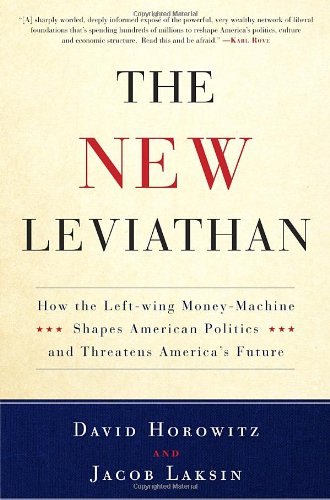
The New Leviathan: How the Left-Wing Money-Machine Shapes American Politics and Threatens America's Future - Hardcover
Inhaltsangabe
The authors of One-Party Classroom examine the growing influence of left-wing organizations and politicians, drawing connections between the Obama administration and progressive groups to explore what the authors believe to be socialist agendas behind hot-button issues, from immigration and health care to labor and the environment. 30,000 first printing.
Die Inhaltsangabe kann sich auf eine andere Ausgabe dieses Titels beziehen.
Über die Autorin bzw. den Autor
David Horowitz is the New York Times bestselling author of, among other books,One-Party Classroom, The Professors, Radical Son, The Shadow Party, and Party of Defeat. He is president of the David Horowitz Freedom Center in Los Angeles.
Jacob Laksin is the managing editor of Front-Page Magazine and coatuhor ofOne-Party Classroom. His articles and reviews have also appeared in the Wall Street Journal, the Philadelphia Inquirer, the Weekly Standard, National Review Online,RealClearWorld, and the Washington Examiner.
Auszug. © Genehmigter Nachdruck. Alle Rechte vorbehalten.
1.
The New Leviathan
This book is about a political force of unprecedented magnitude in American life. The “New Leviathan” is a network of billion-dollar tax-exempt foundations and advocacy think tanks that work in concert with government unions and grassroots radical groups to make up the organizational core of the political left. The New Leviathan is not only a political force in the narrow sense of directly influencing electoral outcomes through the support of candidates and parties. Because its power derives from institutions whose mandates are educational and philanthropic, its influence extends into every aspect of the nation’s life. This influence is exerted through a tax-exempt universe of policy think tanks, grassroots campaign organizations, and public-interest groups, created and supported by its donations. The components of the New Leviathan operate within the framework of a “progressive” ideology that promotes an ever-expanding state, along with policies that undermine America’s sovereignty and weaken her defenses. The New Leviathan’s ever-growing power has already tipped the scales of the national political debate and, as we will show in this volume, transformed its very nature.
Conventional wisdom would dismiss the very possibility of such dominance in the political arena by a money machine of the Left. In the conventional view, it is Republicans and the political right with their corporate sponsors and big-money donors who make up the “party of the rich,” while progressives speak for the powerless and the poor. In this perspective, conservatives are agents of an economic “ruling class,” organized to defend its social privileges. In the exercise of financial power in politics, conservatives are assumed to enjoy an overweening advantage, utilizing unrivaled resources to orchestrate “vast right-wing conspiracies,” which are designed to thwart progressive efforts in behalf of equality and “social justice.”
While casting conservatives as mouthpieces for the rich, the same perspective portrays Democrats as the party of “working Americans and their families,” providing a voice for the voiceless and a shield for the disadvantaged. Accepting the Democratic Party’s presidential nomination in 2000, Al Gore summed up this outlook in a slogan: “They’re for the powerful; we’re for the people!” 1
The political melodrama in which Democrats and progressives posture as paladins of enlightenment has a long and unpretty history. It was forged during the moderately populist and immoderately corrupt presidency of Andrew Jackson, spokesman for the “common man,” who entered the White House as a self-proposed champion of the people battling the “moneyed elite.” Both the image and the aura were transparent manipulations to seduce a willing public. Despite humble beginnings, Jackson was a man of means who basked in the privileges of an aristocratic life. The same comfortable circumstances did not discourage him from plundering the property of his political rivals, or justifying his avarice as a “sharing” of the wealth, or from exploiting the morality play he had created to expand his personal power. Nor did Jackson’s “everyman” enthusiasms keep him from owning and selling slaves throughout his life or from presiding over the forced removal of American Indian tribes from their native lands on the “Trail of Tears.”
Politics being a market in which fictions are currency, the Jacksonian myth established the enduring template of the two-party system. As a Republican newspaper in Tennessee complained, “The rank and file of the democratic party honestly believes . . . the democratic party is the poor man’s party, that the republican party is the party of boodle and corruption and that they obtain and maintain their supremacy in all the states by the undue use of money.”2
Franklin Roosevelt entered the White House a hundred years after Jackson, and despite being a born aristocrat, a “son of privilege who never depended on a pay check,” he was also able to frame his presidential tenure as “the Era of the Common Man.”3 In the 1970s, Jimmy Carter took up the folksy mantle, touting himself as a simple peanut farmer from Georgia and promising to be the “people’s president.” Yet Carter was the son of a wealthy plantation owner, inherited his own business, and spurned a lucrative job in the private sector in order to sow the seeds of a political career with a tale of humble beginnings.4 Carter’s claim to be a progressive was particularly dubious since he won his 1970 gubernatorial campaign by courting the support of southern segregationists and projecting what one biographer has called a “not-so-subtle racism” away from public view.5
In the election of 2000, Al Gore, another scion of an elite segregationist family, took up the populist theme with the campaign slogan, “The People vs. the Powerful.” As part of a White House that set records fund-raising from “special interests,” Gore’s claim was hardly credible, although a politically sympathetic media helped to make it seem so. After losing the presidency, Gore launched a new career posing himself as the people’s champion against global polluters, even winning an Academy Award and a Nobel Prize from fellow progressives for these efforts while trampling on the environment and making himself a wealthy man in the process. Today, Gore travels the world on private carbon-gorging jets and spends an estimated $30,000 a year to heat just one of his luxury mansions, which include a recently purchased $9 million villa in Montecito, California, with six bedrooms, nine bathrooms, a large pool house, and six fireplaces.6 His stake in a “green” energy company that profits from lucrative environmentally correct government contracts has positioned him to become the world’s first “carbon billionaire.”7
Populist hypocrisy was on display again and in a particularly sordid fashion during the next national election when Democratic vice-presidential candidate John Edwards cast America as a benighted home of the oppressed. According to Edwards, there were “two Americas”--on the one hand, the rich Republican America with its boot heel on the necks of the hapless and helpless; on the other, the Democrat America of the poor and voiceless (if not for noble crusaders like Edwards). Back on earth this selfless servant of the workingman had accumulated a personal net worth of $188 million, while his running mate, John Kerry, had married into two fortunes three times the size of Edwards’s own, making him the richest lawmaker in the country.8 Kerry’s opulence was not untypical of the balance between the parties: among the twelve richest lawmakers, Democrats outnumber Republicans three to one.9
The ability to see itself as a perennial underdog in a class war it regards as integral to capitalism is an abiding strength of the political left. But the image is unsupported by the facts. Far from being the party of the people, Democrats and their progressive core represent America’s social and cultural elites and constitute the richest, the most organized, and most economically powerful political force in American history. As Christopher Caldwell observed in a New York Times essay, “the Democratic Party is the party to which elites belong. It is the party of Harvard (and most of the Ivy League), of Microsoft and Apple (and most of Silicon Valley), of Hollywood and Manhattan (and most of the media) and, although there is some evidence that numbers are evening out in this election cycle, of Goldman Sachs (and most of...
„Über diesen Titel“ kann sich auf eine andere Ausgabe dieses Titels beziehen.
Suchergebnisse für The New Leviathan: How the Left-Wing Money-Machine...

Beispielbild für diese ISBN
The New Leviathan: How the Left-wing Money-machine Shapes American Politics and Threatens America's Future
Anbieter: World of Books (was SecondSale), Montgomery, IL, USA
Verkäuferbewertung 5 von 5 Sternen

Hardback. Zustand: Good. Artikel-Nr. 00093824779
Gebraucht kaufen
EUR 4,13
Versand gratis
Versand innerhalb von USA
Versand innerhalb von USA
Anzahl: 3 verfügbar
Beispielbild für diese ISBN
The New Leviathan: How the Left-Wing Money-Machine Shapes American Politics and Threatens America's Future
Verlag:
Crown Forum (edition 0), 2012
ISBN 10: 0307716457
ISBN 13: 9780307716453
Gebraucht
Hardcover
Anbieter: BooksRun, Philadelphia, PA, USA
Verkäuferbewertung 5 von 5 Sternen
Hardcover. Zustand: Very Good. 0. With dust jacket. It's a well-cared-for item that has seen limited use. The item may show minor signs of wear. All the text is legible, with all pages included. It may have slight markings and/or highlighting. Artikel-Nr. 0307716457-8-1-29
Gebraucht kaufen
EUR 6,01
Versand gratis
Versand innerhalb von USA
Versand innerhalb von USA
Anzahl: 1 verfügbar
Beispielbild für diese ISBN
The New Leviathan: How the Left-Wing Money-Machine Shapes American Politics and Threatens America's Future
Anbieter: Wonder Book, Frederick, MD, USA
Verkäuferbewertung 5 von 5 Sternen
Zustand: Good. Good condition. Good dust jacket. A copy that has been read but remains intact. May contain markings such as bookplates, stamps, limited notes and highlighting, or a few light stains. Artikel-Nr. X01H-01095
Gebraucht kaufen
EUR 6,43
Versand gratis
Versand innerhalb von USA
Versand innerhalb von USA
Anzahl: 1 verfügbar
Beispielbild für diese ISBN
The New Leviathan: How the Left-Wing Money-Machine Shapes American Politics and Threatens America's Future
Anbieter: Wonder Book, Frederick, MD, USA
Verkäuferbewertung 5 von 5 Sternen
Zustand: Very Good. Very Good condition. Very Good dust jacket. A copy that may have a few cosmetic defects. May also contain light spine creasing or a few markings such as an owner's name, short gifter's inscription or light stamp. Artikel-Nr. N21C-03235
Gebraucht kaufen
EUR 6,43
Versand gratis
Versand innerhalb von USA
Versand innerhalb von USA
Anzahl: 4 verfügbar
Beispielbild für diese ISBN
The New Leviathan : How the Left-Wing Money-Machine Shapes American Politics and Threatens America's Future
Verlag:
Crown Publishing Group, The, 2012
ISBN 10: 0307716457
ISBN 13: 9780307716453
Gebraucht
Hardcover
Anbieter: Better World Books, Mishawaka, IN, USA
Verkäuferbewertung 5 von 5 Sternen
Zustand: Fine. 0th Edition. Used book that is in almost brand-new condition. May contain a remainder mark. Better World Books: Buy Books. Do Good. Artikel-Nr. 10401466-6
Gebraucht kaufen
EUR 6,75
Versand gratis
Versand innerhalb von USA
Versand innerhalb von USA
Anzahl: 1 verfügbar
Beispielbild für diese ISBN
The New Leviathan : How the Left-Wing Money-Machine Shapes American Politics and Threatens America's Future
Verlag:
Crown Publishing Group, The, 2012
ISBN 10: 0307716457
ISBN 13: 9780307716453
Gebraucht
Hardcover
Anbieter: Better World Books, Mishawaka, IN, USA
Verkäuferbewertung 5 von 5 Sternen
Zustand: Good. 0th Edition. Pages intact with minimal writing/highlighting. The binding may be loose and creased. Dust jackets/supplements are not included. Stock photo provided. Product includes identifying sticker. Better World Books: Buy Books. Do Good. Artikel-Nr. 2258840-6
Gebraucht kaufen
EUR 6,75
Versand gratis
Versand innerhalb von USA
Versand innerhalb von USA
Anzahl: 1 verfügbar
Foto des Verkäufers
The New Leviathan: How the Left-wing Money-machine Shapes American Politics and Threatens America's Future
Verlag:
Crown Publishing Group, Division of Random House Inc, 2012
ISBN 10: 0307716457
ISBN 13: 9780307716453
Gebraucht
Hardcover
Anbieter: WeBuyBooks, Rossendale, LANCS, Vereinigtes Königreich
Verkäuferbewertung 5 von 5 Sternen
hardcover. Zustand: Very Good. Most items will be dispatched the same or the next working day. A copy that has been read, but is in excellent condition. Pages are intact and not marred by notes or highlighting. The spine remains undamaged. Artikel-Nr. rev4408411452
Gebraucht kaufen
EUR 11,19
EUR 8,13 Versand
Versand von Vereinigtes Königreich nach USA
Versand von Vereinigtes Königreich nach USA
Anzahl: 1 verfügbar
Beispielbild für diese ISBN
The New Leviathan: How the Left-Wing Money-Machine Shapes American Politics and Threatens America's Future
Anbieter: Revaluation Books, Exeter, Vereinigtes Königreich
Verkäuferbewertung 5 von 5 Sternen
Hardcover. Zustand: Brand New. 320 pages. 9.50x6.50x1.25 inches. In Stock. Artikel-Nr. 0307716457
Neu kaufen
EUR 20,86
EUR 14,77 Versand
Versand von Vereinigtes Königreich nach USA
Versand von Vereinigtes Königreich nach USA
Anzahl: 1 verfügbar