
Verwandte Artikel zu That's That: A Memoir
Inhaltsangabe
How can we know who we are if we do not understand where we came from?
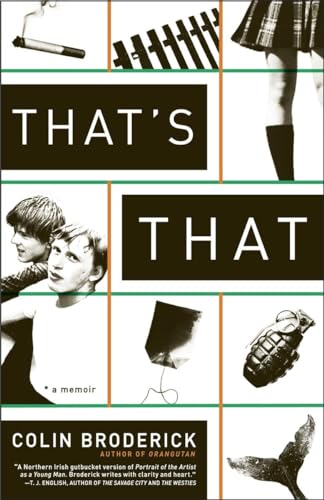
Colin Broderick grew up in Northern Ireland during the period of heightened tension and violence known as the Troubles. Broderick's Catholic family lived in County Tyrone --the heart of rebel country. In That’s That, he brings us into this world and delivers a deeply personal account of what it was like to come of age in the midst of a war that dragged on for over two decades. We watch as he and his brothers play ball with the neighbor children over a fence for years, but are never allowed to play together because it is forbidden. We see him struggle to understand why young men from his community often just disappear. And we feel his frustration when he is held at gunpoint at various military checkpoints in the North. At the center of his world—and this story—is Colin’s mother. Desperate to protect her children from harm, she has little patience for Colin’s growing need to experience and understand all that is happening around them. Spoken with stern finality, "That's that" became the refrain of Colin's childhood.
The first book to paint a detailed depiction of Northern Ireland's Troubles, That’s That is told in the wry, memorable voice of a man who's finally come to terms with his past.
Die Inhaltsangabe kann sich auf eine andere Ausgabe dieses Titels beziehen.
Über die Autorin bzw. den Autor
COLIN BRODERICK was born in Birmingham, England, but raised Irish Catholic in the heart of Northern Ireland. He has a four-year-old daughter and lives in Manhattan.
Auszug. © Genehmigter Nachdruck. Alle Rechte vorbehalten.
Mother. Ireland.
Seen from the window of a plane Ireland is a patchwork quilt, little square fields of green stitched together by thin rows of thorns; spring green, fern green, forest green, pine, sea and shamrock green. From above, she is clean, mystical, magical to behold. That is her first great act of deceit, her lush, rolling beauty the first betrayal of her truth, for on the ground, and deeper still, buried beneath that verdant lawn is her pain; underneath, there is blood.
I assume you’ve heard bits and pieces of the history of Ireland already, some of the landmark atrocities that have made international news over the years, or perhaps you’ve heard snippets grumbled over small glasses of amber in the dim light of a smoky tavern in the Bronx, stories of the long and bitter hatred between the English and the Irish, of heroic young men in balaclavas, petrol bombs being hurled into the dark night, monuments of flame on the claustrophobic streets of Belfast, the ghosts of skeletal boys, naked and excrement-smeared, starving themselves to death in the cold cells of the H-Block. And if you did receive your Irish history lesson in a bar from some furtive creature with a brogue, then as the night wore on, you surely heard about his mother also, for every drink poured in an Irish bar leads back to the mother. As you may well know, there is no mother like the Irish mother, and there is no love more wounded and fierce than the love between an Irish mother and her son.
In honor of that age-old tradition I, too, will start with the history. (The mother I will get to in just a little bit.)
In about 6000 BC the first humans arrived in Ireland. They stayed close to the shores, hunting and fishing for their food. Two thousand years later they had evolved into farmers; they grew crops and kept sheep, pigs, and cattle.
Around 500 BC the Celts arrived in Ireland and took to running the show. They were a wild bunch, prone to battles and orgies of food, drink, dancing, and much lovemaking. Their spiritual guides were Druids, and polygamy was embraced if you could afford it; many could. The Celts divided Ireland up into many kingdoms and worshiped many gods, and the craic was high and mighty, for a while.
Things went along like that without much of a hiccup until an English lad called Patrick came along. He had been kidnapped and held as a slave for a few years by the Celts and he returned in the year 430 AD for retribution. He began telling the Celts that their lifestyle was evil and that the real God, the one true God up in heaven, would punish them for their debauched ways and sentence them to a place called hell. There they would burn in a molten lava–type substance for eternity once they died. Patrick had the gift of the gab, as they say. Many listened. Christianity had arrived.
Six hundred years later, in 1155, once the Irish had been corralled into a more malleable state with a good dose of Christian shame, humiliation, and fear, Pope Adrian came along, the first and only Englishman ever to hold the papacy. He gave the entire island of Ireland to the king of England, King Henry II. Henry, in turn, bequeathed unto his son John the new moniker Lord of Ireland, and John was welcome to hang on to his new title just as long as he kept paying Adrian and the Vatican an annual fee for the honor of retaining sole slavery rights of the Irish people. It was a sweet deal, and John was just about as happy as a clam at high tide to throw the boys over at the Vatican their yearly bone.
In 1536, Henry VIII had himself anointed the king of Ireland by the Irish Parliament, which was comprised at the time of a bunch of his English buddies. Henry VIII decreed that all the Irish chieftains must Anglicize their names and that all of the English landowners, who had arrived in Ireland claiming all the best land up and down the country for themselves, must now clear their estates of native Irish workers. Of course, this was impossible because the landowners needed to keep the Irish on as slaves to work the land, but the threat of banishment for even the slightest misstep was a wonderful little tool to keep the Irish workers on their toes, and productivity soared.
As you can imagine, by this point the Irish natives were getting a little restless. In 1641 there was a rebellion in the northern part of the country known as Ulster, and twelve thousand Irish were slaughtered for their effort. But they had stirred a nest of bees. Others throughout the country had been awakened to the possibility of defeating the English and ending the horror of living as slaves. England got wind of the whispers and they sent Oliver Cromwell and his army across the Channel to put an end to any buzzing.
In 1649, when Cromwell first arrived in the town of Drogheda, he decided to make a name for himself right away. He slaughtered 2,600 people—the entire population of the town: “I am persuaded that this is the righteous judgment of God upon those barbarous wretches,” he said famously, before rolling on down to Wexford and repeating this act.
Over the next ten years, the population of the Irish natives was halved by sword, starvation, and disease. More than 600,000 were killed or died. Another 100,000 were shipped off into slavery in the West Indies. The handful of Irish Catholics still standing were denied voting rights and access to education, and all of their foodstuffs were confiscated and shipped off to England. Then to put the icing on the cake, all land belonging to Irish Catholics was confiscated and given to English Protestants, and that was that.
Thirty years later, there was so much wealth to be gained from the plunder of Ireland’s dairy, meat, and grain products that the English started scuffling among themselves for ownership rights. King James II, who had been deposed from the English throne after producing a Catholic heir, made an attempt to win Ireland back for himself from the hands of the new English king, his successor, William of Orange. James had the support of many Irish who believed he would put an end to discriminatory English penal laws (basically a set of English laws that forbade civil rights and housing to anyone accused of being a practicing Catholic) and restore Irish sovereignty once and for all. In July 1690, the two armies met outside Drogheda for the Battle of the Boyne and later in Limerick to give it a lash. William of Orange was victorious. Even today the Protestants of Northern Ireland, “Orangemen,” celebrate the victory by erecting enormous bonfires and burning the Irish national flag, just to rub Catholic noses in it every year on July 12.
Things were quiet for a period after that thrashing, but in secret the Irish were regaining their strength and getting ready to take another crack at the throne. In the rebellion of 1798 another 30,000 Catholic Irish were slaughtered in an uprising. The great Irish republican hero Mr. Wolfe Tone attempted a landing with a fleet of French ships and 14,000 French troops ready to join the fray against the English, but they encountered such gale-force storms off the coast of Bantry Bay, County Cork, that they eventually had to turn back. The uprising was quelled. The English eventually caught Mr. Wolfe Tone on another one of his missions up at Buncrana on Lough Swilly, County Donegal. He was imprisoned and upon being denied his request that he be given the death of a soldier by being shot (they sentenced him to be hanged), he cut his own throat in his cell and bled to death rather than suffer the humiliation.
A few years later, inspired by Tone, Robert Emmet also led a small group in an uprising in Dublin but he was caught, hanged, then drawn and quartered.
Daniel O’Connell was the next to take the baton in hand and run with it. After a few chaotic years, he managed to...
„Über diesen Titel“ kann sich auf eine andere Ausgabe dieses Titels beziehen.
Suchergebnisse für That's That: A Memoir

Beispielbild für diese ISBN
That's That: A Memoir
Anbieter: World of Books (was SecondSale), Montgomery, IL, USA
Verkäuferbewertung 5 von 5 Sternen

Zustand: Very Good. Item in very good condition! Textbooks may not include supplemental items i.e. CDs, access codes etc. Artikel-Nr. 00100037905
Gebraucht kaufen
EUR 4,18
Versand gratis
Versand innerhalb von USA
Versand innerhalb von USA
Anzahl: 1 verfügbar
Beispielbild für diese ISBN
That's That: A Memoir
Anbieter: World of Books (was SecondSale), Montgomery, IL, USA
Verkäuferbewertung 5 von 5 Sternen
Zustand: Good. Item in good condition. Textbooks may not include supplemental items i.e. CDs, access codes etc. Artikel-Nr. 00097674066
Gebraucht kaufen
EUR 4,18
Versand gratis
Versand innerhalb von USA
Versand innerhalb von USA
Anzahl: 2 verfügbar
Beispielbild für diese ISBN
That's That: A Memoir
Anbieter: BooksRun, Philadelphia, PA, USA
Verkäuferbewertung 5 von 5 Sternen
Paperback. Zustand: Very Good. It's a well-cared-for item that has seen limited use. The item may show minor signs of wear. All the text is legible, with all pages included. It may have slight markings and/or highlighting. Artikel-Nr. 0307716333-11-1
Gebraucht kaufen
EUR 4,53
Versand gratis
Versand innerhalb von USA
Versand innerhalb von USA
Anzahl: 1 verfügbar
Beispielbild für diese ISBN
That's That : A Memoir
Verlag:
Crown Publishing Group, The, 2013
ISBN 10: 0307716333
ISBN 13: 9780307716330
Gebraucht
Softcover
Anbieter: Better World Books, Mishawaka, IN, USA
Verkäuferbewertung 5 von 5 Sternen
Zustand: Good. Pages intact with minimal writing/highlighting. The binding may be loose and creased. Dust jackets/supplements are not included. Stock photo provided. Product includes identifying sticker. Better World Books: Buy Books. Do Good. Artikel-Nr. 390296-6
Gebraucht kaufen
EUR 5,96
Versand gratis
Versand innerhalb von USA
Versand innerhalb von USA
Anzahl: 1 verfügbar
Beispielbild für diese ISBN
That's That
Anbieter: ThriftBooks-Atlanta, AUSTELL, GA, USA
Verkäuferbewertung 5 von 5 Sternen
Paperback. Zustand: Good. No Jacket. Former library book; Pages can have notes/highlighting. Spine may show signs of wear. ~ ThriftBooks: Read More, Spend Less. Artikel-Nr. G0307716333I3N10
Gebraucht kaufen
EUR 6,45
Versand gratis
Versand innerhalb von USA
Versand innerhalb von USA
Anzahl: 1 verfügbar
Beispielbild für diese ISBN
That's That
Anbieter: ThriftBooks-Dallas, Dallas, TX, USA
Verkäuferbewertung 5 von 5 Sternen
Paperback. Zustand: Very Good. No Jacket. Former library book; May have limited writing in cover pages. Pages are unmarked. ~ ThriftBooks: Read More, Spend Less. Artikel-Nr. G0307716333I4N10
Gebraucht kaufen
EUR 6,45
Versand gratis
Versand innerhalb von USA
Versand innerhalb von USA
Anzahl: 1 verfügbar
Beispielbild für diese ISBN
That's That: A Memoir
Anbieter: Powell's Bookstores Chicago, ABAA, Chicago, IL, USA
Verkäuferbewertung 5 von 5 Sternen
Paperback. Zustand: Used-Very Good. Pbk. Some shelf-wear. Else clean copy. Artikel-Nr. 1830518
Gebraucht kaufen
EUR 9,31
EUR 6,45 Versand
Versand innerhalb von USA
Versand innerhalb von USA
Anzahl: 1 verfügbar
Beispielbild für diese ISBN
That's That: A Memoir
Anbieter: WorldofBooks, Goring-By-Sea, WS, Vereinigtes Königreich
Verkäuferbewertung 5 von 5 Sternen
Paperback. Zustand: Very Good. The book has been read, but is in excellent condition. Pages are intact and not marred by notes or highlighting. The spine remains undamaged. Artikel-Nr. GOR006484786
Gebraucht kaufen
EUR 10,27
EUR 6,52 Versand
Versand von Vereinigtes Königreich nach USA
Versand von Vereinigtes Königreich nach USA
Anzahl: 1 verfügbar
Beispielbild für diese ISBN
That's That: A Memoir
Anbieter: Phatpocket Limited, Waltham Abbey, HERTS, Vereinigtes Königreich
Verkäuferbewertung 5 von 5 Sternen
Zustand: Good. Your purchase helps support Sri Lankan Children's Charity 'The Rainbow Centre'. Ex-library, so some stamps and wear, but in good overall condition. Our donations to The Rainbow Centre have helped provide an education and a safe haven to hundreds of children who live in appalling conditions. Artikel-Nr. Z1-J-020-02571
Gebraucht kaufen
EUR 8,83
EUR 12,39 Versand
Versand von Vereinigtes Königreich nach USA
Versand von Vereinigtes Königreich nach USA
Anzahl: 1 verfügbar
Beispielbild für diese ISBN
That's That: A Memoir
Anbieter: Ria Christie Collections, Uxbridge, Vereinigtes Königreich
Verkäuferbewertung 5 von 5 Sternen
Zustand: New. In. Artikel-Nr. ria9780307716330_new
Neu kaufen
EUR 20,19
EUR 13,15 Versand
Versand von Vereinigtes Königreich nach USA
Versand von Vereinigtes Königreich nach USA
Anzahl: Mehr als 20 verfügbar