
Verwandte Artikel zu Foundation, Foundation and Empire, Second Foundation:...
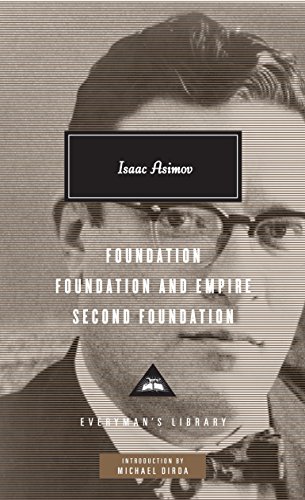
Foundation, Foundation and Empire, Second Foundation: Introduction by Michael Dirda (Everyman's Library Contemporary Classics Series, Band 332) - Hardcover
Inhaltsangabe
Isaac Asimov’s seminal Foundation trilogy—one of the cornerstones of modern speculative fiction—in a single hardcover volume. • Winner of the Hugo Award for Best All-Time Series. • THE EPIC SAGA THAT INSPIRED THE APPLE TV+ SERIES FOUNDATION.
It is the saga of the Galactic Empire, crumbling after twelve thousand years of rule. And it is the particular story of psychohistorian Hari Seldon, the only man who can see the horrors the future has in store—a dark age of ignorance, barbarism, and violence that will last for thirty thousand years. Gathering a band of courageous men and women, Seldon leads them to a hidden location at the edge of the galaxy, where he hopes they can preserve human knowledge and wisdom through the age of darkness.
In 1966, the Foundation trilogy received a Hugo Award for Best All-Time Series, and it remains the only fiction series to have been so honored. More than fifty years after their original publication, the three Foundation novels stand as classics of thrilling, provocative, and inspired world-building."
Everyman's Library pursues the highest production standards, printing on acid-free cream-colored paper, with full-cloth cases with two-color foil stamping, decorative endpapers, silk ribbon markers, European-style half-round spines, and a full-color illustrated jacket. Contemporary Classics include an introduction, a select bibliography, and a chronology of the author's life and times.
Die Inhaltsangabe kann sich auf eine andere Ausgabe dieses Titels beziehen.
Über die Autorin bzw. den Autor
Isaac Asimov (1920–1992), one of the “Big Three” science fiction masters of his time (along with Robert Heinlein and Arthur C. Clarke), is best known for his Robot, Galactic Empire, and Foundation series.
Michael Dirda is a Pulitzer Prize–winning critic for The Washington Post and the author of the memoir An Open Book and of four collections of essays: Readings, Bound to Please, Book by Book, and Classics for Pleasure.
Auszug. © Genehmigter Nachdruck. Alle Rechte vorbehalten.
From the Introduction by Michael Dirda
It is late summer, 1941. A young Jewish intellectual, an admirer of Gibbon's Decline and Fall of the Roman Empire, suddenly finds himself musing about historical determinism, individual initiative and the ideal society. Why did Rome fall? Was the Christian religion a means of preserving ancient culture? What forms of government and economic system are best for mankind? Democratic representation with capitalistic competition? Enlightened despotism? A meritocracy of the best and the brightest?
Having come of age in 1930s' New York, the young intellectual would have heard fervent Trotskyites on street corners proclaim that history advances through class struggle and through the conflict between evolving political and economic ideologies. He already knew that Arnold Toynbee, in A Study of History, contended that civilizations have their seasons — they rise, grow stagnant without sufficient challenges, eventually decay and fall. Still other thinkers, among them H.G. Wells, were convinced that the world should be governed by scientists, with rational benevolence. Wasn't that the theme of the recent movie, Things to Come (1936), with its vision of a perfectly ordered, chrome-bright "world of tomorrow"?
Still, all these systems and theories made historical change seem a cut-and-dried affair, quite logical, utterly inevitable. Yet where was the individual in these grand schemes of Marx and Toynbee and Wells? If only impersonal forces determined the course of events, how did one account for a Hitler? An upstart from nowhere, he had manipulated the German people with a mesmerist's power, promulgated a manifest destiny for his chosen elite, declared a Thousand-Year Reich. Clearly, the so-called Führer viewed himself as a Great Man, able to reshape his time as did Alexander and Napoleon before him. Such overreachers truly make history, don't they?
So Isaac Asimov, a twenty-one-year-old Columbia graduate, must have thought and wondered when he sat down at his typewriter that summer of 1941. However, what the young writer eventually produced was neither a turgid sociological tract nor a summa of world history. Instead, through a series of stories, Asimov tracked the breakdown of a smug conspicuously rich and stultified civilization, while also portraying the efforts of a highly committed group of activists to hasten the birth of a new and more glorious future society. In effect, he took the central myth of the 1930s and '40s — lived out and believed in by Communists, Fascists, the International Brigade and New Deal Democrats alike — and re-imagined it, with spaceships, in a galaxy far, far away. Science fiction is, after all, the art of extrapolation.
By the time Asimov brought his much loved series to a halt in 1949, he had written eight stories and novellas depicting the collapse of a Galactic Empire, the war-torn feudal period that followed, and the mysterious Foundation established to preserve civilization in a time of barbarism. Gathered together into book form — what SF fans call a "fix-up" — the stories required three volumes: Foundation (1951), Foundation and Empire (1952) and Second Foundation (1953). At the 1955 World Science Fiction Convention this trilogy was enthusiastically voted "the greatest all-time science-fiction series." Period. In the view of many, the assembled sequence also represents a watershed in literary history. A noted SF editor Donald Wollheim quickly realized: "Stores published before Foundation belong to the old line, the stories published after belong to 'modern' science fiction."
*
Isaac Asimov (1920-92) grew up in Brooklyn, the son of Russian Jewish immigrants. Something of a whiz kid, he graduated early from high school and attended Columbia University, first as an undergraduate and later as a biochemistry graduate student. After earning his Ph. D., he taught for many years at Boston University before giving up the academic life in 1958 to become a full-time writer.
As a teenager, Asimov had been a devoted reader of the pulp magazines at his father's candy store: Wonder Stories, Amazing Stories, Astounding Science Fiction. In their pages one could follow the galactic adventures of E. E. "Doc" Smith's "Skylark of Space," shudder at "The Human Pets of Mars" and fight alongside "Tumithak of the Corridors." Before long, the teenaged Asimov begun to crank out his own short stories; the first to be published "Marooned on Vest," appearing in Amazing in 1939. After many rejections, he shortly thereafter broke into Astounding — the premier magazine in the field — with "Trends" (originally titled, with a kind of clairvoyance, "Ad Astra" — i.e., "to the stars"). That "yarn" appeared in the same July 1939 issue as A. E. van Vogt's first story ("Black Destroyer," almost certainly a partial inspiration for the film Alien) and only a month before Robert A. Heinlein's first story, "Lifeline." thus began the Golden Age of Science Fiction, which would last until roughly 1950.
Asimov developed quickly as a writer. He sold "Robbie," his first robot story, to Super Science Stories in 1940 (where its title was changed to "Strange Playfellow"), and his later ones to Astounding. Asimov always claimed it was John. W. Campbell, Jr., that magazine's legendary editor, who devised the central "Three Laws of Robotics" during a conversation at the end of 1940:
1. A robot may not injure a human being or, through inaction, allow a human being to come to harm.
2. A robot must obey the orders given it by human beings except where such orders would conflict with the First Law.
3. A robot must protect its own existence as long as such protection does not conflict with the First or Second Law.
By 1941, Asimov was ready for what would prove his annus mirabilis. On March 17, when this still very young writer was visiting the Astounding offices, Campbell unexpectedly quoted a passage from Emerson: "If the stars should appear one night in a thousand years, how would men believe and adore; and preserve for many generations the remembrance of the city of God . . ." What, the magazine editor wondered, would happen to people who suddenly saw stars for the first time? Asimov said he didn't know. Campbell answered: "I think they would go mad. I want you to write a story about that."
According to the first volume of his autobiography, In Memory Yet Green, Asimov began the story on March 18, 1941 and finished it on April 8. "Nightfall," as he called it, was then published as the cover story for the September issue of Astounding — along with the conclusion of Robert Heinlein's short novel Methuselah's Children and in the company of Alfred Bester's now classic "Adam and No Eve." Since that day, "Nightfall" has been judged, over and over again, to be the greatest science-fiction story ever written. Happily neither Heinlein nor Bester would ever complain about this, since the former quickly established himself as the best science-fiction writer of all time and the latter's 1956 novel, The Stars My Destination, is widely and rightly, viewed as the best single SF novel ever written.
Having formulated the Laws of Robotics and then written "Nightfall," one might assume that young Asimov would devote the rest of his time to his studies. Hardly. That fall Astounding also brought out the first two Foundation stories. Years later, Asimov recalled the genesis of the series:
On August 1, 1941, I took the subway to Campbell's office after class was over. On the way down I racked my brain for a story idea. Failing, I tried a device I sometimes used. I opened a book at random and then tried free association, beginning...
„Über diesen Titel“ kann sich auf eine andere Ausgabe dieses Titels beziehen.
Suchergebnisse für Foundation, Foundation and Empire, Second Foundation:...

Beispielbild für diese ISBN
Foundation, Foundation and Emp
Anbieter: World of Books (was SecondSale), Montgomery, IL, USA
Verkäuferbewertung 5 von 5 Sternen

Zustand: Good. Item in good condition. Textbooks may not include supplemental items i.e. CDs, access codes etc. Artikel-Nr. 00110320924
Gebraucht kaufen
EUR 11,75
Versand gratis
Versand innerhalb von USA
Versand innerhalb von USA
Anzahl: 1 verfügbar
Foto des Verkäufers
Foundation, Foundation and Empire, Second Foundation: Introduction by Michael Dirda
Anbieter: ThriftBooksVintage, Tukwila, WA, USA
Verkäuferbewertung 5 von 5 Sternen
Hardcover. Zustand: Good. No Jacket. Shelf and handling wear to cover and binding, with general signs of previous use. Boards may have fading and nicks and other signs of wear and imperfection commensurate with age. Binding is tight and structurally sound. Pages unmarked. Sealed in plastic for shipping. Secure packaging for safe delivery. Artikel-Nr. 1596274959
Gebraucht kaufen
EUR 29,61
Versand gratis
Versand innerhalb von USA
Versand innerhalb von USA
Anzahl: 1 verfügbar
Beispielbild für diese ISBN
Foundation, Foundation and Empire, Second Foundation: Introduction by Michael Dirda
Anbieter: Kennys Bookstore, Olney, MD, USA
Verkäuferbewertung 5 von 5 Sternen
Zustand: New. 2010. Hardcover. . . . . . Books ship from the US and Ireland. Artikel-Nr. V9780307593962
Neu kaufen
EUR 39,94
EUR 9,15 Versand
Versand innerhalb von USA
Versand innerhalb von USA
Anzahl: 15 verfügbar
Beispielbild für diese ISBN
Foundation/ Foundation and Empire/ Second Foundation
Anbieter: Revaluation Books, Exeter, Vereinigtes Königreich
Verkäuferbewertung 5 von 5 Sternen
Hardcover. Zustand: Brand New. everyman's library edition. 664 pages. 8.50x5.50x1.50 inches. In Stock. Artikel-Nr. xi0307593967
Neu kaufen
EUR 36,95
EUR 14,58 Versand
Versand von Vereinigtes Königreich nach USA
Versand von Vereinigtes Königreich nach USA
Anzahl: 2 verfügbar
Beispielbild für diese ISBN
Foundation/ Foundation and Empire/ Second Foundation
Anbieter: Revaluation Books, Exeter, Vereinigtes Königreich
Verkäuferbewertung 5 von 5 Sternen
Hardcover. Zustand: Brand New. everyman's library edition. 664 pages. 8.50x5.50x1.50 inches. In Stock. Artikel-Nr. xr0307593967
Neu kaufen
EUR 36,95
EUR 14,58 Versand
Versand von Vereinigtes Königreich nach USA
Versand von Vereinigtes Königreich nach USA
Anzahl: 2 verfügbar
Foto des Verkäufers
Foundation, Foundation and Empire, Second Foundation: Introduction by Michael Dirda
Verlag:
Knopf Doubleday Publishing Group, 2010
ISBN 10: 0307593967
ISBN 13: 9780307593962
Neu
Hardcover
Anbieter: moluna, Greven, Deutschland
Verkäuferbewertung 5 von 5 Sternen
Gebunden. Zustand: New. ISAAC ASIMOV (1920&ndash1992), one of the &ldquoBig Three&rdquo science fiction masters of his time (along with Robert Heinlein and Arthur C. Clarke), is best known for his Robot, Galactic Empire, and Foundation series.MICHAE. Artikel-Nr. 594509051
Neu kaufen
EUR 30,74
EUR 48,99 Versand
Versand von Deutschland nach USA
Versand von Deutschland nach USA
Anzahl: 3 verfügbar
Foto des Verkäufers
Foundation, Foundation and Empire, Second Foundation : Introduction by Michael Dirda
Verlag:
Knopf Doubleday Publishing Group Nov 2010, 2010
ISBN 10: 0307593967
ISBN 13: 9780307593962
Neu
Hardcover
Anbieter: AHA-BUCH GmbH, Einbeck, Deutschland
Verkäuferbewertung 5 von 5 Sternen
Buch. Zustand: Neu. Neuware - Isaac Asimov's seminal Foundation trilogyone of the cornerstones of modern speculative fictionin a single hardcover volume Winner of the Hugo Award for Best All-Time Series THE EPIC SAGA THAT INSPIRED THE APPLE TV+ SERIES FOUNDATION.It is the saga of the Galactic Empire, crumbling after twelve thousand years of rule. And it is the particular story of psychohistorian Hari Seldon, the only man who can see the horrors the future has in storea dark age of ignorance, barbarism, and violence that will last for thirty thousand years. Gathering a band of courageous men and women, Seldon leads them to a hidden location at the edge of the galaxy, where he hopes they can preserve human knowledge and wisdom through the age of darkness.In 1966, the Foundation trilogy received a Hugo Award for Best All-Time Series, and it remains the only fiction series to have been so honored. More than fifty years after their original publication, the three Foundation novels stand as classics of thrilling, provocative, and inspired world-building.'Everyman's Library pursues the highest production standards, printing on acid-free cream-colored paper, with full-cloth cases with two-color foil stamping, decorative endpapers, silk ribbon markers, European-style half-round spines, and a full-color illustrated jacket. Contemporary Classics include an introduction, a select bibliography, and a chronology of the author's life and times. Artikel-Nr. 9780307593962
Neu kaufen
EUR 57,63
EUR 30,50 Versand
Versand von Deutschland nach USA
Versand von Deutschland nach USA
Anzahl: 1 verfügbar