
Verwandte Artikel zu The Table Comes First: Family, France, and the Meaning...
Inhaltsangabe
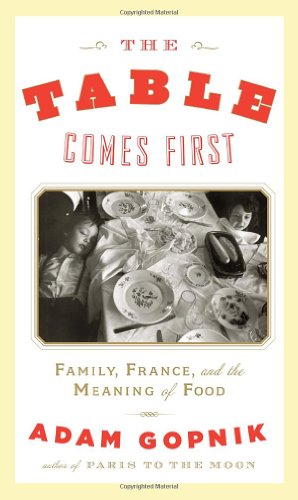
Never before have we cared so much about food. It preoccupies our popular culture, our fantasies, and even our moralizing—“You still eat meat?” With our top chefs as deities and finest restaurants as places of pilgrimage, we have made food the stuff of secular seeking and transcendence, finding heaven in a mouthful. But have we come any closer to discovering the true meaning of food in our lives?
With inimitable charm and learning, Adam Gopnik takes us on a beguiling journey in search of that meaning as he charts America’s recent and rapid evolution from commendably aware eaters to manic, compulsive gastronomes. It is a journey that begins in eighteenth-century France—the birthplace of our modern tastes (and, by no coincidence, of the restaurant)—and carries us to the kitchens of the White House, the molecular meccas of Barcelona, and beyond. To understand why so many of us apparently live to eat, Gopnik delves into the most burning questions of our time, including: Should a Manhattanite bother to find chicken killed in the Bronx? Is a great vintage really any better than a good bottle of wine? And: Why does dessert matter so much?
Throughout, he reminds us of a time-honored truth often lost amid our newfound gastronomic pieties and certitudes: What goes on the table has never mattered as much to our lives as what goes on around the table—the scene of families, friends, lovers coming together, or breaking apart; conversation across the simplest or grandest board. This, ultimately, is who we are.
Following in the footsteps of Jean Anthelme Brillat-Savarin, Adam Gopnik gently satirizes the entire human comedy of the comestible as he surveys the wide world of taste that we have lately made our home. The Table Comes First is the delightful beginning of a new conversation about the way we eat now.
Die Inhaltsangabe kann sich auf eine andere Ausgabe dieses Titels beziehen.
Über die Autorin bzw. den Autor
Author of the beloved best seller Paris to the Moon, Adam Gopnik has been writing for The New Yorker since 1986. He is a three-time winner of the National Magazine Award for Essays and for Reviews and Criticism and of the George Polk Award for Magazine Reporting. He lives in New York City with his wife and their two children.
Auszug. © Genehmigter Nachdruck. Alle Rechte vorbehalten.
Chapter 1
Who Made the Restaurant?
A restaurant is a place where you go to eat. You usually arrive in the early afternoon or the middle of the evening, and you are taken to a table of your own in a room, usually on the ground floor of a city building in a space leased by a cook and made to look like a dining room. There are plush chairs and benches, and often mirrors. Someone, a professional go-between, often dressed in a parody of evening wear, whatever the hour, brings you a card that lists the things the cook is ready to cook, and how much it will cost to get him to cook them for you. You study this card-usually a list with decorations, sometimes bound in a leather pseudobook-and say what you'll have, and then the go-between goes into another room, the kitchen, which you can't see or hear or probably even smell. After a wait, the go-between brings the food you asked for. Very often, you will start with soup before having some grilled or roasted meat, followed by a sweet, almost always something made with sugar, a pudding or cake, rather than something naturally sweet, such as a plain piece of fruit. You are expected to have tea or coffee afterward, and then a bill is brought to your table. Prices are never mentioned out loud, and you pay whatever the card said you would. The place isn't a whorehouse or anything like it, but often you take someone there because you would like to have sex with them afterward, and sometimes you do, although, if you do, you go and do it somewhere else.
All the details, from soup to sex, of this setup, which by now seems as normal as eating itself, as obvious as breathing, can be found in more or less the same form from Sydney to San Francisco. And all of them-waiters, menus, tables, mirrors, closed kitchen, seduction, and silences, even the little table in the corner, tout compris-were thought up in Paris during a twenty-five or ten-year period right before the French Revolution and in the twenty or so years after. When you consider that eating is one of the few things that humans did even before they were people, it seems strange that restaurants should be so recent, but they are-as though the idea of having sex in beds had been discovered in Berlin during the winter of 1857, and then word got around.
There were places where you could go and pay for a meal before there were restaurants, of course: the tavern, the cookshop, the inn, the table d'hôte, the traiteur, or cook-caterer. The tavern as it evolved throughout Europe in the later part of the eighteenth century had many of the essential emotional traits of the modern restaurant. But the restaurant, with its special rituals and its particular look, began at one time and in one place.
The restaurant was known at once to be a modern and amazing thing. The great gastronome Jean Anthelme Brillat-Savarin marveled in 1825 that now "any man with three or four pistoles in his purse, can immediately, infallibly, and simply for the asking procure all the pleasures of which taste is susceptible." Yet how resilient, many- sided, adaptable, this new thing turned out to be, defying the rule that a picnic is made for one lawn and no other! If the restaurant is not the most original of modern instances and institutions, it is surely the most tenacious. It is the primal scene of modern life. Most modern urban people mark their lives by their moments in cafés and restaurants, just as ancient people marked their time on earth by visits to the local oracle, or medieval people by pilgrimages: we are courted, spurned, recruited, hired, fired, lured to a new job, or released from an old one at a table while a waiter hovers nearby. There are few marriages that did not begin at dinner at a table leased for the evening, and few divorces that did not first show signs of approaching doom in a sigh of resentment or an eye roll of exasperation in a similar setting. ("Can't you just make up your mind and stick with it?/Why do you always overtip?"...The "forever" sentiments of anniversary dinners out not rarely sugar over the approaching "no-mores" of domestic life.)
I love restaurants. I love them even though, after many years as a reporter spent being fully disillusioned about their behind-the-scenes- having labored once or twice in their kitchens and befriended their owners-I am aware of how brutal the work is, how long the hours are, and how, aside from the ventures of a handful of those entrepreneurs essentially indifferent to the food they serve, how tiny is the hope of profit. "Sale métier," the cooks and waiters alike mutter in Ludwig Bemelmans' memoirs of restaurant life in prewar Europe-"Filthy occupation"-and the muttering goes on still. Yet when I think of happy moments, I think of eating out.
Though they sometimes witness the ends of our love lives, restaurants surely have a ring of hope about them, a note of innocent celebration that makes them the right background for seduction. The man who asks the girl to dinner is not, after all, actually suggesting sex except by the airiest remote inference; he is pretending to be a better man than that: let's meet, talk, try. It offers the hope of happiness that gives greedy sex the look of lighthearted love, and, in the erotic sphere as much as the eating sphere, turns raw hunger into formal appetite. The restaurant offers not seduction but what precedes seduction, the false promise of pure motives.
I am, doubtless, prejudiced by particular experience. On my tenth birthday, I took the Moloznik boys from across the street to see a double feature of the first two James Bond films-this at a blissful time when the second run of movies in theaters was still a regular event, so that one had the pleasure of reseeing a good thing in the velvet padding of the cinema-not on the sofa, as we do now-with its thrilling moments in the dark: the trickle of sweet, forbidden Coke through a straw, and the chewy, burnt, semipainful edges of caramels. My parents, bless their kind hearts, were blackmailed into taking all three boys out to dinner at a Howard Johnson's on, as I recall, City Line Avenue in Philadelphia.
Howard Johnson's is gone now, reduced to a handful of sad motels, having receded from its excellence. But in its day it had something grand about it. There was the electric sign outside, in green and orange, showing, in rapidly animated yet obviously distinct action (you could see the unlit armature of the next moment of movement waiting just beyond the neon figure that was lit-an endlessly repeating flip book of colored light). Simple Simon and the Pieman enacting a brief drama of supplication and supply; one took eternally, the other fed over and over again, on the sign above City Line Avenue.
I sensed then that the sign, though meant as a come-on, was one of those strange, dense referents that used to be part of the pool of myths of ordinary people. Simon, as I recall, had the bent-kneed neediness of a Maxfield Parrish illustration, which, combined with the zigzagged lettering, made the sign, in retrospect, a kind of Saturday Evening Post cover come to life, or at least to electricity. (It was similar in spirit to, though far more pop in form than, the mural of Old King Cole in New York's St. Regis Hotel, a stylized comment on a nursery rhyme assumed to be known to everyone.) The sign's whimsical high voltage-the elaborate fable electrically enacted simply to signal "Eat!"-was conducted into the HoJo's interior as well, where the color scheme of blue and orange seeped even onto the margins of the many- paged menu. Its dishes were familiar along the highway to New York: the rubbery fried clams, the 3-D burger, the mint-chip ice cream, minted with green food coloring. The burger that I had that evening had the delectable aroma, now vanished from the world, of the griddles of my childhood, something buttery and of the soda fountain. The possibility of...
„Über diesen Titel“ kann sich auf eine andere Ausgabe dieses Titels beziehen.
Suchergebnisse für The Table Comes First: Family, France, and the Meaning...

Beispielbild für diese ISBN
The Table Comes First Family F
Anbieter: World of Books (was SecondSale), Montgomery, IL, USA
Verkäuferbewertung 5 von 5 Sternen

Zustand: Acceptable. Item in acceptable condition! Textbooks may not include supplemental items i.e. CDs, access codes etc. Artikel-Nr. 00103466523
Gebraucht kaufen
EUR 3,69
Versand gratis
Versand innerhalb von USA
Versand innerhalb von USA
Anzahl: 1 verfügbar
Beispielbild für diese ISBN
The Table Comes First Family F
Anbieter: World of Books (was SecondSale), Montgomery, IL, USA
Verkäuferbewertung 5 von 5 Sternen
Zustand: Good. Item in good condition. Textbooks may not include supplemental items i.e. CDs, access codes etc. Artikel-Nr. 00099823344
Gebraucht kaufen
EUR 3,69
Versand gratis
Versand innerhalb von USA
Versand innerhalb von USA
Anzahl: 4 verfügbar
Beispielbild für diese ISBN
The Table Comes First: Family, France, and the Meaning of Food
Verlag:
Knopf (edition First Edition), 2011
ISBN 10: 0307593452
ISBN 13: 9780307593450
Gebraucht
Hardcover
Erstausgabe
Anbieter: BooksRun, Philadelphia, PA, USA
Verkäuferbewertung 5 von 5 Sternen
Hardcover. Zustand: Very Good. First Edition. With dust jacket. It's a well-cared-for item that has seen limited use. The item may show minor signs of wear. All the text is legible, with all pages included. It may have slight markings and/or highlighting. Artikel-Nr. 0307593452-11-1-29
Gebraucht kaufen
EUR 5,19
Versand gratis
Versand innerhalb von USA
Versand innerhalb von USA
Anzahl: 2 verfügbar
Beispielbild für diese ISBN
The Table Comes First: Family, France, and the Meaning of Food
Verlag:
Knopf (edition First Edition), 2011
ISBN 10: 0307593452
ISBN 13: 9780307593450
Gebraucht
Hardcover
Erstausgabe
Anbieter: BooksRun, Philadelphia, PA, USA
Verkäuferbewertung 5 von 5 Sternen
Hardcover. Zustand: Very Good. First Edition. With dust jacket. It's a well-cared-for item that has seen limited use. The item may show minor signs of wear. All the text is legible, with all pages included. It may have slight markings and/or highlighting. Artikel-Nr. 0307593452-11-18-29
Gebraucht kaufen
EUR 5,90
Versand gratis
Versand innerhalb von USA
Versand innerhalb von USA
Anzahl: 1 verfügbar
Beispielbild für diese ISBN
The Table Comes First: Family, France, and the Meaning of Food
Anbieter: ThriftBooks-Dallas, Dallas, TX, USA
Verkäuferbewertung 5 von 5 Sternen
Hardcover. Zustand: Very Good. No Jacket. Former library book; May have limited writing in cover pages. Pages are unmarked. ~ ThriftBooks: Read More, Spend Less. Artikel-Nr. G0307593452I4N10
Gebraucht kaufen
EUR 6,00
Versand gratis
Versand innerhalb von USA
Versand innerhalb von USA
Anzahl: 1 verfügbar
Beispielbild für diese ISBN
The Table Comes First: Family, France, and the Meaning of Food
Anbieter: ThriftBooks-Phoenix, Phoenix, AZ, USA
Verkäuferbewertung 5 von 5 Sternen
Hardcover. Zustand: Very Good. No Jacket. Former library book; May have limited writing in cover pages. Pages are unmarked. ~ ThriftBooks: Read More, Spend Less. Artikel-Nr. G0307593452I4N10
Gebraucht kaufen
EUR 6,00
Versand gratis
Versand innerhalb von USA
Versand innerhalb von USA
Anzahl: 1 verfügbar
Beispielbild für diese ISBN
The Table Comes First: Family, France, and the Meaning of Food
Anbieter: ThriftBooks-Dallas, Dallas, TX, USA
Verkäuferbewertung 5 von 5 Sternen
Hardcover. Zustand: Very Good. No Jacket. Missing dust jacket; May have limited writing in cover pages. Pages are unmarked. ~ ThriftBooks: Read More, Spend Less. Artikel-Nr. G0307593452I4N01
Gebraucht kaufen
EUR 6,00
Versand gratis
Versand innerhalb von USA
Versand innerhalb von USA
Anzahl: 1 verfügbar
Beispielbild für diese ISBN
The Table Comes First: Family, France, and the Meaning of Food
Anbieter: ThriftBooks-Dallas, Dallas, TX, USA
Verkäuferbewertung 5 von 5 Sternen
Hardcover. Zustand: Very Good. No Jacket. May have limited writing in cover pages. Pages are unmarked. ~ ThriftBooks: Read More, Spend Less. Artikel-Nr. G0307593452I4N00
Gebraucht kaufen
EUR 6,00
Versand gratis
Versand innerhalb von USA
Versand innerhalb von USA
Anzahl: 1 verfügbar
Beispielbild für diese ISBN
The Table Comes First : Family, France, and the Meaning of Food
Verlag:
Knopf Doubleday Publishing Group, 2011
ISBN 10: 0307593452
ISBN 13: 9780307593450
Gebraucht
Hardcover
Erstausgabe
Anbieter: Better World Books: West, Reno, NV, USA
Verkäuferbewertung 5 von 5 Sternen
Zustand: Very Good. First Edition. Former library copy. Pages intact with possible writing/highlighting. Binding strong with minor wear. Dust jackets/supplements may not be included. Includes library markings. Stock photo provided. Product includes identifying sticker. Better World Books: Buy Books. Do Good. Artikel-Nr. GRP86858822
Gebraucht kaufen
EUR 6,14
Versand gratis
Versand innerhalb von USA
Versand innerhalb von USA
Anzahl: 1 verfügbar
Beispielbild für diese ISBN
The Table Comes First : Family, France, and the Meaning of Food
Verlag:
Knopf Doubleday Publishing Group, 2011
ISBN 10: 0307593452
ISBN 13: 9780307593450
Gebraucht
Hardcover
Erstausgabe
Anbieter: Better World Books: West, Reno, NV, USA
Verkäuferbewertung 5 von 5 Sternen
Zustand: Good. First Edition. Pages intact with minimal writing/highlighting. The binding may be loose and creased. Dust jackets/supplements are not included. Stock photo provided. Product includes identifying sticker. Better World Books: Buy Books. Do Good. Artikel-Nr. 4515781-75
Gebraucht kaufen
EUR 6,14
Versand gratis
Versand innerhalb von USA
Versand innerhalb von USA
Anzahl: 2 verfügbar