
Verwandte Artikel zu Collaborate or Perish!: Reaching Across Boundaries...
Inhaltsangabe
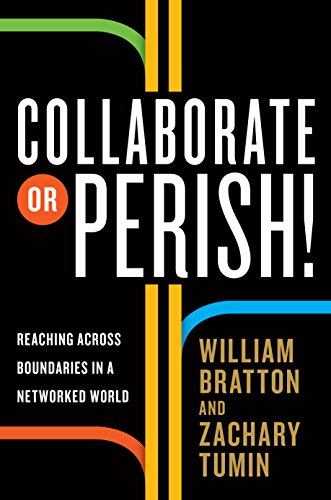
In Collaborate or Perish! former Los Angeles police chief and New York police commissioner William Bratton and Harvard Kennedy School’s Zachary Tumin lay out a field-tested playbook for collaborating across the boundaries of our networked world. Today, when everyone is connected, collaboration is the game changer. Agencies and firms, citizens and groups who can collaborate, Bratton and Tumin argue, will thrive in the networked world; those who can’t are doomed to perish.
No one today is better known around the world for his ability to get citizens, governments, and industries working together to improve the safety of cities than William Bratton. At Harvard, Zachary Tumin has led senior executives from government and industry in executive sessions and classrooms for over a decade, burnishing a global reputation for insight and leadership. Together, Bratton and Tumin draw on in-depth accounts from Fortune 100 giants such as Alcoa, Wells Fargo, and Toyota; from masters of collaboration in education, social work, and the military; and from Bratton’s own storied career. Among the specific strategies they reveal:
• Start collaboration with a broad vision that supporters can add to and make their own
• Rightsize problems, and get value in the hands of users fast
• Get the right people involved—from sponsors to grass roots
• Make collaboration pay in the right currency—whether recognition, rewards, or revenue
Today companies and managers face unique challenges—and opportunities—in reaching out to others, thanks to the incredibly connected world in which we live. Bratton and Tumin provide practical strategies anyone can use, from the cubicle to the boardroom. This is the ultimate guide to getting things done in today’s networked world.
Die Inhaltsangabe kann sich auf eine andere Ausgabe dieses Titels beziehen.
Über die Autorin bzw. den Autor
WILLIAM J. BRATTON is chairman of Kroll, one of Altegrity, Inc.’s three core businesses. Mr. Bratton joined Altegrity in November 2009 after serving as chief of the Los Angeles Police Department for seven years. Prior, he served as chief of the New York City Transit Police and commissioner of the Boston Police Department and the New York City Police Department. A frequent lecturer, writer, and commentator, Bill Bratton is known as one of the world’s premier police chiefs. Mr. Bratton also serves on the Motorola Solutions board of directors. In 2009 Her Majesty Queen Elizabeth II recognized Bratton with the honorary title of Commander of the Most Excellent Order of the British Empire (CBE).
ZACHARY TUMIN is special assistant to the director and faculty chair of Harvard Kennedy School’s Science, Technology, and Public Policy Program, the most recent of a number of key posts that Mr. Tumin has held at the school. In addition to leading research programs and executive teaching at Harvard, Mr. Tumin served in senior executive roles for industry and government, including as head of public safety for the New York City public schools, on the executive staffs of the Brooklyn District Attorney and the New York State Organized Crime Task Force, and as director of the Financial Services Technology Consortium. A frequent lecturer, Mr. Tumin is also author of numerous teaching cases, working papers, reports, and essays.
www.brattonandtumin.com
Auszug. © Genehmigter Nachdruck. Alle Rechte vorbehalten.
1
The Case for Collaboration
THE HUNT FOR TEN RED BALLOONS
On October 29, 2009, the Defense Advanced Research Projects Agency (DARPA) announced its "Network Challenge." At 10:00 a.m. on December 5, 2009, at ten locations throughout the United States, DARPA would let fly an eight-foot-diameter red weather balloon tethered to the ground. Each balloon would be readily visible from local roads and buildings--points the average person could reach. A $40,000 prize would go to the first team to accurately report the location of all ten weather balloons.
The contest was meant to replicate the challenge of trying to gather information about an adversary in an open environment. DARPA wanted to test whether ordinary folks using commonly available off-the-shelf technology and social media like Twitter or Facebook could work together--collaborate--to solve a problem that would be, in the words of one expert from the National Geospatial-Intelligence Agency, "impossible to solve by traditional intelligence gathering methods."
A team from MIT's Media Lab won. No surprise there. MIT had a slew of faculty and top graduate students, the most sophisticated equipment, and great publicity. CNN profiled them and drew attention to their cause. A Georgia Tech team placed second, for similar reasons.
Both teams competed fiercely. They put out misinformation, reporting false sightings, sent others on wild-goose chases, and bought time for themselves. Both teams wrote complex computer programs to defend themselves against such attacks.
Given their advantages, you would expect MIT and Georgia Tech to come out ahead--and they did, with a winning time under nine hours.
But what is interesting is the guy who finished in a tie for third with eight balloons, and actually led the pack for the first four hours of the competition--nineteen-year-old hacker George Hotz. Hotz heard about the contest only a couple of days before, and only an hour before it started he put up a website called Dudeitsaballoon.com.
How did he do it? His idea was based on a kind of mass collaboration.
Hotz had nearly fifty thousand followers on Twitter. They, in turn, had hundreds of thousands of followers. His plan was to mobilize them all--get thousands in the game and all those eyeballs searching for the prized red balloons. It almost worked.
Hotz was already famous in the hacker community for "jailbreaking" the Sony PlayStation and the Apple iPhone. He'd cracked their proprietary codes, and for the iPhone wrote software that let iPhone owners use it on any wireless network, not just AT&T's--much to AT&T's and Apple's chagrin and the hacker community's glee.
These legendary hacks made Hotz a star. He gained tens of thousands of Twitter followers, all of whom wanted to be the first to know what George Hotz might do next. On Twitter, they would soon find out.
On the day before the DARPA contest, Hotz--who went by his Twitter name, @geohot--tweeted his followers to stand by for a major announcement the next day. That started a buzz going in the Twitterverse and on hacker bulletin boards.
On Saturday morning @geohot tweeted his fifty thousand followers:
10AM EST today marks the start of a US wide scavenger hunt, for 10 red balloons http://bit.ly/7chum5 #dudeitsaballoon
He quickly followed up with another tweet:
So I need your help to do two things, 1, find big red balloons, and 2, RT [retweet] and trend this !!!! http://bit.ly/7chum5 #dudeitsaballoon
He included a link to his website. The hashtagged #dudeitsaballoon guaranteed that if his message got retweeted, as requested, #dudeitsaballoon would rise to the top of the Twitter trending terms. That would amplify its effect--and call further attention to Hotz's cause.
Visitors clicking through to Hotz's website found the following message:
Right now you are all probably waking up to another normal Saturday. But this Saturday is not normal. In addition to planes, birds, owls, and everything else in the sky, there are 10 red balloons scattered around the United States. Starting at 10AM EST, your US government is using tax dollars to send 10 big red weather balloons into the sky. I need to know the location of those balloons.
So if you see a big red balloon in the sky, about 8ft round, numbered 1 to 10 . . . report it here ASAP so I can win the contest.
Hotz offered $1,000 to anyone who gave him a confirmed sighting. And he offered something that would incite any die-hard hacker.
"Seriously," Hotz wrote. "If you guys come through for me . . . I'll make you an untethered jailbreak."
"Chop chop."
Offering an untethered jailbreak to the hacker community was like dangling red meat in front of a lion. It was the gold standard of all hacks. Unlike Hotz's earlier iPhone hack, which left the iPhone tethered to software you had to run each time you started the phone, this time Hotz was promising to hack the iPhone again and create an untethered jailbreak. Untethered, you could use your phone just like any cell phone, on any carrier. Untethered, the iPhone would be released from its earthly moorings. It would be hacker heaven.
Word raced around hacker online sites and bulletin boards that George Hotz was offering to do an untethered jailbreak for spotting the red balloons. We have to win this, the hacker community buzzed. Do it for @geohot; do it for us!
By hour four, Hotz had four verified sightings--more than the MIT team and the Georgia Tech team. He traded two of his four sightings with one of the other front-running teams. That made six.
Eventually, the MIT and Georgia Tech teams surged ahead, but not before Hotz found eight of the ten balloons. He had done better than dozens of teams competing. It was far more than what traditional intelligence gathering could accomplish.
More than that, it showed DARPA the raw power of the Internet to foster collaboration. What George Hotz lacked in funding, institutional support, and educational credentials he made up for with digital age assets: networks of followers who, on an otherwise ordinary Saturday and with a promise of glory and gifts, he could get in the game fast. Already arrayed on trusted platforms, Hotz sent current through those networks, turned followers into partisans, and got them collaborating--in minutes. Together, they pulled off something extraordinary (and nearly won the Challenge).
RESTORING AN EMPIRE STATE OF MIND
BILL BRATTON Takes New York
As the commissioner of the New York City Police Department and the Boston Police Department, and chief of the Los Angeles Police Department, I learned about the power of collaboration across departments, agencies, and private industry early on.
In 1993, an army of squeegee people seemed to have taken over New York. At every corner and tunnel entrance in the city, you'd stop for a light and they would pounce, some filthy rag or sponge coming up to your windshield, a face and hand close behind. You could try to wave them off. Or you could try to ignore them, eyes straight ahead. Not always practical. It was sort of a mini-street corner protection racket, with the convenient charade of a spit-enhanced wipe down and a key scratch across your car's paint job if you didn't pay them for the "cleaning."
In 1993, the election for New York City mayor was on. US Attorney Rudy Giuliani was running against Mayor David Dinkins, crime, disorder--and squeegee people. You could almost make a compound noun of those terms, lumping them all together, and many voters did. The news stories were incessant, fueling what every New Yorker sensed anyway, whether they commuted by car, foot, or subway: the city was out of control.
Ten percent of New Yorkers experienced violent crime in a year. But every day 100 percent experienced the city's...
„Über diesen Titel“ kann sich auf eine andere Ausgabe dieses Titels beziehen.
Suchergebnisse für Collaborate or Perish!: Reaching Across Boundaries...

Beispielbild für diese ISBN
Collaborate or Perish!
Anbieter: World of Books (was SecondSale), Montgomery, IL, USA
Verkäuferbewertung 5 von 5 Sternen

Hardback. Zustand: Good. Artikel-Nr. 00096979676
Gebraucht kaufen
EUR 5,34
Versand gratis
Versand innerhalb von USA
Versand innerhalb von USA
Anzahl: 1 verfügbar
Beispielbild für diese ISBN
Collaborate or Perish!
Anbieter: World of Books (was SecondSale), Montgomery, IL, USA
Verkäuferbewertung 5 von 5 Sternen
Hardback. Zustand: Very Good. Artikel-Nr. 00094689926
Gebraucht kaufen
EUR 5,34
Versand gratis
Versand innerhalb von USA
Versand innerhalb von USA
Anzahl: 1 verfügbar
Beispielbild für diese ISBN
Collaborate or Perish!: Reaching Across Boundaries in a Networked World
Verlag:
Crown Business (edition 1), 2012
ISBN 10: 0307592391
ISBN 13: 9780307592392
Gebraucht
Hardcover
Anbieter: BooksRun, Philadelphia, PA, USA
Verkäuferbewertung 5 von 5 Sternen
Hardcover. Zustand: Very Good. 1. It's a well-cared-for item that has seen limited use. The item may show minor signs of wear. All the text is legible, with all pages included. It may have slight markings and/or highlighting. Artikel-Nr. 0307592391-8-1
Gebraucht kaufen
EUR 5,35
Versand gratis
Versand innerhalb von USA
Versand innerhalb von USA
Anzahl: 1 verfügbar
Beispielbild für diese ISBN
Collaborate or Perish! : Reaching Across Boundaries in a Networked World
Verlag:
Crown Publishing Group, The, 2012
ISBN 10: 0307592391
ISBN 13: 9780307592392
Gebraucht
Hardcover
Anbieter: Better World Books, Mishawaka, IN, USA
Verkäuferbewertung 5 von 5 Sternen
Zustand: Good. Former library copy. Pages intact with minimal writing/highlighting. The binding may be loose and creased. Dust jackets/supplements are not included. Includes library markings. Stock photo provided. Product includes identifying sticker. Better World Books: Buy Books. Do Good. Artikel-Nr. 4393316-6
Gebraucht kaufen
EUR 6,37
Versand gratis
Versand innerhalb von USA
Versand innerhalb von USA
Anzahl: 2 verfügbar
Beispielbild für diese ISBN
Collaborate or Perish! : Reaching Across Boundaries in a Networked World
Verlag:
Crown Publishing Group, The, 2012
ISBN 10: 0307592391
ISBN 13: 9780307592392
Gebraucht
Hardcover
Anbieter: Better World Books, Mishawaka, IN, USA
Verkäuferbewertung 5 von 5 Sternen
Zustand: Very Good. Former library copy. Pages intact with possible writing/highlighting. Binding strong with minor wear. Dust jackets/supplements may not be included. Includes library markings. Stock photo provided. Product includes identifying sticker. Better World Books: Buy Books. Do Good. Artikel-Nr. GRP95764272
Gebraucht kaufen
EUR 6,37
Versand gratis
Versand innerhalb von USA
Versand innerhalb von USA
Anzahl: 1 verfügbar
Beispielbild für diese ISBN
Collaborate or Perish!: Reaching Across Boundaries in a Networked World
Anbieter: ThriftBooks-Dallas, Dallas, TX, USA
Verkäuferbewertung 5 von 5 Sternen
Hardcover. Zustand: Good. No Jacket. Former library book; Pages can have notes/highlighting. Spine may show signs of wear. ~ ThriftBooks: Read More, Spend Less. Artikel-Nr. G0307592391I3N10
Gebraucht kaufen
EUR 6,41
Versand gratis
Versand innerhalb von USA
Versand innerhalb von USA
Anzahl: 1 verfügbar
Beispielbild für diese ISBN
Collaborate or Perish!: Reaching Across Boundaries in a Networked World
Anbieter: ThriftBooks-Dallas, Dallas, TX, USA
Verkäuferbewertung 5 von 5 Sternen
Hardcover. Zustand: As New. No Jacket. Pages are clean and are not marred by notes or folds of any kind. ~ ThriftBooks: Read More, Spend Less. Artikel-Nr. G0307592391I2N00
Gebraucht kaufen
EUR 6,41
Versand gratis
Versand innerhalb von USA
Versand innerhalb von USA
Anzahl: 1 verfügbar
Beispielbild für diese ISBN
Collaborate or Perish!: Reaching Across Boundaries in a Networked World
Anbieter: Wonder Book, Frederick, MD, USA
Verkäuferbewertung 5 von 5 Sternen
Zustand: As New. Like New condition. Like New dust jacket. A near perfect copy that may have very minor cosmetic defects. Artikel-Nr. R05A-01762
Gebraucht kaufen
EUR 6,65
Versand gratis
Versand innerhalb von USA
Versand innerhalb von USA
Anzahl: 1 verfügbar
Beispielbild für diese ISBN
Collaborate or Perish!: Reaching Across Boundaries in a Networked World
Anbieter: WorldofBooks, Goring-By-Sea, WS, Vereinigtes Königreich
Verkäuferbewertung 5 von 5 Sternen
Paperback. Zustand: Very Good. The book has been read, but is in excellent condition. Pages are intact and not marred by notes or highlighting. The spine remains undamaged. Artikel-Nr. GOR007534169
Gebraucht kaufen
EUR 23,40
EUR 6,69 Versand
Versand von Vereinigtes Königreich nach USA
Versand von Vereinigtes Königreich nach USA
Anzahl: 1 verfügbar
Beispielbild für diese ISBN
Collaborate or Perish!: Reaching Across Boundaries in a Networked World
Anbieter: Revaluation Books, Exeter, Vereinigtes Königreich
Verkäuferbewertung 5 von 5 Sternen
Hardcover. Zustand: Brand New. 352 pages. 9.75x6.50x1.25 inches. In Stock. Artikel-Nr. 0307592391
Neu kaufen
EUR 45,80
EUR 14,93 Versand
Versand von Vereinigtes Königreich nach USA
Versand von Vereinigtes Königreich nach USA
Anzahl: 1 verfügbar