
Verwandte Artikel zu Surviving Your Stupid, Stupid Decision to Go to Grad...
Inhaltsangabe
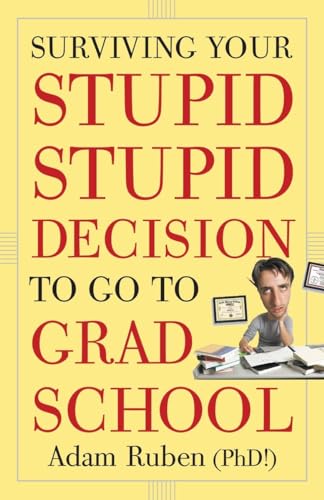
This is a book for dedicated academics who consider spending years masochistically overworked and underappreciated as a laudable goal. They lead the lives of the impoverished, grade the exams of whiny undergrads, and spend lonely nights in the library or laboratory pursuing a transcendent truth that only six or seven people will ever care about. These suffering, unshaven sad sacks are grad students, and their salvation has arrived in this witty look at the low points of grad school.
Inside, you’ll find:
• advice on maintaining a veneer of productivity in front of your advisor
• tips for sleeping upright during boring seminars
• a description of how to find which departmental events have the best unguarded free food
• how you can convincingly fudge data and feign progress
This hilarious guide to surviving and thriving as the lowliest of life-forms—the grad student—will elaborate on all of these issues and more.
Die Inhaltsangabe kann sich auf eine andere Ausgabe dieses Titels beziehen.
Über die Autorin bzw. den Autor
ADAM RUBEN spent seven years at Johns Hopkins University earning his Ph.D. in Molecular Biology. While there, he parlayed his healthy disdain for academia into a stand-up comedy act, which he has performed at clubs, colleges, and private functions from Boston to San Diego, recently opening for Dane Cook's Tourgasm at the Warner Theater in Washington, D.C. and earning second place in the Funniest Jewish Comic Contest at the Laugh Factory in Times Square. For five years, Adam has taught an undergraduate stand-up comedy class that has quickly become one of the most popular January "Intersession" courses at Johns Hopkins University and culminates in a final show open to all students. He's written humor pieces for The National Lampoon and appears weekly on Food Detectives with Ted Allen.
Auszug. © Genehmigter Nachdruck. Alle Rechte vorbehalten.
Foreword
There exists a subculture of dedicated academics who view spending a decade masochistically overworked and underappreciated as a laudable goal. They lead the lives of the impoverished, grade the exams of the whiny, and spend lonely nights in the library or laboratory pursuing a glowing truth that only six or seven people will ever care about. These people are grad students, and they are idiots.
This book is for readers considering or already committed to spending the best years of their lives without sunlight. You’ll learn which departmental events have the best free food, what pranks to play on hot-but-vapid undergrads, how to convincingly fudge data, and why your friends who opted to take faceless nine-to-five jobs after college were actually the smart ones.
Preface
Seriously? A foreword and a preface?
Indeed. The existence of both sections can teach you a lot about grad school:
1. Much can be gained by stretching a small amount of content over multiple pages.
2. In general, such redundancy imparts powerful messages that are powerful.
3. Your reaction reveals whether you should be a grad student:
a. Those unfit for grad school have skipped ahead, probably to a page with an illustration.
b. Those who belong in grad school feel a compulsion to read every word (and, in some cases, take notes to prepare an extensive critique on the book’s use of dialectic assonance).
Prologue
All right, now this is just insane. A prologue? Really? Are we stuck here in limbo, doomed never to begin the book?
Exactly. Now you’re getting it. This book is like your life, and the prologue is grad school. You eagerly want to begin your life, but grad school stands in the way, and just when you think it’s over—nope! Another section.
And the hell of it is, you could begin your life this moment. Really. You could skip to Chapter 1 and begin reading the actual book. But out of obligation to the printed word, or out of inertia, or out of a misguided need to finish what you start, you’ll keep reading and waiting.
A foreword, a preface, and a prologue. Ridiculous. I mean, seriously, what’s next—an introduction?
Introduction
Every speech at my college graduation buzzed with a sense of finality. “You have completed your education,” each one reminded us. “Now go contribute to society!”
And most of my classmates eagerly accepted the challenge, having known that this day—the official, robe-clad end of the beginning—would someday arrive. As they pocketed their diplomas, they envisioned their new jobs, their new responsibilities, their lives outside the academy. They entered college as children, but they exited on that hot June afternoon as citizens of the world.
Most of them. Not me.
And not all of my classmates, either. As guest speakers and valedictorians exhorted us to go forth into the real world, a few of us felt the directive a bit premature. We knew that college had ended, but we also knew that the “real” world was years away. We were prepared instead to enter a half-assed compromise between college and real life, a simultaneously intense and lackadaisical academic perdition called “grad school.”
I felt a little like a cheater, like a twelve-year old who still wades in the kiddie pool, knowing it’s well past time to start swimming, but frightened of the loud teenagers in the big pool. Or maybe like a budding musician who masters Guitar Hero, but never picks up an actual guitar.
Instead of a job and a boss and a mortgage, September would bring another college campus with its dorms and quads and classrooms—and we wouldn’t even feel like its most welcome occupants.
We would walk around our new planned communities in a daze, not quite fitting in with the social culture, and not really supposed to. We would experience all the disorientation of a new campus—just like we did four years ago—but none of the excitement. And we’d have no idea whether to go to football games.
***
I spent the first two months of grad school determining whether three amino acid residues (out of hundreds) were important for the functioning of a certain protein (out of thousands) that helps certain bacteria eat a sugar called arabinose.
I demonstrated that those three residues are not important.
Two months.
But that’s grad school. You take a tiny corner of the universe that a professor finds fascinating and bury your face in it, only looking up occasionally to steal unattended bagels.
At the end of two months, I felt ready to announce my discovery to the world. “Residues 103, 107, and 109 are unimportant!” I wanted to cry from the hilltops. “Unimportant!” But a journal article never quite coalesced, and I moved on to a different lab, and now exactly zero people know about my discovery—which, had I ended up publishing the results, would have been exactly the number of people who cared.
What was this? My entire life, I felt I was gearing up to do something. Now I had finished my college education, and as a reward, I got to sit in an ignored corner of an academic building, growing and harvesting plate after plate of meaningless bacteria, solely for the sake of turning grant money into fodder for more grant money.
To a member of the generation that was reminded, “You’re special!” at every turn, nothing strikes a blow like realizing you’ve reached adulthood positioned to be completely, maybe permanently, irrelevant.
***
Hence this book. No matter where you are in the grad school process, you’ve probably felt this way (or will soon).
Sure, you love what you study—but to the exclusion of nearly all else? When you’re typing page three of a 25-page paper at 4:00 AM, sucking down your ninth Red Bull of the night, will you honestly feel there’s nothing you’d rather do? Or will you shut your laptop in anger, thrust your head into your hands, and lament your stupid, stupid decision to go to grad school?
***
If there’s one thing I’ve learned from writing a book about grad school, it’s that writing a book about college must be easy. Most college students are young, overconfident, drink beer, go to classes, take exams, write papers, party, live in dorms, deal with professors, parents, and roommates—in other words, their experiences are relatively universal.
Grad schools are all different. You could earn a Master’s, a Ph.D., a J.D., an M.B.A., a D.V.M., (that’s a Doctor of Veterinary Medicine), or one of hundreds of other degrees. Your daily routine could include hours of classroom instruction (either giving or receiving it), or you may never need to attend class. You might obligatorily spend twelve hours a day in a lab, or you might have to research your dissertation at your own pace in a location of your choosing. Hell, you may not even write a dissertation. You also might not have oral exams, teaching responsibilities, or an...
„Über diesen Titel“ kann sich auf eine andere Ausgabe dieses Titels beziehen.
Suchergebnisse für Surviving Your Stupid, Stupid Decision to Go to Grad...

Beispielbild für diese ISBN
Surviving Your Stupid, Stupid Decision to Go to Grad School
Anbieter: World of Books (was SecondSale), Montgomery, IL, USA
Verkäuferbewertung 5 von 5 Sternen

Zustand: Acceptable. Item in acceptable condition! Textbooks may not include supplemental items i.e. CDs, access codes etc. Artikel-Nr. 00109632624
Gebraucht kaufen
EUR 3,62
Versand gratis
Versand innerhalb von USA
Versand innerhalb von USA
Anzahl: 1 verfügbar
Beispielbild für diese ISBN
Surviving Your Stupid, Stupid Decision to Go to Grad School
Anbieter: World of Books (was SecondSale), Montgomery, IL, USA
Verkäuferbewertung 5 von 5 Sternen
Zustand: Very Good. Item in very good condition! Textbooks may not include supplemental items i.e. CDs, access codes etc. Artikel-Nr. 00103572718
Gebraucht kaufen
EUR 3,62
Versand gratis
Versand innerhalb von USA
Versand innerhalb von USA
Anzahl: 1 verfügbar
Beispielbild für diese ISBN
Surviving Your Stupid, Stupid Decision to Go to Grad School
Anbieter: World of Books (was SecondSale), Montgomery, IL, USA
Verkäuferbewertung 5 von 5 Sternen
Zustand: Good. Item in good condition. Textbooks may not include supplemental items i.e. CDs, access codes etc. Artikel-Nr. 00081427359
Gebraucht kaufen
EUR 3,62
Versand gratis
Versand innerhalb von USA
Versand innerhalb von USA
Anzahl: 8 verfügbar
Beispielbild für diese ISBN
Surviving Your Stupid, Stupid Decision to Go to Grad School
Anbieter: BooksRun, Philadelphia, PA, USA
Verkäuferbewertung 5 von 5 Sternen
Paperback. Zustand: Very Good. 1. It's a well-cared-for item that has seen limited use. The item may show minor signs of wear. All the text is legible, with all pages included. It may have slight markings and/or highlighting. Artikel-Nr. 0307589447-11-1
Gebraucht kaufen
EUR 4,17
Versand gratis
Versand innerhalb von USA
Versand innerhalb von USA
Anzahl: 1 verfügbar
Beispielbild für diese ISBN
Surviving Your Stupid, Stupid Decision to Go to Grad School
Anbieter: BooksRun, Philadelphia, PA, USA
Verkäuferbewertung 5 von 5 Sternen
Paperback. Zustand: Very Good. 1. It's a well-cared-for item that has seen limited use. The item may show minor signs of wear. All the text is legible, with all pages included. It may have slight markings and/or highlighting. Artikel-Nr. 0307589447-11-18
Gebraucht kaufen
EUR 4,44
Versand gratis
Versand innerhalb von USA
Versand innerhalb von USA
Anzahl: 1 verfügbar
Beispielbild für diese ISBN
Surviving Your Stupid, Stupid Decision to Go to Grad School
Verlag:
Crown Publishing Group, The, 2010
ISBN 10: 0307589447
ISBN 13: 9780307589446
Gebraucht
Softcover
Erstausgabe
Anbieter: Better World Books: West, Reno, NV, USA
Verkäuferbewertung 5 von 5 Sternen
Zustand: Very Good. 1st Edition. Pages intact with possible writing/highlighting. Binding strong with minor wear. Dust jackets/supplements may not be included. Stock photo provided. Product includes identifying sticker. Better World Books: Buy Books. Do Good. Artikel-Nr. 5243794-6
Gebraucht kaufen
EUR 6,03
Versand gratis
Versand innerhalb von USA
Versand innerhalb von USA
Anzahl: 1 verfügbar
Beispielbild für diese ISBN
Surviving Your Stupid, Stupid Decision to Go to Grad School
Verlag:
Crown Publishing Group, The, 2010
ISBN 10: 0307589447
ISBN 13: 9780307589446
Gebraucht
Softcover
Erstausgabe
Anbieter: Better World Books, Mishawaka, IN, USA
Verkäuferbewertung 5 von 5 Sternen
Zustand: Good. 1st Edition. Pages intact with minimal writing/highlighting. The binding may be loose and creased. Dust jackets/supplements are not included. Stock photo provided. Product includes identifying sticker. Better World Books: Buy Books. Do Good. Artikel-Nr. GRP92209206
Gebraucht kaufen
EUR 6,03
Versand gratis
Versand innerhalb von USA
Versand innerhalb von USA
Anzahl: 2 verfügbar
Beispielbild für diese ISBN
Surviving Your Stupid, Stupid Decision to Go to Grad School
Verlag:
Crown Publishing Group (NY), 2010
ISBN 10: 0307589447
ISBN 13: 9780307589446
Gebraucht
Paperback
Anbieter: ThriftBooks-Dallas, Dallas, TX, USA
Verkäuferbewertung 5 von 5 Sternen
Paperback. Zustand: Very Good. No Jacket. May have limited writing in cover pages. Pages are unmarked. ~ ThriftBooks: Read More, Spend Less. Artikel-Nr. G0307589447I4N00
Gebraucht kaufen
EUR 6,10
Versand gratis
Versand innerhalb von USA
Versand innerhalb von USA
Anzahl: 1 verfügbar
Beispielbild für diese ISBN
Surviving Your Stupid, Stupid Decision to Go to Grad School
Verlag:
Crown Publishing Group (NY), 2010
ISBN 10: 0307589447
ISBN 13: 9780307589446
Gebraucht
Paperback
Anbieter: ThriftBooks-Phoenix, Phoenix, AZ, USA
Verkäuferbewertung 5 von 5 Sternen
Paperback. Zustand: Very Good. No Jacket. May have limited writing in cover pages. Pages are unmarked. ~ ThriftBooks: Read More, Spend Less. Artikel-Nr. G0307589447I4N00
Gebraucht kaufen
EUR 6,10
Versand gratis
Versand innerhalb von USA
Versand innerhalb von USA
Anzahl: 1 verfügbar
Beispielbild für diese ISBN
Surviving Your Stupid, Stupid Decision to Go to Grad School
Anbieter: Wonder Book, Frederick, MD, USA
Verkäuferbewertung 5 von 5 Sternen
Zustand: Very Good. Very Good condition. A copy that may have a few cosmetic defects. May also contain light spine creasing or a few markings such as an owner's name, short gifter's inscription or light stamp. Artikel-Nr. P02R-01644
Gebraucht kaufen
EUR 6,27
Versand gratis
Versand innerhalb von USA
Versand innerhalb von USA
Anzahl: 2 verfügbar