
Verwandte Artikel zu No Higher Honor: A Memoir of My Years in Washington
Inhaltsangabe
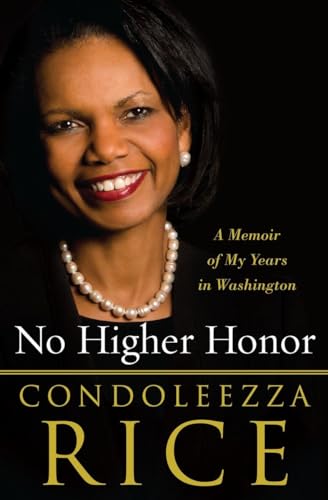
From one of the world’s most admired women, this is former National Security Advisor and Secretary of State Condoleezza Rice’s compelling story of eight years serving at the highest levels of government. In her position as America’s chief diplomat, Rice traveled almost continuously around the globe, seeking common ground among sometimes bitter enemies, forging agreement on divisive issues, and compiling a remarkable record of achievement.
A native of Birmingham, Alabama who overcame the racism of the Civil Rights era to become a brilliant academic and expert on foreign affairs, Rice distinguished herself as an advisor to George W. Bush during the 2000 presidential campaign. Once Bush was elected, she served as his chief adviser on national-security issues – a job whose duties included harmonizing the relationship between the Secretaries of State and Defense. It was a role that deepened her bond with the President and ultimately made her one of his closest confidantes.
With the September 11, 2001, terrorist attacks, Rice found herself at the center of the Administration’s intense efforts to keep America safe. Here, Rice describes the events of that harrowing day – and the tumultuous days after. No day was ever the same. Additionally, Rice also reveals new details of the debates that led to the war in Afghanistan and then Iraq.
The eyes of the nation were once again focused on Rice in 2004 when she appeared before the 9-11 Commission to answer tough questions regarding the country’s preparedness for – and immediate response to – the 9-11 attacks. Her responses, it was generally conceded, would shape the nation’s perception of the Administration’s competence during the crisis. Rice conveys just how pressure-filled that appearance was and her surprised gratitude when, in succeeding days, she was broadly saluted for her grace and forthrightness.
From that point forward, Rice was aggressively sought after by the media and regarded by some as the Administration’s most effective champion.
In 2005 Rice was entrusted with even more responsibility when she was charged with helping to shape and carry forward the President’s foreign policy as Secretary of State. As such, she proved herself a deft crafter of tactics and negotiation aimed to contain or reduce the threat posed by America’s enemies. Here, she reveals the behind-the-scenes maneuvers that kept the world’s relationships with Iran, North Korea and Libya from collapsing into chaos. She also talks about her role as a crisis manager, showing that at any hour -- and at a moment’s notice -- she was willing to bring all parties to the bargaining table anywhere in the world.
No Higher Honor takes the reader into secret negotiating rooms where the fates of Israel, the Palestinian Authority, and Lebanon often hung in the balance, and it draws back the curtain on how frighteningly close all-out war loomed in clashes involving Pakistan-India and Russia-Georgia, and in East Africa.
Surprisingly candid in her appraisals of various Administration colleagues and the hundreds of foreign leaders with whom she dealt, Rice also offers here keen insight into how history actually proceeds. In No Higher Honor, she delivers a master class in statecraft -- but always in a way that reveals her essential warmth and humility, and her deep reverence for the ideals on which America was founded.
Die Inhaltsangabe kann sich auf eine andere Ausgabe dieses Titels beziehen.
Über die Autorin bzw. den Autor
CONDOLEEZZA RICE was the sixty-sixth U.S. Secretary of State and the first black woman to hold that office. Prior to that, she was the first woman to serve as National Security Advisor. She is a professor at Stanford University, and co-founder of the RiceHadley Group. Rice is also the author of the New York Times bestselling Extraordinary, Ordinary People: A Memoir of Family.
Auszug. © Genehmigter Nachdruck. Alle Rechte vorbehalten.
1
Before the Crack in Time
In August 1998, President George H. W. Bush called and invited me to spend time with him and Mrs. Barbara Bush in Maine. I had become close to President Bush in the years after I'd served as his Soviet specialist in the National Security Council, and they had hosted me a few times before at their wonderful family home in Kennebunkport. The weathered, shingle-style house, decorated in calming pastel chintz, has an elegant yet understated decor and a spectacular view of the ocean. I'm not all that fond of being in the water. But I love to look at it, and there isn't a prettier place to view the Atlantic than Walker's Point. I promptly accepted the invitation.
Driving along the rocky New England coast to the entrance of the property, I was struck by two flags flying over the compound: the Texas state flag for the governor and the Stars and Stripes for the former President. (The Florida state flag would later join them when Jeb Bush was elected governor.) It was a subtle reminder that this was no ordinary family and it would be no ordinary weekend.
The elder Bush didn't hide his desire to get me together with his son George just so we could get to know each other better and talk a little about foreign policy. Before a casual lobster dinner that night, I joined Governor Bush on the back porch, where he told me that he was confident of reelection in November and that if he won impressively (which he fully expected), he'd likely run for the presidency.
A run for the White House by the Texas governor struck me as having long odds for success. President Clinton's years had been morally tarnished but peaceful and relatively prosperous. The governor was untested and would likely face a real pro in Vice President Al Gore. I was too polite to say those things that night, but I sure thought them.
Throughout the weekend, while fishing (he fished, I sat in the boat and watched) or exercising side by side in the small family gym on the compound, we talked about Russia, China, and Latin America. He wanted to start thinking about what to do in foreign policy if he got elected. I soon realized that he knew our southern neighbors, particularly Mexico, far better than I did. I made a mental note to read a few articles about Mexico when I got back to my home in California.
But we also talked about other things. He was interested in my upbringing in segregated Birmingham. I was attracted to his passion for improving education for disadvantaged youth. We compared notes on the problems of college admission and affirmative action. I was more traditional in my support of race-based admission; he'd tried to increase diversity at the University of Texas by other means. He proudly said that he would likely receive half of the Hispanic vote and more than a quarter of the African American vote.
I liked him. He was funny and irreverent but serious about policy. We e_mailed back and forth several times during the fall, mostly friendly chitchat about whatever was in the news-the growing conflict in the Balkans or the Clinton administration's efforts to expand NATO. Then, a couple of days after the November election and the landslide victory Governor Bush had hoped for, I received a note from him. He wanted to follow international events more closely.
Early in March 1999, Karl Rove, the governor's political advisor, called to ask if I'd come down to Austin and speak with the governor about the upcoming campaign. "Will you book a hotel room for me?" I asked.
"You won't need a hotel," he replied. "The governor wants you to stay at the residence." It was a signal that he expected me to support his campaign, which was quickly becoming a serious endeavor. A few weeks later, when my picture appeared on the front page of the New York Times as a member of the "exploratory committee" dedicated to electing George W. Bush President of the United States, I was momentarily stunned by the sudden exposure but committed to the cause.
My father was the first person I called after the governor asked me to join his campaign. John Wesley Rice, Jr., loved politics. He watched news shows, particularly C-SPAN, for hours at a time, and had been a loyal Republican ever since a clerk affiliated with the Grand Old Party had helped him register to vote in segregated Alabama. My father could barely contain his excitement.
The campaign itself proved professionally fulfilling, but early on I realized that it would require my full-time focus. For six years I had been the provost-the chief operating officer-of Stanford University. I was ready to step down independent of the chance to join the Bush campaign. Foreign policy would be the governor's Achilles' heel against more seasoned candidates in the primaries and eventually in the general election. I knew that George W. Bush would look to me to help answer the inevitable questions about his readiness to assume the mantle of commander in chief.
Throughout 1999 I worked to assemble a small group of foreign policy specialists to develop policy for the governor. My first call was to Paul Wolfowitz, who had been ambassador to Indonesia under President Ronald Reagan and under secretary for policy in the Pentagon during George H. W. Bush's administration. Paul was a cerebral, almost otherworldly intellectual. He'd done his undergraduate work at Cornell and gone on to complete a PhD in the intense academic environment of the University of Chicago. Though Paul had already had a distinguished public policy career, he was really most comfortable debating ideas. We'd been friends since the 1980s, and when I asked him to join me as cochair of the foreign policy group, he readily did so.
Richard Armitage and Stephen Hadley had also been in the first Bush administration. Rich was a muscular, stout former naval officer who had served in Vietnam and specialized in Asian affairs. Many people believed that the Rambo character had been based on Rich. Yet, there was another side to him: he and his wife had adopted numerous special- needs kids. He was Colin Powell's best friend, a fact that would later lead to considerable conflict within the administration.
Steve was a quiet, Yale-trained lawyer from Cleveland, Ohio, who at the time wore horn-rimmed glasses. He was smart and methodical, and when there was real work to be produced for the campaign (rather than just things to be said and debated), we all looked to Steve to write the first draft of the paper. He did so selflessly and effectively.
Robert Zoellick, Robert Blackwill, and I had worked closely together during the extraordinary days of 1989-1991 at the end of the Cold War. They were among the best policy engineers I had ever known, capable of conceiving of a solution and then actually implementing it. Zoellick had been Secretary of State James Baker's closest aide at the State Department and the architect of many important initiatives concerning Central America and Europe. He had led the three-member U.S. delegation to the talks on German unification on which I had been the White House representative.
Bob Blackwill had been my boss for a while at the NSC the first time around as special assistant for European and Soviet affairs. He'd held numerous high-level positions. He was from Kansas, with very traditional values and a wicked sense of humor. But he could be abrasive and impatient, and he made enemies. Some thought that Bob would be high maintenance, but he would be valuable to the governor, and we were good enough friends to speak honestly about any problems that might arise.
I asked Richard Perle to join the group to represent the right wing of the Republican foreign policy establishment. Perle had been the bane of the party's foreign policy traditionalists such as Brent Scowcroft and Henry Kissinger. He had a well-deserved reputation for ruthlessness too. But Governor...
„Über diesen Titel“ kann sich auf eine andere Ausgabe dieses Titels beziehen.
Suchergebnisse für No Higher Honor: A Memoir of My Years in Washington

Beispielbild für diese ISBN
No Higher Honor: A Memoir of My Years in Washington
Anbieter: World of Books (was SecondSale), Montgomery, IL, USA
Verkäuferbewertung 5 von 5 Sternen

Zustand: Good. Item in good condition. Textbooks may not include supplemental items i.e. CDs, access codes etc. Artikel-Nr. 00085669715
Gebraucht kaufen
EUR 4,04
Versand gratis
Versand innerhalb von USA
Versand innerhalb von USA
Anzahl: Mehr als 20 verfügbar
Beispielbild für diese ISBN
No Higher Honor: A Memoir of My Years in Washington
Anbieter: World of Books (was SecondSale), Montgomery, IL, USA
Verkäuferbewertung 5 von 5 Sternen
Zustand: Acceptable. Item in acceptable condition! Textbooks may not include supplemental items i.e. CDs, access codes etc. Artikel-Nr. 00104640748
Gebraucht kaufen
EUR 4,04
Versand gratis
Versand innerhalb von USA
Versand innerhalb von USA
Anzahl: 5 verfügbar
Beispielbild für diese ISBN
No Higher Honor: A Memoir of My Years in Washington
Verlag:
Crown Publishing Group (NY), 2011
ISBN 10: 030758786X
ISBN 13: 9780307587862
Gebraucht
Hardcover
Anbieter: ThriftBooks-Dallas, Dallas, TX, USA
Verkäuferbewertung 5 von 5 Sternen
Hardcover. Zustand: Very Good. No Jacket. Missing dust jacket; May have limited writing in cover pages. Pages are unmarked. ~ ThriftBooks: Read More, Spend Less. Artikel-Nr. G030758786XI4N01
Gebraucht kaufen
EUR 6,05
Versand gratis
Versand innerhalb von USA
Versand innerhalb von USA
Anzahl: 2 verfügbar
Beispielbild für diese ISBN
No Higher Honor: A Memoir of My Years in Washington
Verlag:
Crown Publishing Group (NY), 2011
ISBN 10: 030758786X
ISBN 13: 9780307587862
Gebraucht
Hardcover
Anbieter: ThriftBooks-Phoenix, Phoenix, AZ, USA
Verkäuferbewertung 5 von 5 Sternen
Hardcover. Zustand: Very Good. No Jacket. Missing dust jacket; May have limited writing in cover pages. Pages are unmarked. ~ ThriftBooks: Read More, Spend Less. Artikel-Nr. G030758786XI4N01
Gebraucht kaufen
EUR 6,05
Versand gratis
Versand innerhalb von USA
Versand innerhalb von USA
Anzahl: 1 verfügbar
Beispielbild für diese ISBN
No Higher Honor: A Memoir of My Years in Washington
Verlag:
Crown Publishing Group (NY), 2011
ISBN 10: 030758786X
ISBN 13: 9780307587862
Gebraucht
Hardcover
Anbieter: ThriftBooks-Dallas, Dallas, TX, USA
Verkäuferbewertung 5 von 5 Sternen
Hardcover. Zustand: Very Good. No Jacket. May have limited writing in cover pages. Pages are unmarked. ~ ThriftBooks: Read More, Spend Less. Artikel-Nr. G030758786XI4N00
Gebraucht kaufen
EUR 6,05
Versand gratis
Versand innerhalb von USA
Versand innerhalb von USA
Anzahl: 1 verfügbar
Beispielbild für diese ISBN
No Higher Honor: A Memoir of My Years in Washington
Verlag:
Crown Publishing Group (NY), 2011
ISBN 10: 030758786X
ISBN 13: 9780307587862
Gebraucht
Hardcover
Anbieter: ThriftBooks-Reno, Reno, NV, USA
Verkäuferbewertung 5 von 5 Sternen
Hardcover. Zustand: Very Good. No Jacket. Missing dust jacket; May have limited writing in cover pages. Pages are unmarked. ~ ThriftBooks: Read More, Spend Less. Artikel-Nr. G030758786XI4N01
Gebraucht kaufen
EUR 6,05
Versand gratis
Versand innerhalb von USA
Versand innerhalb von USA
Anzahl: 2 verfügbar
Beispielbild für diese ISBN
No Higher Honor: A Memoir of My Years in Washington
Verlag:
Crown Publishing Group (NY), 2011
ISBN 10: 030758786X
ISBN 13: 9780307587862
Gebraucht
Hardcover
Anbieter: ThriftBooks-Atlanta, AUSTELL, GA, USA
Verkäuferbewertung 5 von 5 Sternen
Hardcover. Zustand: Very Good. No Jacket. Missing dust jacket; May have limited writing in cover pages. Pages are unmarked. ~ ThriftBooks: Read More, Spend Less. Artikel-Nr. G030758786XI4N01
Gebraucht kaufen
EUR 6,05
Versand gratis
Versand innerhalb von USA
Versand innerhalb von USA
Anzahl: 2 verfügbar
Beispielbild für diese ISBN
No Higher Honor: A Memoir of My Years in Washington
Verlag:
Crown Publishing Group (NY), 2011
ISBN 10: 030758786X
ISBN 13: 9780307587862
Gebraucht
Hardcover
Anbieter: ThriftBooks-Atlanta, AUSTELL, GA, USA
Verkäuferbewertung 5 von 5 Sternen
Hardcover. Zustand: Very Good. No Jacket. May have limited writing in cover pages. Pages are unmarked. ~ ThriftBooks: Read More, Spend Less. Artikel-Nr. G030758786XI4N00
Gebraucht kaufen
EUR 6,05
Versand gratis
Versand innerhalb von USA
Versand innerhalb von USA
Anzahl: 1 verfügbar
Beispielbild für diese ISBN
No Higher Honor: A Memoir of My Years in Washington
Anbieter: BooksRun, Philadelphia, PA, USA
Verkäuferbewertung 5 von 5 Sternen
Hardcover. Zustand: Fair. 1. With dust jacket. The item might be beaten up but readable. May contain markings or highlighting, as well as stains, bent corners, or any other major defect, but the text is not obscured in any way. Artikel-Nr. 030758786X-7-18-13_29
Gebraucht kaufen
EUR 6,27
Versand gratis
Versand innerhalb von USA
Versand innerhalb von USA
Anzahl: 1 verfügbar
Beispielbild für diese ISBN
No Higher Honor : A Memoir of My Years in Washington
Verlag:
Potter/Ten Speed/Harmony/Rodale, 2011
ISBN 10: 030758786X
ISBN 13: 9780307587862
Gebraucht
Hardcover
Erstausgabe
Anbieter: Better World Books, Mishawaka, IN, USA
Verkäuferbewertung 5 von 5 Sternen
Zustand: Good. 1St Edition. Pages intact with minimal writing/highlighting. The binding may be loose and creased. Dust jackets/supplements are not included. Stock photo provided. Product includes identifying sticker. Better World Books: Buy Books. Do Good. Artikel-Nr. 2257572-6
Gebraucht kaufen
EUR 6,66
Versand gratis
Versand innerhalb von USA
Versand innerhalb von USA
Anzahl: 3 verfügbar