
Verwandte Artikel zu The Parthenon Enigma: A New Understanding of the World's...
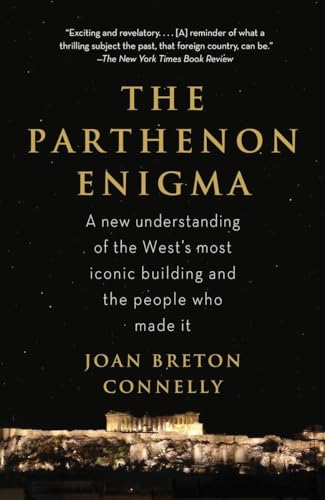
The Parthenon Enigma: A New Understanding of the World's Most Iconic Building and the People Who Made It - Softcover
Inhaltsangabe
A New York Times Notable Book and one of The Daily Beast's Best Books of the Year
Winner of the Ralph Waldo Emerson Award
Since the Enlightenment, the Parthenon—the greatest example of Athenian architecture—has been venerated as the definitive symbol of Western democratic values. Here, Joan Breton Connelly challenges this conventional wisdom, drawing on previously undiscovered sources to present a revolutionary new view of this peerless building. Reaching back across time to trace the Parthenon’s story from the laying of its foundation, Connelly finds its true meaning not in the rationalist ideals we typically associate with Athens but in a vast web of ceaseless cultic observances and a unique mythic identity, in which democracy in our sense of the word would have been inconceivable. Marshalling a breathtaking range of textual and visual evidence, and full of fresh insights woven into a thrilling narrative that brings the distant past to life, The Parthenon Enigma sheds a stunning new light on the ancient Athenians from whom we claim cultural descent—and on Western civilization itself.
Die Inhaltsangabe kann sich auf eine andere Ausgabe dieses Titels beziehen.
Über die Autorin bzw. den Autor
Joan Breton Connelly is a classical archaeologist and the author of two previous books, Portrait of a Priestess: Women and Ritual in Ancient Greece and Votive Sculpture of Hellenistic Cyprus. In 1996, Professor Connelly was awarded a MacArthur Fellowship. She has held visiting fellowships at All Souls College, Magdalen College, New College, and Corpus Christi College at Oxford University, and at the Radcliffe Institute for Advanced Study, Harvard University, and has been a member of the Institute for Advanced Study at Princeton. Professor Connelly has excavated throughout Greece, Kuwait, and Cyprus, where she has directed the Yeronisos Island Excavations since 1990. She is professor of classics and art history at New York University.
Auszug. © Genehmigter Nachdruck. Alle Rechte vorbehalten.
Prologue
Never before in human history has there been a structure that is at once so visible to the world, so celebrated, so examined, so invested with authority, and yet, at the same time, so strangely impenetrable at its core. After centuries of study and admiration, the Parthenon remains, in so many ways, an enigma.
The past three decades have brought perhaps the most intensive period of scrutiny the Parthenon has seen since its construction nearly twenty--five hundred years ago (447–-432 b.c.). The monumental work of the Acropolis Restoration Service in the conservation and analysis of the building has revealed a wealth of new information about how the Parthenon was planned, engineered, and constructed. Surprises, like newly revealed traces of bright paint on architectural moldings set high within the west porch, hint at the original, radiant decoration of the temple. At the same time, freshly emerging evidence from Greek literature, inscriptions, art, and archaeology has broadened our understanding of the world in which the Parthenon was built. The myths, belief systems, ritual and social practices, cognitive structures, even the emotions of the ancient Athenians, are now under rigorous review. But much of what has been discovered in recent years does not fit into the sense we have had of the Parthenon for the past two and a half centuries. Why?
Our contemporary understanding of the Parthenon and the symbolism that has been constructed for it from the Enlightenment on has everything to do with the self--image of those who have described and interpreted it. There is a natural tendency to see likeness to oneself when approaching a culture as foreign as that of Greek antiquity. How much more so this is when looking at a monument that has become the icon of Western art, the very symbol of democracy itself. With these labels comes a projection onto the Parthenon of all our standards of what it means to be civilized. In looking at the building, Western culture inevitably sees itself; indeed, it sees only what flatters its own self--image or explains it through connection to the birthplace of democracy.
This association has been reinforced again and again by the adoption of Parthenonian style for civic architecture beginning with the neoclassical movement and culminating in the Greek Revival. From the early nineteenth century on, financial and governmental institutions, libraries, museums, and universities have reproduced classical architectural forms to communicate a set of values, implicitly aligning themselves with the flowering of democratic Athens. One need only look at the Second Bank of the United States in Philadelphia (1811–-1824), the British Museum (1823–-1852), the U.S. Custom House on Wall Street (1842) (page 341), Founder’s Hall at Girard College in Philadelphia (1847), the U.S. Treasury Building in Washington, D.C. (1836–-1869), the Ohio State Capitol (1857), the Philadelphia Museum of Art (1928), or the U.S. Supreme Court Building (1935) to recognize quotations from the iconic form of the Parthenon.1 Ironically, these unequivocally secular civic structures have appropriated what is, fundamentally, a religious architectural form. Preoccupied with the political and the aesthetic, we have become all too comfortable with the constructed identity of Parthenon as icon, neglecting its primary role as a deeply sacred space.
Any views that depart from the well--established contemporary understanding of the Parthenon, and its association with civic life as we know it, have been effaced, like the traces of paint and intricate detail that once adorned the surface of the temple itself. Criticism of the conventional creed is taken as an attack on an entire belief system. The long--standing association of the Parthenon with Western political ideology has, indeed, caused new interpretations to meet with enormous resistance. But there is much more to the Parthenon and the people who created it than flatters and corresponds to our sense of ourselves. To recover it, we must begin by trying to see the monument through ancient eyes.
Viewing the Parthenon as synonymous with the Western democratic system of government began in the eighteenth century, when the art historian Johann Winckelmann first linked the emergence of individual liberty to the development of high classical style. In his influential book, Geschichte der Kunst des Alterthums (History of the Art of Antiquity, 1764), Winckelmann argued that the rise and decline of artistic styles followed developments in the political sphere. The peak of Greek art, he maintained, coincided with the democratic form of government.2 Nine years later his student Johann Hermann von Riedesel took this model a step further, proclaiming the Parthenon to be “the supreme product of Athenian democracy.”3
This sentiment was robustly embraced during the Greek War of Independence (1821 to 1830) and the period that immediately followed it. As the modern Greek nation was forged, the European powers that helped to shape it constructed narratives through which they could trace their own political systems back to the epicenter of the Athenian Acropolis. On August 28, 1834, the newly designated king of Greece, Otto, son of King Ludwig of Bavaria, officially inaugurated the Parthenon as an ancient monument. In a carefully orchestrated pageant conceived in the very image of Periklean Athens, King Otto rode on horseback with his regents, court, and bodyguards while soldiers from the National Guard led a procession of citizen elders, teachers, guild officers, and other notables.4 Sixty Athenians marched with olive branches in hand, while on the Acropolis, Athenian maidens, dressed in white and carrying bows of myrtle, unfurled a banner displaying the image of Athena.5 Upon reaching the citadel, King Otto was presented with keys to its gate and escorted into the Parthenon by the neoclassical architect Leo von Klenze. There, the king was enthroned upon a chair covered in laurel, olive, and myrtle. Klenze delivered a rousing patriotic address, advocating the restoration of the Parthenon and the obliteration of every trace of Ottoman Turkish building on the Acropolis. “All the remains of barbarity will be removed,” Klenze proclaimed. He then bade King Otto to sanctify the first marble drum to be restored to the “reborn Parthenon.” The king obliged, tapping three times on the white marble column segment set before him.6 Klenze’s vision of a barbarian--free Acropolis was fully realized in his “ideal view” of the Acropolis (following page), painted in 1846 and acquired by King Otto’s father, Ludwig I, some six years later.7
In the century that followed, the growth of archaeology and an ever--increasing recognition of classical Greece as the cradle of Western civilization elevated classical cultural production to a whole new level.8 In 1826 work began on a replica of the Parthenon atop Calton Hill just east of Edinburgh. Designed as the National Monument of Scotland to memorialize Scottish soldiers and sailors lost in the Napoleonic Wars, it would become, people hoped, the final resting place for a host of Scottish notables. The structure was never completed, and the single façade that stands today is marked with an inscription that reads, “A Memorial of the Past and Incentive to the Future Heroes of the Men of Scotland.”9 Meanwhile, just above Regensburg in Bavaria, King Ludwig I built his own Parthenon (1830–-1842), designed by the same Leo von Klenze of the ceremony on the Acropolis. Named Walhalla, “the Hall of the Dead” (facing page), the Bavarian Parthenon was furnished with portrait busts and inscribed plaques commemorating more than a hundred famous individuals across eighteen hundred years of German history. By 1897 the United...
„Über diesen Titel“ kann sich auf eine andere Ausgabe dieses Titels beziehen.
Suchergebnisse für The Parthenon Enigma: A New Understanding of the World's...

Beispielbild für diese ISBN
The Parthenon Enigma: A New Understanding of the World's Most Iconic Building and the People Who Made It
Anbieter: World of Books (was SecondSale), Montgomery, IL, USA
Verkäuferbewertung 5 von 5 Sternen

Paperback. Zustand: Good. A New York Times Notable Book and one of The Daily Beast's Best Books of the Year Winner of the Ralph Waldo Emerson Award Since the Enlightenment, the Parthenon--the greatest example of Athenian architecture--has been venerated as the definitive symbol of Western democratic values. Here, Joan Breton Connelly challenges this conventional wisdom, drawing on previously undiscovered sources to present a revolutionary new view of this peerless building. Reaching back across time to trace the Parthenon's story from the laying of its foundation, Connelly finds its true meaning not in the rationalist ideals we typically associate with Athens but in a vast web of ceaseless cultic observances and a unique mythic identity, in which democracy in our sense of the word would have been inconceivable. Marshalling a breathtaking range of textual and visual evidence, and full of fresh insights woven into a thrilling narrative that brings the distant past to life, The Parthenon Enigma sheds a stunning new light on the ancient Athenians from whom we claim cultural descent--and on Western civilization itself. Artikel-Nr. 00108172626
Gebraucht kaufen
EUR 3,87
Versand gratis
Versand innerhalb von USA
Versand innerhalb von USA
Anzahl: 1 verfügbar
Foto des Verkäufers
The Parthenon Enigma: a New Understanding of the West's Most Iconic Building and the People Who Made It.
Verlag:
Knopf Doubleday Publishing Group, 2014
ISBN 10: 0307476596
ISBN 13: 9780307476593
Gebraucht
Softcover
Anbieter: Dream Books Co., Denver, CO, USA
Verkäuferbewertung 5 von 5 Sternen
Zustand: good. Gently used with minimal wear on the corners and cover. A few pages may contain light highlighting or writing, but the text remains fully legible. Dust jacket may be missing, and supplemental materials like CDs or codes may not be included. May be ex-library with library markings. Ships promptly! Artikel-Nr. DBV.0307476596.G
Gebraucht kaufen
EUR 3,88
Versand gratis
Versand innerhalb von USA
Versand innerhalb von USA
Anzahl: 1 verfügbar
Beispielbild für diese ISBN
The Parthenon Enigma: a New Understanding of the West's Most Iconic Building and the People Who Made It.
Verlag:
Knopf Doubleday Publishing Group, 2014
ISBN 10: 0307476596
ISBN 13: 9780307476593
Gebraucht
Softcover
Anbieter: Wonder Book, Frederick, MD, USA
Verkäuferbewertung 5 von 5 Sternen
Zustand: Good. Good condition. Artikel-Nr. I23B-04784
Gebraucht kaufen
EUR 6,41
Versand gratis
Versand innerhalb von USA
Versand innerhalb von USA
Anzahl: 1 verfügbar
Beispielbild für diese ISBN
The Parthenon Enigma : A New Understanding of the World's Most Iconic Building and the People Who Made It
Verlag:
Knopf Doubleday Publishing Group, 2014
ISBN 10: 0307476596
ISBN 13: 9780307476593
Gebraucht
Softcover
Anbieter: Better World Books: West, Reno, NV, USA
Verkäuferbewertung 5 von 5 Sternen
Zustand: Good. Pages intact with minimal writing/highlighting. The binding may be loose and creased. Dust jackets/supplements are not included. Stock photo provided. Product includes identifying sticker. Better World Books: Buy Books. Do Good. Artikel-Nr. 5821807-6
Gebraucht kaufen
EUR 7,38
Versand gratis
Versand innerhalb von USA
Versand innerhalb von USA
Anzahl: 1 verfügbar
Beispielbild für diese ISBN
The Parthenon Enigma : A New Understanding of the World's Most Iconic Building and the People Who Made It
Verlag:
Knopf Doubleday Publishing Group, 2014
ISBN 10: 0307476596
ISBN 13: 9780307476593
Gebraucht
Softcover
Anbieter: Better World Books, Mishawaka, IN, USA
Verkäuferbewertung 5 von 5 Sternen
Zustand: Good. Pages intact with minimal writing/highlighting. The binding may be loose and creased. Dust jackets/supplements are not included. Stock photo provided. Product includes identifying sticker. Better World Books: Buy Books. Do Good. Artikel-Nr. 5821807-6
Gebraucht kaufen
EUR 7,38
Versand gratis
Versand innerhalb von USA
Versand innerhalb von USA
Anzahl: 3 verfügbar
Beispielbild für diese ISBN
The Parthenon Enigma: A New Understanding of the World's Most Iconic Building and the People Who Made It
Anbieter: ThriftBooks-Atlanta, AUSTELL, GA, USA
Verkäuferbewertung 5 von 5 Sternen
Paperback. Zustand: Fair. No Jacket. Readable copy. Pages may have considerable notes/highlighting. ~ ThriftBooks: Read More, Spend Less. Artikel-Nr. G0307476596I5N00
Gebraucht kaufen
EUR 7,66
Versand gratis
Versand innerhalb von USA
Versand innerhalb von USA
Anzahl: 1 verfügbar
Beispielbild für diese ISBN
The Parthenon Enigma: A New Understanding of the World's Most Iconic Building and the People Who Made It
Anbieter: ThriftBooks-Dallas, Dallas, TX, USA
Verkäuferbewertung 5 von 5 Sternen
Paperback. Zustand: Fair. No Jacket. Readable copy. Pages may have considerable notes/highlighting. ~ ThriftBooks: Read More, Spend Less. Artikel-Nr. G0307476596I5N00
Gebraucht kaufen
EUR 7,66
Versand gratis
Versand innerhalb von USA
Versand innerhalb von USA
Anzahl: 1 verfügbar
Beispielbild für diese ISBN
The Parthenon Enigma A New Understanding of the World's Most Iconic Building and the People Who Made It
Anbieter: Powell's Bookstores Chicago, ABAA, Chicago, IL, USA
Verkäuferbewertung 5 von 5 Sternen
Paperback. Zustand: Very Good. Minimal shelf wear, clean internals. Remainder mark. Artikel-Nr. 2047897
Gebraucht kaufen
EUR 11,01
EUR 4,45 Versand
Versand innerhalb von USA
Versand innerhalb von USA
Anzahl: 8 verfügbar
Beispielbild für diese ISBN
The Parthenon Enigma: a New Understanding of the West's Most Iconic Building and the People Who Made It.
Anbieter: My Dead Aunt's Books, Hyattsville, MD, USA
Verkäuferbewertung 5 von 5 Sternen
Paperback. Zustand: Very Good. 494 p., immaculate and unmarked; many ill. and photos; binding tight--probably unread; clean wrapper has minimal wear--only a touch at upper margin in order to keep this from being "like new.". Artikel-Nr. 034559
Gebraucht kaufen
EUR 11,65
EUR 4,90 Versand
Versand innerhalb von USA
Versand innerhalb von USA
Anzahl: 1 verfügbar
Foto des Verkäufers
The Parthenon Enigma
Anbieter: Southampton Books, Sag Harbor, NY, USA
Verkäuferbewertung 5 von 5 Sternen
Paperback. Zustand: Like New. FIRST THUS. First Edition Thus, First Printing. Not price-clipped. Published by Vintage Book, 2014. Octavo. Paperback. Book is like new. 100% positive feedback. 30 day money back guarantee. NEXT DAY SHIPPING! Excellent customer service. Please email with any questions. All books packed carefully and ship with free delivery confirmation/tracking. All books come with free bookmarks. Ships from Sag Harbor, New York. Artikel-Nr. 457223
Gebraucht kaufen
EUR 18,35
EUR 4,44 Versand
Versand innerhalb von USA
Versand innerhalb von USA
Anzahl: 1 verfügbar