
Verwandte Artikel zu Must You Go?: My Life With Harold Pinter
Inhaltsangabe
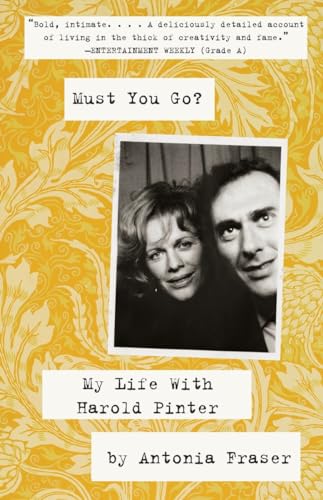
A moving and exquisite testament to one of the literary world’s most celebrated marriages: that of the greatest playwright of our age, Harold Pinter, and the beautiful and famous prize-winning biographer Antonia Fraser.
“Bold, intimate.... A deliciously detailed account of living in the thick of creativity and fame.” —Entertainment Weekly, A
Based on Fraser’s recollections and the diaries she has kept since October 1968, Must You Go? is the story of a thirty-year marriage, beginning with their initial meeting when Fraser was the wife of a member of Parliament and Pinter was married to a distinguished actress, and ending with Harold’s tragic death after battling illness for many years. In between, we hear firsthand the joy of their love and partnership, as well as the mutual devotion both felt towards their work and the creative process. Courageous, powerful, and extraordinarily compelling, Must You Go? is a love story and a marvelously insightful account of the pleasures of married love.
Die Inhaltsangabe kann sich auf eine andere Ausgabe dieses Titels beziehen.
Über die Autorin bzw. den Autor
ANTONIA FRASER is the author of many internationally bestselling historical works, including Love and Louis XIV, Marie Antoinette, which was made into a film by Sofia Coppola, The Wives of Henry VIII, Mary Queen of Scots, and Faith and Treason: The Story of the Gunpowder Plot. She has received the Wolfson Prize for History, the 2000 Norton Medlicott Medal of Britain’s Historical Association, and the Franco-British Society’s Enid McLeod Literary Prize. She was made a Dame for services to Literature in 2011.
Auszug. © Genehmigter Nachdruck. Alle Rechte vorbehalten.
Chapter One
First Night
I first saw Harold across a crowded room, but it was lunchtime, not some enchanted evening, and we did not speak. I was having lunch in the Etoile restaurant in Charlotte Street; my companion pointed to a trio of men lunching opposite us. They were in fact Robert Shaw, Donald Pleasence and Harold; they were discussing Robert’s play, The Man in the Glass Booth, in which Harold would direct Donald. My companion admired Robert Shaw intensely: the handsome red-headed star who was said to do his own stuntwork and embodied machismo. Apparently I said thoughtfully: ‘I’ll take the dark one.’
On the next occasion I heard Harold’s voice, once aptly described by Arthur Miller as his ‘awesome baritone’, before we met. There was a recital about Mary Queen of Scots at the National Portrait Gallery, based on my book. Harold’s wife Vivien Merchant took the part of Mary, an actor took all the male parts and I read the narrative. These were professionals and I was intensely nervous; a kind friend in the audience told me afterwards that my knees were visibly shaking in my natty white trouser suit which had perhaps been the wrong call as a costume. Nevertheless things were running along smoothly – Vivien was an accomplished reader who gave Mary the correct Scottish accent – when suddenly there was some kind of interruption, a man’s voice raised, at the back of the gallery. Afterwards I enquired rather crossly what had happened. ‘Oh, that was Harold Pinter,’ I was told. ‘He attacked the attendant for opening the door in the middle of the recital.’ ‘I didn’t hear the door,’ I muttered, having just learned that the projected LP of the recital would have to be abandoned due to the disturbance. Later, when I was introduced to Harold, I asked him if it had indeed been him. `Yes,' he replied with satisfaction, `I do that kind of thing all the time.' In similar situations in the future, I sometimes reflected wryly: `I can't say I wasn't warned . . .'
And so to the evening of 8 January 1975 when I went to the first night of The Birthday Party at the Shaw Theatre, directed by Kevin Billington, husband of my sister Rachel. The author was of course there and there was to be a dinner party afterwards at the Billingtons' house in Holland Park.
At this point, Hugh and I, Harold and Vivien, had both been married, oddly enough, for exactly the same period almost to the day: that is, eighteen years since September 1956 when Harold and Vivien got married in a Registry Office in Bournemouth (they were in rep there) while I dolled myself up as Mary Queen of Scots and Hugh wore a kilt at the Catholic Church in WarwickStreet, Soho, with a full sung Nuptial Mass. Hugh and I had six children; Harold and Vivien had one. Hugh had been a Conservative MP since 1945; Vivien was a celebrated actress. I was forty-two; Harold was forty-four.
I considered myself to be happily married, or at any rate happy in my marriage; I admired Hugh for his cavalier nature, his high spirits, his courage – friends nicknamed him `Fearless Fraser' after some 1930s trapeze artist – his independence, his essential decency and kindness. I even admired him for his detachment, although his lackof emotional intimacy – he once told me that he preferred families to individuals – was with hindsight probably what doomed us. I on the other hand was intensely romantic and always had been since early childhood; the trouble with romantics is that they tend to gravitate towards other like-minded people, or people they choose to regard as such. So there had been romances. But I had never for one moment envisaged leaving my marriage.
Harold, I learned much later, did not consider himself to be happily married. He too had had his romances, perhaps more than the world, which cast him as the dark, brooding, eponymously `Pinteresque' playwright, realized. Later he also told me that he had never been in love before, but had once loved Vivien very much, her essential vulnerability inspiring him with a wish to protect her, before other matters drove them apart. They led essentially separate lives in an enormous stately six-storey house in Regent's ParkTerrace; but he too had never contemplated leaving his marriage.
8 January 1975
A very enjoyable dinner party at Rachel and Kevin's house in Addison Avenue: a long and convivial table. I was slightly disappointed not to sit next to the playwright who looked full of energy, with black curly hair and pointed ears, like a satyr. Gradually the guests filtered away. My neighbours Richard and Viv King offered me a lift up the road. `Wait a minute,' I said. `I must just say goodbye to Harold Pinter and tell him I enjoyed the play; I haven't said hello all evening.' They waited at the door. I went over to where Harold was sitting. `Wonderful play, marvellous acting, now I'm off.'
He looked at me with those amazing, extremely bright black eyes. `Must you go?' he said. I thought of home, my lift, taking the children to school the next morning, the exhausting past night in the sleeper from Scotland, my projected biography of King Charles II . . . `No, it's not absolutely essential,' I said.
About 2.30 in the morning, poor Rachel and Kevin were visibly exhausted, and we were the last guests. In the end, it was Harold who gave me a lift home, in a white car with a driver (he never drove at night having once been found `weaving' in Regent's Park). I offered him coffee. I actually gave him champagne. He stayed until six o'clock in the morning with extraordinary recklessness, but of course the real recklessness was mine.
* * *
We sometimes speculated later what would have happened if I had in fact answered: `Yes, I really must go.' Harold, convinced by then that I was his destiny, would gallantly reply: `I would have found you somehow.' But we had few friends in common: Edna O'Brien was one, and the producer Sam Spiegel another. But fundamentally we lived in different worlds. The night of 8/9 January was the chance and our chance.
Subsequently the tabloids made much of our different backgrounds, the working-class Jewish boy from the East End and the Catholic aristocrat with her title. But we were, in our early forties, a long way from our backgrounds and, as usual with the tabloids, these descriptions were more for headlines than accuracy. Although Harold was technically born into the working class – his father worked in a tailoring factory – ever since the success of The Caretaker in 1960 he had been extremely well-off by most standards: he was able, for example, to retire his father, worn-out with his labours, to salubrious Hove where his parents would live happily for another thirty years.
Again technically, since my father was an earl and my mother a countess, I could be argued to be an aristocrat. But my father, born FrankPakenham, only succeeded to the Earldom of Longford when I was nearly thirty; my childhood was spent in a modest North Oxford house, my father, with no private income, teaching at the University. My mother, being a Harley Street doctor's daughter, was in any case convinced (and thus convinced us) that the middle classes were the salt of the earth whereas the aristocracy was feckless, unpunctual and extravagant, an assumption that our beloved father's attitude to life did nothing to discourage. I had no inherited money myself, and had earned my own living since the age of twenty-one, first working for a publisher and, after marriage, by journalism and books.
After the publication of Mary Queen of Scots, an unexpected bestseller in 1969,...
„Über diesen Titel“ kann sich auf eine andere Ausgabe dieses Titels beziehen.
Suchergebnisse für Must You Go?: My Life With Harold Pinter

Beispielbild für diese ISBN
Must You Go My LIfe With Harol
Anbieter: World of Books (was SecondSale), Montgomery, IL, USA
Verkäuferbewertung 5 von 5 Sternen

Zustand: Good. Item in good condition. Textbooks may not include supplemental items i.e. CDs, access codes etc. Artikel-Nr. 00106553775
Gebraucht kaufen
EUR 3,46
Versand gratis
Versand innerhalb von USA
Versand innerhalb von USA
Anzahl: 1 verfügbar
Beispielbild für diese ISBN
Must You Go?: My LIfe With Harold Pinter
Verlag:
Knopf Doubleday Publishing Group (edition Reprint), 2011
ISBN 10: 0307475573
ISBN 13: 9780307475572
Gebraucht
Paperback
Anbieter: BooksRun, Philadelphia, PA, USA
Verkäuferbewertung 5 von 5 Sternen
Paperback. Zustand: Very Good. Reprint. It's a well-cared-for item that has seen limited use. The item may show minor signs of wear. All the text is legible, with all pages included. It may have slight markings and/or highlighting. Artikel-Nr. 0307475573-11-1
Gebraucht kaufen
EUR 5,02
Versand gratis
Versand innerhalb von USA
Versand innerhalb von USA
Anzahl: 1 verfügbar
Beispielbild für diese ISBN
Must You Go? : My LIfe with Harold Pinter
Verlag:
Knopf Doubleday Publishing Group, 2011
ISBN 10: 0307475573
ISBN 13: 9780307475572
Gebraucht
Softcover
Anbieter: Better World Books, Mishawaka, IN, USA
Verkäuferbewertung 5 von 5 Sternen
Zustand: Good. Reprint. Former library copy. Pages intact with minimal writing/highlighting. The binding may be loose and creased. Dust jackets/supplements are not included. Includes library markings. Stock photo provided. Product includes identifying sticker. Better World Books: Buy Books. Do Good. Artikel-Nr. 14760770-6
Gebraucht kaufen
EUR 6,16
Versand gratis
Versand innerhalb von USA
Versand innerhalb von USA
Anzahl: 1 verfügbar
Beispielbild für diese ISBN
Must You Go? : My LIfe with Harold Pinter
Verlag:
Knopf Doubleday Publishing Group, 2011
ISBN 10: 0307475573
ISBN 13: 9780307475572
Gebraucht
Softcover
Anbieter: Better World Books, Mishawaka, IN, USA
Verkäuferbewertung 5 von 5 Sternen
Zustand: Fine. Reprint. Used book that is in almost brand-new condition. May contain a remainder mark. Better World Books: Buy Books. Do Good. Artikel-Nr. 54393187-6
Gebraucht kaufen
EUR 6,16
Versand gratis
Versand innerhalb von USA
Versand innerhalb von USA
Anzahl: 1 verfügbar
Beispielbild für diese ISBN
Must You Go? : My LIfe with Harold Pinter
Verlag:
Knopf Doubleday Publishing Group, 2011
ISBN 10: 0307475573
ISBN 13: 9780307475572
Gebraucht
Softcover
Anbieter: Better World Books, Mishawaka, IN, USA
Verkäuferbewertung 5 von 5 Sternen
Zustand: Good. Reprint. Pages intact with minimal writing/highlighting. The binding may be loose and creased. Dust jackets/supplements are not included. Stock photo provided. Product includes identifying sticker. Better World Books: Buy Books. Do Good. Artikel-Nr. 9231406-6
Gebraucht kaufen
EUR 6,16
Versand gratis
Versand innerhalb von USA
Versand innerhalb von USA
Anzahl: 1 verfügbar
Beispielbild für diese ISBN
Must You Go?: My LIfe With Harold Pinter
Verlag:
Knopf Doubleday Publishing Group, 2011
ISBN 10: 0307475573
ISBN 13: 9780307475572
Gebraucht
Softcover
Anbieter: Wonder Book, Frederick, MD, USA
Verkäuferbewertung 5 von 5 Sternen
Zustand: Good. Good condition. A copy that has been read but remains intact. May contain markings such as bookplates, stamps, limited notes and highlighting, or a few light stains. Artikel-Nr. K11Q-01425
Gebraucht kaufen
EUR 6,40
Versand gratis
Versand innerhalb von USA
Versand innerhalb von USA
Anzahl: 1 verfügbar
Beispielbild für diese ISBN
Must You Go?: My LIfe With Harold Pinter
Verlag:
Knopf Doubleday Publishing Group, 2011
ISBN 10: 0307475573
ISBN 13: 9780307475572
Gebraucht
Paperback
Anbieter: ThriftBooks-Dallas, Dallas, TX, USA
Verkäuferbewertung 5 von 5 Sternen
Paperback. Zustand: Very Good. No Jacket. May have limited writing in cover pages. Pages are unmarked. ~ ThriftBooks: Read More, Spend Less. Artikel-Nr. G0307475573I4N00
Gebraucht kaufen
EUR 6,99
Versand gratis
Versand innerhalb von USA
Versand innerhalb von USA
Anzahl: 1 verfügbar
Beispielbild für diese ISBN
Must You Go?: My Life With Harold Pinter
Anbieter: Revaluation Books, Exeter, Vereinigtes Königreich
Verkäuferbewertung 5 von 5 Sternen
Paperback. Zustand: Brand New. reprint edition. 328 pages. 8.25x5.50x0.75 inches. In Stock. Artikel-Nr. x-0307475573
Neu kaufen
EUR 22,62
EUR 11,77 Versand
Versand von Vereinigtes Königreich nach USA
Versand von Vereinigtes Königreich nach USA
Anzahl: 2 verfügbar
Foto des Verkäufers
Must You Go? : My LIfe With Harold Pinter
Verlag:
Penguin Random House LLC Okt 2011, 2011
ISBN 10: 0307475573
ISBN 13: 9780307475572
Neu
Taschenbuch
Anbieter: AHA-BUCH GmbH, Einbeck, Deutschland
Verkäuferbewertung 5 von 5 Sternen
Taschenbuch. Zustand: Neu. Neuware - A moving and exquisite testament to one of the literary world's most celebrated marriages: that of the greatest playwright of our age, Harold Pinter, and the beautiful and famous prize-winning biographer Antonia Fraser. 'Bold, intimate. A deliciously detailed account of living in the thick of creativity and fame.' --Entertainment Weekly, A Based on Fraser's recollections and the diaries she has kept since October 1968, Must You Go is the story of a thirty-year marriage, beginning with their initial meeting when Fraser was the wife of a member of Parliament and Pinter was married to a distinguished actress, and ending with Harold's tragic death after battling illness for many years. In between, we hear firsthand the joy of their love and partnership, as well as the mutual devotion both felt towards their work and the creative process. Courageous, powerful, and extraordinarily compelling, Must You Go is a love story and a marvelously insightful account of the pleasures of married love. Artikel-Nr. 9780307475572
Neu kaufen
EUR 23,28
EUR 35,00 Versand
Versand von Deutschland nach USA
Versand von Deutschland nach USA
Anzahl: 2 verfügbar
Foto des Verkäufers
Must You Go?: My Life with Harold Pinter
Anbieter: moluna, Greven, Deutschland
Verkäuferbewertung 5 von 5 Sternen
Zustand: New. KlappentextA moving and exquisite testament to one of the literary world s most celebrated marriages: that of the greatest playwright of our age, Harold Pinter, and the beautiful and famous prize-winning biographer Antonia Fraser. Artikel-Nr. 897693557
Neu kaufen
EUR 20,11
EUR 48,99 Versand
Versand von Deutschland nach USA
Versand von Deutschland nach USA
Anzahl: Mehr als 20 verfügbar