
Verwandte Artikel zu The Baseball: Stunts, Scandals, and Secrets Beneath...
Inhaltsangabe
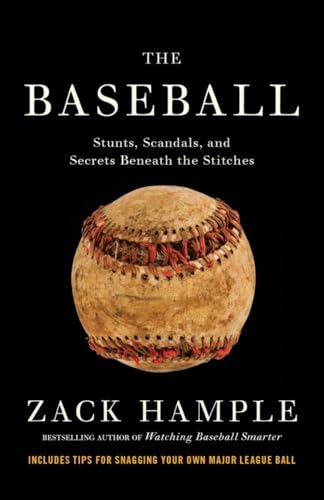
The Baseball is a salute to the ball, filled with insider trivia, anecdotes, and generations of ball-induced insanity—from Zack Hample, the bestselling author of Watching Baseball Smarter
• Which Hall of Famer once caught a ball dropped from an airplane?
• Why do balls get stamped with invisible ink?
• What’s the best ticket to buy for catching a foul ball?
• Which part of the ball once came from dog food companies?
• How could a 10,000-year-old glacier help a pitcher grip the ball?
In this enlightening, entertaining, and often wildly funny book, Zack Hample shares ballpark legends and lore, explores the history of the baseball souvenir craze, and also details the evolution of the ball. Finally, Hample—who has snagged more than 4,600 balls from 48 different major league stadiums—offers up his secret methods for snagging your own ball from major league games.
Features a ballhawk glossary, profiles of legendary ballhawks, top 10 lists, and black-and-white photos throughout.
Die Inhaltsangabe kann sich auf eine andere Ausgabe dieses Titels beziehen.
Über die Autorin bzw. den Autor
Zack Hample has written three books about baseball and has appeared on dozens of TV and radio shows. He has snagged more than 4,600 baseballs from 48 different major league stadiums. Hample runs a business called "Watch With Zack" and has a popular blog, The Baseball Collector, chronicling his obsession.
http://www.zackhample.com
Auszug. © Genehmigter Nachdruck. Alle Rechte vorbehalten.
Chapter 1
The Souvenir Craze
"BALL GRABBERS, READ THIS"
Way back in 1915, a first-class stamp cost two cents, a gallon of gas went for a quarter, and a game-used baseball fetched three bucks. At least, that was the going rate at the Polo Grounds when a Yankee fan named Guy Clarke snagged one in the left-field bleachers, got arrested for refusing to return it, and had to pay a $3 fine. That was a lot of money back then, but we're not talking about any old ball. It was a ninth-inning home run hit by Yankees shortstop Roger Peckinpaugh against the Boston Red Sox. Considering what that ball would sell for today, it was totally worth it. The editors at the New York Times, however, didn't see it that way, and on May 8, 1915—one day after the incident—the paper ran a short article called "Ball Grabbers, Read This." It was a warning, and the message was clear: if you steal a baseball, you're gonna get busted.
This was old news.
And it wasn't entirely true.
Clarke was just one of the unlucky few who got prosecuted; fans had been snapping up baseballs for years, and by 1915 more than two dozen balls were disappearing at the Polo Grounds each week. Yeah, these balls were expensive—owners were paying $15 per dozen—but beyond the financial burden, it didn't really matter. If a few balls were lost here and there, the home plate umpire simply replaced them.
That's not how things worked when the National League formed in 1876. High-quality balls were so scarce that each one was expected to last an entire game, and if the ball went missing, the players went looking for it. As a result, fans policed themselves whenever a ball landed in the crowd and made sure that it was returned. It had to be. There was no room for debate. But when foul balls flew completely over the grandstand and landed outside the ballpark, they were much harder to recover. These balls were often grabbed by little kids who didn't have enough money to buy tickets, so teams came up with a solution: anyone who returned a ball got to watch the game for free.
This reward system was effective at first, but kids eventually began to value the ball more than the opportunity to watch grown men play with it. (Can you blame them?) On June 1, 1887, Toronto World reported that "fifteen balls were knocked over the left field fence at Buffalo Monday and were stolen by bad boys." In other words, teams weren't just losing balls during games; kids were taking them during batting practice as well. What began as a nuisance—a missing ball every once in a while—was turning into an epidemic.
On May 1, 1897, The Sporting News declared that "the souvenir craze" was affecting games in the South. In 1899 the Washington Senators hired a group of boys to retrieve baseballs. By 1901 teams were spending so much money on balls that the National League Rules Committee suggested penalizing batters who fouled off good pitches. On May 2, 1902, the Detroit Free Press said, "Baseballs that go into the stands at St. Louis are hopelessly lost, the man who first gets his hands on the flying sphere clinging to it." Sometime around 1903, it was rumored that on one occasion when a fan at the Polo Grounds refused to return a ball, John McGraw, the Hall of Fame manager of the New York Giants, retaliated by stealing the guy's hat.
Major League Baseball took action the following season by officially giving teams the right to retrieve balls that were hit into the stands. This new measure worked in some cases, but for the most part all it did was piss off the fans and make them more determined than ever not to cooperate.
In 1905 a Cubs fan named Samuel Scott was arrested in Chicago after catching a foul ball and refusing to hand it over to an usher. Cubs president James Hart personally confronted him and signed a larceny complaint, but the charges were dropped the next day when Scott, a member of the Board of Trade, threatened to sue for assault and false arrest.
Things got progressively worse from there.
"Brooklynites seem to prize highly balls which go into the bleachers," reported the New York Tribune in 1908.
"Women are as bad as men about stealing baseballs; they aren't so skillful in hiding them," said baseball manufacturer Tom Shibe in 1911.
"The practice of concealing balls fouled into the grandstand or bleachers has reached disgusting proportions in New York," claimed Sporting Life magazine in 1915.
Cubs owner Charles Weeghman felt otherwise. He recognized the foul ball frenzy as a business opportunity—a chance to bring more folks to the ballpark—and on April 29, 1916, he began letting fans keep the foul balls they caught. Two and a half months later, the Phillies' business manager billed Weeghman for eight baseballs that were hit into the stands during BP, but that was the price of good PR. The October 1916 issue of Baseball magazine praised Weeghman in a lengthy staff editorial. "The charm of novelty, of possible gain might lure far more spectators than enough to pay for the lost balls," it said. "At any rate, Mr. Weeghman evidently thinks so. For he has recently inaugurated this common-sense policy in his park at Chicago."
Other owners just didn't get it.
"Why should a man carry away an object worth $2.50 just because he gets his hands on it?" asked Colonel "Cap" Huston, part-owner of the Yankees. "When people go to a restaurant, do they take the dishes or silverware home for souvenirs?"
Most teams generously donated used balls to servicemen during World War I, but continued bullying the regular fans.
Enter Reuben Berman.
On May 16, 1921, Berman, a 31-year-old stockbroker from Connecticut, caught a foul ball during a Reds-Giants game at the Polo Grounds,and when the ushers demanded that he return it, he responded by tossing it deeper into the crowd. Berman was whisked away by security personnel, taken to the team offices, threatened with arrest, and ejected from the stadium. Giants management figured that was the end of it, but nearly three months later Berman's attorney served the team with legal papers, claiming that his client had been unlawfully detained and had suffered mental anguish and a loss of reputation. The case was tried in New York's Supreme Court, and Berman was awarded $100—far less than the $20,000 sum originally sought by his attorney, but the message was delivered.
"Reuben's Rule" (as it came to be known) was the real turning point, although change didn't happen all at once. Several owners still refused to give in, and as a result, there were a few more high-profile clashes between fans and security personnel. The most outrageous incident took place in 1923, when an 11-year-old boy named Robert Cotter was arrested and thrown in jail for pocketing a ball at the Baker Bowl in Philadelphia. The following day he was released by a sympathetic judge who said, "Such an act on the part of a boy is merely proof that he is following his most natural impulses. It is a thing I would do myself."
Seven years later in Chicago, with Weeghman long gone as Cubs owner, there was another ugly incident involving a young fan. Arthur Porto, age 17, caught a Hack Wilson foul ball and brawled with stadium security when they tried to take it from him. He and his two friends, who had joined the scuffle, were booked for disorderly conduct. The next day in court the judge dismissed the charges and ruled that a ball hit into the crowd belongs "to the boy who grabs it."
There were still a few more altercations in the 1930s,and during World War II teams once again donated balls to the armed forces.During that time fans were asked to return whatever they snagged, but that was the end of it. Ballhawking bliss, along with a whole new set of controversies, was about to...
„Über diesen Titel“ kann sich auf eine andere Ausgabe dieses Titels beziehen.
Suchergebnisse für The Baseball: Stunts, Scandals, and Secrets Beneath...

Beispielbild für diese ISBN
The Baseball: Stunts, Scandals, and Secrets Beneath the Stitches
Anbieter: World of Books (was SecondSale), Montgomery, IL, USA
Verkäuferbewertung 5 von 5 Sternen

Zustand: Good. Item in good condition. Textbooks may not include supplemental items i.e. CDs, access codes etc. Artikel-Nr. 00093622627
Gebraucht kaufen
EUR 4,05
Versand gratis
Versand innerhalb von USA
Versand innerhalb von USA
Anzahl: 17 verfügbar
Beispielbild für diese ISBN
The Baseball: Stunts, Scandals, and Secrets Beneath the Stitches
Anbieter: World of Books (was SecondSale), Montgomery, IL, USA
Verkäuferbewertung 5 von 5 Sternen
Zustand: Acceptable. Item in good condition. Textbooks may not include supplemental items i.e. CDs, access codes etc. Artikel-Nr. 00064621243
Gebraucht kaufen
EUR 4,05
Versand gratis
Versand innerhalb von USA
Versand innerhalb von USA
Anzahl: 1 verfügbar
Beispielbild für diese ISBN
The Baseball: Stunts, Scandals, and Secrets Beneath the Stitches
Anbieter: World of Books (was SecondSale), Montgomery, IL, USA
Verkäuferbewertung 5 von 5 Sternen
Zustand: Very Good. Item in very good condition! Textbooks may not include supplemental items i.e. CDs, access codes etc. Artikel-Nr. 00105876031
Gebraucht kaufen
EUR 4,05
Versand gratis
Versand innerhalb von USA
Versand innerhalb von USA
Anzahl: 3 verfügbar
Beispielbild für diese ISBN
The Baseball: Stunts, Scandals, and Secrets Beneath the Stitches
Verlag:
Anchor (edition Illustrated), 2011
ISBN 10: 030747545X
ISBN 13: 9780307475459
Gebraucht
Paperback
Anbieter: BooksRun, Philadelphia, PA, USA
Verkäuferbewertung 5 von 5 Sternen
Paperback. Zustand: Very Good. Illustrated. It's a well-cared-for item that has seen limited use. The item may show minor signs of wear. All the text is legible, with all pages included. It may have slight markings and/or highlighting. Artikel-Nr. 030747545X-11-22
Gebraucht kaufen
EUR 4,98
Versand gratis
Versand innerhalb von USA
Versand innerhalb von USA
Anzahl: 1 verfügbar
Beispielbild für diese ISBN
The Baseball: Stunts, Scandals, and Secrets Beneath the Stitches
Verlag:
Anchor (edition Illustrated), 2011
ISBN 10: 030747545X
ISBN 13: 9780307475459
Gebraucht
Paperback
Anbieter: BooksRun, Philadelphia, PA, USA
Verkäuferbewertung 5 von 5 Sternen
Paperback. Zustand: Very Good. Illustrated. It's a well-cared-for item that has seen limited use. The item may show minor signs of wear. All the text is legible, with all pages included. It may have slight markings and/or highlighting. Artikel-Nr. 030747545X-8-18
Gebraucht kaufen
EUR 5,04
Versand gratis
Versand innerhalb von USA
Versand innerhalb von USA
Anzahl: 1 verfügbar
Beispielbild für diese ISBN
The Baseball: Stunts, Scandals, and Secrets Beneath the Stitches
Anbieter: ThriftBooks-Atlanta, AUSTELL, GA, USA
Verkäuferbewertung 5 von 5 Sternen
Paperback. Zustand: Very Good. No Jacket. May have limited writing in cover pages. Pages are unmarked. ~ ThriftBooks: Read More, Spend Less. Artikel-Nr. G030747545XI4N00
Gebraucht kaufen
EUR 6,12
Versand gratis
Versand innerhalb von USA
Versand innerhalb von USA
Anzahl: 1 verfügbar
Beispielbild für diese ISBN
The Baseball: Stunts, Scandals, and Secrets Beneath the Stitches
Anbieter: ThriftBooks-Dallas, Dallas, TX, USA
Verkäuferbewertung 5 von 5 Sternen
Paperback. Zustand: As New. No Jacket. Pages are clean and are not marred by notes or folds of any kind. ~ ThriftBooks: Read More, Spend Less. Artikel-Nr. G030747545XI2N00
Gebraucht kaufen
EUR 6,12
Versand gratis
Versand innerhalb von USA
Versand innerhalb von USA
Anzahl: 1 verfügbar
Beispielbild für diese ISBN
The Baseball: Stunts, Scandals, and Secrets Beneath the Stitches
Anbieter: ThriftBooks-Atlanta, AUSTELL, GA, USA
Verkäuferbewertung 5 von 5 Sternen
Paperback. Zustand: Very Good. No Jacket. Former library book; May have limited writing in cover pages. Pages are unmarked. ~ ThriftBooks: Read More, Spend Less. Artikel-Nr. G030747545XI4N10
Gebraucht kaufen
EUR 6,12
Versand gratis
Versand innerhalb von USA
Versand innerhalb von USA
Anzahl: 1 verfügbar
Beispielbild für diese ISBN
The Baseball : Stunts, Scandals, and Secrets Beneath the Stitches
Verlag:
Knopf Doubleday Publishing Group, 2011
ISBN 10: 030747545X
ISBN 13: 9780307475459
Gebraucht
Softcover
Anbieter: Better World Books, Mishawaka, IN, USA
Verkäuferbewertung 5 von 5 Sternen
Zustand: Good. Pages intact with minimal writing/highlighting. The binding may be loose and creased. Dust jackets/supplements are not included. Stock photo provided. Product includes identifying sticker. Better World Books: Buy Books. Do Good. Artikel-Nr. 5430510-6
Gebraucht kaufen
EUR 6,18
Versand gratis
Versand innerhalb von USA
Versand innerhalb von USA
Anzahl: 1 verfügbar
Beispielbild für diese ISBN
The Baseball : Stunts, Scandals, and Secrets Beneath the Stitches
Verlag:
Knopf Doubleday Publishing Group, 2011
ISBN 10: 030747545X
ISBN 13: 9780307475459
Gebraucht
Softcover
Anbieter: Better World Books, Mishawaka, IN, USA
Verkäuferbewertung 5 von 5 Sternen
Zustand: Very Good. Pages intact with possible writing/highlighting. Binding strong with minor wear. Dust jackets/supplements may not be included. Stock photo provided. Product includes identifying sticker. Better World Books: Buy Books. Do Good. Artikel-Nr. 4031477-6
Gebraucht kaufen
EUR 6,18
Versand gratis
Versand innerhalb von USA
Versand innerhalb von USA
Anzahl: 1 verfügbar