
Inhaltsangabe
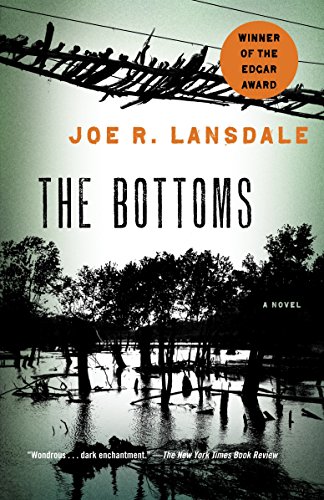
This Edgar Award winner is "equal parts morality tale and page-turning thriller" (Denver Post)—classic American storytelling in its truest, darkest, and most affecting form, with echoes of William Faulkner and Harper Lee.
Its 1933 in East Texas and the Depression lingers in the air like a slow moving storm. When a young Harry Collins and his little sister stumble across the body of a black woman who has been savagely mutilated and left to die in the bottoms of the Sabine River, their small town is instantly charged with tension. When a second body turns up, this time of a white woman, there is little Harry can do from stopping his Klan neighbors from lynching an innocent black man. Together with his younger sister, Harry sets out to discover who the real killer is, and to do so they will search for a truth that resides far deeper than any river or skin color.
Die Inhaltsangabe kann sich auf eine andere Ausgabe dieses Titels beziehen.
Über die Autorin bzw. den Autor
Joe R. Lansdale is the author of over thirty novels and numerous short stories. His work has appeared in national anthologies, magazines, and collections, as well as numerous foreign publications. He has written for comics, television, film, newspapers, and Internet sites. His work has been collected in eighteen short-story collections, and he has edited or co-edited over a dozen anthologies.
Lansdale has received the Edgar Award, eight Bram Stoker Awards, the Horror Writers Association Lifetime Achievement Award, the British Fantasy Award, the Grinzani Cavour Prize for Literature, the Herodotus Historical Fiction Award, the Inkpot Award for Contributions to Science Fiction and Fantasy, and many others.
A major motion picture based on Lansdale's crime thriller Cold in July was released in May 2014, starring Michael C. Hall (Dexter), Sam Shepard (Black Hawk Down), and Don Johnson (Miami Vice). His novella Bubba Hotep was adapted to film by Don Coscarelli, starring Bruce Campbell and Ossie Davis. His story "Incident On and Off a Mountain Road" was adapted to film for Showtime's "Masters of Horror." He is currently co-producing a TV series, "Hap and Leonard" for the Sundance Channel and films including The Bottoms, based on his Edgar Award-winning novel, with Bill Paxton and Brad Wyman, and The Drive-In, with Greg Nicotero.
Lansdale is the founder of the martial arts system Shen Chuan: Martial Science and its affiliate, Shen Chuan Family System. He is a member of both the United States and International Martial Arts Halls of Fame. He lives in Nacogdoches, Texas with his wife, dog, and two cats.
Auszug. © Genehmigter Nachdruck. Alle Rechte vorbehalten.
1
I suppose there were some back then had money, but we weren't among them. The Depression was on. And if we had been one of those with money, there really wasn't that much to buy, outside of hogs, chickens, vegetables, and the staples, and since we raised the first three, with us it was the staples, and sometimes we bartered for them.
Daddy farmed some, and where we lived wasn't so bad for growing things. The wind had blown away most of North and West Texas, along with Oklahoma, but the eastern part of Texas was lush with greenery and the soil was rich and there was enough rain so that things grew quick and hardy. Even during dry periods the soil tended to hold some moisture, and if a crop wasn't as good as it might be, it could still turn out. In fact, when the rest of Texas was tired out and gone to dust, East Texas would sometimes be subject to terrific rainstorms and even floods. We were more likely to lose a crop to dampness than to dryness.
Daddy had a barbershop as well, and he ran it most days except Sunday and Monday, and was a community constable because nobody else wanted the job. For a time he had been justice of the peace as well, but he finally decided it was more than he wanted, and Jim Jack Formosa took on the justice of the peace position, and Daddy always said Jim Jack was a damn sight better at marrying and declaring people stone cold dead than he ever was.
We lived back in the deep woods near the Sabine River in a three-room white house Daddy had built before we were born. We had a leak in the roof, no electricity, a smoky wood stove, a rickety barn, a sleeping porch with a patched screen, and an outhouse prone to snakes.
We used kerosene lamps, hauled water from the well, and did a lot of hunting and fishing to add to the larder. We had about four acres cut out of the woods, and owned another twenty-five acres of hard timber and pine. We farmed the cleared four acres of sandy land with a mule named Sally Redback. We had a car, but Daddy used it mostly for his constable business and Sunday church. The rest of the time we walked, or me and my sister rode Sally Redback.
The woods we owned, and the hundreds of acres of it that surrounded our land, was full of game, chiggers, and ticks. Back then in East Texas, all the big woods hadn't been timbered out and we didn't have a real advanced Forestry Department telling us how the forest needed help to survive. We just sort of figured since it had survived centuries without us it could probably figure things out on its own. And the woods didn't all belong to somebody back then, though of course timber was a big industry and was growing even bigger.
But there were still mighty trees and lost places in the woods and along the cool shaded riverbanks that no one had touched but animals.
Wild hogs, squirrels, rabbits, coons, possums, some armadillo, and all manner of birds and plenty of snakes were out there. Sometimes you could see water moccasins swimming in a school down the river, their evil heads bobbing up like knobs on logs. And woe unto the fella fell in amongst them, and bless the heart of the fool who believed if he swam down under them he'd be safe because a moccasin couldn't bite underwater. They not only could, but would.
Deer roamed the woods too. Maybe fewer than now, as people grow them like crops these days and harvest them on a three-day drunk during season from a deer stand with a high-powered rifle. Deer they've corn-fed and trained to be like pets' so they can get a cheap free shot and feel like they've done some serious hunting. It costs them more to shoot the deer, ride its corpse around in a pickup, and mount its head than it would cost to go to the store and buy an equal amount of beefsteak. Then there's those who like to smear their faces with the blood after the kill and take photos, as if this makes them some kind of warrior. You'd think the damn deer were armed and dangerous.
But I've quit talking, and gone to preaching. I was saying how we lived. And I was saying about all the game. Then too, there was the Goat Man. Half goat, half man, he liked to hang around what was called the Swinging Bridge. Up until the time I'm telling you about I had never seen him, but sometimes at night, out possum hunting, I thought maybe I heard him, howling and whimpering down there near the cable bridge that hung bold over the river, swinging with the wind in the moonlight, the beams playing on the metal cables like fairies on ropes.
He was supposed to steal animals and children, and though I didn't know of any children that had been eaten, some farmers claimed the Goat Man had taken their livestock, and there were kids I knew claimed they had cousins taken off by the Goat Man, never to be seen again.
It was said he didn't go as far as the main road because Baptist preachers traveled regular there on foot and by car, making the rounds, and therefore making the road holy. We called it the Preacher's Road.
It was said the Goat Man didn't get out of the woods that made up the Sabine bottoms. High land was something he couldn't tolerate. He needed the damp, thick leaf mush beneath his feet, which were hooves.
Dad said there wasn't any Goat Man. That it was a wives' tale heard throughout the South. He said what I heard out there was water and animal sounds, but I tell you, those sounds made your skin crawl, and they did remind you of a hurt goat. Mr. Cecil Chambers, who worked with my Daddy at the barbershop, said it was probably a panther. They showed up now and then in the deep woods, and they could scream like a woman, he said.
Me and my sister, Tom-well, Thomasina, but we all called her Tom 'cause it was easier to remember and because she was a tomboy-roamed those woods from daylight to dark. That wasn't unusual for kids back then. The woods were darn near a second home to us.
We had a dog named Toby that was part hound, part terrier, and part what we called feist. Toby was a hunting son of a gun. But the summer of nineteen thirty-three, while rearing up against a tree so he could bark at a squirrel he'd tracked, the oak he was under lost a rotten limb and it fell on him, striking him so hard he couldn't move his back legs or tail. I carried him home in my arms. Him whimpering, me and Tom crying.
Daddy was out in the field plowing with Sally Redback, working the plow around a stump that was still in the field. Now and then he chopped at its base with an axe and set fire to it, but it was stubborn and remained.
Daddy stopped his plowing when he saw us, took the looped lines off his shoulders and dropped them, left Sally Redback standing in the field hitched up to the plow. He walked part of the way across the field to meet us, and we carried Toby out to him and put him on the soft plowed ground and Daddy looked him over.
Unlike most farmers, Daddy never wore overalls. He always wore khaki pants, work shirts, work shoes, and a brown felt hat. His idea of dressing up was a clean white shirt with a thin black tie and the rest of him decked out in khakis and work shoes and a less battered hat.
This day he took off his sweat-ringed hat, squatted down, and put the hat on his knee. He had dark brown hair and in the sunlight you could see it was touched with streaks of gray. He had a slightly long face and light green eyes that, though soft, seemed to look right through you.
Daddy moved Toby's paws around, tried to straighten his back, but Toby whined hard when he did that.
After a while, as if considering all possibilities, he told me and Tom to get the gun and take poor Toby out in the woods and put him out of his misery.
"It ain't what I want you...
„Über diesen Titel“ kann sich auf eine andere Ausgabe dieses Titels beziehen.
Weitere beliebte Ausgaben desselben Titels

Suchergebnisse für The Bottoms

Beispielbild für diese ISBN
The Bottoms
Verlag:
Vintage Crime/Black Lizard, 2010
ISBN 10: 0307475263
ISBN 13: 9780307475268
Gebraucht
Softcover
Anbieter: World of Books (was SecondSale), Montgomery, IL, USA
Verkäuferbewertung 5 von 5 Sternen

Zustand: Good. Item in good condition. Textbooks may not include supplemental items i.e. CDs, access codes etc. Artikel-Nr. 00103205098
Gebraucht kaufen
EUR 5,35
Versand gratis
Versand innerhalb von USA
Versand innerhalb von USA
Anzahl: 2 verfügbar
Beispielbild für diese ISBN
The Bottoms
Verlag:
Vintage Crime/Black Lizard, 2010
ISBN 10: 0307475263
ISBN 13: 9780307475268
Gebraucht
Softcover
Anbieter: World of Books (was SecondSale), Montgomery, IL, USA
Verkäuferbewertung 5 von 5 Sternen
Zustand: Very Good. Item in very good condition! Textbooks may not include supplemental items i.e. CDs, access codes etc. Artikel-Nr. 00104418964
Gebraucht kaufen
EUR 5,35
Versand gratis
Versand innerhalb von USA
Versand innerhalb von USA
Anzahl: 1 verfügbar
Beispielbild für diese ISBN
The Bottoms
Verlag:
Vintage Crime/Black Lizard, 2010
ISBN 10: 0307475263
ISBN 13: 9780307475268
Gebraucht
Paperback
Anbieter: ThriftBooks-Dallas, Dallas, TX, USA
Verkäuferbewertung 5 von 5 Sternen
Paperback. Zustand: Fair. No Jacket. Readable copy. Pages may have considerable notes/highlighting. ~ ThriftBooks: Read More, Spend Less. Artikel-Nr. G0307475263I5N00
Gebraucht kaufen
EUR 5,95
Versand gratis
Versand innerhalb von USA
Versand innerhalb von USA
Anzahl: 1 verfügbar
Beispielbild für diese ISBN
The Bottoms
Verlag:
Vintage Crime/Black Lizard, 2010
ISBN 10: 0307475263
ISBN 13: 9780307475268
Gebraucht
Paperback
Anbieter: ThriftBooks-Atlanta, AUSTELL, GA, USA
Verkäuferbewertung 5 von 5 Sternen
Paperback. Zustand: Fair. No Jacket. Readable copy. Pages may have considerable notes/highlighting. ~ ThriftBooks: Read More, Spend Less. Artikel-Nr. G0307475263I5N00
Gebraucht kaufen
EUR 5,95
Versand gratis
Versand innerhalb von USA
Versand innerhalb von USA
Anzahl: 1 verfügbar
Beispielbild für diese ISBN
The Bottoms
Verlag:
Vintage Crime/Black Lizard, 2010
ISBN 10: 0307475263
ISBN 13: 9780307475268
Gebraucht
Paperback
Anbieter: ThriftBooks-Phoenix, Phoenix, AZ, USA
Verkäuferbewertung 5 von 5 Sternen
Paperback. Zustand: Fair. No Jacket. Readable copy. Pages may have considerable notes/highlighting. ~ ThriftBooks: Read More, Spend Less. Artikel-Nr. G0307475263I5N00
Gebraucht kaufen
EUR 5,95
Versand gratis
Versand innerhalb von USA
Versand innerhalb von USA
Anzahl: 1 verfügbar
Beispielbild für diese ISBN
The Bottoms
Verlag:
Vintage Crime/Black Lizard, 2010
ISBN 10: 0307475263
ISBN 13: 9780307475268
Gebraucht
Paperback
Anbieter: ThriftBooks-Reno, Reno, NV, USA
Verkäuferbewertung 5 von 5 Sternen
Paperback. Zustand: Fair. No Jacket. Readable copy. Pages may have considerable notes/highlighting. ~ ThriftBooks: Read More, Spend Less. Artikel-Nr. G0307475263I5N00
Gebraucht kaufen
EUR 5,95
Versand gratis
Versand innerhalb von USA
Versand innerhalb von USA
Anzahl: 1 verfügbar
Beispielbild für diese ISBN
The Bottoms
Verlag:
Vintage Crime/Black Lizard, 2010
ISBN 10: 0307475263
ISBN 13: 9780307475268
Gebraucht
Softcover
Anbieter: Wonder Book, Frederick, MD, USA
Verkäuferbewertung 5 von 5 Sternen
Zustand: Good. Good condition. A copy that has been read but remains intact. May contain markings such as bookplates, stamps, limited notes and highlighting, or a few light stains. Artikel-Nr. V15C-03207
Gebraucht kaufen
EUR 6,79
Versand gratis
Versand innerhalb von USA
Versand innerhalb von USA
Anzahl: 1 verfügbar
Beispielbild für diese ISBN
The Bottoms
Verlag:
Vintage Crime/Black Lizard, 2010
ISBN 10: 0307475263
ISBN 13: 9780307475268
Gebraucht
Paperback
Anbieter: WorldofBooks, Goring-By-Sea, WS, Vereinigtes Königreich
Verkäuferbewertung 5 von 5 Sternen
Paperback. Zustand: Very Good. The book has been read, but is in excellent condition. Pages are intact and not marred by notes or highlighting. The spine remains undamaged. Artikel-Nr. GOR004393899
Gebraucht kaufen
EUR 4,01
EUR 6,48 Versand
Versand von Vereinigtes Königreich nach USA
Versand von Vereinigtes Königreich nach USA
Anzahl: 3 verfügbar
Foto des Verkäufers
The Bottoms
Verlag:
Vintage Crime/Black Lizard, 2010
ISBN 10: 0307475263
ISBN 13: 9780307475268
Gebraucht
Softcover
Anbieter: WeBuyBooks, Rossendale, LANCS, Vereinigtes Königreich
Verkäuferbewertung 5 von 5 Sternen
Zustand: Good. Most items will be dispatched the same or the next working day. A copy that has been read but remains in clean condition. All of the pages are intact and the cover is intact and the spine may show signs of wear. The book may have minor markings which are not specifically mentioned. Small Tears to the Dust Jacket, Slipcase, or cover. Artikel-Nr. rev2880264971
Gebraucht kaufen
EUR 4,39
EUR 6,44 Versand
Versand von Vereinigtes Königreich nach USA
Versand von Vereinigtes Königreich nach USA
Anzahl: 1 verfügbar
Beispielbild für diese ISBN
The Bottoms
Anbieter: AwesomeBooks, Wallingford, Vereinigtes Königreich
Verkäuferbewertung 5 von 5 Sternen
Paperback. Zustand: Very Good. The Bottoms This book is in very good condition and will be shipped within 24 hours of ordering. The cover may have some limited signs of wear but the pages are clean, intact and the spine remains undamaged. This book has clearly been well maintained and looked after thus far. Money back guarantee if you are not satisfied. See all our books here, order more than 1 book and get discounted shipping. Artikel-Nr. 7719-9780307475268
Gebraucht kaufen
EUR 5,93
EUR 5,78 Versand
Versand von Vereinigtes Königreich nach USA
Versand von Vereinigtes Königreich nach USA
Anzahl: 2 verfügbar