
Verwandte Artikel zu The Origin of Financial Crises: Central Banks, Credit...
The Origin of Financial Crises: Central Banks, Credit Bubbles, and the Efficient Market Fallacy - Softcover
Inhaltsangabe
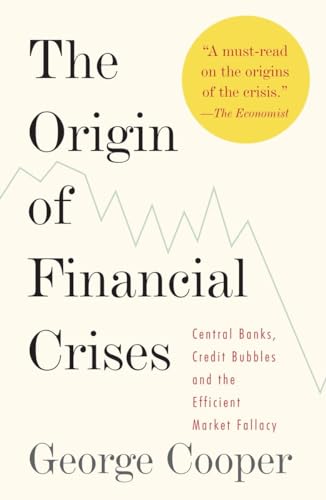
In a series of disarmingly simple arguments financial market analyst George Cooper challenges the core principles of today's economic orthodoxy and explains how we have created an economy that is inherently unstable and crisis prone. With great skill, he examines the very foundations of today's economic philosophy and adds a compelling analysis of the forces behind economic crisis. His goal is nothing less than preventing the seemingly endless procession of damaging boom-bust cycles, unsustainable economic bubbles, crippling credit crunches, and debilitating inflation. His direct, conscientious, and honest approach will captivate any reader and is an invaluable aid in understanding today's economy.
Die Inhaltsangabe kann sich auf eine andere Ausgabe dieses Titels beziehen.
Über die Autorin bzw. den Autor
Dr. George Cooper is a principal of Alignment Investors a division of BlueCrest Capital Management Ltd. He was born in Sunderland and studied at Durham University. Dr. Cooper has worked as a fund manager at Goldman Sachs and as strategist for Deutsche Bank and JPMorgan. He lives in London with his wife and two children.
Auszug. © Genehmigter Nachdruck. Alle Rechte vorbehalten.
1.1 Lopsided PolicyThe first years of this millennium were marred with a corporate credit crisis; this being the hangover of a credit binge associated with the stock market boom of the late 1990s. Just as this crisis ebbed we found ourselves engulfed in a housing boom and, sure as night follows day, this boom has now morphed into its inevitable credit crunch. The proximity of these boom-bust cycles has fuelled the popular perception that financial crises are becoming larger and more frequent. The following chapters will explain why this popular perception is correct.Toward the end of the book I make some policy suggestions that, it is hoped, could begin to dampen the current chain of overlapping boombust cycles. The overall thrust of these suggestions is that avoiding the financial tsunamis comes at the price of permitting, even encouraging, a greater number of smaller credit cycles. And also at the price of requiring central banks to occasionally halt credit expansions. That is to say, the central banks must be required to prick asset price bubbles. Key to the success of any such policy will be a political climate that accepts the need for symmetric monetary policy; excessive credit expansion should be fought with the same vigour as is used to fight excessive credit contraction. As things stand neither politicians nor voters are ready for such tough love and central bankers have neither the stomach nor inclination to deliver it. In large part this is because economists have taught us that it is unwise and unnecessary to combat asset price bubbles and excessive credit creation. Even if we were unwise enough to wish to prick an asset price bubble, we are told it is impossible to see the bubble while it is in its inflationary phase.We are told, however, that by some unspecified means the bubble's camouflage is lifted immediately as it begins deflating, thereby providing a trigger for prompt fiscal and monetary stimulus.In recent years this lopsided approach to monetary and fiscal policy has been further refined into what has been described as a “risk management paradigm”, whereby policy makers attempt to get their retaliation in early by easing policy in anticipation of an economic slowdown, even before firm evidence of the slowdown has been accumulated. This strategy is perhaps best described as pre-emptive asymmetric monetary policy.To followers of orthodox economic theory, based on the presumption of efficient financial markets, this new flavour of monetary policy can be justified. Yet, current events suggest these asymmetric policies have gone badly wrong, leading not to a higher average economic growth rate, as was hoped, but instead to a an unsustainable level of borrowing ending in abrupt credit crunches.1.2 Efficient Markets – More Faith Than FactThe bare outlines of a competitive profit-and-loss system are simple to describe. Everything has a price — each commodity and each service. Even the different kinds of human labor have prices, usually called 'wage rates.'Everybody receives money for what he sells and uses this money to buy what he wishes. If more is wanted of any one good, say shoes, a flood of new orders will be given for it. This will cause its price to rise and more to be produced. Similarly, if more is available of a good like tea than people want, its price will be marked down as a result of competition. At the lower price people will drink more tea, and producers will no longer produce so much. Thus equilibrium of supply and demand will be restored.What is true of the markets for consumers' goods is also true of markets for factors of production such as labor, land, and capital inputs.—Paul A SamuelsonWho could possibly argue with the above passage? It was written by one of the world's most respected economists and is no more than a statement of the common-sense principle of supply and demand. When the demand for a particular product goes up, so does its price, which is then followed by an increase in supply. According to this theory, prices jostle up and down keeping supply and demand in perfect balance.With just a little more thought we can stretch the argument further and convince ourselves not only that this process generates a stable equilibrium state, but that it also ensures the best possible arrangement of prices, leading to the optimal allocation of resources; if a better, more-economically productive, allocation of resources could be achieved, then those able to make better use of the resources would be able to pay more for them, causing prices to change accordingly. Naturally, if markets tend toward an optimal arrangement of prices, with the most productive allocation of resources, this configuration must also be a stable equilibrium situation. The upshot of all of this is what is known as the laissez-faire2 school of economic theory, which argues that market forces be given free rein to do as they choose. The logic of the laissez-faire school being that, if free markets naturally achieve an optimal equilibrium, any interference with market forces can at best achieve nothing, but more likely will push the system away from equilibrium toward a sub-optimal state. The prevailing laissez-faire school therefore requires the minimization, even elimination, of all forms of interference with the operation of market processes.It also follows from the efficient market philosophy that only external adverse shocks are able to push markets away from their natural optimal state, as, by definition, an equilibrium-seeking system cannot internally generate destabilising forces able to push it away from equilibrium.1.3 A Slight Of HandNow re-read Samuelson's passage, only this time look out for the slight of hand in the final sentence:What is true of the markets for consumers' goods is also true of markets for factors of production such as labor, land, and capital inputs.The passage provides a convincing explanation of how equilibrium is established in the marketplace for goods, but when it comes to the markets for labour, land and capital inputs, there is no explanation of the mechanisms through which equilibrium is established. For these markets we are offered nothing better than proof by assertion. This logical trick is pervasive in economic teaching: we are first persuaded that the markets for goods are efficient, and then beguiled into believing this to be a general principle applicable to all markets. As the failure of Northern Rock and Bear Stearns show it is unsafe to assume that all markets are inherently stable.1.4 The Market For BlingWe can easily find a counter example to Samuelson's well-behaved supply-and-demand driven markets. In the marketplace for fine art and luxury goods, demand is frequently stimulated precisely because supply cannot be increased in the manner required for market efficiency: Who would pay $140,000,000 for a Jackson Pollock painting if supply could be increased in proportion to demand? The phrase “conspicuous consumption” was coined by the economist Thorstein Veblen to describe markets where demand rose rather than declined with price. Veblen's theory was that in these markets it was the high price, the publically high price, of the object that generated the demand for it. Veblen argued that the wealthy used the purchase of high-priced goods to signal their economic status.3 Veblen was the original economist of bling — if you've got it you want to flaunt it.Fortunately for the high priests of market efficiency, Veblen's observations can be dismissed as minor distortions within an overall economic environment that responds in a rational manner to higher prices. That is to say, even at a price of $140,000,000, the market for Jackson Pollock paintings is irrelevant to the wider economy.1.5 When The Absence Of Supply Drives DemandWhile the markets for bling can be dismissed as economically...
„Über diesen Titel“ kann sich auf eine andere Ausgabe dieses Titels beziehen.
Suchergebnisse für The Origin of Financial Crises: Central Banks, Credit...

Beispielbild für diese ISBN
The Origin of Financial Crises: Central Banks, Credit Bubbles, and the Efficient Market Fallacy
Anbieter: World of Books (was SecondSale), Montgomery, IL, USA
Verkäuferbewertung 5 von 5 Sternen

Paperback. Zustand: Good. In a series of disarmingly simple arguments financial market analyst George Cooper challenges the core principles of today's economic orthodoxy and explains how we have created an economy that is inherently unstable and crisis prone. With great skill, he examines the very foundations of today's economic philosophy and adds a compelling analysis of the forces behind economic crisis. His goal is nothing less than preventing the seemingly endless procession of damaging boom-bust cycles, unsustainable economic bubbles, crippling credit crunches, and debilitating inflation. His direct, conscientious, and honest approach will captivate any reader and is an invaluable aid in understanding today's economy. Artikel-Nr. 00091393640
Gebraucht kaufen
EUR 4,01
Versand gratis
Versand innerhalb von USA
Versand innerhalb von USA
Anzahl: 15 verfügbar
Beispielbild für diese ISBN
The Origin of Financial Crises: Central Banks, Credit Bubbles, and the Efficient Market Fallacy
Verlag:
Knopf Doubleday Publishing Group, 2008
ISBN 10: 0307473457
ISBN 13: 9780307473455
Gebraucht
Softcover
Anbieter: World of Books (was SecondSale), Montgomery, IL, USA
Verkäuferbewertung 5 von 5 Sternen
Zustand: Acceptable. Item in acceptable condition! Textbooks may not include supplemental items i.e. CDs, access codes etc. Artikel-Nr. 00107468947
Gebraucht kaufen
EUR 4,01
Versand gratis
Versand innerhalb von USA
Versand innerhalb von USA
Anzahl: 1 verfügbar
Beispielbild für diese ISBN
The Origin of Financial Crises: Central Banks, Credit Bubbles, and the Efficient Market Fallacy
Verlag:
Knopf Doubleday Publishing Group, 2008
ISBN 10: 0307473457
ISBN 13: 9780307473455
Gebraucht
Softcover
Anbieter: World of Books (was SecondSale), Montgomery, IL, USA
Verkäuferbewertung 5 von 5 Sternen
Zustand: Very Good. Item in very good condition! Textbooks may not include supplemental items i.e. CDs, access codes etc. Artikel-Nr. 00104482245
Gebraucht kaufen
EUR 4,01
Versand gratis
Versand innerhalb von USA
Versand innerhalb von USA
Anzahl: 1 verfügbar
Beispielbild für diese ISBN
The Origin of Financial Crises : Central Banks, Credit Bubbles, and the Efficient Market Fallacy
Verlag:
Knopf Doubleday Publishing Group, 2008
ISBN 10: 0307473457
ISBN 13: 9780307473455
Gebraucht
Softcover
Erstausgabe
Anbieter: Better World Books, Mishawaka, IN, USA
Verkäuferbewertung 5 von 5 Sternen
Zustand: Very Good. 1ST. Pages intact with possible writing/highlighting. Binding strong with minor wear. Dust jackets/supplements may not be included. Stock photo provided. Product includes identifying sticker. Better World Books: Buy Books. Do Good. Artikel-Nr. 389191-6
Gebraucht kaufen
EUR 6,12
Versand gratis
Versand innerhalb von USA
Versand innerhalb von USA
Anzahl: 1 verfügbar
Beispielbild für diese ISBN
The Origin of Financial Crises : Central Banks, Credit Bubbles, and the Efficient Market Fallacy
Verlag:
Knopf Doubleday Publishing Group, 2008
ISBN 10: 0307473457
ISBN 13: 9780307473455
Gebraucht
Softcover
Erstausgabe
Anbieter: Better World Books, Mishawaka, IN, USA
Verkäuferbewertung 5 von 5 Sternen
Zustand: Good. 1ST. Pages intact with minimal writing/highlighting. The binding may be loose and creased. Dust jackets/supplements are not included. Stock photo provided. Product includes identifying sticker. Better World Books: Buy Books. Do Good. Artikel-Nr. GRP71406914
Gebraucht kaufen
EUR 6,12
Versand gratis
Versand innerhalb von USA
Versand innerhalb von USA
Anzahl: 1 verfügbar
Beispielbild für diese ISBN
The Origin of Financial Crises : Central Banks, Credit Bubbles, and the Efficient Market Fallacy
Verlag:
Knopf Doubleday Publishing Group, 2008
ISBN 10: 0307473457
ISBN 13: 9780307473455
Gebraucht
Softcover
Erstausgabe
Anbieter: Better World Books, Mishawaka, IN, USA
Verkäuferbewertung 5 von 5 Sternen
Zustand: Good. 1ST. Former library copy. Pages intact with minimal writing/highlighting. The binding may be loose and creased. Dust jackets/supplements are not included. Includes library markings. Stock photo provided. Product includes identifying sticker. Better World Books: Buy Books. Do Good. Artikel-Nr. GRP73619321
Gebraucht kaufen
EUR 6,12
Versand gratis
Versand innerhalb von USA
Versand innerhalb von USA
Anzahl: 1 verfügbar
Beispielbild für diese ISBN
The Origin of Financial Crises: Central Banks, Credit Bubbles, and the Efficient Market Fallacy
Verlag:
Knopf Doubleday Publishing Group, 2008
ISBN 10: 0307473457
ISBN 13: 9780307473455
Gebraucht
Softcover
Anbieter: Wonder Book, Frederick, MD, USA
Verkäuferbewertung 5 von 5 Sternen
Zustand: As New. Like New condition. A near perfect copy that may have very minor cosmetic defects. Artikel-Nr. J10Q-01144
Gebraucht kaufen
EUR 6,36
Versand gratis
Versand innerhalb von USA
Versand innerhalb von USA
Anzahl: 1 verfügbar
Beispielbild für diese ISBN
The Origin of Financial Crises: Central Banks, Credit Bubbles, and the Efficient Market Fallacy
Verlag:
Knopf Doubleday Publishing Group, 2008
ISBN 10: 0307473457
ISBN 13: 9780307473455
Gebraucht
Softcover
Anbieter: Wonder Book, Frederick, MD, USA
Verkäuferbewertung 5 von 5 Sternen
Zustand: Very Good. Very Good condition. A copy that may have a few cosmetic defects. May also contain light spine creasing or a few markings such as an owner's name, short gifter's inscription or light stamp. Artikel-Nr. L19P-00216
Gebraucht kaufen
EUR 6,36
Versand gratis
Versand innerhalb von USA
Versand innerhalb von USA
Anzahl: 3 verfügbar
Beispielbild für diese ISBN
The Origin of Financial Crises: Central Banks, Credit Bubbles, and the Efficient Market Fallacy
Anbieter: ThriftBooks-Reno, Reno, NV, USA
Verkäuferbewertung 5 von 5 Sternen
Paperback. Zustand: Very Good. No Jacket. May have limited writing in cover pages. Pages are unmarked. ~ ThriftBooks: Read More, Spend Less. Artikel-Nr. G0307473457I4N00
Gebraucht kaufen
EUR 6,90
Versand gratis
Versand innerhalb von USA
Versand innerhalb von USA
Anzahl: 1 verfügbar
Beispielbild für diese ISBN
The Origin of Financial Crises: Central Banks, Credit Bubbles, and the Efficient Market Fallacy
Anbieter: ThriftBooks-Atlanta, AUSTELL, GA, USA
Verkäuferbewertung 5 von 5 Sternen
Paperback. Zustand: Very Good. No Jacket. May have limited writing in cover pages. Pages are unmarked. ~ ThriftBooks: Read More, Spend Less. Artikel-Nr. G0307473457I4N00
Gebraucht kaufen
EUR 6,90
Versand gratis
Versand innerhalb von USA
Versand innerhalb von USA
Anzahl: 1 verfügbar