
Verwandte Artikel zu How Capitalism Will Save Us: Why Free People and Free...
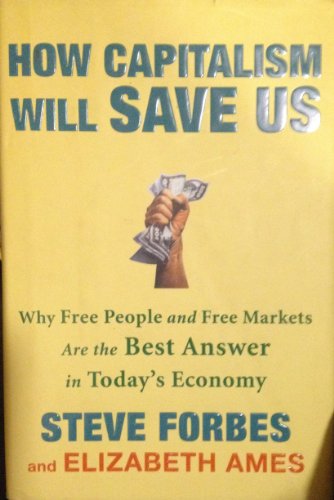
How Capitalism Will Save Us: Why Free People and Free Markets Are the Best Answer in Today's Economy - Hardcover
Inhaltsangabe
Addresses key issues about the fundamentals of a free-market economy to explain why democratic capitalism is more effective than other systems in improving everyday life, providing coverage of topics ranging from taxes and health care to the causes of the recent financial crisis.
Die Inhaltsangabe kann sich auf eine andere Ausgabe dieses Titels beziehen.
Über die Autorin bzw. den Autor
STEVE FORBES is chairman, CEO, and editor in chief at Forbes Media and an internationally respected authority in the worlds of economics, finance, and corporate leadership. He campaigned twice for the Republican nomination for the presidency. His previous books include Flat Tax Revolution, A New Birth of Freedom, and the New York Times bestseller Power Ambition Glory.
ELIZABETH AMES is founder of BOLDE Communications, which advises corporate and individual clients on communications strategies. Her work as a writer and journalist has appeared in a variety of magazines and newspapers.
Auszug. © Genehmigter Nachdruck. Alle Rechte vorbehalten.
Chapter One
"Is Capitalism Moral?"
The Rap eCapitalism is an amoral, dog-eat-dog system founded on greed and the survival of the fittest.
The Reality eCapitalism is the world's most humane economic system, promoting the democratic values of a free and open society: hard work, cooperation, generosity, charity, and devotion to the rule of law.
Is capitalism moral? The question has been debated since before the days of Karl Marx. But it has more relevance today than ever in the wake of the recent financial crisis and recession.
Capitalism's critics insist that evidence of its "immorality" is everywhere—from the collapse of Enron in the early 2000s to the "predatory lending" that helped bring on the subprime-mortgage meltdown and subsequent recession to investment adviser Bernard Madoff's mammoth $50 billion Ponzi scheme that wiped out personal and institutional fortunes around the globe. These and other events, they say, demonstrate that the free market is a winner-take-all jungle, a place where the most ferocious and dishonest triumph, where nice guys finish last, where greed rules and people get ahead by exploiting others.
No doubt there can be bad behavior in a capitalist system. There is bad behavior in any society. However, when viewed as a system, capitalism is more moral than any and all alternatives.
Capitalism has produced the world's highest standard of living by promoting the moral values of cooperation, democracy, and free choice. Nobel Prize–winning economist and noted free-market advocate Milton Friedman frequently made the point that capitalism's foremost historic contribution has been its moral influence.
As we started to discuss in the introduction to this book, capitalism is not about selfishness, but about the needs and wants of others. Former U.S. ambassador, noted theologian, and author Michael Novak makes this point:
The capitalist economy is not characterized, as Marx thought, by private ownership of the means of production, market exchange, and profit. All these were present in the precapitalist aristocratic age. Rather, the distinctive, defining difference of the capitalist economy is enterprise: the habit of employing human wit to invent new goods and services, and to discover new and better ways to bring them to the broadest possible public.1
Adam Smith explained in his classic work The Wealth of Nations that the exchange of goods and services in a market takes place only if both sides benefit. Such mutually beneficial exchanges, multiplied by the hundreds of millions, form what Smith referred to as "the invisible hand." The classic example of the pencil illustrates how these exchanges spontaneously allocate resources in a way that benefits more and more people.
To see the benefits of the Invisible Hand, one need only look around at the profusion of entrepreneurial businesses in most American communities. The vast array of goods and services generated by our vibrant democratic capitalist economy is unequaled: from 24-hour gyms and copy centers to supermarkets with countless varieties of food to even day spas in airports. The open markets of democratic capitalism meet needs that people don't even realize they had. Who ever would have imagined, for example, that we would need social networking sites such as Facebook? Or that you'd want to get a massage at an airport? Millions of Americans—and people around the world—now use Facebook and other similar sites every day, and they benefit from an Internet industry that began in the United States.
Free markets don't just meet the needs of the majority. If there's something people want or need, entrepreneurs in an open market will figure out a way to provide it—from size 22 shoes to hard-to-find spare parts for home appliances.
Since the emergence of democratic capitalism in the last three hundred years, humankind has made more advances—in incomes, standard of living, social mobility, and longevity—than in all the previous centuries put together.
Those who buy into capitalism's bad rap fail to see the moral significance of democratic capitalism's ability to provide for people's material well-being. And yet, would anyone question the immorality of regimes such as Venezuela, North Korea, and the former Soviet Union, where restrictions on personal and economic freedom have caused citizens to suffer extreme deprivation, food shortages, and even famine?
Democratic capitalism is moral precisely because it gives people the greatest latitude to meet their needs and desires by serving those of their fellow citizens, and, through doing so, it generates broad-based prosperity.
Many people today have forgotten that, for centuries, China was technologically ahead of Europe in metallurgy and shipbuilding. Both Europe and China, for example, developed the compass. But Europeans were the first to use it in navigating and exploring the earth. Why? Because Europe had a religious belief in the necessity of progress that eventually became a key underpinning of capitalism.
Milton Friedman wrote that capitalism is about being "free to choose."2 That's why free markets have caused people around the world to move in the direction of democracy. Michael Novak has observed: "Every democracy on earth that really does protect the human rights of its individual citizens is based, in fact, upon a free capitalist economy. Empirically speaking, there is not a single contrary case."3
Free markets are about people expressing their desires, saying yes or no to a product or service by essentially voting with their money. Economist Walter Williams has written that, in contrast to state- dominated societies, capitalism respects "the sanctity of the individual" and is "rooted in voluntary relationships rather than force and coercion."4
In a democratic capitalist economy, people interact in networks of cooperation that teach discipline and moral lessons—from the importance of showing up for work and handling money responsibly to the value of teamwork. Americans take capitalism's moral ethos for granted. Cynics may ridicule chirpy fast-food servers who greet them with "Have a nice day." But this etiquette reflects an emphasis on meeting the needs of others that is not present in other societies.
For example, twenty years after the fall of the Soviet Union, visitors to Russia still complain about the sullen customer service. That's because Russia's formerly communist society was run by a repressive government that controlled all resources and imposed its agenda on citizens. People had to accept what they got, take it or leave it. The idea of freely meeting people's needs—and being polite to them—in an open market was largely alien to this culture.
Russians are only now learning customer-service values from Western businesses like McDonald's that have managed to gain a foothold in the country's difficult business environment. The story is often told that when McDonald's started in Russia twenty years ago, company trainers had to overcome the famously dour attitude of service personnel whose attitude was "We've got the hamburgers. The customers don't."5
The value capitalism places on meeting the needs of others doesn't stop with the marketplace. It has made America a more charitable nation. No citizens give more of their income and time than the American people. According to New York University professor Claire Gaudiani, the U.S. gives twice as much as the next most charitable country—about $300 billion each year. This generosity extends throughout all income levels and is not limited to domestic charities. Americans have sent hundreds of millions of dollars overseas to help those in need after natural disasters ranging from the Burmese cyclone to the Asian Tsunami.
To fully appreciate the morality of...
„Über diesen Titel“ kann sich auf eine andere Ausgabe dieses Titels beziehen.
Suchergebnisse für How Capitalism Will Save Us: Why Free People and Free...

Beispielbild für diese ISBN
How Capitalism Will Save Us: W
Anbieter: World of Books (was SecondSale), Montgomery, IL, USA
Verkäuferbewertung 5 von 5 Sternen

Zustand: Very Good. Item in very good condition! Textbooks may not include supplemental items i.e. CDs, access codes etc. Artikel-Nr. 00109656042
Gebraucht kaufen
EUR 4,85
Versand gratis
Versand innerhalb von USA
Versand innerhalb von USA
Anzahl: 1 verfügbar
Beispielbild für diese ISBN
How Capitalism Will Save Us: W
Anbieter: World of Books (was SecondSale), Montgomery, IL, USA
Verkäuferbewertung 5 von 5 Sternen
Zustand: Acceptable. Item in acceptable condition! Textbooks may not include supplemental items i.e. CDs, access codes etc. Artikel-Nr. 00105601313
Gebraucht kaufen
EUR 4,85
Versand gratis
Versand innerhalb von USA
Versand innerhalb von USA
Anzahl: 1 verfügbar
Beispielbild für diese ISBN
How Capitalism Will Save Us: W
Anbieter: World of Books (was SecondSale), Montgomery, IL, USA
Verkäuferbewertung 5 von 5 Sternen
Zustand: Good. Item in good condition. Textbooks may not include supplemental items i.e. CDs, access codes etc. Artikel-Nr. 00102624706
Gebraucht kaufen
EUR 4,85
Versand gratis
Versand innerhalb von USA
Versand innerhalb von USA
Anzahl: 5 verfügbar
Beispielbild für diese ISBN
How Capitalism Will Save Us: Why Free People and Free Markets Are the Best Answer in Today's Economy
Anbieter: Wonder Book, Frederick, MD, USA
Verkäuferbewertung 5 von 5 Sternen
Zustand: As New. Like New condition. Very Good dust jacket. A near perfect copy that may have very minor cosmetic defects. Artikel-Nr. F11B-02464
Gebraucht kaufen
EUR 6,19
Versand gratis
Versand innerhalb von USA
Versand innerhalb von USA
Anzahl: 1 verfügbar
Beispielbild für diese ISBN
How Capitalism Will Save Us: Why Free People and Free Markets Are the Best Answer in Today's Economy
Anbieter: Wonder Book, Frederick, MD, USA
Verkäuferbewertung 5 von 5 Sternen
Zustand: Good. Good condition. Very Good dust jacket. A copy that has been read but remains intact. May contain markings such as bookplates, stamps, limited notes and highlighting, or a few light stains. Artikel-Nr. M13B-03050
Gebraucht kaufen
EUR 6,19
Versand gratis
Versand innerhalb von USA
Versand innerhalb von USA
Anzahl: 1 verfügbar
Beispielbild für diese ISBN
How Capitalism Will Save Us: Why Free People and Free Markets Are the Best Answer in Today's Economy
Anbieter: Wonder Book, Frederick, MD, USA
Verkäuferbewertung 5 von 5 Sternen
Zustand: Very Good. Very Good condition. Very Good dust jacket. A copy that may have a few cosmetic defects. May also contain light spine creasing or a few markings such as an owner's name, short gifter's inscription or light stamp. Artikel-Nr. H04L-00066
Gebraucht kaufen
EUR 6,19
Versand gratis
Versand innerhalb von USA
Versand innerhalb von USA
Anzahl: 1 verfügbar
Beispielbild für diese ISBN
How Capitalism Will Save Us: Why Free People and Free Markets Are the Best Answer in Today's Economy
Anbieter: ThriftBooks-Dallas, Dallas, TX, USA
Verkäuferbewertung 5 von 5 Sternen
Hardcover. Zustand: As New. No Jacket. Pages are clean and are not marred by notes or folds of any kind. ~ ThriftBooks: Read More, Spend Less. Artikel-Nr. G0307463095I2N00
Gebraucht kaufen
EUR 6,33
Versand gratis
Versand innerhalb von USA
Versand innerhalb von USA
Anzahl: 1 verfügbar
Beispielbild für diese ISBN
How Capitalism Will Save Us: Why Free People and Free Markets Are the Best Answer in Today's Economy
Anbieter: ThriftBooks-Atlanta, AUSTELL, GA, USA
Verkäuferbewertung 5 von 5 Sternen
Hardcover. Zustand: As New. No Jacket. Pages are clean and are not marred by notes or folds of any kind. ~ ThriftBooks: Read More, Spend Less. Artikel-Nr. G0307463095I2N00
Gebraucht kaufen
EUR 6,33
Versand gratis
Versand innerhalb von USA
Versand innerhalb von USA
Anzahl: 1 verfügbar
Beispielbild für diese ISBN
How Capitalism Will Save Us : Why Free People and Free Markets Are the Best Answer in Today's Economy
Verlag:
Crown Publishing Group, The, 2009
ISBN 10: 0307463095
ISBN 13: 9780307463098
Gebraucht
Hardcover
Erstausgabe
Anbieter: Better World Books, Mishawaka, IN, USA
Verkäuferbewertung 5 von 5 Sternen
Zustand: Very Good. 1st Edition. Pages intact with possible writing/highlighting. Binding strong with minor wear. Dust jackets/supplements may not be included. Stock photo provided. Product includes identifying sticker. Better World Books: Buy Books. Do Good. Artikel-Nr. 388662-6
Gebraucht kaufen
EUR 6,50
Versand gratis
Versand innerhalb von USA
Versand innerhalb von USA
Anzahl: 1 verfügbar
Beispielbild für diese ISBN
How Capitalism Will Save Us : Why Free People and Free Markets Are the Best Answer in Today's Economy
Verlag:
Crown Publishing Group, The, 2009
ISBN 10: 0307463095
ISBN 13: 9780307463098
Gebraucht
Hardcover
Erstausgabe
Anbieter: Better World Books, Mishawaka, IN, USA
Verkäuferbewertung 5 von 5 Sternen
Zustand: Good. 1st Edition. Pages intact with minimal writing/highlighting. The binding may be loose and creased. Dust jackets/supplements are not included. Stock photo provided. Product includes identifying sticker. Better World Books: Buy Books. Do Good. Artikel-Nr. 388661-75
Gebraucht kaufen
EUR 6,50
Versand gratis
Versand innerhalb von USA
Versand innerhalb von USA
Anzahl: 1 verfügbar