
Verwandte Artikel zu The Talent Masters: Why Smart Leaders Put People Before...
Inhaltsangabe
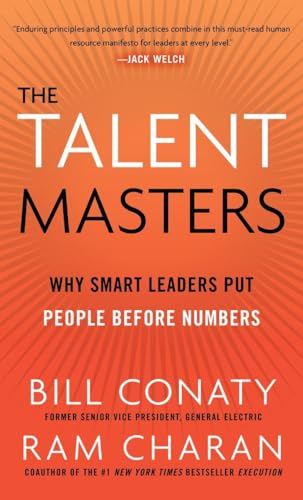
If talent is the leading indicator of whether a business is up or down, a success or a failure (and it is) . . . do you know how to accurately judge raw human talent? Understand a person's unique combination of traits? Develop that talent? Convert what supposedly are "soft" subjective judgments about people into objective criteria that are as specific, verifiable, and concrete as the contents of a financial statement?
The talent masters do. They put people before numbers for the simple reason that it is talent that delivers the numbers. Success comes from those who are able to extract meaning from events and the forces affecting a business, and are able to look at the world and assess the risks to take and the risks to avoid.
The Talent Masters itself stems from a unique combination of talent: During a forty-year career at General Electric, Bill Conaty worked closely with CEOs Jack Welch and Jeff Immelt to build that company's worldrenowned talent machine. Ram Charan is the legendary advisor to companies around the world. Together they use their unparalleled experience and insight to write the definitive book on talent—a breakthrough in how to take a business to the next level:
• Secrets of the masters. The specifics on how companies regarded as world-class—GE, P&G, Hindustan Unilever (and others)—base their stellar performance decade after decade on their systems for finding and nurturing leadership talent.
• Intimate and systemic. Why deep knowledge and intimacy with your talent and a systemic rhythm of reviews are the foundation for creating a steady, selfrenewing stream of leaders for all levels of an organization—from first-line supervisors to the CEO.
• The competency that lasts. Financial results, market share, brand, and legacy products all have a half-life that seems to grow shorter by the year. Talent is the only competency that endures.
• What to do Monday morning. The Talent Masters tool kit provides the specific guidelines for assessing and improving your company’s talent mastery capabilities.
Die Inhaltsangabe kann sich auf eine andere Ausgabe dieses Titels beziehen.
Über die Autorin bzw. den Autor
BILL CONATY, long recognized as a world leader in his field, recently retired as senior vice president for human resources at General Electric, the company consistently ranked as without peer in developing world-class leaders. The management development and training programs that Conaty engineered provided GE with one of the world’s most talent-rich management benches. Conaty has served as chairman of the National Academy of Human Resources and was named as a Distinguised Fellow, the organization’s highest honor. He currently serves as a personal advisor to the CEOs of companies around the world, including P&G, Boeing, Dell, Goodyear, LG Electronics (Korea), and UniCredit (Italy).
RAM CHARAN is a highly sought after business advisor and speaker famous among senior executives for his uncanny ability to solve their toughest business problems. For more than thirty-five years, Dr. Charan has worked behind the scenes with top executives at some of the world’s most successful companies, providing advice that is down-to-earth and relevant and that takes into account the real-world complexities of business. Dr. Charan is also the coauthor of Execution, The Game-Changer, and Confronting Reality and the author of What the CEO Wants You to Know, Know-How, and Leadership in the Era of Economic Uncertainty.
Auszug. © Genehmigter Nachdruck. Alle Rechte vorbehalten.
Chapter 1
TALENT is the EDGE
No Talent, No Numbers
If businesses managed their money as carelessly as they manage their people, most would be bankrupt.
The great majority of companies that control their finances masterfully don't have any comparable processes for developing their leaders or even pinpointing which ones to develop. No matter how much effort they put into recruiting, training, and assessing leaders, their talent management remains hit-or-miss: governed by superficial criteria and outdated concepts, dependent as much on luck as on skill. These are the companies that wake up some morning suddenly realizing they need a new CEO but don't know where to start looking. More pervasively, by repeatedly putting people into the wrong jobs, they waste both human and financial capital when those people don't perform.
How did this come to be? After all, it's clear enough that people make the decisions and take the actions that produce the numbers. Talent is the leading indicator of whether a business is headed up or down. Everyone agrees that it's a company's most important resource. But a spreadsheet full of numbers is a lot easier to parse than the characteristics unique to a human being. You can control what you're doing: the numbers are unambiguous, the outputs are clear. People, not so much. Better to leave that to the HR staff or search firms, particularly since the pressure to make your numbers quarter after quarter is so great that there's no time to waste on the soft stuff. And of course the law requires financial reports.
You've no doubt noticed, however, that making money has gotten harder. It will remain so for the imaginable future. In the fast-changing global marketplace, all of the familiar competitive advantages are constantly at risk: market share, brand, scale of a business, cost structure, technological know-how, patents, and all the rest. The half- life of core competencies grows ever shorter.
Talent will be the big differentiator between companies that succeed and those that don't. Those that win will be led by people who can adapt their organizations to change, make the right strategic bets, take calculated risks, conceive and execute new value-creating opportunities, and build and rebuild competitive advantage.
Only one competency lasts. It is the ability to create a steady, self- renewing stream of leaders. Money is just a commodity. Talent supplies the edge. We can't put it any better than Ron Nersesian, the head of Agilent Technologies' Electronic Measurement Group: "Developing people's talent is the whole of the company at the end of the day. Our products all are time-perishable. The only thing that stays is the institutional learning and the development of the skills and the capabilities that we have in our people."
Managing people with precision is without question harder than managing numbers, but it is doable and gets easier once you know how. Companies such as GE, P&G, Hindustan Unilever, and many others analyze talent, understand it, shape it, and build it through a combination of disciplined routines and processes, and something even rarer and harder to observe from outside: a collective expertise, honed through years of continuous improvement in recognizing and developing talent.
These companies have disproved the myth that the judgment of human potential is a "soft" art. Their rigorous, iterative, and repetitive processes convert subjective judgment about a person's talent into an objective set of observations that are specific, verifiable, and ultimately just as concrete as the analysis of a financial statement.
They have embedded in their culture the habits of observing talent, making judgments about it, and figuring out how to unleash it. They draw from their large toolboxes and creative imaginations to accelerate each leader's growth. Their executives are expected to make developing, deploying, and refreshing leadership talent an everyday, top-of-the-mind part of their jobs, and they are held accountable for how well they do it.
These companies are building for the long term. We call them talent masters, and this book will show you how they do it.
SEARCHING FOR THE SPECIFICS
One reason hardheaded managers disdain the "soft stuff" is that it so often reflects soft thinking. Take some of the criteria human resources staffs commonly use to evaluate leadership competencies. They'll rank people on a scale according to labels like these: "strategic," "innovative," "master communicator," "very bright," "analytic," "intuitive," and so on. These cryptic descriptions so broad that they are worthless in the real world of managing. They cannot even predict whether a person is a good or poor fit for a given job, much less capture the unique abilities of an outstanding leader.
An exercise in a course at Wharton's advanced management program exposes the futility of buzzword descriptors. The instructor at a recent session asked the participants to explain Steve Jobs's distinguishing talent. Put aside his controversial personality and behaviors for the moment, the instructor advised. What we want to know is why he has beaten all expectations in his second act at Apple. (Including his own; when Apple's market value overtook Microsoft's in June 2010, Jobs called the development "surreal.") In the dozen years since he reclaimed the failing company, he has turned it into a hard- driving, cash-generating machine. He doesn't just develop new products; he changes games. The iPod, iPhone, and iPad, along with iTunes, have created massive disruptions, forcing players in the music and telecom industries-among others-to change their business models.
There's enough information available about the way Jobs thinks, behaves, and makes decisions that anyone who cared to could assess his real talent in several dimensions and describe it in clear language with specificity and nuance. Most people don't even try.
When the instructor at Wharton asks participants the question about what Jobs's talent is, hands shoot up all over the room: he's creative, innovative, entrepreneurial; he's a master of communication; he breaks the paradigm, creates new businesses; he changes the game of other people. After a couple of minutes the instructor calls a halt. "You can't do it in buzzwords," he says. "To really define a person's talent, you need to express your full thought about a human being in whole sentences with nuances that are specific to that person. And you have to get the information by closely observing the person's actions, decisions, and patterns of behavior." He shows the way by asking some probing questions: "How is he creative?" Somebody replies, "He figures out what will be a great product." Okay, but how does he do that? "He interacts with consumers." Fine, but how does he interact with consumers? Somebody has read that he hangs out with young people. Another observes that he is always looking for upcoming technologies ahead of others. Still no cigar.
The instructor next gives the executives information they can use to drill down and get to the real nature of Steve Jobs's talent. For starters, they hear a tale from one Apple director about the special board meeting held after Jobs accepted the post. Jobs walked up to the wall of the conference room where Apple's roughly two dozen current products were on display and began taking them down, one at a time. When he was done, only four were left. Those were the ones, he said, that would give Apple new life by differentiating it in the marketplace.
The story provided two observable and verifiable facts about Jobs: he understands what appeals to customers, and he acts decisively. Now the instructor asks people to explain what the creation of the iPod reveals about his talent. The first replies from the group point to his grasp of technology. But the...
„Über diesen Titel“ kann sich auf eine andere Ausgabe dieses Titels beziehen.
Weitere beliebte Ausgaben desselben Titels

Suchergebnisse für The Talent Masters: Why Smart Leaders Put People Before...

Beispielbild für diese ISBN
The Talent Masters Why Smart L
Anbieter: World of Books (was SecondSale), Montgomery, IL, USA
Verkäuferbewertung 5 von 5 Sternen

Zustand: Very Good. Item in very good condition! Textbooks may not include supplemental items i.e. CDs, access codes etc. Artikel-Nr. 00101483931
Gebraucht kaufen
EUR 3,82
Versand gratis
Versand innerhalb von USA
Versand innerhalb von USA
Anzahl: 4 verfügbar
Beispielbild für diese ISBN
The Talent Masters Why Smart L
Anbieter: World of Books (was SecondSale), Montgomery, IL, USA
Verkäuferbewertung 5 von 5 Sternen
Zustand: Good. Item in good condition. Textbooks may not include supplemental items i.e. CDs, access codes etc. Artikel-Nr. 00092617171
Gebraucht kaufen
EUR 3,82
Versand gratis
Versand innerhalb von USA
Versand innerhalb von USA
Anzahl: 4 verfügbar
Beispielbild für diese ISBN
The Talent Masters Why Smart L
Anbieter: World of Books (was SecondSale), Montgomery, IL, USA
Verkäuferbewertung 5 von 5 Sternen
Zustand: Acceptable. Item in acceptable condition! Textbooks may not include supplemental items i.e. CDs, access codes etc. Artikel-Nr. 00102637596
Gebraucht kaufen
EUR 3,82
Versand gratis
Versand innerhalb von USA
Versand innerhalb von USA
Anzahl: 1 verfügbar
Beispielbild für diese ISBN
The Talent Masters: Why Smart Leaders Put People Before Numbers
Anbieter: BooksRun, Philadelphia, PA, USA
Verkäuferbewertung 5 von 5 Sternen
Hardcover. Zustand: Very Good. 1. With dust jacket. It's a well-cared-for item that has seen limited use. The item may show minor signs of wear. All the text is legible, with all pages included. It may have slight markings and/or highlighting. Artikel-Nr. 0307460266-11-1-29
Gebraucht kaufen
EUR 5,52
Versand gratis
Versand innerhalb von USA
Versand innerhalb von USA
Anzahl: 1 verfügbar
Beispielbild für diese ISBN
The Talent Masters: Why Smart Leaders Put People Before Numbers
Anbieter: Wonder Book, Frederick, MD, USA
Verkäuferbewertung 5 von 5 Sternen
Zustand: As New. Like New condition. Very Good dust jacket. A near perfect copy that may have very minor cosmetic defects. Artikel-Nr. A04A-02798
Gebraucht kaufen
EUR 6,28
Versand gratis
Versand innerhalb von USA
Versand innerhalb von USA
Anzahl: 1 verfügbar
Beispielbild für diese ISBN
The Talent Masters : Why Smart Leaders Put People Before Numbers
Verlag:
Crown/Archetype, 2010
ISBN 10: 0307460266
ISBN 13: 9780307460264
Gebraucht
Hardcover
Erstausgabe
Anbieter: Better World Books: West, Reno, NV, USA
Verkäuferbewertung 5 von 5 Sternen
Zustand: Very Good. 1st Edition. Pages intact with possible writing/highlighting. Binding strong with minor wear. Dust jackets/supplements may not be included. Stock photo provided. Product includes identifying sticker. Better World Books: Buy Books. Do Good. Artikel-Nr. 4374465-6
Gebraucht kaufen
EUR 6,59
Versand gratis
Versand innerhalb von USA
Versand innerhalb von USA
Anzahl: 1 verfügbar
Beispielbild für diese ISBN
The Talent Masters : Why Smart Leaders Put People Before Numbers
Verlag:
Crown/Archetype, 2010
ISBN 10: 0307460266
ISBN 13: 9780307460264
Gebraucht
Hardcover
Erstausgabe
Anbieter: Better World Books, Mishawaka, IN, USA
Verkäuferbewertung 5 von 5 Sternen
Zustand: Very Good. 1st Edition. Pages intact with possible writing/highlighting. Binding strong with minor wear. Dust jackets/supplements may not be included. Stock photo provided. Product includes identifying sticker. Better World Books: Buy Books. Do Good. Artikel-Nr. 4374465-6
Gebraucht kaufen
EUR 6,59
Versand gratis
Versand innerhalb von USA
Versand innerhalb von USA
Anzahl: 1 verfügbar
Beispielbild für diese ISBN
The Talent Masters : Why Smart Leaders Put People Before Numbers
Verlag:
Crown/Archetype, 2010
ISBN 10: 0307460266
ISBN 13: 9780307460264
Gebraucht
Hardcover
Erstausgabe
Anbieter: Better World Books, Mishawaka, IN, USA
Verkäuferbewertung 5 von 5 Sternen
Zustand: Good. 1st Edition. Pages intact with minimal writing/highlighting. The binding may be loose and creased. Dust jackets/supplements are not included. Stock photo provided. Product includes identifying sticker. Better World Books: Buy Books. Do Good. Artikel-Nr. 4706752-6
Gebraucht kaufen
EUR 6,59
Versand gratis
Versand innerhalb von USA
Versand innerhalb von USA
Anzahl: 1 verfügbar
Beispielbild für diese ISBN
The Talent Masters : Why Smart Leaders Put People Before Numbers
Verlag:
Crown/Archetype, 2010
ISBN 10: 0307460266
ISBN 13: 9780307460264
Gebraucht
Hardcover
Erstausgabe
Anbieter: Better World Books, Mishawaka, IN, USA
Verkäuferbewertung 5 von 5 Sternen
Zustand: Fine. 1st Edition. Used book that is in almost brand-new condition. May contain a remainder mark. Better World Books: Buy Books. Do Good. Artikel-Nr. 12836044-75
Gebraucht kaufen
EUR 6,59
Versand gratis
Versand innerhalb von USA
Versand innerhalb von USA
Anzahl: 1 verfügbar
Beispielbild für diese ISBN
The Talent Masters: Why Smart Leaders Put People Before Numbers
Anbieter: ThriftBooks-Dallas, Dallas, TX, USA
Verkäuferbewertung 5 von 5 Sternen
Hardcover. Zustand: Very Good. No Jacket. May have limited writing in cover pages. Pages are unmarked. ~ ThriftBooks: Read More, Spend Less. Artikel-Nr. G0307460266I4N00
Gebraucht kaufen
EUR 6,93
Versand gratis
Versand innerhalb von USA
Versand innerhalb von USA
Anzahl: 1 verfügbar