
Verwandte Artikel zu Hitler's Private Library: The Books That Shaped...
Inhaltsangabe
A Washington Post Notable Book
With a new chapter on eugenicist Madison Grant’s The Passing of the Great Race
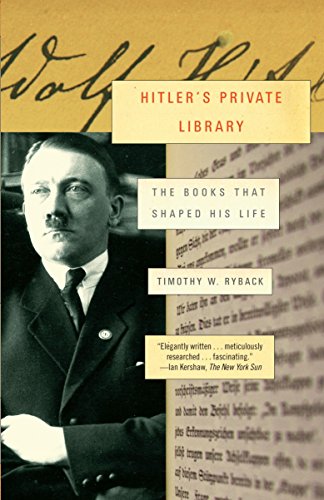
In this brilliant and original exploration of some of the formative influences in Adolf Hitler’s life, Timothy Ryback examines the books that shaped the man and his thinking.
Hitler was better known for burning books than collecting them but, as Ryback vividly shows us, books were Hitler’s constant companions throughout his life. They accompanied him from his years as a frontline corporal during the First World War to his final days before his suicide in Berlin. With remarkable attention to detail, Ryback examines the surviving volumes from Hitler’s private book collection, revealing the ideas and obsessions that occupied Hitler in his most private hours and the consequences they had for our world.
A feat of scholarly detective work, and a captivating biographical portrait, Hitler’s Private Library is one of the most intimate and chilling works on Hitler yet written.
Die Inhaltsangabe kann sich auf eine andere Ausgabe dieses Titels beziehen.
Über die Autorin bzw. den Autor
Timothy W. Ryback is the author of The Last Survivor: Legacies of Dachau, a New York Times Notable Book for 1999. He has written for The Atlantic Monthly, The New Yorker, The Wall Street Journal, and The New York Times. He is cofounder and codirector of the Institute for Historical Justice and Reconciliation and lives in Paris with his wife and three children.
Auszug. © Genehmigter Nachdruck. Alle Rechte vorbehalten.
The Man Who Burned Books
FOR HIM THE LIBRARY represented a Pierian spring, that mataphorica source of knowledge and inspiration. He drew deeply there, quelling his intellectual insecurities and nourishing his fanatic ambitions.He read voraciously, at least one book per night, sometimes more, so he claimed. “When one gives one also has to take,” he once said, “and I take what I need from books.”
He ranked Don Quixote,along with Robinson Crusoe, Uncle Tom’s Cabin, and Gulliver’s Travels,among the great works of world literature. “Each of them is a grandiose idea unto itself,” he said. In Robinson Crusoehe perceived “the development of the entire history of mankind.” Don Quixotecaptured “ingeniously” the end of an era. He owned illustrated editions of both books and was especially impressed by Gustave Doré’s romantic depictions ofCervantes’s delusion-plagued hero.
He also owned the collected works of William Shakespeare, published in German translation in 1925 by Georg Müller as part of a series intended to make great literature available to the general public. Volume six includes As You Like It, Twelfth Night, Hamlet, and Troilus and Cressida. The entire set is bound in hand-tooled Moroccan leather with a gold-embossed eaglevflanked by his initials on the spine.
He considered Shakespeare superior to Goethe and Schiller in every respect. While Shakespeare had fueled his imagination on the protean forces of the emerging British empire, these two Teutonic playwright-poets squandered their talent on stories ofmidlife crises and sibling rivalries. Why was it, he once wondered, that the German Enlightenment produced Nathan the Wise, the story of the rabbi who reconciles Christians, Muslims, and Jews, while it had been left to Shakespeare to give the world The Merchant of Veniceand Shylock?
He appears to have imbibed his Hamlet. “To be or not to be” was a favorite phrase, as was “It is Hecuba to me.” He was especially fond of Julius Caesar. In a 1926 sketchbook he drew a detailed stage set for the first act of the Shakespeare tragedy with sinister façades enclosing the forum where Caesar is cut down. “We will meet again at Philippi,” he threatened an opponent on more than one occasion, plagiarizing the spectral warning to Brutus after Caesar’s murder. He was said to have reserved the Ides ofMarch for momentous decisions.
He kept his Shakespeare volumes in the second-floor study of his alpine retreat in southern Germany, along with a leather edition of another favorite author, the adventure novelist Karl May. “The first Karl May that I read was The Ride Across the Desert,” he once recalled. “I was overwhelmed! I threw myself into him immediately which resulted in a noticeable decline in my grades.” Later in life, he was said to have sought solace in Karl May the way others did in the Bible.
He was versed in the Holy Scriptures, and owned a particularly handsome tome with Worte Christi,or Words of Christ,embossed in gold on a cream-colored calfskin cover that even today remains as smooth as silk. He also owned a German translation ofHenry Ford’s anti-Semitic tract, The International Jew: The World’s Foremost Problem, and a 1931 handbook on poison gas with a chapter detailing the qualities and effects ofprussic acid, the homicidal asphyxiant marketed commercially as Zyklon B. On his bedstand, he kept a well-thumbed copy of Wilhelm Busch’s mischievous cartoon duo Max and Moritz.
WALTER BENJAMIN ONCE SAID that you could tell a lot about a man by the books he keeps—his tastes, his interests, his habits. The books we retain and those we discard, those we read as well as those we decide not to, all say something about who we are. As a German-Jewish culture critic born ofan era when it was possible to be “German” and “Jewish,” Benjamin believed in the transcendent power ofKultur.He believed that creative expression not only enriches and illuminates the world we inhabit, but also provides the cultural adhesive that binds one generation
to the next, a Judeo-Germanic rendering of the ancient wisdom ars longa, vita brevis.
Benjamin held the written word—printed and bound—in especially highr egard. He loved books. He was fascinated by their physicality, by their durability, by their provenance. An astute collector, heargued, could“read”a book the way a physiognomist decipheredt he essence of a person’s character through his physical features. “Dates, placenames, formats, previous owners, bindings, and all the like,”Benjamin observed, “all these details must tell him something—not as dry isolated facts, but as a harmonious whole.”In short, you could j udge a book by its cover, and in turn the collector byhis collection. Quoting Hegel, Benjamin noted, “Only when it is dark does the owl of Minerva begin its flight,” and concluded,“Only in extinction is the collector comprehended.”
When Benjamin invoked a nineteenth-century German philosopher, a Roman goddess, and an owl, he was of course alluding to Georg Wilhelm Friedrich Hegel’s famous maxim: “The owl of Minerva spreads its wings only with the falling of dusk,” by which Hegel meant that philosophizing can begin only after events have run their course.
Benjamin felt the same was true about private libraries. Only after the collector had shelved his last book and died, when his library was allowed to speak for itself, without the proprietor to distract or obfuscate, could the individual volumes reveal the “preserved” knowledge of their owner: how he asserted his claim over them, with a name scribbled on the inside cover or an ex libris bookplate pasted across an entire page; whether he left them dog-eared and stained, or the pages uncut and unread.
Benjamin proposed that a private library serves as a permanent and credible witness to the character of its collector, leading him to the following philosophic conceit: we collect books in the belief that we are preserving them when in fact it is the books that preserve their collector. “Not that they come alive in him,” Benjamin posited. “It is he who lives in them.”
FOR THE LAST HALF CENTURY remnants of Adolf Hitler’s library have occupied shelf space in climatized obscurity in the Rare Book Division of the Library of Congress. The twelve hundred surviving volumes that once graced Hitler’s bookcases in his three elegantly appointed libraries—wood paneling, thick carpets, brass lamps, over- stuffed armchairs—at private residences in Munich, Berlin, and the Obersalzberg near Berchtesgaden, now stand in densely packed rows on steel shelves in an unadorned, dimly lit storage area of the Thomas Jefferson Building in downtown Washington, a stone’s throw from the Washington Mall and just across the street from the United States Supreme Court.
The sinews ofemotional logic that once ran through this collection— Hitler shuf?ed his books ceaselessly and insisted on reshelving them himself—have been severed. Hitler’s personal copy of his family genealogy is sandwiched between a bound collection of newspaper articles titled Sunday Meditationsand a folio ofpolitical cartoons from the 1920s. A handsomely bound facsimile edition ofletters by Frederick the Great, specially designed for Hitler’s ?ftieth birthday, lies on a shelf for oversized books beneath a similarly massive presentation volume on the city of Hamburg and an illustrated history of the German navy in the First World War. Hitler’s copy of the writings of the legendary Prussian general Carl von...
„Über diesen Titel“ kann sich auf eine andere Ausgabe dieses Titels beziehen.
Suchergebnisse für Hitler's Private Library: The Books That Shaped...

Beispielbild für diese ISBN
Hitler's Private Library: The Books That Shaped His Life
Anbieter: Books From California, Simi Valley, CA, USA
Verkäuferbewertung 4 von 5 Sternen

Paperback. Zustand: Very Good. Artikel-Nr. mon0003881864
Gebraucht kaufen
EUR 10,14
EUR 4,35 Versand
Versand innerhalb von USA
Versand innerhalb von USA
Anzahl: 2 verfügbar
Beispielbild für diese ISBN
Hitler's Private Library: The Books That Shaped His Life
Anbieter: Revaluation Books, Exeter, Vereinigtes Königreich
Verkäuferbewertung 5 von 5 Sternen

Paperback. Zustand: Brand New. 1st edition. 300 pages. 8.25x5.25x0.75 inches. In Stock. Artikel-Nr. x-0307455262
Neu kaufen
EUR 21,67
EUR 11,67 Versand
Versand von Vereinigtes Königreich nach USA
Versand von Vereinigtes Königreich nach USA
Anzahl: 2 verfügbar
Foto des Verkäufers
Hitler's Private Library: The Books That Shaped His Life
Verlag:
Knopf Doubleday Publishing Group, 2010
ISBN 10: 0307455262
ISBN 13: 9780307455260
Gebraucht
Softcover
Anbieter: Book Broker, Berlin, Deutschland
Verkäuferbewertung 5 von 5 Sternen
Zustand: Gut. 1. 324 S. Alle Bücher & Medienartikel von Book Broker sind stets in gutem & sehr gutem gebrauchsfähigen Zustand. Unser Produktfoto entspricht dem hier angebotenen Artikel, dieser weist folgende Merkmale auf: Ausgabejahr:. 2008. Helle/saubere Seiten in fester Bindung. Leichte Gebrauchsspuren. Sprache: Englisch Gewicht in Gramm: 278 Taschenbuch, Maße: 13.18 cm x 2.06 cm x 20.32 cm. Artikel-Nr. 661287923
Gebraucht kaufen
EUR 16,54
EUR 33,64 Versand
Versand von Deutschland nach USA
Versand von Deutschland nach USA
Anzahl: 1 verfügbar
Foto des Verkäufers
Hitler s Private Library
Verlag:
Knopf Doubleday Publishing Group, 2010
ISBN 10: 0307455262
ISBN 13: 9780307455260
Neu
Kartoniert / Broschiert
Anbieter: moluna, Greven, Deutschland
Verkäuferbewertung 5 von 5 Sternen
Kartoniert / Broschiert. Zustand: New. Timothy W. Ryback is the author of The Last Survivor: Legacies of Dachau, a New York Times Notable Book for 1999. He has written for The Atlantic Monthly, The New Yorker, The Wall Street Journal, and The New York. Artikel-Nr. 897693138
Neu kaufen
EUR 23,43
EUR 48,99 Versand
Versand von Deutschland nach USA
Versand von Deutschland nach USA
Anzahl: Mehr als 20 verfügbar