
Verwandte Artikel zu Zone One (Knopf Doubleday Publishing Group)
Inhaltsangabe
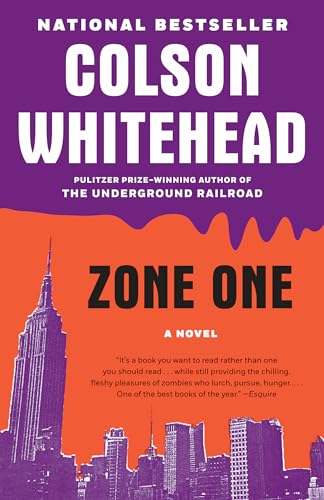
NATIONAL BESTSELLER • From the two-time Pulitzer Prize-winning author of The Underground Railroad and The Nickel Boys: A pandemic has devastated the planet, sorting humanity into two types: the uninfected and the infected, the living and the living dead. • "One of the best books of the year." —Esquire
After the worst of the plague is over, armed forces stationed in Chinatown’s Fort Wonton have successfully reclaimed the island south of Canal Street—aka Zone One. Mark Spitz is a member of one of the three-person civilian sweeper units tasked with clearing lower Manhattan of the remaining feral zombies. Zone One unfolds over three surreal days in which Spitz is occupied with the mundane mission of straggler removal, the rigors of Post-Apocalyptic Stress Disorder (PASD), and the impossible task of coming to terms with a fallen world. And then things start to go terribly wrong…
At once a chilling horror story and a literary novel by a contemporary master, Zone One is a dazzling portrait of modern civilization in all its wretched, shambling glory.
Look for Colson Whitehead’s new novel, Crook Manifesto!
Die Inhaltsangabe kann sich auf eine andere Ausgabe dieses Titels beziehen.
Über die Autorin bzw. den Autor
COLSON WHITEHEAD is the Pulitzer-Prize winning author of The Underground Railroad. His other works include The Noble Hustle, Zone One, Sag Harbor, The Intuitionist, John Henry Days, Apex Hides the Hurt, and one collection of essays, The Colossus of New York. A National Book Award winner and a recipient of MacArthur and Guggenheim fellowships, he lives in New York City.
Von der hinteren Coverseite
From the bestselling author of The Underground Railroad. A pandemic has devastated the planet, sorting humanity into two types: the uninfected and the infected, the living and the living dead. After the worst of the plague is over, armed forces stationed in Chinatown's Fort Wonton have successfully reclaimed the island south of Canal Street--aka Zone One. Mark Spitz is a member of one of the three-person civilian sweeper units tasked with clearing lower Manhattan of the remaining feral zombies. Zone One unfolds over three surreal days in which Spitz is occupied with the mundane mission of straggler removal, the rigors of Post-Apocalyptic Stress Disorder (PASD), and the impossible task of coming to terms with a fallen world. And then things start to go terribly wrong... At once a chilling horror story and a literary novel by a contemporary master, Zone One is a dazzling portrait of modern civilization in all its wretched, shambling glory.
Auszug. © Genehmigter Nachdruck. Alle Rechte vorbehalten.
He always wanted to live in New York. His Uncle Lloyd lived downtown on Lafayette, and in the long stretches between visits he daydreamed about living in his apartment. When his mother and father dragged him to the city for that season's agreed-upon exhibit or good-for-you Broadway smash, they usually dropped in on Uncle Lloyd for a quick hello. These afternoons were preserved in a series of photographs taken by strangers. His parents were holdouts in an age of digital multiplicity, raking the soil in lonesome areas of resistance: a coffee machine that didn't tell time, dictionaries made out of paper, a camera that only took pictures. The family camera did not transmit their coordinates to an orbiting satellite. It did not allow them to book airfare to beach resorts with close access to rain forests via courtesy shuttle. There was no prospect of video, high-def or otherwise. The camera was so backward that every lurching specimen his father enlisted from the passersby was able to operate it sans hassle, no matter the depth of cow-eyed vacancy in their tourist faces or local wretchedness inverting their spines. His family posed on the museum steps or beneath the brilliant marquee with the poster screaming over their left shoulders, always the same composition. The boy stood in the middle, his parents' hands dead on his shoulders, year after year. He didn't smile in every picture, only that percentage culled for the photo album. Then it was in the cab to his uncle's and up the elevator once the doorman screened them. Uncle Lloyd dangled in the doorframe and greeted them with a louche "Welcome to my little bungalow."
As his parents were introduced to Uncle Lloyd's latest girlfriend, the boy was down the hall, giddy and squeaking on the leather of the cappuccino sectional and marveling over the latest permutations in home entertainment. He searched for the fresh arrival first thing. This visit it was the wireless speakers haunting the corners like spindly wraiths, the next he was on his knees before a squat blinking box that served as some species of multimedia brainstem. He dragged a finger down their dark surfaces and then huffed on them and wiped the marks with his polo shirt. The televisions were the newest, the biggest, levitating in space and pulsing with a host of extravagant functions diagrammed in the unopened owner's manuals. His uncle got every channel and maintained a mausoleum of remotes in the storage space inside the ottoman. The boy watched TV and loitered by the glass walls, looking out on the city through smoky anti-UV glass, nineteen stories up.
The reunions were terrific and rote, early tutelage in the recursive nature of human experience. "What are you watching?" the girlfriends asked as they padded in bearing boutique seltzer and chips, and he'd say "The buildings," feeling weird about the pull the skyline had on him. He was a mote cycling in the wheels of a giant clock. Millions of people tended to this magnificent contraption, they lived and sweated and toiled in it, serving the mechanism of metropolis and making it bigger, better, story by glorious story and idea by unlikely idea. How small he was, tumbling between the teeth. But the girlfriends were talking about the monster movies on TV, the women in the monster movies bolting through the woods or shriveling in the closet trying not to make a sound or vainly flagging down the pickup that might rescue them from the hillbilly slasher. The ones still standing at the credit roll made it through by dint of an obscure element in their character. "I can't stand these scary stories," the girlfriends said before returning to the grown-ups, attempting an auntly emanation as if they might be the first of their number promoted to that office. His father's younger brother was fastidious when it came to expiration dates.
He liked to watch monster movies and the city churning below. He fixed on odd details. The ancient water towers lurking atop obstinate old prewars and, higher up, the massive central-air units that hunkered and coiled on the striving high-rises, glistening like extruded guts. The tar-paper pates of tenements. He spotted the occasional out-of-season beach chair jackknifed on gravel, seemingly gusted up from the street below. Who was its owner? This person staked out corners of the city and made a domain. He squinted at the slogans cantering along stairwell entrances, the Day-Glo threats and pidgin manifestos, a.k.a.'s of impotent revolutionaries. Blinds and curtains were open, half open, shut, voids in a punch card decipherable only by defunct mainframes lodged in the crust of unmarked landfills. Pieces of citizens were on display in the windows, arranged by a curator with a taste for non sequitur: the splayed pinstriped legs of an urban golfer putting into a colander; half a lady's torso, wrapped in a turquoise blazer, as glimpsed through a trapezoid; a fist trembling on a titanium desk. A shadow bobbed behind a bathroom's bumpy glass, steam slithering through the slit.
He remembered how things used to be, the customs of the skyline. Up and down the island the buildings collided, they humiliated runts through verticality and ambition, sulked in one another's shadows. Inevitability was mayor, term after term. Yesterday's old masters, stately named and midwifed by once-famous architects, were insulted by the soot of combustion engines and by technological advances in construction. Time chiseled at elegant stonework, which swirled or plummeted to the sidewalk in dust and chips and chunks. Behind the façades their insides were butchered, reconfigured, rewired according to the next era's new theories of utility. Classic six into studio honeycomb, sweatshop killing floor into cordoned cubicle mill. In every neighborhood the imperfect in their fashion awaited the wrecking ball and their bones were melted down to help their replacements surpass them, steel into steel. The new buildings in wave upon wave drew themselves out of rubble, shaking off the past like immigrants. The addresses remained the same and so did the flawed philosophies. It wasn't anyplace else. It was New York City.
The boy was smitten. His family stopped by Uncle Lloyd's every couple of months. He drank the seltzer, he watched monster movies, he was a sentry at the window. The building was a totem sheathed in blue metal, a changeling in the nest of old walk-ups. The zoning commission had tucked the bribes into their coats, and now there he was, floating over the tapering island. There was a message there, if he could teach himself the language. On rainy-day visits the surfaces of the buildings were pitiless and blank, as they were this day, years later. With the sidewalks hidden from view, the boy conjured an uninhabited city, where no one lived behind all those miles and miles of glass, no one caught up with loved ones in living rooms filled with tasteful and affirming catalog furniture, and all the elevators hung like broken puppets at the end of long cables. The city as ghost ship on the last ocean at the rim of the world. It was a gorgeous and intricate delusion, Manhattan, and from crooked angles on overcast days you saw it disintegrate, were forced to consider this tenuous creature in its true nature.
If you'd asked him on any of those childhood afternoons what he wanted to be when he grew up--tapping his shoulder as the family car inserted itself into the queue for the Midtown Tunnel or as they hummed toward their exit on the Long Island Expressway--he would have had nothing to offer with regards to profession or avocation. His father wanted to be an astronaut when he was a kid, but the boy had never been anything but earthbound, kicking pebbles. All he was truly sure of was that he wanted to live in a city gadget, something well-stocked and white-walled, equipped with rotating bosomy beauties. His uncle's apartment resembled the future, a brand of...
„Über diesen Titel“ kann sich auf eine andere Ausgabe dieses Titels beziehen.
Suchergebnisse für Zone One (Knopf Doubleday Publishing Group)

Beispielbild für diese ISBN
Zone One
Verlag:
Knopf Doubleday Publishing Group July 2012, 2012
ISBN 10: 0307455173
ISBN 13: 9780307455178
Gebraucht
Paper Back
Anbieter: Eagle Eye Books, Decatur, GA, USA
Verkäuferbewertung 4 von 5 Sternen

Paper Back. Zustand: Used. Artikel-Nr. 919023
Gebraucht kaufen
EUR 5,31
EUR 3,44 Versand
Versand innerhalb von USA
Versand innerhalb von USA
Anzahl: 1 verfügbar
Beispielbild für diese ISBN
Zone One (Knopf Doubleday Publ
Anbieter: World of Books (was SecondSale), Montgomery, IL, USA
Verkäuferbewertung 5 von 5 Sternen

Zustand: Acceptable. Item in acceptable condition! Textbooks may not include supplemental items i.e. CDs, access codes etc. Artikel-Nr. 00109515877
Gebraucht kaufen
EUR 9,63
Versand gratis
Versand innerhalb von USA
Versand innerhalb von USA
Anzahl: 1 verfügbar
Beispielbild für diese ISBN
Zone One (Knopf Doubleday Publ
Anbieter: World of Books (was SecondSale), Montgomery, IL, USA
Verkäuferbewertung 5 von 5 Sternen
Zustand: Very Good. Item in very good condition! Textbooks may not include supplemental items i.e. CDs, access codes etc. Artikel-Nr. 00109133845
Gebraucht kaufen
EUR 9,63
Versand gratis
Versand innerhalb von USA
Versand innerhalb von USA
Anzahl: 2 verfügbar
Beispielbild für diese ISBN
Zone One (Knopf Doubleday Publ
Anbieter: World of Books (was SecondSale), Montgomery, IL, USA
Verkäuferbewertung 5 von 5 Sternen
Zustand: Good. Item in good condition. Textbooks may not include supplemental items i.e. CDs, access codes etc. Artikel-Nr. 00109572483
Gebraucht kaufen
EUR 9,63
Versand gratis
Versand innerhalb von USA
Versand innerhalb von USA
Anzahl: 1 verfügbar
Beispielbild für diese ISBN
Zone One
Verlag:
Knopf Doubleday Publishing Group, 2012
ISBN 10: 0307455173
ISBN 13: 9780307455178
Gebraucht
Softcover
Anbieter: Better World Books: West, Reno, NV, USA
Verkäuferbewertung 5 von 5 Sternen
Zustand: Very Good. Pages intact with possible writing/highlighting. Binding strong with minor wear. Dust jackets/supplements may not be included. Stock photo provided. Product includes identifying sticker. Better World Books: Buy Books. Do Good. Artikel-Nr. 5674182-6
Gebraucht kaufen
EUR 9,76
Versand gratis
Versand innerhalb von USA
Versand innerhalb von USA
Anzahl: 1 verfügbar
Beispielbild für diese ISBN
Zone One
Verlag:
Knopf Doubleday Publishing Group July 2012, 2012
ISBN 10: 0307455173
ISBN 13: 9780307455178
Gebraucht
Paper Back
Anbieter: Eagle Eye Books, Decatur, GA, USA
Verkäuferbewertung 4 von 5 Sternen
Paper Back. Zustand: Used. Artikel-Nr. 925885
Gebraucht kaufen
EUR 7,09
EUR 3,44 Versand
Versand innerhalb von USA
Versand innerhalb von USA
Anzahl: 1 verfügbar
Beispielbild für diese ISBN
Zone One (Knopf Doubleday Publishing Group)
Anbieter: WorldofBooks, Goring-By-Sea, WS, Vereinigtes Königreich
Verkäuferbewertung 5 von 5 Sternen
Paperback. Zustand: Good. The book has been read but remains in clean condition. All pages are intact and the cover is intact. Some minor wear to the spine. Artikel-Nr. GOR006855951
Gebraucht kaufen
EUR 18,41
EUR 6,52 Versand
Versand von Vereinigtes Königreich nach USA
Versand von Vereinigtes Königreich nach USA
Anzahl: 1 verfügbar
Beispielbild für diese ISBN
Zone One (Knopf Doubleday Publishing Group)
Anbieter: WorldofBooks, Goring-By-Sea, WS, Vereinigtes Königreich
Verkäuferbewertung 5 von 5 Sternen
Paperback. Zustand: Very Good. The book has been read, but is in excellent condition. Pages are intact and not marred by notes or highlighting. The spine remains undamaged. Artikel-Nr. GOR004925588
Gebraucht kaufen
EUR 18,41
EUR 6,52 Versand
Versand von Vereinigtes Königreich nach USA
Versand von Vereinigtes Königreich nach USA
Anzahl: 1 verfügbar
Beispielbild für diese ISBN
Zone One
Anbieter: Roundabout Books, Greenfield, MA, USA
Verkäuferbewertung 4 von 5 Sternen
paperback. Zustand: New. Condition Notes: New from the publisher. Artikel-Nr. 1771883
Beispielbild für diese ISBN
Zone One: Journeys in Nordic Music and Culture
Anbieter: Majestic Books, Hounslow, Vereinigtes Königreich
Verkäuferbewertung 4 von 5 Sternen
Zustand: New. pp. 336. Artikel-Nr. 55205889
Neu kaufen
EUR 19,37
EUR 7,56 Versand
Versand von Vereinigtes Königreich nach USA
Versand von Vereinigtes Königreich nach USA
Anzahl: 3 verfügbar