
Verwandte Artikel zu Perilous Fight: America's Intrepid War with Britain...
Inhaltsangabe
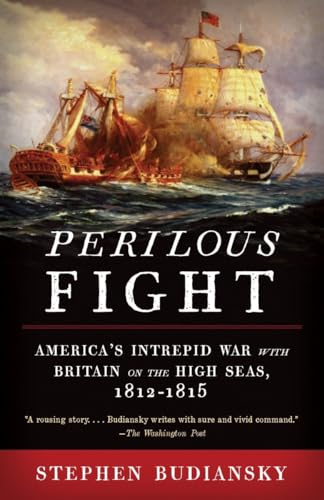
In Perilous Fight, Stephen Budiansky tells the rousing story of the U.S. Navy during the War of 1812, when an upstart American fleet fought off the legendary Royal Navy and established America as a world power for the first time.
Through vivid re-creations of riveting and dramatic encounters at sea, Budiansky shows how this underdog coterie of seamen and their visionary secretary of the navy combined bravery and strategic brilliance to defeat the British, who had dominated the seas for more than two centuries. A gripping and essential hsitory, this is the military and political story of how the U.S. Navy became a permanent and essential part of the nation’s defense.
Die Inhaltsangabe kann sich auf eine andere Ausgabe dieses Titels beziehen.
Über die Autorin bzw. den Autor
Stephen Budiansky is a military historian and journalist. His writings have appeared in The New York Times, The Atlantic, Men’s Journal, MHQ, Civil War Times, and many other publications. His previous books include The Bloody Shirt, Her Majesty’s Spymaster, Air Power, and Battle of Wits. He lives in Leesburg, Virginia.
Auszug. © Genehmigter Nachdruck. Alle Rechte vorbehalten.
Chapter 1
That America would have a navy at all in 1812 on the eveof her mad war against Britain was the direct result of events of a decadebefore that had spoken more to the young nation's heart than to her mind. The American mind was dead set against the temptations that the republic's foundersbelieved always led governments to war and tyranny. A solid majority of America's political leaders opposed on principle the very notion of a standing navy, a solid majority of Americans opposed the taxes that would be required topay for one, and no sane American of any political inclination thought that anynavy their country could ever possess would be able to contend with those ofthe great European powers.
Yet from the Anglophile merchants of New England to thebackwoods farmers on the frontier, Americans had been stirred by the glory that had been won by the captains and men of the tiny United States navy in worldsfar away ever since its founding in 1794, and it was that glory that had kep tthe service alive against all rational calculation to the contrary.
Edward Preble had no illusions about the price to be paidfor that glory. "People who handle dangerous weapons," he once wrote,"must expect wounds and Death." Preble was a man of action to the core, possessed of a legendary decisiveness and a volcanic temper. Just a year before joining his country's young navy in 1798 as a not-so-young thirty-seven-year-old lieutenant, Preble had taken exception to something a fellow merchant sailor had said to him in Boston, and cracked him over the head with a musket. Preble ended up paying his victim's room and board and medical bills while herecovered, then gave him $200 for his troubles; he never apologized, though.
The first week of February 1804 found Commodore Edward Preble, forty-two years old, captain of the frigate Constitution and commander of America's six-ship Mediterranean squadron, going prematurely bald and gray.His dark blue eyes were as fierce as ever, but he was increasingly given tobouts of racking physical debilitation from a griping stomach complaint that laid him low for days at a time. On the outside he usually managed to keep up afront of self-control and even optimism; inside he was blackened by darts of despair at the task before him, at his mission in life, at the distressing runof bad luck that kept coming his way.
Just a year before taking command of the Constitution the previous May, he had tried to resign his commission from the navy altogether, pleading his shattered state of health, which had kept him bedridden more oftenthan not for weeks on end. Writing the secretary of the navy, Robert Smith ,with his decision, Preble had enclosed a statement from his physician confirming that he was "reduced to a distressing state of debility andemaciation," adding, "he is extremely susceptible of injury from thecares and fatigues of business." His ship's surgeon agreed that theburdens of the job had proved too much for a man of Preble's hard-driving and easily provoked temperament.
But Secretary Smith had spurned the resignation, orderingPreble on furlough to get some rest, and slowly his health had improved enough for him to return to the endless vexations of commanding one of the three plumships of the tiny American fleet. For more than two years the American squadron in the Mediterranean had been waging an anemic battle against the Barbary corsairs that were raiding American ships traversing the region. For centuries the semi-independent Muslim states of Tunis, Algiers, and Tripoli had flourished on piracy and tribute extorted from European shippers that sailedthe Mediterranean. On May 14, 1801, the pasha of Tripoli had made known his dissatisfaction with the amount of tribute he had been receiving from the United States in return for allowing American ships to pass unmolested: in a symbolic declaration of war, the pasha had sent his men to chop down the flagstaff in front of the American consul's residence.
Little had happened since. The American naval force foundit could not effectively blockade Tripoli's harbor and had been reduced to defensive measures, convoying American ships rather than directly confrontingthe Tripolitan corsairs. American consuls in the region warned that the UnitedStates' prestige was plummeting-as was her navy's, both at home and abroad. Jefferson's cabinet, true to the anti-navalist credo of the Republican party,was strongly inclined to simply pay off the pasha and be done with it; Treasury Secretary Albert Gallatin wrote the president that he considered the decision "a mere matter of calculation whether the purchase of peace is not cheaper than the expense of a war."
Preble's and the Constitution's mission was to prove themwrong; or at least to prove that the navy had some value at all. Painfullyaware how much was riding on their mission, the secretary of the navyconfidently let be it known in Washington that Preble would be on station tenweeks from the date of receiving his orders. Instead, the months had slipped byas Preble struggled to get his ship seaworthy. The Constitution was only five years old but was literally rotting away at her moorings. She had served withdistinction during America's undeclared naval war with France from 1798 to 1800-the Quasi War, as it came to be called, triggered by French captures ofAmerican merchant ships trading with Britain and then by a wave of popularanger over the XYZ Affair, when an American delegation sent to Paris to resolvethe rising tensions was approached by three agents of the French government who demanded a large bribe. In February 1799 the Constitution had captured the French frigate Insurgente in the Caribbean; a year later she fought acourageous action to a draw with the much more powerful French fifty-two-gunwarship Vengeance. But with the signing of a peace treaty between America and France in September 1800, the ship had returned to Boston after one final cruise in the West Indies, and since June 1802 she had lain utterly neglected, accumulating weeds and decay, in the Charles River near Boston's Charlestown Navy Yard.
On May 20, 1803, Preble had come aboard, inspected herskeleton crew of one midshipman, one boatswain, and twelve men, and ordered a caulking stage brought alongside so he could examine the ship's bottom. The next day he climbed out onto the stage armed with a rake and began pulling upswaths of sea grass that had grown through gaping holes in the copper sheathing below the waterline.
Through the spring and summer of 1803 Preble worked dayafter day, morning to night, making "every exertion in my power," he wrote an old acquaintance, denying himself even "the pleasure of dining with a friend" as he urged the work on. Every seam of the frigate's planking had to be recaulked, a job that required all of the officers' roomsalongside the wardroom to be knocked out. There were cables to be made and tarred, ballast to be brought in, fifty-four thousand gallons of water in casksto be loaded, all new yards to be fitted, all of the ship's rigging to beremoved and rerigged. For the damaged copper sheathing to be replaced, the shipfirst had to be brought over to a wharf at Boston's North End, just across themouth of the Charles River, and all her guns and nearly all her ballast laboriously removed. Then the gunports had to be hammered shut and temporarily caulked tight to make them waterproof, everything that might slide around hadto be unloaded and the rudder unshipped, and then each day she was tipped overand held at a frightening angle by huge ten-inch-thick ropes running from herlower masts to a capstan on the wharf alongside. Massive poles braced the mastsagainst the edge of the deck to take the strain as the ship was heaved over, exposing her side all the way down to the keel, while relieving tackles running from the opposite side made sure she did not...
„Über diesen Titel“ kann sich auf eine andere Ausgabe dieses Titels beziehen.
Suchergebnisse für Perilous Fight: America's Intrepid War with Britain...

Beispielbild für diese ISBN
Perilous Fight: America's Intrepid War with Britain on the High Seas, 1812-1815
Verlag:
Knopf Doubleday Publishing Group, 2012
ISBN 10: 0307454959
ISBN 13: 9780307454959
Gebraucht
Softcover
Anbieter: World of Books (was SecondSale), Montgomery, IL, USA
Verkäuferbewertung 5 von 5 Sternen

Zustand: Good. Item in good condition. Textbooks may not include supplemental items i.e. CDs, access codes etc. Artikel-Nr. 00085096950
Gebraucht kaufen
EUR 4,32
Versand gratis
Versand innerhalb von USA
Versand innerhalb von USA
Anzahl: 2 verfügbar
Beispielbild für diese ISBN
Perilous Fight : America's Intrepid War with Britain on the High Seas, 1812-1815
Verlag:
Knopf Doubleday Publishing Group, 2012
ISBN 10: 0307454959
ISBN 13: 9780307454959
Gebraucht
Softcover
Anbieter: Better World Books, Mishawaka, IN, USA
Verkäuferbewertung 5 von 5 Sternen
Zustand: Good. Pages intact with minimal writing/highlighting. The binding may be loose and creased. Dust jackets/supplements are not included. Stock photo provided. Product includes identifying sticker. Better World Books: Buy Books. Do Good. Artikel-Nr. 8259228-6
Gebraucht kaufen
EUR 5,98
Versand gratis
Versand innerhalb von USA
Versand innerhalb von USA
Anzahl: 2 verfügbar
Beispielbild für diese ISBN
Perilous Fight: America's Intrepid War with Britain on the High Seas, 1812-1815
Anbieter: ThriftBooks-Atlanta, AUSTELL, GA, USA
Verkäuferbewertung 5 von 5 Sternen
Paperback. Zustand: Good. No Jacket. Pages can have notes/highlighting. Spine may show signs of wear. ~ ThriftBooks: Read More, Spend Less. Artikel-Nr. G0307454959I3N00
Gebraucht kaufen
EUR 7,10
Versand gratis
Versand innerhalb von USA
Versand innerhalb von USA
Anzahl: 1 verfügbar
Beispielbild für diese ISBN
Perilous Fight: America's Intrepid War with Britain on the High Seas, 1812-1815
Verlag:
Knopf Doubleday Publishing Group, 2012
ISBN 10: 0307454959
ISBN 13: 9780307454959
Gebraucht
Paperback
Anbieter: WorldofBooks, Goring-By-Sea, WS, Vereinigtes Königreich
Verkäuferbewertung 5 von 5 Sternen
Paperback. Zustand: Very Good. The book has been read, but is in excellent condition. Pages are intact and not marred by notes or highlighting. The spine remains undamaged. Artikel-Nr. GOR008007787
Gebraucht kaufen
EUR 2,51
EUR 6,52 Versand
Versand von Vereinigtes Königreich nach USA
Versand von Vereinigtes Königreich nach USA
Anzahl: 1 verfügbar
Beispielbild für diese ISBN
Perilous Fight: America's Intrepid War with Britain on the High Seas, 1812-1815
Anbieter: Powell's Bookstores Chicago, ABAA, Chicago, IL, USA
Verkäuferbewertung 5 von 5 Sternen
Paperback. Zustand: Used-Very Good. Reprint. Light shelf-wear. Clean copy. Artikel-Nr. 1734646
Gebraucht kaufen
EUR 11,12
EUR 6,47 Versand
Versand innerhalb von USA
Versand innerhalb von USA
Anzahl: 1 verfügbar
Beispielbild für diese ISBN
Perilous Fight: America's Intrepid War With Britain on the High Seas, 1812-1815
Anbieter: Revaluation Books, Exeter, Vereinigtes Königreich
Verkäuferbewertung 5 von 5 Sternen
Paperback. Zustand: Brand New. reprint edition. 422 pages. 8.00x5.25x1.00 inches. In Stock. Artikel-Nr. x-0307454959
Neu kaufen
EUR 23,35
EUR 11,64 Versand
Versand von Vereinigtes Königreich nach USA
Versand von Vereinigtes Königreich nach USA
Anzahl: 2 verfügbar
Foto des Verkäufers
Perilous Fight: America's Intrepid War with Britain on the High Seas, 1812-1815
Verlag:
Knopf Doubleday Publishing Group, 2012
ISBN 10: 0307454959
ISBN 13: 9780307454959
Gebraucht
Softcover
Anbieter: Book Broker, Berlin, Deutschland
Verkäuferbewertung 5 von 5 Sternen
Zustand: Sehr gut. Reprint. 456 S. Alle Bücher & Medienartikel von Book Broker sind stets in gutem & sehr gutem gebrauchsfähigen Zustand. Unser Produktfoto entspricht dem hier angebotenen Artikel, dieser weist folgende Merkmale auf: Helle/saubere Seiten in fester Bindung. Leichte Gebrauchsspuren. Sprache: Englisch Gewicht in Gramm: 400 Taschenbuch, Maße: 13.18 cm x 2.62 cm x 20.32 cm. Artikel-Nr. 661288170
Gebraucht kaufen
EUR 9,17
EUR 34,36 Versand
Versand von Deutschland nach USA
Versand von Deutschland nach USA
Anzahl: 1 verfügbar