
Verwandte Artikel zu Science Matters: Achieving Scientific Literacy
Inhaltsangabe
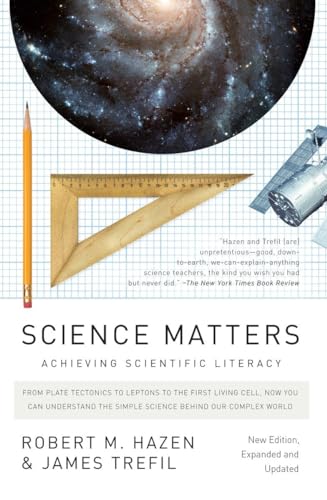
A science book for the general reader that is informative enough to be a popular textbook and yet well-written enough to appeal to general readers. “Hazen and Trefil [are] unpretentious—good, down-to-earth, we-can-explain-anything science teachers, the kind you wish you had but never did.”—The New York Times Book Review
Knowledge of the basic ideas and principles of science is fundamental to cultural literacy. But most books on science are often too obscure or too specialized to do the general reader much good.
Science Matters is a rare exception—a science book that is informative enough for introductory courses in high school and college, and yet lucid enough for readers uncomfortable with scientific jargon and complicated mathematics. And now, revised and expanded, it is up-to-date, so that readers can enjoy Hazen and Trefil's refreshingly accessible explanations of the most recent developments in science, from particle physics to biotechnology.
Die Inhaltsangabe kann sich auf eine andere Ausgabe dieses Titels beziehen.
Über die Autorin bzw. den Autor
ROBERT M. HAZEN is the author of more than 350 articles and 20 books on earth science, materials science, origins of life, history and music. A Fellow of the American Association for the Advancement of Science, he received the Mineralogical Society of America Award, the Ipatief Prize, the ASCAP-Deems Taylor Award, and other awards for his research and writing. Hazen is a researcher at the Carnegie Institution for Science and is Robinson Professor of Earth Sciences at George Mason University. His recent books include Genesis: The Scientific Quest for Life's Origins and The Sciences: An Integrated Approach (with James Trefil).
JAMES TREFIL, Robinson Professor of Physics at George Mason University, is the author of over 40 books and 100 articles in professional journals. He is a fellow of the American Physical Society, the American Association for the Advancement of Science, and the World Economic Forum. He is the recipient of the Andrew Gemant Award (American institute of Physics), the Westinghouse and Subaru Awards (American Association for the Advancement of Science) and the 2008 Science Writing Award (American Physical Society). His most recent books are Why Science and The Sciences: An Integrated Approach (with Robert Hazen).
Auszug. © Genehmigter Nachdruck. Alle Rechte vorbehalten.
CHAPTER ONE
Knowing
YOUR LIFE IS FILLED with routine—you set your alarm clock at night, take a shower in the morning, brush your teeth after breakfast, pay your bills on time, and fasten your seat belt. With each of these actions and a hundred others every day you acknowledge the power of predictability. If you don’t set the alarm you’ll probably be late for work or school. If you don’t take a shower you’ll probably smell. If you don’t fasten your seat belt and then get into a freeway accident you may die.
We all seek order to deal with life’s uncertainties. We look for patterns to help us cope. Scientists do the same thing. They constantly examine nature, guided by one overarching principle:
The universe is regular and predictable.
The universe is not random. The sun comes up every morning, the stars sweep across the sky at night. The universe moves in regular, predictable ways. Human beings can grasp the regularities of the universe and can even uncover the basic, simple laws that produce them. We call this activity “science.”
WAYS OF KNOWING
Science is one way of knowing about the world. The unspoken assumption behind the scientific endeavor is that general laws, discoverable by the human mind, exist and govern everything in the physical world. In its most advanced form, science is written in the language of mathematics, and therefore is not always easily accessible to the general public. But, like any other language, the language of science can be translated into simple English. When this is done, the beauty and simplicity of the great scientific laws can be shared by everyone.
Science is not the only way, nor always the best way, to gain an understanding of the world in which we find ourselves. Religion and philosophy help us come to grips with the meaning of life without the need for experimentation or mathematics, while art, music, and literature provide us with a kind of aesthetic, nonquantitative knowledge. You don’t need calculus to tell you whether a symphony or a poem has meaning for you. Science complements these other ways of knowing, providing us with insights about a different aspect of the universe.
The Regularity of Nature
Our ancestors perceived the universe in ways that sometimes seem very strange to us. For all but the past few hundred years of human existence the universe was viewed by most people as a place without deep order or rules, governed by the whims of the gods or even by chance. By noting the daily movements of objects in the sky, however, our ancestors got their first hints that some kind of order and regularity might exist in nature. The position of the sun, the phases of the moon, and the dominant constellations of stars cycled over the years, decades, and centuries with unerring regularity. Whatever governs its motion, the fact is that the sun does come up every morning.
Most historians of science point to the need for a reliable calendar to regulate agricultural activity as the impetus for learning about what we now call astronomy. Early astronomy provided information about when to plant crops and gave humans their first formal method of recording the passage of time. Stonehenge, the 4,000-year-old ring of stones in southern Britain, is perhaps the best-known monument to the discovery of regularity and predictability in the world we inhabit. The great markers of Stonehenge point to the spots on the horizon where the sun rises at the solstices and equinoxes—the dates we still use to mark the beginnings of the seasons. The stones may even have been used to predict eclipses. The existence of Stonehenge, built by people without writing, bears silent testimony both to the regularity of nature and to the ability of the human mind to see behind immediate appearances and discover deeper meanings in events.
The Invention of Science
Astronomy was the first science. Throughout history some of the best minds produced by the human race have pondered the meaning of the celestial display. Most of the resulting theories shared a common property—they all assumed that in some way Earth was special, and that what happened in the heavens had no relevance to phenomena on Earth. In one important version of the universe, for example, the stars and the planets turned eternally on crystal spheres, and their motion had nothing to do with mundane events like the fall of an apple in an orchard. People who believed that the universe was built this way produced a large body of accurate observations of the positions of heavenly bodies, but astronomers were divorced from craftsmen and artisans who were doing different things for the development of science.
While the astronomers were gazing into the heavens, other men and women, equally ingenious, were trying to understand the way things operated on Earth. Their motivation was practical: they studied the properties of heated metals because they wanted to develop stronger alloys, they studied the flow of fluids because they wanted to build canals, they experimented with different combinations of ingredients to make better-tasting food and more effective medicines, and so on. They never seemed to think that the prosaic tasks in which they were engaged had anything to do with the stars and planets.
The branch of science that finally broke out and forged a link between the cerebral astronomers and the practical artisans was “mechanics.” This is an old term for the study of motion. Every system, natural or man-made, contains matter in motion. Planets orbit, blood circulates, chemicals explode, people walk. Mechanics is the superbly pragmatic science of pocket billiards and car crashes, cannonballs and guided missiles. Today, the principles of mechanics point to such useful things as stronger buildings, faster cars, more exciting sports, and, as always, more sophisticated weapons. But more important from the point of view of the birth of modern science, the study of mechanics blazed the trail that subsequent scientists have followed. While studying mechanics, scientists developed and refined the scientific method, a technique that has given us so many new insights into the universe we inhabit.
THE CLOCKWORK UNIVERSE
Modern science can be said to have started with the work of Isaac Newton (1642–1727) in England. According to Newton, the universe is something like a clock. In a clock, the external appearance—the slow sweeping of the hands—is a result of the motion of internal gears. In the same way, all of the natural phenomena we see in the world around us are the result of a few natural laws working beneath the surface of things. Newton demonstrated that:
One set of laws describes all motion.
For Newton, the key fact about motion was that it occurs in response to the action of one or more forces. The “gears” that connect forces and motion are Newton’s three laws of motion, and they apply to everything that moves. Gases streaming out of an exploding star, a football thrown downfield, and blood cells in your arteries all move in compliance with these very simple, but very general, laws.
MOTION
Uniform Motion and Acceleration
If you’re going to study something like motion, the first thing you have to do is decide what sorts of motion are found in nature. Scientists recognize only two kinds: uniform and accelerated. Everything in the universe is either in uniform motion or accelerating.
Any object that stands still or moves in a straight line at constant speed is in uniform motion. A book sitting on your desk, a car driving along an interstate with the cruise control set at 65 mph, and a spaceship traveling at 1,000 miles per...
„Über diesen Titel“ kann sich auf eine andere Ausgabe dieses Titels beziehen.
Suchergebnisse für Science Matters: Achieving Scientific Literacy

Beispielbild für diese ISBN
Science Matters: Achieving Scientific Literacy
Verlag:
Anchor (edition Revised), 2009
ISBN 10: 0307454584
ISBN 13: 9780307454584
Gebraucht
Paperback
Anbieter: BooksRun, Philadelphia, PA, USA
Verkäuferbewertung 5 von 5 Sternen

Paperback. Zustand: Very Good. Revised. It's a well-cared-for item that has seen limited use. The item may show minor signs of wear. All the text is legible, with all pages included. It may have slight markings and/or highlighting. Artikel-Nr. 0307454584-11-1
Gebraucht kaufen
EUR 5,42
Versand gratis
Versand innerhalb von USA
Versand innerhalb von USA
Anzahl: 2 verfügbar
Beispielbild für diese ISBN
Science Matters (New Edition, Expanded and Updated): Achieving Scientific Literacy
Verlag:
Anchor (edition Revised), 2009
ISBN 10: 0307454584
ISBN 13: 9780307454584
Gebraucht
Paperback
Anbieter: BooksRun, Philadelphia, PA, USA
Verkäuferbewertung 5 von 5 Sternen
Paperback. Zustand: Very Good. Revised. It's a well-cared-for item that has seen limited use. The item may show minor signs of wear. All the text is legible, with all pages included. It may have slight markings and/or highlighting. Artikel-Nr. 0307454584-8-1
Gebraucht kaufen
EUR 6,22
Versand gratis
Versand innerhalb von USA
Versand innerhalb von USA
Anzahl: 1 verfügbar
Beispielbild für diese ISBN
Science Matters (New Edition, Expanded and Updated): Achieving Scientific Literacy
Anbieter: ThriftBooks-Reno, Reno, NV, USA
Verkäuferbewertung 5 von 5 Sternen
Paperback. Zustand: Fair. No Jacket. Readable copy. Pages may have considerable notes/highlighting. ~ ThriftBooks: Read More, Spend Less. Artikel-Nr. G0307454584I5N00
Gebraucht kaufen
EUR 6,24
Versand gratis
Versand innerhalb von USA
Versand innerhalb von USA
Anzahl: 2 verfügbar
Beispielbild für diese ISBN
Science Matters (New Edition, Expanded and Updated): Achieving Scientific Literacy
Anbieter: ThriftBooks-Phoenix, Phoenix, AZ, USA
Verkäuferbewertung 5 von 5 Sternen
Paperback. Zustand: Good. No Jacket. Former library book; Pages can have notes/highlighting. Spine may show signs of wear. ~ ThriftBooks: Read More, Spend Less. Artikel-Nr. G0307454584I3N10
Gebraucht kaufen
EUR 6,24
Versand gratis
Versand innerhalb von USA
Versand innerhalb von USA
Anzahl: 1 verfügbar
Beispielbild für diese ISBN
Science Matters (New Edition, Expanded and Updated): Achieving Scientific Literacy
Anbieter: ThriftBooks-Atlanta, AUSTELL, GA, USA
Verkäuferbewertung 5 von 5 Sternen
Paperback. Zustand: Very Good. No Jacket. May have limited writing in cover pages. Pages are unmarked. ~ ThriftBooks: Read More, Spend Less. Artikel-Nr. G0307454584I4N00
Gebraucht kaufen
EUR 6,24
Versand gratis
Versand innerhalb von USA
Versand innerhalb von USA
Anzahl: 1 verfügbar
Beispielbild für diese ISBN
Science Matters (New Edition, Expanded and Updated): Achieving Scientific Literacy
Anbieter: ThriftBooks-Dallas, Dallas, TX, USA
Verkäuferbewertung 5 von 5 Sternen
Paperback. Zustand: Good. No Jacket. Pages can have notes/highlighting. Spine may show signs of wear. ~ ThriftBooks: Read More, Spend Less. Artikel-Nr. G0307454584I3N00
Gebraucht kaufen
EUR 6,24
Versand gratis
Versand innerhalb von USA
Versand innerhalb von USA
Anzahl: 2 verfügbar
Beispielbild für diese ISBN
Science Matters (New Edition, Expanded and Updated): Achieving Scientific Literacy
Anbieter: ThriftBooks-Atlanta, AUSTELL, GA, USA
Verkäuferbewertung 5 von 5 Sternen
Paperback. Zustand: Fair. No Jacket. Former library book; Readable copy. Pages may have considerable notes/highlighting. ~ ThriftBooks: Read More, Spend Less. Artikel-Nr. G0307454584I5N10
Gebraucht kaufen
EUR 6,24
Versand gratis
Versand innerhalb von USA
Versand innerhalb von USA
Anzahl: 1 verfügbar
Beispielbild für diese ISBN
Science Matters (New Edition, Expanded and Updated): Achieving Scientific Literacy
Anbieter: ThriftBooks-Dallas, Dallas, TX, USA
Verkäuferbewertung 5 von 5 Sternen
Paperback. Zustand: Fair. No Jacket. Former library book; Readable copy. Pages may have considerable notes/highlighting. ~ ThriftBooks: Read More, Spend Less. Artikel-Nr. G0307454584I5N10
Gebraucht kaufen
EUR 6,24
Versand gratis
Versand innerhalb von USA
Versand innerhalb von USA
Anzahl: 1 verfügbar
Beispielbild für diese ISBN
Science Matters (New Edition, Expanded and Updated): Achieving Scientific Literacy
Anbieter: ThriftBooks-Phoenix, Phoenix, AZ, USA
Verkäuferbewertung 5 von 5 Sternen
Paperback. Zustand: Very Good. No Jacket. May have limited writing in cover pages. Pages are unmarked. ~ ThriftBooks: Read More, Spend Less. Artikel-Nr. G0307454584I4N00
Gebraucht kaufen
EUR 6,24
Versand gratis
Versand innerhalb von USA
Versand innerhalb von USA
Anzahl: 1 verfügbar
Beispielbild für diese ISBN
Science Matters (New Edition, Expanded and Updated): Achieving Scientific Literacy
Anbieter: ThriftBooks-Phoenix, Phoenix, AZ, USA
Verkäuferbewertung 5 von 5 Sternen
Paperback. Zustand: Fair. No Jacket. Readable copy. Pages may have considerable notes/highlighting. ~ ThriftBooks: Read More, Spend Less. Artikel-Nr. G0307454584I5N00
Gebraucht kaufen
EUR 6,24
Versand gratis
Versand innerhalb von USA
Versand innerhalb von USA
Anzahl: 2 verfügbar