
Verwandte Artikel zu MBA in a Book: Mastering Business with Attitude
Inhaltsangabe
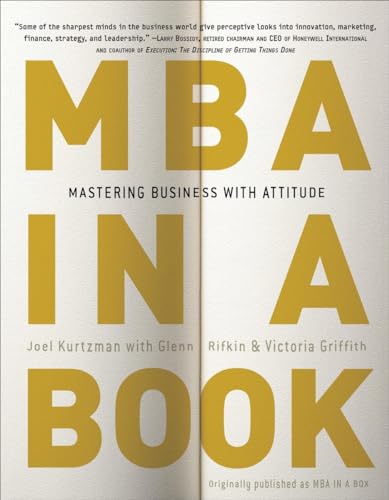
Practical ideas from the best brains in Business
A sharp, jargon-free guide to the core curriculum of an MBA program, MBA in a Book shows how to master the big ideas of business and use them in a practical way to build and enhance career success.
“In the world of business, ideas matter. . . . Some of the sharpest minds in the business world give perceptive looks into innovation, marketing, finance, strategy, and leadership, providing stimulating, useful perspectives on these core topics.”
—Larry Bossidy, retired chairman and CEO of Honeywell International and coauthor of Execution: The Discipline of Getting Things Done
Great business thinkers such as Michael Porter, Rosabeth Kanter, and Bill George of Harvard Business School; Paul Argenti of the Tuck School at Dartmouth; Jeffrey Sonnenfeld of Yale; Peter Senge of MIT; the entrepreneur and inventor Dean Kamen; and the financial innovator Michael Milken are just a few of the best brains in business, providing the intellectual nourishment that will help you play the game of business at the highest level.
Die Inhaltsangabe kann sich auf eine andere Ausgabe dieses Titels beziehen.
Über die Autorin bzw. den Autor
JOEL KURTZMAN is chairman of the Kurtzman Group (www.KurtzmanGroup.com), a research and consulting firm that focuses on issues relating to knowledge management, strategy, economic development, global risk, governance, and thought leadership. Earlier in his career he was a New York Times reporter and editor, an editor of Harvard Business Review, the founder of strategy+business magazine, and a senior partner for thought leadership and innovation at PricewaterhouseCoopers.
Auszug. © Genehmigter Nachdruck. Alle Rechte vorbehalten.
INTRODUCTION
When I was the editor of the Harvard Business Review, I had a recurring fantasy (no, not that kind of fantasy). In my fantasy the dean of the Harvard Business School–my boss–would call me into his dimly lit, book-lined, wood-paneled office. He would sit me down, draw the shades, and lock the door. He would pace. In some version of the fantasy he would wring his hands, shrug, hem and haw. In others he would offer me a glass of port and a fine cigar. (I liked the second version better.)
In that fantasy, the dean–an enormous man with a raspy, conspirator’s voice–would say to me that my job at the Harvard Business Review was to make business appear difficult to the readers. “Don’t publish any smart-aleck articles about how Andrew Carnegie or Henry Ford never finished grammar school or how Bill Gates dropped out of college. Publish articles that talk about how difficult business is, how complicated it is to read a balance sheet, how many times you have to run a regression analysis to really understand your market, how the problems of strategy are intractable. Make it all seem hard,” he would tell me with a scowl.
“Hard? Why?” I would ask rather meekly.
“Why? Why?” he would repeat, eyes narrowed into tiny slits. “Did you really ask me why, you nincompoop?”
“Yes,” I would say, clearing my throat. “I did.”
“Because it is. And besides, what would happen to our business if your readers thought business wasn’t all that difficult? That any imbecile could do it? What do we do then?” the dean would bellow. “We sell business education, business books, business magazines, online business content, business videos, business case studies, lectures, degrees, research, class notes. The whole shebang. If people thought business was easy, we’d be wiped out. Finito. End of story.”
My fantasy did not go on much after that. And in truth, I have great admiration for the dean, the school, the students, and the faculty. The Harvard Business School is a tremendous institution, and it has done an enormous amount of good for thousands of people and institutions on many, many levels. Even so, as I think about business, I have come to understand that my fantasy was in some ways right as well as wrong.
It was wrong because business isn’t easy. At least it isn’t at the moment. The forces governing competition today are very difficult to navigate. They are global, technological, financial, and human. The cycles of growth and decline–which many pundits in the 1990s said were no longer applicable–are back in full force. In fact, the same items–globalization and technology–that people said had ended the business cycle are now being viewed as making it worse. Globalization and technology, it is now said, have destroyed the ability of many companies to price their goods and services at a premium, which is hurting profits globally. (In the ’90s, the same phenomenon was viewed the other way around. Globalization and technology would check inflation and keep prices low so that cost-conscious consumers would continue buying, fueling what some people at the time called the “long boom.”)
But that’s not all.
The forces governing business are large–very large. They range from sudden, short-term shifts in consumer buying habits–a two-season-long denim craze, a two-year Hula Hoop frenzy, a four-year-long cigar fad, for example–to slower, medium-term changes, such as the decade-long shift from conservative business attire to clothes for casual Fridays and then to clothes for (as my children might say) whatever.
And then there are the longer-term changes on top of these shorter-term shifts. In many countries since the 1960s there has been a slow growth of citizen movements (nongovernmental organizations, protest and pressure groups, business-oriented religious groups, human rights groups, antiglobalization groups, animal rights groups, and so on). Over the last three or four decades, these groups have become very sophisticated, professional, and well organized. Many are well funded and highly strategic in their approach. Many of their leaders have degrees from elite business and professional schools. These groups employ carefully thought-out strategies to achieve their overall goals. They ally themselves with political parties and labor groups.
I have had direct experience with several of these groups in the United States and in Europe. The leader of a French antiglobalization group told me that his organization would never compromise with business on their aims because they have a greater political agenda. The group–whose leaders include some well-respected French journalists and university professors–told me they will not negotiate. Their aim was to restrict outbound French investment (keep French jobs in France), create tougher environmental restrictions, and limit non-French cultural imports (movies, music, and books), among other things. The leader of the group said he was against markets and against American-style capitalism. When this group plans a demonstration, tens of thousands of people show up. As a result, the politicians listen and companies must cope.
Another group, an American environmental organization, explained to me why it had mounted a boycott against a certain Japanese automaker. The carmaker, the group’s leader explained, was actually innocent when it came to the environmental offense in question. It did, however, have significant investment from, and shared directorships with, another Japanese company that was clear-cutting hardwood forests in Indonesia. By putting pressure on one company it could exert influence over the other due to their shared governance structure, the environmental leader explained. Over the last twenty-five years this organization has come to know as much about business as the best stock market analysts and investment bankers do.
There are other large, long-term changes as well–new technologies (broadband, for example) where the business case has been obvious for decades but the correct business model has yet to materialize.
In this category, difficult, long-term problems increased competition from nontraditional corporate and/or global rivals–the three-decade-long rise of China from economic backwater to high-tech manufacturing giant, the nearly three-decade move by several European governments to develop Airbus Industries into a powerful rival to Boeing for passenger jets, the growing threat to Microsoft from the so-called free (you still have to pay experts to install it and customize it) Linux operating system.
Competition from the margins moves to center stage in a familiar pattern written about by Harvard’s Clayton Christensen, author of The Innovator’s Dilemma. In this work Christensen recounts the story of Digital Equipment Company (DEC), which, until the late ’80s, produced a market-leading minicomputer–the VAX–whose dominance was overturned by the PC, which began as an inferior product that wasn’t even on DEC’s competitive radar scope. He also recounts the story of how Big Steel suddenly found itself supplanted by the rise of mini-mills that produced far cheaper steel from scrap, while the big players were forced to smelt ore using higher-priced technologies and processes.
There is no question that business is complex. On that point, I have to hand it to the dean. But difficult does not mean hard, which I take to mean something akin to joyless toil. From my point of view, doing business is not the emotional equivalent of a sentence to San Quentin or Rikers Island. Nor is it drudgery. Business is...
„Über diesen Titel“ kann sich auf eine andere Ausgabe dieses Titels beziehen.
Suchergebnisse für MBA in a Book: Mastering Business with Attitude

Beispielbild für diese ISBN
MBA in a Book: Mastering Business with Attitude
Anbieter: World of Books (was SecondSale), Montgomery, IL, USA
Verkäuferbewertung 5 von 5 Sternen

Paperback. Zustand: Very Good. Practical ideas from the best brains in Business A sharp, jargon-free guide to the core curriculum of an MBA program, MBA in a Book shows how to master the big ideas of business and use them in a practical way to build and enhance career success. In the world of business, ideas matter. . . . Some of the sharpest minds in the business world give perceptive looks into innovation, marketing, finance, strategy, and leadership, providing stimulating, useful perspectives on these core topics.--Larry Bossidy, retired chairman and CEO of Honeywell International and coauthor of Execution: The Discipline of Getting Things Done Great business thinkers such as Michael Porter, Rosabeth Kanter, and Bill George of Harvard Business School; Paul Argenti of the Tuck School at Dartmouth; Jeffrey Sonnenfeld of Yale; Peter Senge of MIT; the entrepreneur and inventor Dean Kamen; and the financial innovator Michael Milken are just a few of the best brains in business, providing the intellectual nourishment that will help you play the game of business at the highest level. Artikel-Nr. 00086897955
Gebraucht kaufen
EUR 5,04
Versand gratis
Versand innerhalb von USA
Versand innerhalb von USA
Anzahl: 2 verfügbar
Beispielbild für diese ISBN
MBA in a Book: Mastering Business with Attitude
Verlag:
Crown (edition Reprint), 2008
ISBN 10: 0307451585
ISBN 13: 9780307451583
Gebraucht
Paperback
Anbieter: BooksRun, Philadelphia, PA, USA
Verkäuferbewertung 5 von 5 Sternen
Paperback. Zustand: Very Good. Reprint. It's a well-cared-for item that has seen limited use. The item may show minor signs of wear. All the text is legible, with all pages included. It may have slight markings and/or highlighting. Artikel-Nr. 0307451585-8-1
Gebraucht kaufen
EUR 5,05
Versand gratis
Versand innerhalb von USA
Versand innerhalb von USA
Anzahl: 1 verfügbar
Beispielbild für diese ISBN
MBA in a Book : Mastering Business with Attitude
Verlag:
Crown Publishing Group, The, 2008
ISBN 10: 0307451585
ISBN 13: 9780307451583
Gebraucht
Softcover
Anbieter: Better World Books, Mishawaka, IN, USA
Verkäuferbewertung 5 von 5 Sternen
Zustand: Good. 1 Edition. Pages intact with minimal writing/highlighting. The binding may be loose and creased. Dust jackets/supplements are not included. Stock photo provided. Product includes identifying sticker. Better World Books: Buy Books. Do Good. Artikel-Nr. 2258079-6
Gebraucht kaufen
EUR 6,82
Versand gratis
Versand innerhalb von USA
Versand innerhalb von USA
Anzahl: 1 verfügbar
Beispielbild für diese ISBN
MBA in a Book : Mastering Business with Attitude
Verlag:
Crown Publishing Group, The, 2008
ISBN 10: 0307451585
ISBN 13: 9780307451583
Gebraucht
Softcover
Anbieter: Better World Books, Mishawaka, IN, USA
Verkäuferbewertung 5 von 5 Sternen
Zustand: Fine. 1 Edition. Used book that is in almost brand-new condition. May contain a remainder mark. Better World Books: Buy Books. Do Good. Artikel-Nr. 54393357-6
Gebraucht kaufen
EUR 6,82
Versand gratis
Versand innerhalb von USA
Versand innerhalb von USA
Anzahl: 1 verfügbar
Beispielbild für diese ISBN
MBA in a Book : Mastering Business with Attitude
Verlag:
Crown Publishing Group, The, 2008
ISBN 10: 0307451585
ISBN 13: 9780307451583
Gebraucht
Softcover
Anbieter: Better World Books, Mishawaka, IN, USA
Verkäuferbewertung 5 von 5 Sternen
Zustand: Good. 1 Edition. Former library copy. Pages intact with minimal writing/highlighting. The binding may be loose and creased. Dust jackets/supplements are not included. Includes library markings. Stock photo provided. Product includes identifying sticker. Better World Books: Buy Books. Do Good. Artikel-Nr. 7796006-6
Gebraucht kaufen
EUR 6,82
Versand gratis
Versand innerhalb von USA
Versand innerhalb von USA
Anzahl: 1 verfügbar
Beispielbild für diese ISBN
MBA in a Book: Mastering Business with Attitude
Verlag:
Crown Publishing Group (NY), 2008
ISBN 10: 0307451585
ISBN 13: 9780307451583
Gebraucht
Paperback
Anbieter: ThriftBooks-Atlanta, AUSTELL, GA, USA
Verkäuferbewertung 5 von 5 Sternen
Paperback. Zustand: Good. No Jacket. Pages can have notes/highlighting. Spine may show signs of wear. ~ ThriftBooks: Read More, Spend Less. Artikel-Nr. G0307451585I3N00
Gebraucht kaufen
EUR 6,87
Versand gratis
Versand innerhalb von USA
Versand innerhalb von USA
Anzahl: 1 verfügbar
Beispielbild für diese ISBN
MBA in a Book: Mastering Business with Attitude
Anbieter: WorldofBooks, Goring-By-Sea, WS, Vereinigtes Königreich
Verkäuferbewertung 5 von 5 Sternen
Paperback. Zustand: Fine. Artikel-Nr. GOR014418412
Gebraucht kaufen
EUR 11,44
EUR 6,50 Versand
Versand von Vereinigtes Königreich nach USA
Versand von Vereinigtes Königreich nach USA
Anzahl: 1 verfügbar
Beispielbild für diese ISBN
MBA in a Book: Mastering Business with Attitude
Anbieter: WorldofBooks, Goring-By-Sea, WS, Vereinigtes Königreich
Verkäuferbewertung 5 von 5 Sternen
Paperback. Zustand: Very Good. The book has been read, but is in excellent condition. Pages are intact and not marred by notes or highlighting. The spine remains undamaged. Artikel-Nr. GOR004317813
Gebraucht kaufen
EUR 11,44
EUR 6,50 Versand
Versand von Vereinigtes Königreich nach USA
Versand von Vereinigtes Königreich nach USA
Anzahl: 2 verfügbar
Beispielbild für diese ISBN
MBA in a Book: Mastering Business with Attitude
Anbieter: Ria Christie Collections, Uxbridge, Vereinigtes Königreich
Verkäuferbewertung 5 von 5 Sternen
Zustand: New. In English. Artikel-Nr. ria9780307451583_new
Neu kaufen
EUR 24,49
EUR 13,11 Versand
Versand von Vereinigtes Königreich nach USA
Versand von Vereinigtes Königreich nach USA
Anzahl: Mehr als 20 verfügbar
Beispielbild für diese ISBN
MBA in a Box: Practical Ideas from the Best Brains in Business
Anbieter: Revaluation Books, Exeter, Vereinigtes Königreich
Verkäuferbewertung 5 von 5 Sternen
Paperback. Zustand: Brand New. reprint edition. 448 pages. 9.50x7.00x1.25 inches. In Stock. Artikel-Nr. x-0307451585
Neu kaufen
EUR 30,64
EUR 14,52 Versand
Versand von Vereinigtes Königreich nach USA
Versand von Vereinigtes Königreich nach USA
Anzahl: 2 verfügbar