
Verwandte Artikel zu Way Beyond Compare: The Beatles' Recorded Legacy,...
Way Beyond Compare: The Beatles' Recorded Legacy, Volume One, 1957-1965 - Softcover
Buch 1 von 2: The Beatles' Recorded Legacy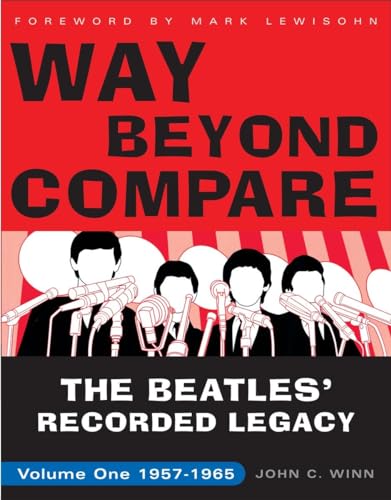
Inhaltsangabe
An answered prayer for Beatles fans and collectors, the first volume of a unique work that exhaustively chronicles all known and available Beatles recordings!
Have you ever watched a Beatles film clip and wondered:
• Where was that filmed?
• Is any more of that footage available?
Have you ever heard a Beatles interview and asked:
• When was that taped?
• Where’s the best place to find the complete recording?
Way Beyond Compare has the answers to these and thousands of similar questions. It’s the key to unlocking the secrets behind every known Beatles recording in circulation through 1965, telling you where to find them, what makes them unique, and how they fit within the context of the Beatles’ amazing musical and cultural journey.
Author John C. Winn has spent twenty years (twice as long as the Beatles were together!) sifting through, scrutinizing, organizing, and analyzing hundreds of hours of audio and video recordings—and putting them into a digestible chronological framework for Way Beyond Compare and its companion volume, That Magic Feeling: The Beatles’ Recorded Legacy, Volume Two, 1966–1970.
“It takes a rare and special kind of mind to sift through it all, to research and enquire, catalogue and chronicle, assess and contrast, identify and label, and to fit all the myriad pieces into the vast jigsaw puzzle that is the Beatles’ career. John C. Winn is that person, and he’s done it with a rare skill and intelligence.”
—Mark Lewisohn
Die Inhaltsangabe kann sich auf eine andere Ausgabe dieses Titels beziehen.
Über die Autorin bzw. den Autor
JOHN C. WINN was born one year after the Beatles disbanded. He has dedicated most of his life to collecting, studying, and enjoying their music. His second volume, That Magic Feeling: The Beatles’ Recorded Legacy, Volume Two, 1966–1970, is forthcoming from Three Rivers Press.
Auszug. © Genehmigter Nachdruck. Alle Rechte vorbehalten.
1957–1962: Who Was to Know?
1. Concert J
Date: 6 July 1957
Time: 8:45–10:30 p.m.
Location: St. Peter’s Church Hall, Woolton, Liverpool
Producer: Bob Molyneux
[A.] Puttin’ on the Style (1:40)
[B.] Baby Let’s Play House (0:28)
What are the odds? Not that a sixteen-year-old John Lennon and a fifteen-year-old Paul McCartney would meet at a church fête and go on to conquer the music world, but that someone would be there to record Lennon’s band, the Quarry Men that very day. After all, of the dozens of shows the Quarry Men played from 1957–1959, this is the only one for which a tape has surfaced. Not only that, there are no other known recordings of a Beatle performing in front of an audience prior to 1962!
Without knowing the rich history behind it, the recording itself (or what we have of it) is distinctly underwhelming: the distant thumpa-thumpa of Colin Hanton’s drums and Len Garry’s tea-chest bass, with a higher-pitched but unmistakably nasal John Lennon vocal cutting through the murk. His and Eric Griffiths’ guitars, Pete Shotton’s washboard, and Rod Davis’ banjo are essentially inaudible, but judging by John’s vocal pitch, they performed both songs in the key of G major.
“Puttin’ On the Style” was a skiffle standard popularized by Lonnie Donegan, whose other numbers featured heavily in the Quarry Men’s repertoire (“John Henry,” “Railroad Bill,” “Diggin’ My Potatoes,” “Lost John,” “Cumberland Gap,” “Midnight Special,” and of course “Rock Island Line”). They also played a few rock numbers that day; John recalled singing Gene Vincent’s “Be-Bop-A-Lula,” while Paul has said he heard John sing the Del-Vikings’ “Come Go with Me,” substituting his own words for the lyrics he hadn’t deciphered.
Maybe that explains why Paul was able to impress John by playing a word-perfect rendition of Eddie Cochran’s “Twenty Flight Rock” backstage between the Quarry Men’s two sets that day. In the afternoon, they had played outdoors, but moved inside the church hall for the grand dance that evening. Also attending the dance was amateur recording enthusiast Bob Molyneux, whose mother owned a shop in Woolton. He switched on his portable Grundig TK8 reel-to-reel machine and pointed the handheld microphone in the direction of the stage.
The tape captured performances by the George Edwards Band as well as their support act, the Quarry Men Skiffle Group. In the months afterward, Molyneux copied portions of the recordings to a separate 3-inch reel and erased the original tapes. By 1963, the Beatles were making a splash across Great Britain, and Molyneux checked the recordings to discover that two songs from the Quarry Men’s set had been preserved—“Puttin’ On the Style” and a rendition of Elvis Presley’s “Baby Let’s Play House.” He apparently tried to contact John (via Ringo) to see if he was interested in the tape, but never received a reply, so the tape went into storage for the next thirty years.
All three verses of “Puttin’ On the Style” have surfaced over the years, beginning with the second verse in 1994, in which John sings lyrics updated by Donegan to change the “pair of horses” and “whip” to a “hot-rod car” and “yellow gloves.” In 2007, on the fiftieth anniversary of the performance, BBC Radio aired the song’s first verse (played at a slower tempo), along with 28 seconds of “Baby Let’s Play House.” The final verse of “Puttin’ On the Style” appeared shortly thereafter, from an offline recording apparently taped at an EMI exhibit.
RELEASE HISTORY
1994: The Bob Molyneux tape, along with the Grundig reel-to-reel recorder used to tape it, was auctioned by Sotheby’s on September 15. EMI acquired the lot for £78,500, but neglected to release it as part of the Anthology CD or video projects. A poor-quality 27-second excerpt of A stems from a sample tape circulated to the media, which took a surprisingly long time to reach bootleg. It finally appeared on the 1998 bootleg CD Puttin’ On the Style.
2007: B and a further 29 seconds of A were broadcast on BBC Radio 2’s documentary The Day John Met Paul. The remaining 44 seconds of A surfaced online the same year, in truly dismal quality. Both songs appear on the CD-R Strong Before Our Birth.
2. Studio session
Date: spring–early summer 1958
Time: afternoon
Location: P. F. Phillips Studio, Liverpool
Producer: Percy Phillips
[A.] That’ll Be the Day (2:06)
[B.] In Spite of All the Danger (2:43)
Over the winter of 1957–58, various Quarry Men dropped out, while new guitarist Paul McCartney inducted his schoolmate George Harrison, the youngest but most musically dedicated band member. With Colin Hanton on drums and John “Duff” Lowe on piano, the core lineup of John, Paul, and George gathered outside the Hippodrome Cinema on a cold, wet morning midway through 1958.
Their destination was the nearby home of Percy Phillips, who had professional recording equipment installed in his drawing room, which he would operate for a small fee. The Quarry Men scraped together the necessary seventeen shillings and sixpence needed to cut a 78 rpm single. For one pound, they could have gone to tape first, which would have allowed for editing, but they opted for the budget method of recording directly onto a 10-inch shellac disc via an MSS disc-cutting machine.
For the A-side, they chose the first big hit from their idol Buddy Holly, “That’ll Be the Day,” with John singing lead, Paul harmonizing, and George playing the guitar solo (spurred on by a shout of “honky tonk!” from an unidentified Quarry Man). The B-side was an original composition: Paul’s “In Spite of All the Danger,” a ballad fashioned after Elvis Presley’s “Trying to Get to You.” It’s a charming performance, with John continually missing his vocal entrance cues, Paul adding “wah-wah” backing vocals, and George playing another solo (enough to garner him co-composer credit on Paul’s handwritten disc label).
The song actually ran on for 3:25, long enough to cause Mr. Phillips to signal the boys frantically that the disc was running out of room, but for release on Anthology 1, it’s been edited by 42 seconds (the edit removes a repeated verse and chorus). “Day” is performed in the key of A major, while “Danger” is in E, including the elusive B7 chord the Quarry Men had ridden clear across town to obtain.
When the disc was finished, they paid Phillips (though he later claimed they had only 15 shillings with them and had to pay the balance later) and secured the sole copy of the disc. John kept it first, and it passed from band member to band member, even getting broadcast over the PA at a local factory, before ending up in John Lowe’s linen drawer.
In July 1981, Lowe made noises about auctioning the disc but was served with an injunction by Paul to keep him from selling it until he could make an offer of his own. Lowe eventually accepted a generous amount, and Paul took possession, having copies made so the songs could be played without further degrading the valuable original. He played a segment of A on a TV documentary in 1985 (see release history), but it wasn’t until 1995 that the world would hear the full
A-side and edited B-side. Portions played in the Anthology documentary...
„Über diesen Titel“ kann sich auf eine andere Ausgabe dieses Titels beziehen.
Suchergebnisse für Way Beyond Compare: The Beatles' Recorded Legacy,...

Beispielbild für diese ISBN
Way Beyond Compare Vol. 1 : The Beatles' Recorded Legacy, Volume One, 1957-1965
Verlag:
Crown Publishing Group, The, 2008
ISBN 10: 0307451577
ISBN 13: 9780307451576
Gebraucht
Softcover
Anbieter: Better World Books, Mishawaka, IN, USA
Verkäuferbewertung 5 von 5 Sternen

Zustand: Good. Pages intact with minimal writing/highlighting. The binding may be loose and creased. Dust jackets/supplements are not included. Stock photo provided. Product includes identifying sticker. Better World Books: Buy Books. Do Good. Artikel-Nr. 39133628-6
Gebraucht kaufen
EUR 25,48
Versand gratis
Versand innerhalb von USA
Versand innerhalb von USA
Anzahl: 1 verfügbar
Foto des Verkäufers
Way Beyond Compare: The Beatles' Recorded Legacy, Volume One, 1957-1965: 1
Anbieter: WeBuyBooks, Rossendale, LANCS, Vereinigtes Königreich
Verkäuferbewertung 5 von 5 Sternen
paperback. Zustand: Very Good. Most items will be dispatched the same or the next working day. A copy that has been read, but is in excellent condition. Pages are intact and not marred by notes or highlighting. The spine remains undamaged. Artikel-Nr. rev8763663550
Gebraucht kaufen
EUR 17,57
EUR 12,65 Versand
Versand von Vereinigtes Königreich nach USA
Versand von Vereinigtes Königreich nach USA
Anzahl: 1 verfügbar
Beispielbild für diese ISBN
Way Beyond Compare: The Beatles' Recorded Legacy, Volume One, 1957-1965
Verlag:
Crown, New York, 2008
ISBN 10: 0307451577
ISBN 13: 9780307451576
Gebraucht
Soft cover
Erstausgabe
Anbieter: Bookplate, Chestertown, MD, USA
Verkäuferbewertung 4 von 5 Sternen

Soft cover. Zustand: As New. 1st Edition. Clean unread copy. As new. BP/Beatles. Artikel-Nr. ABE-1702269899497
Gebraucht kaufen
EUR 27,58
EUR 7,59 Versand
Versand innerhalb von USA
Versand innerhalb von USA
Anzahl: 1 verfügbar
Beispielbild für diese ISBN
Way Beyond Compare: The Beatles' Recorded Legacy, 1957-1965: Vol 1
Anbieter: Revaluation Books, Exeter, Vereinigtes Königreich
Verkäuferbewertung 5 von 5 Sternen
Paperback. Zustand: Brand New. 395 pages. 10.75x8.50x1.00 inches. In Stock. Artikel-Nr. zk0307451577
Neu kaufen
EUR 48,52
EUR 17,72 Versand
Versand von Vereinigtes Königreich nach USA
Versand von Vereinigtes Königreich nach USA
Anzahl: 1 verfügbar
Foto des Verkäufers
Way Beyond Compare
Anbieter: moluna, Greven, Deutschland
Verkäuferbewertung 5 von 5 Sternen
Zustand: New. JOHN C. WINN was born one year after the Beatles disbanded. He has dedicated most of his life to collecting, studying, and enjoying their music. His second volume, That Magic Feeling: The Beatles’ Recorded Legacy, Volume Two, 1966�, i. Artikel-Nr. 594508887
Neu kaufen
EUR 30,02
EUR 48,99 Versand
Versand von Deutschland nach USA
Versand von Deutschland nach USA
Anzahl: Mehr als 20 verfügbar
Foto des Verkäufers
Way Beyond Compare : The Beatles' Recorded Legacy, Volume One, 1957-1965
Anbieter: AHA-BUCH GmbH, Einbeck, Deutschland
Verkäuferbewertung 5 von 5 Sternen
Taschenbuch. Zustand: Neu. Neuware - An answered prayer for Beatles fans and collectors, the first volume of a unique work that exhaustively chronicles all known and available Beatles recordings!Have you ever watched a Beatles film clip and wondered: Where was that filmed Is any more of that footage available Have you ever heard a Beatles interview and asked: When was that taped Where's the best place to find the complete recording Way Beyond Compare has the answers to these and thousands of similar questions. It's the key to unlocking the secrets behind every known Beatles recording in circulation through 1965, telling you where to find them, what makes them unique, and how they fit within the context of the Beatles' amazing musical and cultural journey.Author John C. Winn has spent twenty years (twice as long as the Beatles were together!) sifting through, scrutinizing, organizing, and analyzing hundreds of hours of audio and video recordingsand putting them into a digestible chronological framework for Way Beyond Compare and its companion volume, That Magic Feeling: The Beatles' Recorded Legacy, Volume Two, 19661970."It takes a rare and special kind of mind to sift through it all, to research and enquire, catalogue and chronicle, assess and contrast, identify and label, and to fit all the myriad pieces into the vast jigsaw puzzle that is the Beatles' career. John C. Winn is that person, and he's done it with a rare skill and intelligence." Mark Lewisohn. Artikel-Nr. 9780307451576
Neu kaufen
EUR 42,23
EUR 42,81 Versand
Versand von Deutschland nach USA
Versand von Deutschland nach USA
Anzahl: 2 verfügbar