
Verwandte Artikel zu Can't Remember What I Forgot: The Good News from...
Inhaltsangabe
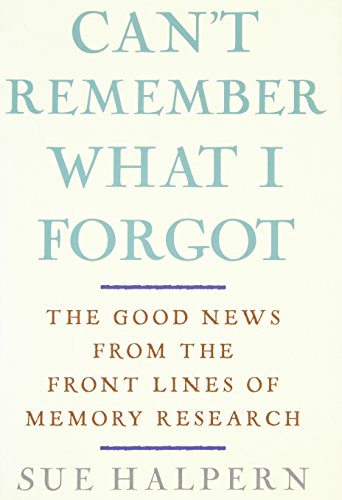
A behind-the-scenes examination of the ground-breaking world of memory research reveals the latest findings about memory loss, how close scientists are in coming up with ways to diagnose, treat, and even cure Alzheimer's and other forms of dementia, and the effectiveness of keeping one's mind active in terms of leaving one's mind intact. 50,000 first printing.
Die Inhaltsangabe kann sich auf eine andere Ausgabe dieses Titels beziehen.
Über die Autorin bzw. den Autor
SUE HALPERN received her doctorate from Oxford University in 1985 and ?rst began teaching at Columbia University’s College of Physicians and Surgeons. She is the author of Four Wings and a Prayer, Migrations to Solitude, and two books of ?ction. Her work has appeared in The New Yorker, the New York Times, Rolling Stone, Condé Nast Traveler, and The New York Review of Books, among other publications. She lives in Ripton, Vermont, with her husband, writer Bill McKibben, and their daughter, Sophie, and is a scholar-in-residence at Middlebury College.
Auszug. © Genehmigter Nachdruck. Alle Rechte vorbehalten.
Author’s Note
On the canted ceiling above my desk is a map of the brain. It
shows the frontal lobe and temporal lobe and parietal lobe and occipital
lobe as if they were places to visit–Rome, Milan, Trieste,
San Remo. The map, of course, is dumb. It says nothing about what
goes on in those places: that deep in the middle of the temporal
lobe, which itself is deep in the middle of the brain, there is a tiny,
cashew-shaped region called the hippocampus that is essential to
forming new memories, or that the prefrontal cortex, which sits behind
the eyebrows, is vital to foresight and being polite and paying
attention, or that the occipital lobe, which brings up the rear of the
brain, is central to sight itself.
I look at that map sometimes and think about how it is my own
brain apprehending it, and that to do so, it is traveling express. And
then my mind, declaring its independence from my brain, begins to
wander among the events of the day, past and future, and plans for
summer vacation, and concern for a friend who is sick and the dog
in the yard, but never getting so far afield that it doesn’t heed its
own call back.
Near the map, tacked to the wall, is a picture of the brain that is
doing all of that and all of this–this writing, thinking, typing,
seeing–my brain, in bright colors, which was taken a few years ago
in California. When I look at that picture I am not only seeing it,
but recalling that day, or aspects of it, so much has gone out with
the tide. I took notes on that trip, and carried a digital recorder, and
have read and reread those notes over the years, and listened to the
conversations, so I remember that day better than most, and what I
remember comes with a certain confidence, but even so it is fuzzy. I
cannot say, for instance, what kind of rental car I drove, or what
book I was reading later that afternoon when I went to the beach,
or which beach, specifically, it was.
We rely on memory not only to remember, but to walk and dream
and talk and smell and plan and fear and love and think and learn
and more and more and more. Memory is how we know the world–
that is a tree, this is a sentence–and know ourselves–I like chocolate
ice cream, I am a singer–and know ourselves in the world. Amnesiacs
make the case well: it is not, simply, that they don’t remember
their name or where they live, it is that absent memory, they are
strangers to themselves. The English philosopher John Locke believed
that we came into the world with our mind a blank slate, a
“tabula rasa,” ready for the pen of experience to inscribe. It’s a perfect
metaphor (even if it’s not exactly true), because it works to describe
what it’s like to gain knowledge, and what it’s like to lose your mind.
Stroke by uneven stroke, the eraser plies the board.
My father, before he died at the age of seventy-seven, had begun
to know this intimately, though never to the extent that the board
was wiped so clean that he approached Locke’s natal state. He
knew, and he talked about it–about how frustrating it was to read
the newspaper and then have to read it again, or to stare at a can
opener, not knowing what it was for, or to pick up the phone to call
a friend, whose funeral he’d attended two years earlier.
While it might have been natural for me to worry that my father’s
fate someday would be my own, I didn’t, really. The doctor
said he didn’t have Alzheimer’s disease, and since Alzheimer’s disease
tends to run in families, I figured I was safe. This was not one of
those calculate-your-odds kind of conclusions. It wasn’t a calculation
at all. At best it was a passing thought. Call it denial, call it repression,
or maybe arrogance, I just figured that if he didn’t have
AD, what was it to me?
But later, after he was gone, and all that was left were my memories,
some photos, and the key-chain recorder my mother made
him carry like a pair of military dog tags at the end in case he got
lost, into which he spoke his name, his phone number, and his
street address in the flattest of voices, I began to wonder. What if
the doctor had been wrong? Almost everyone I knew had a parent
or an in-law or a favorite aunt or a colleague or a neighbor or a
grandfather or a friend or a friend of a friend who had Alzheimer’s,
as if the standard six degrees of separation had been universally
abridged to one or two. But another question bothered me more:
what if the doctor had been right? What I mean is: what if my father
hadn’t been sick?
This was not a wishful fantasy about what my father’s last years
would have been like if, when going to the basement to sort the recycling,
he didn’t lose track of which items went in which bin and
stood there, paralyzed by confusion, for half an hour, or if he hadn’t
thought he’d filed his income tax when he hadn’t. He knew who his
children were. He remained interested in politics. He had never
needed to activate the key-chain recorder. The question, rather,
was a kind of private, one-person, one-vote referendum on sickness
and health: if he wasn’t sick, what was going on?
Since it is the nature of questions to beget more questions before
they yield answers, I soon stopped thinking about my father,
specifically, or about myself, even when I wondered why, for instance,
the memory of a forty-four-year-old was generally better
than the memory of a seventy-seven-year-old (or was it?), and why
the memory of a twenty-six-year-old was better than both. The answer
to this was not as obvious as it might appear. If age were the
culprit, what, precisely, was it stealing?
In the popular literature I kept coming across references to the
brain that made it sound like a muscle. “Use it or lose it” was the standard
dogma. I read countless self-help books that promised to help
their readers “use it,” and compiled a stack of newspaper articles
that touted crossword puzzles and sudokus as the mental equivalents
of jogging and strength-training, and the more of these I looked at,
the more curious it all seemed to me: I understood that these activities
were supposed to be good for you because, apparently, they
built mental muscle, but why was that? Was there a physiological
response to crossword puzzles, something that happened to the body
by doing them, and just whom did they help? Anyone of any age?
People with mild memory problems? The worried well? People who
were sick? And if they were beneficial for people who were sick as
well as people who were not, was that because the same thing was
going wrong in the healthy brains that had already gone awry in
pathological ones?
The questions piled up in my notebook, a sign, perhaps, that I
was using my brain, but to what end? Books evolve idiosyncratically,
their single law of natural selection being, it seems, that they
choose you. I began calling up neuroscientists and spending time
with doctors and sometimes their patients. They were in New York,
New Haven, San Francisco, Minnesota, Massachusetts, Chicago,
Los Angeles, and Irvine. They were in England and the Dominican
Republic and Canada and Italy and Iceland. To friends or acquaintances
who, upon hearing what I was doing, told me their particular
memory complaint or expressed a more generalized worry, I could
tell them how many smart and committed people were out there
looking for genes and molecules, developing drugs and vaccines,
searching out cures and therapies in plants and...
„Über diesen Titel“ kann sich auf eine andere Ausgabe dieses Titels beziehen.
Suchergebnisse für Can't Remember What I Forgot: The Good News from...

Beispielbild für diese ISBN
Can'T Remember What I Forgot
Anbieter: World of Books (was SecondSale), Montgomery, IL, USA
Verkäuferbewertung 5 von 5 Sternen

Hardback. Zustand: Very Good. When Sue Halpern decided to emulate the first modern scientist of memory, Hermann Ebbinghaus, who experimented on himself, she had no idea that after a day of radioactive testing, her brain would become so hot that leaving through the front door of the lab would trigger the alarm. This was not the first time that Halpern had her head examined while researching Can't Remember What I Forgot, nor would it be the last. Halpern spent years in the company of the neuroscientists, pharmacologists, psychologists, nutritionists, and inventors who are hunting for the genes and molecules, the drugs and foods, the machines, the prosthetics, the behaviors, and the therapies that will stave off Alzheimer's and other forms of dementia and keep our minds -- and memories -- intact. Like many of us who have had a relative or friend succumb to memory loss, who are getting older, who are hearing statistics about our own chances of falling victim to dementia, or who worry that each lapse of memory portends disease, Halpern wanted to find out what the experts really knew; what the bench scientists were working on; how close science is to a cure, to treatment, and to accurate early diagnosis; and, of course, whether the crossword puzzles, sudokus, and ballroom dancing we've been told to take up can really keep us lucid or if they're just something to do before the inevitable overtakes us. Beautifully written, sharply observed, and deeply informed, Can't Remember What I Forgot is a book full of vital information -- and a solid dose of hope. Artikel-Nr. 00106061956
Gebraucht kaufen
EUR 4,80
Versand gratis
Versand innerhalb von USA
Versand innerhalb von USA
Anzahl: 2 verfügbar
Beispielbild für diese ISBN
Can'T Remember What I Forgot
Anbieter: World of Books (was SecondSale), Montgomery, IL, USA
Verkäuferbewertung 5 von 5 Sternen
Hardback. Zustand: Good. When Sue Halpern decided to emulate the first modern scientist of memory, Hermann Ebbinghaus, who experimented on himself, she had no idea that after a day of radioactive testing, her brain would become so hot that leaving through the front door of the lab would trigger the alarm. This was not the first time that Halpern had her head examined while researching Can't Remember What I Forgot, nor would it be the last. Halpern spent years in the company of the neuroscientists, pharmacologists, psychologists, nutritionists, and inventors who are hunting for the genes and molecules, the drugs and foods, the machines, the prosthetics, the behaviors, and the therapies that will stave off Alzheimer's and other forms of dementia and keep our minds -- and memories -- intact. Like many of us who have had a relative or friend succumb to memory loss, who are getting older, who are hearing statistics about our own chances of falling victim to dementia, or who worry that each lapse of memory portends disease, Halpern wanted to find out what the experts really knew; what the bench scientists were working on; how close science is to a cure, to treatment, and to accurate early diagnosis; and, of course, whether the crossword puzzles, sudokus, and ballroom dancing we've been told to take up can really keep us lucid or if they're just something to do before the inevitable overtakes us. Beautifully written, sharply observed, and deeply informed, Can't Remember What I Forgot is a book full of vital information -- and a solid dose of hope. Artikel-Nr. 00106677200
Gebraucht kaufen
EUR 4,80
Versand gratis
Versand innerhalb von USA
Versand innerhalb von USA
Anzahl: 3 verfügbar
Beispielbild für diese ISBN
Can'T Remember What I Forgot
Anbieter: World of Books (was SecondSale), Montgomery, IL, USA
Verkäuferbewertung 5 von 5 Sternen
Hardback. Zustand: Fair. When Sue Halpern decided to emulate the first modern scientist of memory, Hermann Ebbinghaus, who experimented on himself, she had no idea that after a day of radioactive testing, her brain would become so hot that leaving through the front door of the lab would trigger the alarm. This was not the first time that Halpern had her head examined while researching Can't Remember What I Forgot, nor would it be the last. Halpern spent years in the company of the neuroscientists, pharmacologists, psychologists, nutritionists, and inventors who are hunting for the genes and molecules, the drugs and foods, the machines, the prosthetics, the behaviors, and the therapies that will stave off Alzheimer's and other forms of dementia and keep our minds -- and memories -- intact. Like many of us who have had a relative or friend succumb to memory loss, who are getting older, who are hearing statistics about our own chances of falling victim to dementia, or who worry that each lapse of memory portends disease, Halpern wanted to find out what the experts really knew; what the bench scientists were working on; how close science is to a cure, to treatment, and to accurate early diagnosis; and, of course, whether the crossword puzzles, sudokus, and ballroom dancing we've been told to take up can really keep us lucid or if they're just something to do before the inevitable overtakes us. Beautifully written, sharply observed, and deeply informed, Can't Remember What I Forgot is a book full of vital information -- and a solid dose of hope. Artikel-Nr. 00108686424
Gebraucht kaufen
EUR 4,80
Versand gratis
Versand innerhalb von USA
Versand innerhalb von USA
Anzahl: 1 verfügbar
Beispielbild für diese ISBN
Can't Remember What I Forgot : The Good News from the Frontlines of Memory Research
Verlag:
Crown Publishing Group, The, 2008
ISBN 10: 0307406741
ISBN 13: 9780307406743
Gebraucht
Hardcover
Erstausgabe
Anbieter: Better World Books, Mishawaka, IN, USA
Verkäuferbewertung 5 von 5 Sternen
Zustand: Good. 1st Edition. Former library copy. Pages intact with minimal writing/highlighting. The binding may be loose and creased. Dust jackets/supplements are not included. Includes library markings. Stock photo provided. Product includes identifying sticker. Better World Books: Buy Books. Do Good. Artikel-Nr. GRP102354056
Gebraucht kaufen
EUR 6,25
Versand gratis
Versand innerhalb von USA
Versand innerhalb von USA
Anzahl: 1 verfügbar
Beispielbild für diese ISBN
Can't Remember What I Forgot : The Good News from the Frontlines of Memory Research
Verlag:
Crown Publishing Group, The, 2008
ISBN 10: 0307406741
ISBN 13: 9780307406743
Gebraucht
Hardcover
Erstausgabe
Anbieter: Better World Books, Mishawaka, IN, USA
Verkäuferbewertung 5 von 5 Sternen
Zustand: Very Good. 1st Edition. Former library copy. Pages intact with possible writing/highlighting. Binding strong with minor wear. Dust jackets/supplements may not be included. Includes library markings. Stock photo provided. Product includes identifying sticker. Better World Books: Buy Books. Do Good. Artikel-Nr. 4724092-6
Gebraucht kaufen
EUR 6,25
Versand gratis
Versand innerhalb von USA
Versand innerhalb von USA
Anzahl: 1 verfügbar
Beispielbild für diese ISBN
Can't Remember What I Forgot: The Good News from the Front Lines of Memory Research
Anbieter: ThriftBooks-Atlanta, AUSTELL, GA, USA
Verkäuferbewertung 5 von 5 Sternen
Hardcover. Zustand: As New. No Jacket. Pages are clean and are not marred by notes or folds of any kind. ~ ThriftBooks: Read More, Spend Less. Artikel-Nr. G0307406741I2N00
Gebraucht kaufen
EUR 6,36
Versand gratis
Versand innerhalb von USA
Versand innerhalb von USA
Anzahl: 1 verfügbar
Beispielbild für diese ISBN
Can't Remember What I Forgot: The Good News from the Front Lines of Memory Research
Anbieter: ThriftBooks-Atlanta, AUSTELL, GA, USA
Verkäuferbewertung 5 von 5 Sternen
Hardcover. Zustand: Very Good. No Jacket. May have limited writing in cover pages. Pages are unmarked. ~ ThriftBooks: Read More, Spend Less. Artikel-Nr. G0307406741I4N00
Gebraucht kaufen
EUR 6,36
Versand gratis
Versand innerhalb von USA
Versand innerhalb von USA
Anzahl: 1 verfügbar
Beispielbild für diese ISBN
Can't Remember What I Forgot: The Good News from the Front Lines of Memory Research
Anbieter: ThriftBooks-Dallas, Dallas, TX, USA
Verkäuferbewertung 5 von 5 Sternen
Hardcover. Zustand: Very Good. No Jacket. Missing dust jacket; May have limited writing in cover pages. Pages are unmarked. ~ ThriftBooks: Read More, Spend Less. Artikel-Nr. G0307406741I4N01
Gebraucht kaufen
EUR 6,36
Versand gratis
Versand innerhalb von USA
Versand innerhalb von USA
Anzahl: 1 verfügbar
Beispielbild für diese ISBN
Can't Remember What I Forgot: The Good News from the Front Lines of Memory Research
Anbieter: Wonder Book, Frederick, MD, USA
Verkäuferbewertung 5 von 5 Sternen
Zustand: Good. Good condition. Acceptable dust jacket. A copy that has been read but remains intact. May contain markings such as bookplates, stamps, limited notes and highlighting, or a few light stains. Artikel-Nr. P02S-00324
Gebraucht kaufen
EUR 7,22
Versand gratis
Versand innerhalb von USA
Versand innerhalb von USA
Anzahl: 1 verfügbar
Foto des Verkäufers
Can't Remember What I Forgot: The Good News from the Front Lines of Memory Research
Anbieter: WeBuyBooks, Rossendale, LANCS, Vereinigtes Königreich
Verkäuferbewertung 5 von 5 Sternen
Zustand: Very Good. Most items will be dispatched the same or the next working day. A copy that has been read, but is in excellent condition. Pages are intact and not marred by notes or highlighting. The spine remains undamaged. Artikel-Nr. rev2353235887
Gebraucht kaufen
EUR 4,65
EUR 7,84 Versand
Versand von Vereinigtes Königreich nach USA
Versand von Vereinigtes Königreich nach USA
Anzahl: 1 verfügbar