
Verwandte Artikel zu Borderlands: Riding the Edge of America
Inhaltsangabe
"The periphery of a place can tell us a great deal about its heartland. along the edge of a nation's territory, its real prejudices, fears and obsessions - but also its virtues - irrepressibly bubble up as its people confront the 'other' whom they admire, or fear, or hold in contempt, and know little about. September 11, 2001, changed the United States utterly and nothing more so than the physical reality, the perception - and the meaning - of its borders."
-from Borderlands
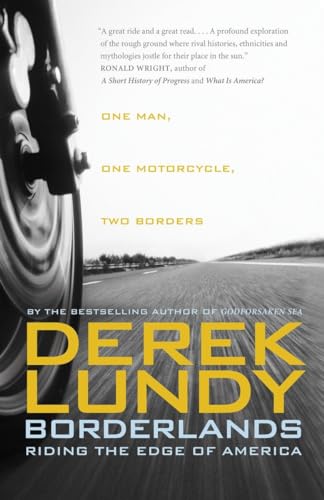
Derek Lundy turns sixty at the end of a year in which three good friends have died. He feels the need to do something radical, and sets out on his motorcycle - a Kawasaki KLR 650 cc single-cylinder "thumper," which he describes as "unpretentious" and also "butt-ugly." Fascinated by the United States' post-9/11 passion for security, particularly on its two international borders, he chooses to investigate.
He takes a firsthand look at both borders. The U.S.-Mexican borderlands, often disorderly and violent, operate according to their own ad hoc system of rules and conventions, and are distinct in many ways from the two countries the border divides. When security trumps trade, the economic well-being of both countries is threatened, and the upside is difficult to determine. American policy makers think the issues of drugs and illegals are ample reason to keep building fences to keep Mexicans out, even with no evidence that fences work or are anything but cruel. Mexicans' cheap labour keeps the wheels turning in the U.S. economy yet they are resented for trying to get into the country illegally (or legally). More people have died trying to cross this border than in the 9/11 attacks.
At almost 9,000 kilometres, the U.S. border with Canada is the longest in the world. The northern border divides the planet's two biggest trading partners, and that relationship demands the fast, easy flow of goods and services in both directions. Since the events of 9/11, however, the United States has slowly and steadily choked the flux of trade: "just-in-time" parts shipments are in jeopardy; trucks must wait for inspection and clearance; people must be questioned. The border is "thickening."
In prose that is compelling, impressive and at times frightening, Derek Lundy's incredible journey is illuminating enough to change minds, as great writing can sometimes do.
Die Inhaltsangabe kann sich auf eine andere Ausgabe dieses Titels beziehen.
Über die Autorin bzw. den Autor
Derek Lundy is the bestselling author of Godforsaken Sea: Racing The World's Most Dangerous Waters, The Way of a Ship: A Square-Rigger Voyage in the Last Days of Sail, and The Bloody Red Hand: A Journey Through Truth, Myth and Terror in Northern Ireland. He lives and rides on Salt Spring Island, B.C.
Auszug. © Genehmigter Nachdruck. Alle Rechte vorbehalten.
CHAPTER 1
A HOLY ALTAR
THIS LAND IS YOUR LAND, THIS LAND IS MY LAND . . .
THIS LAND WAS MADE FOR YOU AND ME.
—WOODY GUTHRIE
Remember the Alamo? Part of America was forged there. Almost all the elements of America’s story of itself were present during the thirteen-day-long battle in 1836 at a small, remote, old Spanish mission deep in the heart of Texas. I intend to ride the border from east to west, but the Alamo, in the centre of San Antonio, is a necessary place to start. It is about three hundred miles north of Brownsville at the present border’s eastern end, but it’s as much a part of the history of the borderlands as if it was right on the Rio Grande—the River—or in some nearby dusty border town.
Americans remember the story of the Alamo because it seems to represent everything they hold dear in the United States: courage and sacrifice in the name of freedom; like-minded citizens coming together under arms to resist tyranny; a laconic and offhand heroism; an absorption with democracy and the rights of man; a demonstration of America’s destiny to grow west and south, and maybe north, too (perhaps only the ocean could limit this God-sanctioned expansion and dominion). And military prowess: like the soldiers of the War of Independence, the few men at the Alamo fought for a long time against a superior enemy.
The battle at the Alamo was a siege, and it is the sieges of history that catch the imagination: Masada, Constantinople, Londonderry, Leningrad, the Battle of Britain. The besieged almost always have the choice of surrender, a way out of their fear and suffering. They must keep their guts and hearts strong to resist the threat and press of the encircling enemy over a stretch of time. This is far more than the momentary heroism of battle, which rides on a surge of fear and adrenaline, and is over and done with quickly. At four in the morning, in the dark, with time to think about death, how easy and appealing it must seem to get things over with, to give up.
That’s what another group of Americans did a few weeks after the Alamo fell. Between 400 and 450 men under Colonel James Walker Fannin surrendered to the Mexican army under General Antonio López de Santa Anna after the Battle of Coleto Creek, near Goliad, about a hundred miles south of San Antonio. The Americans had been assured of good treatment and they were briefly held prisoner. But on March 27, 1836—Palm Sunday—their guards, under Santa Anna’s orders, and over the objections of less bloody-minded officers, divided them into three groups, marched them off in different directions and massacred them. Three hundred and forty-one men were killed, in an atrocity that mobilized support for the Texan cause across the territory, and within the United States, as well.
Coleto Creek made it clear that this was to be a war to the finish, but somehow it did not trigger a popular emotional response, as did the Alamo. Far more men were killed at Goliad, but unlike the massacre there, the Alamo was a fair fight in the sense that the defenders chose to keep resisting. Killing them was not, therefore, a crime, but merely cruel war.
The account of the Alamo in U.S. mythology is dramatic and colourful. Two hundred men fought to the death against an army of five thousand. It was to be a victory for Protestants over Catholics and for free white men over degenerate mestizos. The American commander, Colonel William B. Travis, traced a line in the sand and said: “Those of you who are willing to stay with me and die with me, cross this line.” All but one man did so. The defenders knew from the beginning that their position was hopeless, but they fought on. Their battle cry was “Victory or Death!” They died to a man on the mission walls and in the shadowy niches of its stone buildings. Davy Crockett was one of them, and his blood, wrote one historian, was shed upon “a holy altar.”
The story has become a part of the mythology of the United States: how it was founded; how it grew and prospered; how it was a beacon for the world it eventually came to dominate. Every nation tells a story of itself to explain and justify how it arrived at where it is now, and to provide guidance and comfort to its people in the present. The myth is the version of itself the nation would like, and in fact needs, to be true.
Historians and other academics revise or debunk myths. They question the story of the Alamo. How can we know what really happened, they churlishly ask, if every man there died? And the fight for Texan independence from Mexico (in 1836, Texas was part of the Mexican state of Coahuila y Tejas) was hardly a battle of cultures. When the Texas Declaration of Independence was signed, David G. Burnet was the president of the new republic, but its vice-president was Lorenzo de Zavala. In those days, a “Texian” was as likely to mean a Spanish-speaking, brown-skinned Catholic whose family had lived in Texas for a hundred years or more, as a white, Protestant Anglo whose parents had recently come from England, Ireland or Germany. But none of these historical nuances or cautions means much to a nation and the story it tells about itself. Historians may quibble, but the people keep the faith.
The chain of events from the Alamo to the border is straightforward. The fight to the death there, and the massacre at Goliad, drew volunteers and aid from the United States. Texas (or the eastern third of the present state north of the Nueces River) won its independence from Mexico with a decisive victory at San Jacinto, later in 1836. Whereas a Texas that was part of a Mexican state could become part of the United States only through invasion and war, an independent Texian republic could join the United States voluntarily. After several unsuccessful attempts (because of disagreements in Congress), the United States annexed a willing Texas in 1845, ignoring Mexico’s loud objections.
For all these reasons of history, I must look at the Alamo if I want to understand the border. I’ll ride to Goliad, too, to find there the antithesis of remembered glory.
Here’s how my motorcycle ride along the two thousand–mile-long U.S.-Mexico border begins: I almost kill myself three, maybe four, times in the first sixty seconds.
In retrospect, this shouldn’t really surprise me. I bought this bike new a few months ago, and I’ve ridden it for about nine hundred miles, none of those in the last six weeks. Before that, I have to go back exactly twenty-five years to the last time I sat on a motorcycle. Now, I’m carrying about ninety pounds of gear on a Kawasaki KLR 650 cc, single-cylinder “thumper,” and it’s the first time I’ve ridden with a heavy load of any sort. I’m wearing my brand new armoured riding jacket, pants and boots—the first time I’ve worn them all together—and their padded bulk distracts me. Protecting my precious skull is a new helmet, different in design from the one I’m somewhat used to. It’s a “full coverage” helmet with a chin guard as well as a plastic visor, and it feels claustrophobic.
I have to pull out of a motel parking lot onto the service road of Interstate 10 on the fringe of San Antonio, Texas; the traffic, even on this road, is moving at forty or fifty miles an hour. I must turn into the fast-moving stream, accelerate hard, crunch my way through the gears, and, as I’m doing that, merge left across three lanes to get onto the highway itself. If I wanted to attempt suicide on a motorcycle, this would be a pretty good way to do it.
I wait for a hole in the rush of heavy metal,...
„Über diesen Titel“ kann sich auf eine andere Ausgabe dieses Titels beziehen.
Suchergebnisse für Borderlands: Riding the Edge of America

Beispielbild für diese ISBN
Borderlands: Riding the Edge of America
Verlag:
Vintage Canada (edition Reprint), 2011
ISBN 10: 0307398633
ISBN 13: 9780307398635
Gebraucht
Paperback
Anbieter: BooksRun, Philadelphia, PA, USA
Verkäuferbewertung 5 von 5 Sternen

Paperback. Zustand: Fair. Reprint. The item might be beaten up but readable. May contain markings or highlighting, as well as stains, bent corners, or any other major defect, but the text is not obscured in any way. Artikel-Nr. 0307398633-7-1
Gebraucht kaufen
EUR 4,73
Versand gratis
Versand innerhalb von USA
Versand innerhalb von USA
Anzahl: 1 verfügbar
Beispielbild für diese ISBN
Borderlands: Riding the Edge of America
Anbieter: World of Books (was SecondSale), Montgomery, IL, USA
Verkäuferbewertung 5 von 5 Sternen
Paperback. Zustand: Good. The periphery of a place can tell us a great deal about its heartland. along the edge of a nation's territory, its real prejudices, fears and obsessions - but also its virtues - irrepressibly bubble up as its people confront the 'other' whom they admire, or fear, or hold in contempt, and know little about. September 11, 2001, changed the United States utterly and nothing more so than the physical reality, the perception - and the meaning - of its borders.-from Borderlands Derek Lundy turns sixty at the end of a year in which three good friends have died. He feels the need to do something radical, and sets out on his motorcycle - a Kawasaki KLR 650 cc single-cylinder thumper, which he describes as unpretentious and also butt-ugly. Fascinated by the United States' post-9/11 passion for security, particularly on its two international borders, he chooses to investigate. He takes a firsthand look at both borders. The U.S.-Mexican borderlands, often disorderly and violent, operate according to their own ad hoc system of rules and conventions, and are distinct in many ways from the two countries the border divides. When security trumps trade, the economic well-being of both countries is threatened, and the upside is difficult to determine. American policy makers think the issues of drugs and illegals are ample reason to keep building fences to keep Mexicans out, even with no evidence that fences work or are anything but cruel. Mexicans' cheap labour keeps the wheels turning in the U.S. economy yet they are resented for trying to get into the country illegally (or legally). More people have died trying to cross this border than in the 9/11 attacks. At almost 9,000 kilometres, the U.S. border with Canada is the longest in the world. The northern border divides the planet's two biggest trading partners, and that relationship demands the fast, easy flow of goods and services in both directions. Since the events of 9/11, however, the United States has slowly and steadily choked the flux of trade: just-in-time parts shipments are in jeopardy; trucks must wait for inspection and clearance; people must be questioned. The border is thickening. In prose that is compelling, impressive and at times frightening, Derek Lundy's incredible journey is illuminating enough to change minds, as great writing can sometimes do. Artikel-Nr. 00110615793
Gebraucht kaufen
EUR 11,31
Versand gratis
Versand innerhalb von USA
Versand innerhalb von USA
Anzahl: 1 verfügbar
Beispielbild für diese ISBN
Borderlands: Riding the Edge of America
Anbieter: Visible Voice Books, Cleveland, OH, USA
Verkäuferbewertung 5 von 5 Sternen
paperback. Zustand: Fine. Vintage Books Canada October 2011 8vo. 420 pages. clean, tight copy. Artikel-Nr. 187535
Gebraucht kaufen
EUR 14,69
EUR 4,01 Versand
Versand innerhalb von USA
Versand innerhalb von USA
Anzahl: 1 verfügbar
Beispielbild für diese ISBN
Borderlands: Riding the Edge of America
Anbieter: WorldofBooks, Goring-By-Sea, WS, Vereinigtes Königreich
Verkäuferbewertung 5 von 5 Sternen
Paperback. Zustand: Very Good. The book has been read, but is in excellent condition. Pages are intact and not marred by notes or highlighting. The spine remains undamaged. Artikel-Nr. GOR013653989
Gebraucht kaufen
EUR 24,28
EUR 6,60 Versand
Versand von Vereinigtes Königreich nach USA
Versand von Vereinigtes Königreich nach USA
Anzahl: 1 verfügbar
Beispielbild für diese ISBN
Borderlands: Riding the Edge of America
Anbieter: Revaluation Books, Exeter, Vereinigtes Königreich
Verkäuferbewertung 5 von 5 Sternen
Paperback. Zustand: Brand New. reprint edition. 421 pages. 8.25x5.50x1.00 inches. In Stock. Artikel-Nr. 0307398633
Neu kaufen
EUR 31,90
EUR 11,78 Versand
Versand von Vereinigtes Königreich nach USA
Versand von Vereinigtes Königreich nach USA
Anzahl: 1 verfügbar