
Inhaltsangabe
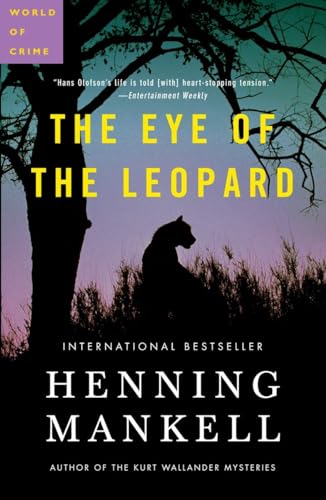
Interweaving past and present, Sweden and Zambia, The Eye of the Leopard draws on bestselling author Henning Mankell's deep understanding of the two worlds he has inhabited for over twenty years.
Hans Olofson lived through a tough childhood. His father drank himself into oblivion, and his mother was completely absent, only faded photographs offered Olofson any hint of what she may have been like. His adolescence was just as trying, and when his best friend and lover, Janine, tragically dies, he flees to Africa to carry out Janine's only real dream in life — to visit the grave of a legendary missionary in isolated Northern Zambia. Upon his arrival in Zambia, Olofson is stunned. He finds it beautiful and mysterious, so he decides to stay and make it his home, eventually taking control of a small farm. It is there that Olofson discovers the fragile truce between the rich newcomers and black natives of the recently independent state . . . a truce that could rupture at any moment.
Alternating between Olofson's years in Africa and those in Sweden, The Eye of the Leopard is a bravura achievement, a study in contrasts — black and white, poor and wealthy, Africa and Europe — and an exploration of the challenges and responsibilities that come with freedom.
Die Inhaltsangabe kann sich auf eine andere Ausgabe dieses Titels beziehen.
Über die Autorin bzw. den Autor
Henning Mankell is the prize-winning and internationally acclaimed author of the Inspector Wallander mysteries, now dominating the bestseller lists throughout Europe. He devotes much of his free time to working with AIDS charities in Africa, where he is director of the Teatro Avenida in Maputo.
Auszug. © Genehmigter Nachdruck. Alle Rechte vorbehalten.
Chapter One
He wakes in the African night, convinced that his body has split in two. Cracked open, as if his guts had exploded, with the blood running down his face and chest.
In the darkness he fumbles in terror for the light switch, but when he flips it there is no light, and he thinks the electricity must be out again. His hand searches under the bed for a torch, but the batteries are dead and so he lies there in the dark.
It’s not blood, he tells himself. It’s malaria. I’ve got the fever, the sweat is being squeezed out of my body. I’m having nightmares, fever dreams. Time and space are dissolving, I don’t know where I am, I don’t even know if I’m still alive . . .
Insects are crawling across his face, enticed by the moisture that is oozing from his pores.He thinks he ought to get out of bed and find a towel. But he knows he wouldn’t be able to stand upright, he would have to crawl, and maybe he wouldn’t even be able to make it back to bed. If I die now at least I’ll be in my own bed, he thinks, as he feels the next attack of fever coming on.
I don’t want to die on the floor. Naked, with cockroaches crawling across my face.
His fingers clutch at the wet sheet as he prepares himself for an attack that will be more violent than the ones before. Feebly, in a voice that is hardly audible, he cries out in the darkness for Luka, but there is only silence and the chirping cicadas of the African night.
Maybe he’s sitting right outside the door, he thinks in desperation. Maybe he’s sitting there waiting for me to die.
The fever comes rolling through his body in waves, like sudden storm swells.His head burns as if thousands of insects were stinging and boring into his forehead and temples. Slowly he is dragged away from consciousness, sucked down into the underground corridors of the fever attack, where he glimpses the distorted faces of nightmares among the shadows.
I can’t die now, he thinks, gripping the sheet to keep himself alive.
But the suction draught of the malaria attack is stronger than his will. Reality is chopped up, sawed into pieces that fit nowhere. He believes he is sitting in the back seat of an old Saab that is racing through the endless forests of Norrland in Sweden.He can’t see who is sitting in front of him: only a black back, no neck, no head.
It’s the fever, he thinks again. I have to hold on, keep thinking that it’s only the fever, nothing more.
He notices that it has started to snow in the room.White flakes are falling on his face and instantly it’s cold all around him.
Now it’s snowing in Africa, he thinks. That’s odd, it really shouldn’t be doing that. I have to get hold of a spade. I have to get up and start shovelling, otherwise I’ll be buried in here.
Again he calls for Luka, but no one answers, no one comes. He decides to fire Luka, that’s the first thing he’ll do if he survives this fever.
Bandits, he thinks in confusion. Of course, that’s who cut the electrical line.
He listens and seems to hear the patter of their feet outside the walls of the house.With one hand he grips the revolver under his pillow, forces himself up to a sitting position, and points the gun at the front door. He has to use both hands just to lift it, and in desperation he fears he doesn’t have enough strength in his finger to pull the trigger.
I’m going to give Luka the sack, he thinks in a rage.He’s the one who cut the electrical line, he’s the one who lured the bandits here. I have to remember to fire him in the morning.
He tries to catch some snowflakes in the barrel of the revolver, but they melt before his eyes.
I have to put on my shoes, he thinks. Otherwise I’ll freeze to death.
With all his might he leans over the edge of the bed and searches with one hand, but finds only the dead torch.
The bandits, he thinks groggily.They’ve stolen my shoes.They’ve already been inside while I was asleep. Maybe they’re still here . . .
He fires the pistol out into the room.The shot roars in the dark and he falls back against the pillows with the recoil, feeling calm, almost content.
Luka is behind it all, naturally. It was he who plotted with the bandits, he who cut the electrical line. But now he’s been unmasked, so he has no more power. He will be sacked, chased off the farm.
They won’t get me, he thinks. I’m stronger than all of them.
The insects continue boring into his forehead and he is very tired. He wonders whether dawn is far off, and he thinks that he must sleep. The malaria comes and goes, that’s what is giving him the nightmares. He has to force himself to distinguish what he’s imagining from what’s real.
It can’t snow here, he thinks. And I’m not sitting in the back seat of an old Saab racing through the bright summer forests of Norrland. I’m in Africa, not in Härjedal. I’ve been here for eighteen years. I have to keep my mind together.The fever is compelling me to stir up old memories, bring them to the surface, and to fool myself that they’re real.
Memories are dead things, albums and archives that have to be kept cold and under lock and key. Reality requires my consciousness. To have a fever is to lose one’s internal directions. I mustn’t forget that. I’m in Africa and I’ve been here for eighteen years. It was never my intention, but that’s how it turned out.
I’ve lost count of how many times I’ve had malaria. Sometimes the attacks are violent, like now; other times milder, a shadow of fever that quickly passes across my face. The fever is seductive, it wants to lure me away, creating snow even though it’s over thirty degrees Celsius. But I’m still here in Africa, I’ve always been here, ever since I landed and stepped off the plane in Lusaka. I was going to stay a few weeks, but I’ve been here a long time, and that is the truth. It is not snowing.
His breathing is heavy and he feels the fever dancing inside him. Dancing him back to the beginning, to that early morning eighteen years ago when for the first time he felt the African sun on his face.
From the mists of the fever an instant of great clarity emerges, a landscape in which the contours are sharp and washed clean.He brushes off a large cockroach that is feeling his nostril with its antennae and sees himself standing in the doorway of the big jet at the top of the mobile staircase they have brought out.
He recalls that his first impression ofAfrica was how the sunshine turned the concrete of the airport completely white. Then a smell, something bitter, like an unknown spice or a charcoal fire.
That’s how it was, he thinks. I will be able to reproduce that moment exactly, for as long as I live. It was eighteen years ago.Much of what happened later I’ve forgotten. For me Africa became a habit. A realisation that I can never feel completely calm when faced with this wounded and lacerated continent . . . I, Hans Olofson, have grrown used to the fact that it’s impossible for me to comprehend anything but fractions of this continent. But despite this perpetual disadvantage I have persevered, I have stayed on, learned one of the many languages that exist here, become the employer of over 200 Africans.
I’ve learned to endure this peculiar life, that involves being both loved and hated at the same time. Each day I stand face to face with 200 black human beings who would gladly murder me, slit my throat, offer up my genitals in sacrifice, eat my heart. Every morning when I awake I am still, after eighteen...
„Über diesen Titel“ kann sich auf eine andere Ausgabe dieses Titels beziehen.
Weitere beliebte Ausgaben desselben Titels

Suchergebnisse für The Eye of the Leopard

Beispielbild für diese ISBN
The Eye of the Leopard
Anbieter: ThriftBooks-Dallas, Dallas, TX, USA
Verkäuferbewertung 5 von 5 Sternen

Paperback. Zustand: Fair. No Jacket. Readable copy. Pages may have considerable notes/highlighting. ~ ThriftBooks: Read More, Spend Less. Artikel-Nr. G030739784XI5N00
Gebraucht kaufen
EUR 16,30
Versand gratis
Versand innerhalb von USA
Versand innerhalb von USA
Anzahl: 1 verfügbar
Beispielbild für diese ISBN
The Eye of the Leopard
Anbieter: ThriftBooks-Atlanta, AUSTELL, GA, USA
Verkäuferbewertung 5 von 5 Sternen
Paperback. Zustand: Very Good. No Jacket. May have limited writing in cover pages. Pages are unmarked. ~ ThriftBooks: Read More, Spend Less. Artikel-Nr. G030739784XI4N00
Gebraucht kaufen
EUR 16,30
Versand gratis
Versand innerhalb von USA
Versand innerhalb von USA
Anzahl: 1 verfügbar
Beispielbild für diese ISBN
The Eye of the Leopard
Anbieter: Better World Books, Mishawaka, IN, USA
Verkäuferbewertung 5 von 5 Sternen
Zustand: Good. Reprint. Pages intact with minimal writing/highlighting. The binding may be loose and creased. Dust jackets/supplements are not included. Stock photo provided. Product includes identifying sticker. Better World Books: Buy Books. Do Good. Artikel-Nr. 3173662-6
Gebraucht kaufen
EUR 17,63
Versand gratis
Versand innerhalb von USA
Versand innerhalb von USA
Anzahl: 1 verfügbar
Beispielbild für diese ISBN
Eye of the Leopard, The
Anbieter: Whodunit Bookshop, Winnipeg, MB, Kanada
Verkäuferbewertung 4 von 5 Sternen

Paperback. Zustand: Very Good. Artikel-Nr. 978030739784U
Gebraucht kaufen
EUR 8,44
EUR 46,56 Versand
Versand von Kanada nach USA
Versand von Kanada nach USA
Anzahl: 2 verfügbar