
Verwandte Artikel zu Called Out of Darkness: A Spiritual Confession
Inhaltsangabe
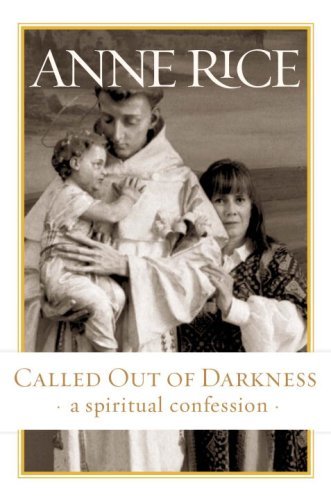
An intimate memoir of Anne Rice’s Catholic girlhood, her unmaking as a devout believer, and her return to the Church – what she calls a decision of the heart.
Moving from her New Orleans childhood in the 1940s and ‘50s, with all its religious devotions, through how she slowly lost her belief in God, Called Out of Darkness also recounts Anne’s years in radical Berkeley, where she wrote Interview with the Vampire (a lament for her lost faith) and where she came to admire the principles of secular humanists. She writes about loss and alienation (her mother’s drinking, the deaths of her young daughter and later, her husband); about the birth of her son, Christopher; and about how, after 38 years as an atheist, she once again came to believe in Christ. Anne Rice makes a spiritual confession that is a celebration: a brilliant, subtle exploration of the journey through life that allows one to answer the call out of darkness.
Die Inhaltsangabe kann sich auf eine andere Ausgabe dieses Titels beziehen.
Über die Autorin bzw. den Autor
Anne Rice is the author of twenty-seven books. She lives in La Jolla, California.
Auszug. © Genehmigter Nachdruck. Alle Rechte vorbehalten.
1
This book is about faith in God.
For more than twenty centuries, Christianity has given us dazzling works of theology, yet it remains a religion in which the heart is absolutely essential to faith.
The appeal of Jesus Christ was first and foremost to the heart.
The man knocked on his back on the Road to Damascus experienced a transformation of the heart. St. Francis of Assisi, giving away all of his clothes as he turned to follow Christ, was reflecting a decision of the heart. Mother Teresa founded her world-famous order of nuns because of a decision of the heart.
The immensity of these figures finds an imperfect student in me, but not an inattentive one.
I want to tell, as simply as I can — and nothing with me as a writer has ever really been simple — the story of how I made my decision of the heart.
So here is the story of one path to God.
The story has a happy ending because I have found the Transcendent God both intellectually and emotionally. And complete belief in Him and devotion to Him, no matter how interwoven with occasional fear and constant personal failure and imperfection, has become the true story of my life.
If this path to God is an illusion, then the story is worthless. If the path is real, then we have something here that may matter to you as well as to me.
2
Before I can describe how I returned to faith, at the age of fifty-seven, I want to describe how I learned about God as a child.
What strikes me now as most important about this experience is that it preceded reading books. Christians are People of the Book, and our religion is often described as a Religion of the Book. And for two thousand years, all that we believe has been handed down in texts.
But no doubt many children learned about God as I did — from my mother and from the experience of church which had little or nothing directly to do with knowing how to read.
Over the years, I turned out to be a consistently poor reader, and I don’t think I ever read a novel for pleasure until I was in the sixth grade. Even in my college years, I was a poor reader and, in fact, couldn’t major in English because I could not read the amounts of Chaucer or Shakespeare assigned in the classes. I graduated with a bachelor of arts degree in political science, principally because I could understand the historic background I received for political ideas through good lectures.
I was twenty-seven before I began to make up an undergraduate degree in English, and thirty-one before I received a master’s in English. Even then I read so slowly and poorly that I took my master’s orals on three authors, Shakespeare, Virginia Woolf, and Ernest Hemingway, without having read all of their works. I couldn’t possibly read all of their works.
The reason I’m emphasizing this is because I believe that what we learn through reading is essentially different from what we learn in other ways. And my concept of God came through the spoken words of my mother, and also the intensely beautiful experiences I had in church.
It’s important to stress here that my earliest experiences involved beauty; my strongest memories are of beautiful things I saw, things which evoked such profound feeling in me that I often felt pain.
In fact I remember my early childhood as full of beauty, and no ugly moment from that time has any reality for me. The beauty is the song of those days.
I vividly remember knowing about God, that He loved us, made us, took care of us, that we belonged to Him; and I remember loving Jesus as God; and praying to Him and to His Blessed Mother, the Virgin Mary, when I was very small.
I can’t really associate any one image with Jesus because there were so many around me, from small highly sentimental holy pictures, which we treasured at home, to magnificent images of Jesus in St. Alphonsus Church.
I’ll describe the church in a minute, as it takes considerable describing, but first I want to mention a small place where we went often to pray. This was the Chapel of Our Mother of Perpetual Help on Third and Prytania streets, a consecrated Catholic chapel with a tabernacle and an altar, in which Mass was celebrated every day. The chapel was a huge room inside an old Garden District mansion, set in spacious gardens, that was also a high school.
My mother had graduated from this high school many years before, and I recall going to a garden party on the grounds when I was a little child. The building itself was impressive, with a central doorway, floor-length windows on the front and on both sides, and colonnettes along the front porch that held up the porch above.
Much later in life — during the 1990s — when I was a well-known author, I actually bought this building, as it had tremendous meaning for me. Not only had my mother gone to school there, but my aunts and cousins had gone to school there as well. Some cousins had been married in the chapel. And my strongest religious memories were centered on this place. The story of that purchase and what it meant requires a book, and indeed I wrote a novel using the building as a key backdrop, but that is not my concern just now.
This is what it was like in the 1940s to go to the Chapel of Our Mother of Perpetual Help.
We left our house at St. Charles and Philip, and walked up the avenue, under the oaks, and almost always to the slow roar of the passing streetcars, and rumble of traffic, then crossed over into the Garden District, a very special neighborhood filled with immense Greek Revival–style homes, many of which had been built before the Civil War. This was an immediate plunge into a form of quiet, because though traffic did move steadily on Prytania Street, it was nothing as loud as the traffic of the avenue. The oaks were bigger and more ancient, and the enormous houses with their Corinthian or Doric columns were monuments in themselves. Everywhere there were flowers. Purple lantana and ice blue plumbago burst through the pickets of black iron fences, and beyond in the more groomed gardens grew the flowers I associated with rich people: multi-petaled camellias and gorgeously defined roses in black beds. It was fine to pick the soft fragrant lantana, and the bunches of plumbago. The finer flowers one left alone.
It was often evening when we made this short walk, and I remember the pavements as clearly as I remember the cicadas singing in the trees. The pavements varied; some were herringbone brick, very dark, uneven, and often trimmed in velvet green moss. Other sidewalks were purple flagstone, just like the purple flagstones of our own front yard. Even the rare stretches of raw cement were interesting because the cement had broken and buckled in so many places over the roots of the giant magnolias and the oaks.
The walk was two and a half blocks.
The chapel stood behind a high black picket fence with its gate permanently open, and a short flight of white marble steps led up to the white marble porch. I don’t recall the chapel ever being locked.
The sky during these trips was often bloodred, or purple, and the trees were so thick that one could only see hundreds of fragments of the sky amid clusters of darkening leaves. The color of the sky seemed to me to be connected with the song of the cicadas, and the drowsy shadows playing everywhere on the margins of what was visible, and the distinct feel of the humid air. Even in winter the air was moist, so that the world itself seemed to be pulsing around us, enfolding us, holding us as we moved through it.
The chapel had an immense and ornate doorway.
Immediately on entering, one smelled the wax of the flickering candles, and the lingering incense from the Tuesday night benediction...
„Über diesen Titel“ kann sich auf eine andere Ausgabe dieses Titels beziehen.
Weitere beliebte Ausgaben desselben Titels

Suchergebnisse für Called Out of Darkness: A Spiritual Confession

Beispielbild für diese ISBN
Called Out of Darkness A Spiri
Anbieter: World of Books (was SecondSale), Montgomery, IL, USA
Verkäuferbewertung 5 von 5 Sternen

Zustand: Good. Good condition ex-library book with usual library markings and stickers. Artikel-Nr. 00104442910
Gebraucht kaufen
EUR 3,93
Versand gratis
Versand innerhalb von USA
Versand innerhalb von USA
Anzahl: 1 verfügbar
Beispielbild für diese ISBN
Called Out of Darkness A Spiri
Anbieter: World of Books (was SecondSale), Montgomery, IL, USA
Verkäuferbewertung 5 von 5 Sternen
Zustand: Very Good. Item in very good condition! Textbooks may not include supplemental items i.e. CDs, access codes etc. Artikel-Nr. 00102922897
Gebraucht kaufen
EUR 3,93
Versand gratis
Versand innerhalb von USA
Versand innerhalb von USA
Anzahl: 1 verfügbar
Beispielbild für diese ISBN
Called Out of Darkness : A Spiritual Confession
Anbieter: Better World Books, Mishawaka, IN, USA
Verkäuferbewertung 5 von 5 Sternen
Zustand: Very Good. Pages intact with possible writing/highlighting. Binding strong with minor wear. Dust jackets/supplements may not be included. Stock photo provided. Product includes identifying sticker. Better World Books: Buy Books. Do Good. Artikel-Nr. 2877607-6
Gebraucht kaufen
EUR 6,37
Versand gratis
Versand innerhalb von USA
Versand innerhalb von USA
Anzahl: 2 verfügbar
Beispielbild für diese ISBN
Called Out of Darkness : A Spiritual Confession
Anbieter: Better World Books, Mishawaka, IN, USA
Verkäuferbewertung 5 von 5 Sternen
Zustand: Good. Former library copy. Pages intact with minimal writing/highlighting. The binding may be loose and creased. Dust jackets/supplements are not included. Includes library markings. Stock photo provided. Product includes identifying sticker. Better World Books: Buy Books. Do Good. Artikel-Nr. GRP92814575
Gebraucht kaufen
EUR 6,37
Versand gratis
Versand innerhalb von USA
Versand innerhalb von USA
Anzahl: 1 verfügbar
Beispielbild für diese ISBN
Called Out of Darkness: A Spiritual Confession
Anbieter: ThriftBooks-Atlanta, AUSTELL, GA, USA
Verkäuferbewertung 5 von 5 Sternen
Hardcover. Zustand: Very Good. No Jacket. May have limited writing in cover pages. Pages are unmarked. ~ ThriftBooks: Read More, Spend Less. Artikel-Nr. G0307397599I4N00
Gebraucht kaufen
EUR 6,91
Versand gratis
Versand innerhalb von USA
Versand innerhalb von USA
Anzahl: 1 verfügbar