
Verwandte Artikel zu Twin Set: Moms of Multiples Share Survive and Thrive...
Inhaltsangabe
When Baby Makes (Much) More Than Three
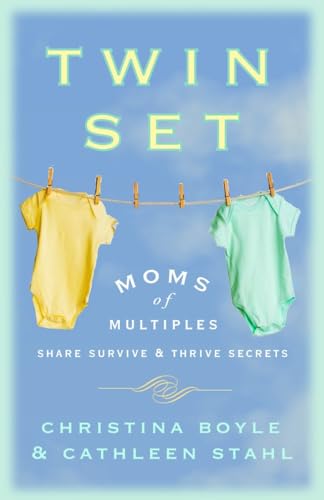
If you’re a new mom of multiples, it can be hard to find advice and enough people in your life who “get it” or give you the support you need. Luckily, there’s Twin Set: for moms of twins, by moms of twins. Twin Set provides a parent-to-parent support network—based on an exclusive national survey of more than 300 moms of multiples—and shares indispensable, mom-tested, solution-oriented advice . . . and a few laughs along the way. There’s also a Mommy Doc and Daddy Doc onboard, two pediatricians who contribute medical perspectives on various issues, in addition to special features from experts ranging from a financial planner to a nutritionist—many parents of twins themselves! Twin Set includes:
• Answers to your biggest twin pregnancy questions
• Advice on handling the emotional impact of premature delivery
• Lessons on feeding, bathing, and dressing your twins, taking them out, and
putting them to bed
• Tips from dads of twins, for dads of twins
• Solutions for managing twice the laundry, bottles, spills, and other messes
• Options for multiples child care, from birth through school age
• Insights into twin bonding, development, and safety
• Lists of essential twin resources, gear, and equipment
This encouraging and essential guide will help you savor—not just survive—life as a time-crunched mom of multiples.
Die Inhaltsangabe kann sich auf eine andere Ausgabe dieses Titels beziehen.
Über die Autorin bzw. den Autor
CHRISTINA BOYLE is a seasoned magazine writer and editor who frequently contributes to Baby Talk. CATHLEEN STAHL has spent her career as a marketer in the financial services industry, where she currently works for a leading global asset management firm. Both moms live with their families in Connecticut. Check out their blog at twinsetmoms.com.
Auszug. © Genehmigter Nachdruck. Alle Rechte vorbehalten.
0307393526|excerpt
Boyle: TWIN SET
1
Pregnancy
Finding out that you’re having twins is the double surprise of a lifetime. Whether you’ve conceived them spontaneously or with some medical assistance, it’s a big leap to go from longing to have one baby to knowing that you are going to be responsible for two. You are suddenly initiated into a very special club of mothers, one that seems to be expanding steadily. If you live in Connecticut, Massachusetts, New York, or New Jersey, you may feel like you see a lot of twins, and you’d be right. These states are known to have higher twin populations than the rest of the country. The twin trend is on the rise in Canada, the United Kingdom, and Australia as well.
Experts attribute the rise in twin birth rates to several things: moms are having babies later (after thirty-five), which means they ovulate differently and may produce two separate eggs during a cycle; moms are relying more on fertility medications (such as Clomid, which can increase your chance of having twins to one in ten); and moms are often using assisted-reproduction technology such as in vitro fertilization (IVF), which commonly transfers more than one embryo. (About 60 percent of the moms who took our survey used some sort of fertility treatment to get pregnant.)
But no matter how prepared—or unprepared—you were for the possibility of twins, you now have several months of lead time to take care of yourself properly, get the bare basics for their nursery, educate yourself on what’s unique about having twins, and get excited about the babies you are going to have.
As both of us know from experience, a twin pregnancy is hands down way more demanding than a singleton pregnancy. Physically, you may be gaining more weight, carrying more baby weight, and experiencing the side effects of hormonal turmoil, such as heartburn (which can start as early as 20 weeks). Mentally, you may be riddled with practical worries (“Are their car seats going to fit in our car?”) or forced to switch from a languid, easy-going mind-set to breaking down your life into weekly components. Emotionally, your moods may shift from bliss to panic, depending on how you feel physically or what twin thing you are thinking about. It can be even more nerve-racking if it’s your first pregnancy. Luckily, the Twin Set Moms have some hard-won advice on how to keep your pregnancy feeling more blessed than stressed, even when the emotional stakes are high.
First Time, Double Time
Being pregnant for the first time is an unbelievably special period in a woman’s life. Everything is new, and there’s a lot to learn and get excited about. If you are pregnant with multiples for your first pregnancy, it’s a big deal and deserves to be cherished, celebrated, and respected. Blood tests, sonograms, and screenings can all bring you happy news, but they may also present an element of uncertainty as to the health of your developing babies. It’s normal for any newly pregnant mom to freak out about a questionable or confusing test result, and probably even more so for a woman carrying multiples. Remember, you have a great reward waiting for you at the end of this marathon pregnancy, and that is two sweet babies who have nothing but love in their hearts for you. Still, it’s important not to keep your worries bottled up inside; it’s not good for you or your babies. Rather, share your concerns with your partner and your obstetrician. Sometimes, all any pregnant mom needs is a reassuring word to put your mind at ease and to help your body get the rest you require.
Are You Automatically Defined as “High Risk” When You Are Pregnant with Twins or More?
Dr. Roger Newman’s opinion is yes. “Twins can have various complications that increase the risk of something going astray.” According to Dr. Newman, virtually every potential obstetrical complication is magnified with multiple pregnancies. For instance, the average birth weight for twins is 5 pounds, as opposed to 7 pounds with singletons. Some general OB/GYNs prefer to follow their patients’ twins themselves and watch them carefully for the development of such potential complications, referring them to a “high risk” specialist or perinatalogist for additional care. Cathy’s OB managed the beginning of her twin pregnancy just as he did her singleton ones until she was about sixteen weeks. Then he had her visit a perinatalogist for monthly ultrasounds (sonograms). At the beginning of the third trimester, Cathy had sonograms every two weeks until thirty weeks, and then weekly ones until she delivered at thirty-seven weeks.
Nurse Shirley Griffith says that most perinatalogists work for hospitals and run a small department for consultation and ultrasounds. “Very few do deliveries,” according to Griffith. “The most common reason that a patient is referred to a perinatalogist is for a level two ultrasound and possible chromosome testing, due to advanced maternal age (thirty-five and older),” she adds. If you would like more information on being seen by a high risk specialist, talk to your OB about it.
How to Deal: What’s Different About Twin Pregnancy
“Different” doesn’t necessarily mean bad in the context of twin versus singleton pregnancy. Some differences are awesome, others not so much. For us, these were the biggies:
•More doctor’s visits and sonograms. Addictive! Both of us were fortunate enough to have obstetricians who were exceptionally familiar with multiple pregnancies and births. Even though our doctors and nurses had seen their fair share of multiple mommas, our radiologists still oohed and aahed with us during our sonograms, and our nurses laughed as we groaned about getting on the scale. If you are a working woman, you may need to give your boss a heads-up that you’ll probably have to duck out of the office a bit more frequently; if you are a stay-at-home mom, you may need to figure out what to do with your kids. You can plan for the frequency of both your doctor visits and sonograms to escalate as your pregnancy progresses. Dr. Newman breaks it down:
First trimester. The first sonogram is usually when the radiologist figures out that there are two babies in there instead of one.
Second trimester. Usually between eighteen and twenty weeks’ gestation, you’ll be given an ultrasound to check if the twins are developing properly. Dr. Newman adds, “At this scan we also check for the mother’s cervical length measurement to try to assess her risk of preterm delivery. There is a significant direct relationship between cervix length and gestation length.” Around twenty-four weeks, “we scan the patient again, and repeat the transvaginal cervical length measurement.”
Third trimester. “We will usually follow the twins’ gestation on a monthly basis with ultrasounds in order to assess growth.”
•More glimpses of babies’ personalities. Awesome! The extra sonograms meant that we had the added bonus of seeing Baby A and Baby B interact. You may find that Baby A hogged more room in the beginning, yet Baby B kicked his or her way into position two weeks before delivery day. Some of the personality traits you notice in vitro may be consistent with what you see after your twins are born. For example, Christina’s sonograms showed that Baby A was her son and Baby B was her daughter. Baby A was born first and almost a pound bigger. Baby B was often scrunched up on the sonogram and harder to see. Baby A is currently a loud and friendly child, and Baby B is a bit shyer and snuggly. Cathy’s Twin A was dominant in utero, taking up the majority of space...
„Über diesen Titel“ kann sich auf eine andere Ausgabe dieses Titels beziehen.
Suchergebnisse für Twin Set: Moms of Multiples Share Survive and Thrive...

Beispielbild für diese ISBN
Twin Set: Moms of Multiples Share Survive and Thrive Secrets
Anbieter: World of Books (was SecondSale), Montgomery, IL, USA
Verkäuferbewertung 5 von 5 Sternen

Zustand: Good. Item in good condition. Textbooks may not include supplemental items i.e. CDs, access codes etc. Artikel-Nr. 00084290099
Gebraucht kaufen
EUR 4,04
Versand gratis
Versand innerhalb von USA
Versand innerhalb von USA
Anzahl: 2 verfügbar
Beispielbild für diese ISBN
Twin Set: Moms of Multiples Share Survive and Thrive Secrets
Anbieter: World of Books (was SecondSale), Montgomery, IL, USA
Verkäuferbewertung 5 von 5 Sternen
Zustand: Very Good. Item in very good condition! Textbooks may not include supplemental items i.e. CDs, access codes etc. Artikel-Nr. 00099049733
Gebraucht kaufen
EUR 4,04
Versand gratis
Versand innerhalb von USA
Versand innerhalb von USA
Anzahl: 1 verfügbar
Beispielbild für diese ISBN
Twin Set : Moms of Multiples Share Survive and Thrive Secrets
Verlag:
Potter/Ten Speed/Harmony/Rodale, 2008
ISBN 10: 0307393526
ISBN 13: 9780307393524
Gebraucht
Softcover
Anbieter: Better World Books, Mishawaka, IN, USA
Verkäuferbewertung 5 von 5 Sternen
Zustand: Good. Former library copy. Pages intact with minimal writing/highlighting. The binding may be loose and creased. Dust jackets/supplements are not included. Includes library markings. Stock photo provided. Product includes identifying sticker. Better World Books: Buy Books. Do Good. Artikel-Nr. 3173920-6
Gebraucht kaufen
EUR 7,00
Versand gratis
Versand innerhalb von USA
Versand innerhalb von USA
Anzahl: 1 verfügbar
Beispielbild für diese ISBN
Twin Set: Moms of Multiples Share Survive & Thrive Secrets
Anbieter: ThriftBooks-Dallas, Dallas, TX, USA
Verkäuferbewertung 5 von 5 Sternen
Paperback. Zustand: Very Good. No Jacket. May have limited writing in cover pages. Pages are unmarked. ~ ThriftBooks: Read More, Spend Less. Artikel-Nr. G0307393526I4N00
Gebraucht kaufen
EUR 7,02
Versand gratis
Versand innerhalb von USA
Versand innerhalb von USA
Anzahl: 1 verfügbar
Beispielbild für diese ISBN
Twin Set: Moms of Multiples Share Survive & Thrive Secrets
Anbieter: ThriftBooks-Dallas, Dallas, TX, USA
Verkäuferbewertung 5 von 5 Sternen
Paperback. Zustand: Good. No Jacket. Pages can have notes/highlighting. Spine may show signs of wear. ~ ThriftBooks: Read More, Spend Less. Artikel-Nr. G0307393526I3N00
Gebraucht kaufen
EUR 7,02
Versand gratis
Versand innerhalb von USA
Versand innerhalb von USA
Anzahl: 1 verfügbar