
Verwandte Artikel zu Presidential Command: Power, Leadership, and the Making...
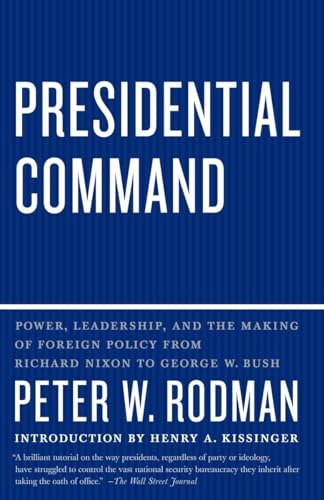
Presidential Command: Power, Leadership, and the Making of Foreign Policy from Richard Nixon to George W. Bush - Softcover
Inhaltsangabe
An official in the Nixon, Ford, Reagan, and both Bush administrations, Peter W. Rodman draws on his firsthand knowledge of the Oval Office to explore the foreign-policy leadership of every president from Nixon to George W. Bush. This riveting and informative book about the inner workings of our government is rich with anecdotes and fly-on-the-wall portraits of presidents and their closest advisors. It is essential reading for historians, political junkies, and for anyone in charge of managing a large organization.
Die Inhaltsangabe kann sich auf eine andere Ausgabe dieses Titels beziehen.
Über die Autorin bzw. den Autor
Peter W. Rodman was a senior fellow in foreign policy at the Brookings Institution in Washington, D.C. He served as deputy assistant to the president for National Security Affairs, as director of the State Department’s Policy Planning Staff, as special assistant to Henry Kissinger in the White House, and, most recently, as assistant secretary of defense of international security affairs (2001–2007). Rodman is the author of More Precious Than Peace. He died in August 2008.
Auszug. © Genehmigter Nachdruck. Alle Rechte vorbehalten.
Chapter One
Bureaucracy, Democracy, and Legitimacy
There is a famous story of President Abraham Lincoln, taking a vote in a cabinet meeting on whether to sign the Emancipation Proclamation. All his cabinet secretaries vote nay, whereupon Lincoln raises his right hand and declares: “The ayes have it!”
The story is apocryphal, but it well captures the truth of Lincoln’s relations with his cabinet. That cabinet included supremely ambitious men, substantial political figures in their own right, several of whom had sought the presidency in 1860 and remained convinced that they,
not the country lawyer from Illinois, should be sitting in his chair. Yet Lincoln came to dominate this “team of rivals” and seized the responsibility
that was inescapably his.
Such a story brings a smile when the president under discussion is the most revered political leader in the history of the republic. But our modern political culture and sensibility are more ambivalent. When less revered presidents make controversial decisions, what do we really believe about presidential authority? How do we feel, for example, about Richard Nixon overruling the dissent of both his secretary of state and his secretary of defense to order military escalations that he thought essential to prosecute the Vietnam War? What do we think of Ronald Reagan pursuing what he thought was a strategic opening with Iran, over the objection of his chief cabinet officers? With respect to the very public anguish of Secretary of State Colin Powell and his State Department over George W. Bush’s decisions on Iraq, do we identify with Bush or with Powell? How often do we read in the press about White House “interference” in the work of experts in the departments and agencies, and complaints that their work is being “politicized”? One part of our brain seems to side with the permanent government. In the age of the whistle-blower, what do we really think about a president’s authority to decide and carry out policies with which subordinates disagree?
The answer should not depend simply on one’s own policy or partisan preferences. There ought to be neutral principles, not only to guide the public discourse but also to guide presidents. The modern trend, especially since the United States emerged from World War II as a global power, has been to expand the White House staff and institutions like the National Security Council (NSC) precisely to enable more centralized control, or at least better central coordination, over an expanding policy community. That policy community includes traditional cabinet departments with an international role (State, Defense, Treasury), other institutions (the Central Intelligence Agency, the uniformed military, and agencies in charge of trade and foreign aid policy), and departments and agencies only recently playing an important role in foreign policy (the departments of Justice and Homeland Security, the Federal Bureau of Investigation, and the Drug Enforcement Administration). But like a law of physics, presidential efforts to strengthen control over this expanding community only stimulate the countertrends that are at work—powerful centrifugal forces in Congress, in the media, and in the Executive Branch itself.
The subject of this book is not the question of presidential prerogative vis-à-vis Congress. Library shelves are already filled with books on the two “co-equal” branches, and especially the ancient debate over war powers. The issue here is presidential control over the Executive Branch.
Congress’s role, however, is an enormously important factor. As scholar Richard Neustadt has expressed it, the Constitutional Convention of 1787 did not, as commonly thought, create a system of separated powers. “Rather, it created a government of separated institutions sharing powers.” Presidents undoubtedly have more freedom of action in the national security realm than in making domestic policy. Nonetheless, cabinet secretaries and their departments have obligations to Congress by statute; they are beholden to Congress for the final disposition of their budgets and their testimony is a duty. Cabinet secretaries are thus inevitably responsive, at least in part, to Congress as well as to the president. But that only restates the problem.
Neustadt recounts that President Harry Truman in 1952, contemplating the possibility that Dwight Eisenhower would be elected to succeed him, predicted that the eminent general would have problems adjusting: “ ‘He’ll sit here,’ Truman would remark (tapping his desk for emphasis), ‘and he’ll say, “Do this! Do that!” And nothing will happen. Poor Ike—it won’t be a bit like the Army. He’ll find it very frustrating.’ ” Truman’s own experience was: “I sit here all day trying to persuade people to do the things they ought to have sense enough to do without my persuading them. . . . That’s all the powers of the President amount to.”
That was Neustadt’s analysis as well. His answer was to counsel presidents and would-be presidents on how to maximize their power to persuade. His classic book Presidential Power, first published in 1960, explained that a president’s success depended on expanding and husbanding his personal political leverage and prestige, his mastery of tools of influence that convince his subordinates that what the president wants them to do comports with their own personal and bureaucratic interests. Neustadt graded presidents according to their “power sense”—their instinct for maintaining their personal political power; he thought Franklin Roosevelt and Harry Truman had this “power sense,” but Eisenhower did not. His book was seized upon by the new administration of John F. Kennedy as a primer on how to strengthen presidential control. However, the centrifugal forces have only strengthened since then—to the point where Neustadt, in an edition of his book twenty years later, felt compelled to go out of his way to debunk the notion of the “imperial presidency” that had become fashionable in some circles in the interim. As late as 1990, even after the Reagan presidency, Neustadt was still preoccupied with what he saw as the weakness of the office: “Weakness is still what I see: weakness in the sense of a great gap between what is expected of a man (or someday a woman) and assured capacity to carry through.” Part of this weakness resides in the expansion of the modern bureaucracy and the increasing difficulty of a single individual’s asserting systematic control over it.
Concepts of Legitimacy
Our Constitution, on the face of it, seems unambiguous about who is in charge of the Executive Branch: “The executive power shall be vested in
a President of the United States of America” (Article II, section 1). But, as usual, a closer reading of our founding document reveals a more
complex picture. Passages in section 2 of the same Article II refer specifically to the “executive departments” and to Congress’s power to authorize the heads of those departments to appoint subordinates. The president’s authority over the civilian establishment is less explicit than his authority as commander in chief of the armed forces. The renowned constitutional scholar Edward S. Corwin concluded that the phrase “executive power” is a “term of uncertain content.” While the United States may have a cabinet, we do not have a cabinet system, which is what the British have. The cabinet at Westminster is “the government”—the body of ministers (what we would call cabinet secretaries) headed by the prime minister, who is in...
„Über diesen Titel“ kann sich auf eine andere Ausgabe dieses Titels beziehen.
Suchergebnisse für Presidential Command: Power, Leadership, and the Making...

Beispielbild für diese ISBN
Presidential Command: Power, Leadership, and the Making of Foreign Policy from Richard Nixon to George W. Bush
Anbieter: World of Books (was SecondSale), Montgomery, IL, USA
Verkäuferbewertung 5 von 5 Sternen

Paperback. Zustand: Good. An official in the Nixon, Ford, Reagan, and both Bush administrations, Peter W. Rodman draws on his firsthand knowledge of the Oval Office to explore the foreign-policy leadership of every president from Nixon to George W. Bush. This riveting and informative book about the inner workings of our government is rich with anecdotes and fly-on-the-wall portraits of presidents and their closest advisors. It is essential reading for historians, political junkies, and for anyone in charge of managing a large organization. Artikel-Nr. 00105274196
Gebraucht kaufen
EUR 5,14
Versand gratis
Versand innerhalb von USA
Versand innerhalb von USA
Anzahl: 1 verfügbar
Beispielbild für diese ISBN
Presidential Command: Power, Leadership, and the Making of Foreign Policy from Richard Nixon to George W. Bush
Anbieter: ThriftBooks-Dallas, Dallas, TX, USA
Verkäuferbewertung 5 von 5 Sternen
Paperback. Zustand: Good. No Jacket. Pages can have notes/highlighting. Spine may show signs of wear. ~ ThriftBooks: Read More, Spend Less. Artikel-Nr. G0307390527I3N00
Gebraucht kaufen
EUR 6,14
Versand gratis
Versand innerhalb von USA
Versand innerhalb von USA
Anzahl: 1 verfügbar
Beispielbild für diese ISBN
Presidential Command : Power, Leadership, and the Making of Foreign Policy from Richard Nixon to George W. Bush
Verlag:
Knopf Doubleday Publishing Group, 2010
ISBN 10: 0307390527
ISBN 13: 9780307390523
Gebraucht
Softcover
Anbieter: Better World Books, Mishawaka, IN, USA
Verkäuferbewertung 5 von 5 Sternen
Zustand: Very Good. Pages intact with possible writing/highlighting. Binding strong with minor wear. Dust jackets/supplements may not be included. Stock photo provided. Product includes identifying sticker. Better World Books: Buy Books. Do Good. Artikel-Nr. 8854766-6
Gebraucht kaufen
EUR 7,18
Versand gratis
Versand innerhalb von USA
Versand innerhalb von USA
Anzahl: 1 verfügbar
Beispielbild für diese ISBN
Presidential Command: Power, Leadership, and the Making of Foreign Policy from Richard Nixon to George W. Bush
Anbieter: Revaluation Books, Exeter, Vereinigtes Königreich
Verkäuferbewertung 5 von 5 Sternen
Paperback. Zustand: Brand New. 1st edition. 351 pages. 8.25x4.75x0.75 inches. In Stock. Artikel-Nr. 0307390527
Neu kaufen
EUR 34,02
EUR 11,77 Versand
Versand von Vereinigtes Königreich nach USA
Versand von Vereinigtes Königreich nach USA
Anzahl: 1 verfügbar
Foto des Verkäufers
Presidential Command : Power, Leadership, and the Making of Foreign Policy from Richard Nixon to George
Anbieter: AHA-BUCH GmbH, Einbeck, Deutschland
Verkäuferbewertung 5 von 5 Sternen
Taschenbuch. Zustand: Neu. Neuware - An official in the Nixon, Ford, Reagan, and both Bush administrations, Peter W. Rodman draws on his firsthand knowledge of the Oval Office to explore the foreign-policy leadership of every president from Nixon to George W. Bush. This riveting and informative book about the inner workings of our government is rich with anecdotes and fly-on-the-wall portraits of presidents and their closest advisors. It is essential reading for historians, political junkies, and for anyone in charge of managing a large organization. Artikel-Nr. 9780307390523
Neu kaufen
EUR 25,07
EUR 35,00 Versand
Versand von Deutschland nach USA
Versand von Deutschland nach USA
Anzahl: 2 verfügbar
Foto des Verkäufers
Presidential Command
Verlag:
Knopf Doubleday Publishing Group, 2010
ISBN 10: 0307390527
ISBN 13: 9780307390523
Neu
Kartoniert / Broschiert
Anbieter: moluna, Greven, Deutschland
Verkäuferbewertung 5 von 5 Sternen
Kartoniert / Broschiert. Zustand: New. Peter W. Rodman was a senior fellow in foreign policy at the Brookings Institution in Washington, D.C. He served as deputy assistant to the president for National Security Affairs, as director of the State Department&rsquos Policy Planning Staff, as. Artikel-Nr. 897692805
Neu kaufen
EUR 22,65
EUR 48,99 Versand
Versand von Deutschland nach USA
Versand von Deutschland nach USA
Anzahl: Mehr als 20 verfügbar