
Verwandte Artikel zu And the Show Went On: Cultural Life in Nazi-Occupied...
Inhaltsangabe
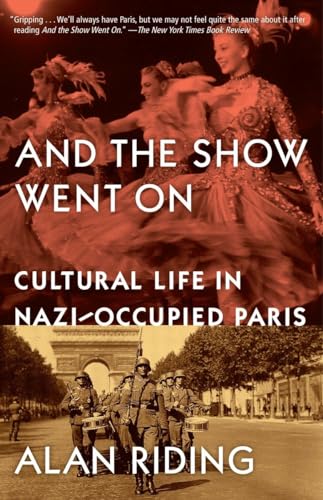
On June 14, 1940, German tanks rolled into a silent and deserted Paris. Eight days later, a humbled France accepted defeat along with foreign occupation. While the swastika now flew over Paris, the City of Light was undamaged, and soon a peculiar kind of normalcy returned as theaters, opera houses, movie theaters, and nightclubs reopened for business. Shedding light on this critical moment of twentieth-century European cultural history, And the Show Went On focuses anew on whether artists and writers have a special duty to show moral leadership in moments of national trauma.
Die Inhaltsangabe kann sich auf eine andere Ausgabe dieses Titels beziehen.
Über die Autorin bzw. den Autor
For twelve years, Alan Riding was the European cultural correspondent for The New York Times. He was previously bureau chief for the Times in Paris, Madrid, Rio de Janeiro, and Mexico City. Riding is the author of Distant Neighbors: A Portrait of the Mexicans. He continues to live in Paris with his wife, Marlise Simons, a writer for the Times.
Auszug. © Genehmigter Nachdruck. Alle Rechte vorbehalten.
· c h a p t e r 1 ·
Everyone on Stage
ON JUNE 14, 1940, the German army drove into Paris unopposed. Within weeks, the remnants of French democracy were quietly buried and the Third Reich settled in for an indefinite occupation of France. Who was to blame? With the country on its knees, many in France now saw this as a defeat foretold, a debacle that had been in the making since France emerged from World War I, victorious in name but shattered in spirit. In the bloody and muddy trenches of theWestern Front, 1.4 million Frenchmen died, representing 3.5 percent of the population and almost 10 percent of working-age men. Further, the 1 million Frenchmen who were left badly maimed, those ever-present mutilés de guerre, made it impossible to forget the past. With France already alarmed by its low prewar birthrate, this slaughter ofmen and future fathers meant that it was not until 1931 that the country exceeded its 1911 population of 41.4 million—and, even then, this was in large part thanks to immigration.
At the same time, the country was being let down by its political class. The Third Republic, founded in 1870 after France’s defeat in the Franco-Prussian War, was plagued by instability and consumed by political bickering. Although the economy fared relatively well in the 1920s, postwar reconstruction lagged far behind. Then, in the 1930s, confronted by the twin threats of the Great Depression and the spread of extremist ideologies across Europe, France’s rulers chose to ignore both. In a country that had long boasted the originality of its political ideas, a string of dysfunctional governments eroded public faith in democracy and boosted the appeal of the Nazi, Fascist and Communist alternatives. Most critically, with the Great War spawning a nation of pacifists, the French preferred to ignore mounting evidence that the country would soon again be at war with Germany. And when war became inevitable, they chose to believe official propaganda boasting that their army was invincible. This monumental self-delusion only compounded the shock at what followed. When Hitler’s army swept across western Europe in the spring of 1940, French defenses crumbled in a matter of weeks. Neither 1870 nor 1914 had been this bad.
Yet even in the deepening gloom of the interwar years, as artistic and intellectual freedoms were being extinguished across Europe, Paris continued to shine as a cultural beacon. The majority of Parisians were poor, but they had long since been evicted from the elegant heart of Paris by Baron Haussmann’s drastic urban redesign a half century earlier. This “new” Paris was the favored arena of elitist divertimento, drawing minor royalty, aristocrats and millionaires to buy art, to race their horses in the Bois de Boulogne, to hear Richard Strauss conduct Der Rosenkavalier at the Paris Opera, to party in the latest Chanel and Schiaparelli designs.
Painters, writers, musicians and dancers also flocked there from across Europe and the Americas, in some cases seeking sexual freedom, in others fleeing dictatorships, in many hoping for inspiration and recognition. Embracing everything from the literary solemnity of the Académie Française through the avant-garde of Surrealism to the high kicks of the Moulin Rouge, Paris offered both enlightenment and entertainment. And wandering across its pages and stages like eloquent courtesans were intellectuals, artists and performers. Whether admired for their ideas, their imagination or simply their Bohemian lifestyle, they enjoyed the trappings of a privileged caste. “The prestige of the writer was something peculiarly French, I believe,” the astute essayist Jean Guéhenno later wrote. “In no other country of the world was the writer treated with such reverence by the people. Each bourgeois family might fear that its son would become an artist, but the French bourgeoisie as a group was in agreement in giving the artist and the writer an almost sacred preeminence.” Put differently, culture had become inseparable from France’s very image of itself. And the rest of Europe recognized this. But with the swastika now flying over Paris, how would French culture— its artists, writers and intellectuals, as well as its great institutions— respond? Again, the answer lay in the turmoil of the interwar years.
Nowhere was French cultural leadership greater than in the visual arts. Between the Franco-Prussian War and World War I alone, art movements born in France— Impressionism, Post-Impressionism, Les Nabis, Fauvism and Cubism— succeeded one another in what came to resemble a permanent revolution. The 1914–18 conflict did little to disrupt this. While German artists like Otto Dix, George Grosz and Max Beckmann addressed the nightmare of trench warfare, artists in France paid little heed to a war being fought barely a hundred miles north of Paris. When it was over, those nineteenth-century giants Renoir, Monet and Rodin were still alive, while the influence of Pablo Picasso, Marcel Duchamp and Henri Matisse continued to grow. Many artists with prewar reputations, men like Georges Braque, André Derain, Maurice de Vlaminck, Kees van Dongen, Pierre Bonnard and Aristide Maillol, also remained faithful to their prewar styles. Fernand Léger was a rare exception. After he spent two years on the front, his art was transformed, with his sketches of artillery and planes anticipating his tubular “mechanical” paintings of the 1920s. Bonnard avoided the trenches, serving briefly as a war artist and painting just one scene of desolation, Un Village en ruines près du Ham. But he quickly returned to his cherished themes of nudes and interior scenes.
For European artists, Paris was the place to meet great artists and to aspire to become great oneself. And it helped that the city was an important art market. From the late 1890s, the legendary dealer Ambroise Vollard carried the names of Cézanne, Gauguin and Van Gogh abroad and, in 1901, he gave Picasso his first exhibition in Paris. In the interwar years, it was the turn of other dealers, notably Daniel-Henry Kahnweiler and the Rosenberg brothers, Léonce and Paul, to keep European and American collectors supplied with the new art from Paris. For foreign artists, the city’s energy, bubbling away in the studios and cafés of the Left Bank, was as appealing as any specific art movement. True, Salvador Dalí, Max Ernst, Man Ray and Joan Miró embraced Surrealism, but other foreigners went their own ways, among them Constantin Brancusi, Chaïm Soutine, Piet Mondrian, Amedeo Modigliani and Alberto Giacometti. The list of prominent French artists in Paris at that time was even longer. And to these could be added the architects and designers who created Art Deco as a style that would define the 1930s. Probably at no time since the Italian Renaissance had one city boasted such a remarkable concentration of artistic brilliance.
In the performing arts, change came from abroad, with Sergei Diaghilev’s Ballets Russes leading a revolution in dance that would influence ballet for much of the twentieth century. In 1912, the troupe’s star dancer, Vaslav Nijinsky, shocked Paris with his erotic interpretation of Claude Debussy’s Prélude à l’après- midi d’un faune. The following year, the dancer was at the center of a riot in the Théâtre des Champs- Élysées during the premiere of Igor Stravinsky’s Rite of Spring, when some spectators mutinied against Nijinsky’s unorthodox choreography and the music’s disturbingly primitive rhythm.
Diaghilev’s role as a promoter and organizer of...
„Über diesen Titel“ kann sich auf eine andere Ausgabe dieses Titels beziehen.
Weitere beliebte Ausgaben desselben Titels

Suchergebnisse für And the Show Went On: Cultural Life in Nazi-Occupied...

Beispielbild für diese ISBN
And the Show Went On : Cultural Life in Nazi-Occupied Paris
Verlag:
Knopf Doubleday Publishing Group, 2011
ISBN 10: 0307389057
ISBN 13: 9780307389053
Gebraucht
Softcover
Anbieter: Better World Books, Mishawaka, IN, USA
Verkäuferbewertung 5 von 5 Sternen

Zustand: Good. Former library copy. Pages intact with minimal writing/highlighting. The binding may be loose and creased. Dust jackets/supplements are not included. Includes library markings. Stock photo provided. Product includes identifying sticker. Better World Books: Buy Books. Do Good. Artikel-Nr. 5418306-6
Gebraucht kaufen
EUR 7,00
Versand gratis
Versand innerhalb von USA
Versand innerhalb von USA
Anzahl: 1 verfügbar
Beispielbild für diese ISBN
And the Show Went On : Cultural Life in Nazi-Occupied Paris
Verlag:
Knopf Doubleday Publishing Group, 2011
ISBN 10: 0307389057
ISBN 13: 9780307389053
Gebraucht
Softcover
Anbieter: Better World Books, Mishawaka, IN, USA
Verkäuferbewertung 5 von 5 Sternen
Zustand: Good. Pages intact with minimal writing/highlighting. The binding may be loose and creased. Dust jackets/supplements are not included. Stock photo provided. Product includes identifying sticker. Better World Books: Buy Books. Do Good. Artikel-Nr. 10234253-6
Gebraucht kaufen
EUR 7,00
Versand gratis
Versand innerhalb von USA
Versand innerhalb von USA
Anzahl: 1 verfügbar
Beispielbild für diese ISBN
And the Show Went On : Cultural Life in Nazi-Occupied Paris
Verlag:
Knopf Doubleday Publishing Group, 2011
ISBN 10: 0307389057
ISBN 13: 9780307389053
Gebraucht
Softcover
Anbieter: Better World Books, Mishawaka, IN, USA
Verkäuferbewertung 5 von 5 Sternen
Zustand: Very Good. Pages intact with possible writing/highlighting. Binding strong with minor wear. Dust jackets/supplements may not be included. Stock photo provided. Product includes identifying sticker. Better World Books: Buy Books. Do Good. Artikel-Nr. 5636100-6
Gebraucht kaufen
EUR 7,00
Versand gratis
Versand innerhalb von USA
Versand innerhalb von USA
Anzahl: 1 verfügbar
Beispielbild für diese ISBN
And the Show Went On
Anbieter: Hamelyn, Madrid, M, Spanien
Verkäuferbewertung 5 von 5 Sternen
Zustand: Aceptable. : Sumérgete en la vida cultural de París durante la ocupación nazi con 'And the Show Went On' de Alan Riding. Este libro explora cómo el teatro, la música, el cine y otras formas de arte florecieron bajo la sombra de la guerra, y plantea preguntas sobre el papel de los artistas en tiempos de crisis moral. A través de una narrativa cautivadora, Riding examina las decisiones difíciles que enfrentaron los artistas franceses y su impacto en la identidad cultural de una nación en conflicto. EAN: 9780307389053 Tipo: Libros Categoría: Historia Título: And the Show Went On Autor: Alan Riding Editorial: Penguin Random House Idioma: en Páginas: 432 Formato: tapa blanda. Artikel-Nr. Happ-2025-10-08-34d85f94
Gebraucht kaufen
EUR 10,08
EUR 12,99 Versand
Versand von Spanien nach USA
Versand von Spanien nach USA
Anzahl: 1 verfügbar
Beispielbild für diese ISBN
And the Show Went On: Cultural Life in Nazi-Occupied Paris
Anbieter: Kennys Bookstore, Olney, MD, USA
Verkäuferbewertung 5 von 5 Sternen
Zustand: New. 2011. Illustrated. paperback. . . . . . Books ship from the US and Ireland. Artikel-Nr. V9780307389053
Neu kaufen
EUR 23,24
EUR 9,09 Versand
Versand innerhalb von USA
Versand innerhalb von USA
Anzahl: 15 verfügbar
Beispielbild für diese ISBN
And the Show Went On: Cultural Life in Nazi-occupied Paris
Anbieter: Revaluation Books, Exeter, Vereinigtes Königreich
Verkäuferbewertung 5 von 5 Sternen
Paperback. Zustand: Brand New. reprint edition. 399 pages. 8.50x5.75x1.00 inches. In Stock. Artikel-Nr. __0307389057
Neu kaufen
EUR 20,65
EUR 11,70 Versand
Versand von Vereinigtes Königreich nach USA
Versand von Vereinigtes Königreich nach USA
Anzahl: 1 verfügbar
Beispielbild für diese ISBN
And the Show Went On
Anbieter: Majestic Books, Hounslow, Vereinigtes Königreich
Verkäuferbewertung 4 von 5 Sternen

Zustand: New. pp. 432. Artikel-Nr. 5332338
Neu kaufen
EUR 28,68
EUR 7,61 Versand
Versand von Vereinigtes Königreich nach USA
Versand von Vereinigtes Königreich nach USA
Anzahl: 1 verfügbar
Beispielbild für diese ISBN
And the Show Went On: Cultural Life in Nazi-Occupied Paris
Anbieter: Global Village Books, Bundall, QLD, Australien
Verkäuferbewertung 3 von 5 Sternen

Soft cover. Zustand: Near Fine. 1st Edition. xiv,400pp, index, b&w plates . Well reviewed. Very good copy 432 p. Artikel-Nr. 324816
Gebraucht kaufen
EUR 10,07
EUR 28,15 Versand
Versand von Australien nach USA
Versand von Australien nach USA
Anzahl: 1 verfügbar
Beispielbild für diese ISBN
And the Show Went on
Anbieter: Mooney's bookstore, Den Helder, Niederlande
Verkäuferbewertung 4 von 5 Sternen
Zustand: As New. Artikel-Nr. 9DE0BD4FEC732F9
Gebraucht kaufen
EUR 45,73
EUR 14,95 Versand
Versand von Niederlande nach USA
Versand von Niederlande nach USA
Anzahl: 1 verfügbar
Foto des Verkäufers
And the Show Went On
Verlag:
Knopf Doubleday Publishing Group, 2011
ISBN 10: 0307389057
ISBN 13: 9780307389053
Neu
Kartoniert / Broschiert
Anbieter: moluna, Greven, Deutschland
Verkäuferbewertung 5 von 5 Sternen
Kartoniert / Broschiert. Zustand: New. For twelve years, Alan Riding was the European cultural correspondent for The New York Times. He was previously bureau chief for the Times in Paris, Madrid, Rio de Janeiro, and Mexico City. Riding is the author of Distant Neighbor. Artikel-Nr. 897692725
Neu kaufen
EUR 21,92
EUR 48,99 Versand
Versand von Deutschland nach USA
Versand von Deutschland nach USA
Anzahl: Mehr als 20 verfügbar