
Verwandte Artikel zu The Thing About Life Is That One Day You'll Be...
Inhaltsangabe
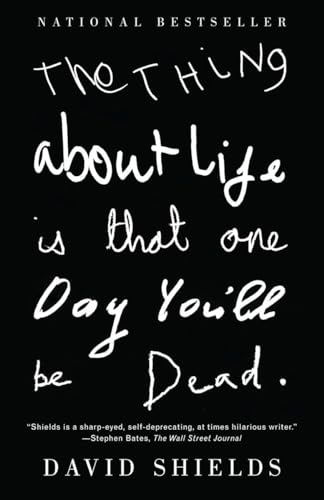
NATIONAL BESTSELLER • Weaving together personal anecdote, biological fact, philosophical doubt, cultural criticism, and the wisdom of an eclectic range of writers and thinkers, a book that expertly renders both a hilarious family portrait and a truly resonant meditation on mortality.
“Shields is a sharp-eyed, self-deprecating, at times hilarious writer.”
—The Wall Street Journal
Mesmerized and somewhat unnerved by his 97-year-old father's vitality and optimism, David Shields undertakes an original investigation of our flesh-and-blood existence, our mortal being.
The Thing About Life provokes us to contemplate the brevity and radiance of our own sojourn on earth and challenges us to rearrange our thinking in crucial and unexpected ways.
Die Inhaltsangabe kann sich auf eine andere Ausgabe dieses Titels beziehen.
Über die Autorin bzw. den Autor
DAVID SHIELDS is the author of eight previous books, including Black Planet: Facing Race during an NBA Season (a finalist for the National Book Critics Circle Award), Remote: Reflections on Life in the Shadow of Celebrity (winner of the PEN/Revson Award), and Dead Languages: A Novel (winner of a PEN/Syndicated Fiction award). A senior editor of Conjunctions, Shields has published essays and stories in dozens of periodicals, including The New York Times Magazine, Harper's Magazine, Yale Review, Village Voice, Salon, Slate, McSweeney's, and Believer. He teaches at the University of Washington and lives in Seattle with his wife and daughter.
Auszug. © Genehmigter Nachdruck. Alle Rechte vorbehalten.
Letter to My FatherLet the wrestling match begin: my stories versus his stories.This book is an autobiography of my body, a biography of my father’s body, an anatomy of our bodies together–especially my dad’s, his body, his relentless body.This is my research; this is what I now know: the brute facts of existence, the fragility and ephemerality of life in its naked corporeality, human beings as bare, forked animals, the beauty and pathos in my body and his body and everybody else’s body as well.Accept death, I always seem to be saying.Accept life, is his entirely understandable reply.Why am I half in love with easeful death? I just turned 51. As Martin Amis has said, “Who knows when it happens, but it happens. Suddenly you realize that you’re switching from saying ‘Hi’ to saying ‘Bye.’ And it’s a full-time job: death. You really have to wrench your head around to look in the other direction, because death’s so apparent now, and it wasn’t apparent before. You were intellectually persuaded that you were going to die, but it wasn’t a reality.” So, too, for myself, being the father of an annoyingly vital 14-year-old girl only deepens these feelings. I’m no longer athletic (really bad back–more on this later). Natalie is. After a soccer game this season, a parent of one of the players on the other team came up to her and said, “Turn pro.”Why, at 97, is my father so devoted to longevity per se, to sheer survival? He is–to me–cussedly, maddeningly alive and interesting, but I also don’t want to romanticize him. He’s life force as life machine–exhausting and exhaustive. Rest in peace? Hard to imagine.Mark Harris, trying to explain why he thought Saul Bellow was a better writer than any of his contemporaries, said Bellow was simply more alive than anyone else, and there’s something of that in my father. D. H. Lawrence was said to have lived as if he were a man without skin. That, too, is my father: I keep on urging him to don skin, and he keeps declining.I seem to have an Oedipal urge to bury him in a shower of death data. Why do I want to cover my dad in an early shroud? He’s strong and he’s weak and I love him and I hate him and I want him to live forever and I want him to die tomorrow.Our Birth Is Nothing But Our Death BegunA fetus doesn't sit passively in its mother's womb and wait to be fed. Its placenta aggressively sprouts blood vessels that invade its mother's tissues to extract nutrients. A mother and her unborn child engage in an unconscious struggle over the nutrients she will provide it. Pregnancy is, as the evolutionary biologist David Haig says, a tug of war: each side pulls hard; the flag tied to the middle of the rope barely moves. Existence is warfare.Human beings have existed for 250,000 years; during that time, 90 billion individuals have lived and died. You're one of 6.5 billion people now on the planet, and 99.9 percent of your genes are the same as everyone else's. The difference is in the remaining 0.1 percent—one nucleotide base in every 1,000.You're born with 350 bones (long, short, flat, and irregular); as you grow, the bones fuse together: an adult's body has 206 bones. Approximately 70 percent of your body weight is water—which is about the same percentage of the earth's surface that is water.A newborn baby, whose average heart rate is 120 beats per minute, makes the transition from a comfortable, fluid-filled environment to a cold, air-filled one by creating a suction 50 times stronger than the average adult breath. I was a breech birth, the danger of which is that the head (in this case, my head) comes out last, which dramatically increases the possibility that the umbilical cord will get wrapped around the neck (in this case, my neck). I entered the world feet first, then remained in the hospital an extra week to get a little R & R in a warm incubator that my father guarded like a goalie whenever anyone came within striking distance. If I laid still for more than a few minutes, my father reportedly pounded on the glass dome. I wasn't dead, Dad. I was only sleeping. All my life I've pretended to seek a cold, air-filled environment (danger), but really what I'm drawn to is that comfortable, fluid-filled environment (safety).I remember once being complimented by my mother for not entering a playground when the gate was locked and my father being disgusted that I hadn't climbed the fence. As a wide receiver, I would run intricate patterns, then stand all alone in the middle of the field, waving my hands, calling for the ball. I never dropped a pass, but when I was hit hard, I would typically tighten up and fumble. I was the best softball player in the neighborhood, but as we grew older, we began to play overhand, fast-pitch hardball, and I started flinching. Trying to beat out a ground ball, I would always slow down so that the throw to first base would arrive ahead of me and I'd avoid getting hit in the head with a wild toss. Batting, I was afraid of getting hit with the pitch; fielding, I dreaded bad hops off the rocky infield. I could run 100 yards in 10.8 seconds, but I had very long legs and the track coach insisted that I run high hurdles; I stutter-stepped before each hurdle to make sure I cleared it and came in last. Having never learned to dive, I jumped in the pool feet first. The swimming instructor dragged me to the edge of the diving board, positioned my arms and legs, held me in the air for a second, then dropped me into the pool. At the last instant, I turned my face, and water broke my fall like a bed of electric needles. What was I scared of? Why have I always been so afraid of getting hurt?In the Bhagavad Gita, the human body is defined as a wound with nine openings.A newborn baby is, objectively, no beauty. The fat pads that will fill out the cheeks are missing. The jaws are unsupported by teeth. Hair, if there is any, is often so fine as to make the baby (especially Caucasian babies) appear bald. Cheesy material—called vernix caseosa—covers the body, providing a protective dressing for the skin, which is reddened, moist, and deeply creased. Swelling formed by pressure during the passage through the birth canal may have temporarily deformed the nose, caused one or both eyes to swell up, or elongated the head into a strange shape. The skull is incompletely formed: in some places, the bones haven't fully joined together, leaving the brain covered only by soft tissue. External genitalia in both sexes are disproportionately larger because of stimulation by the mother's hormones. For the same reason, the baby's breasts may be somewhat enlarged and secrete a watery discharge called "witch's milk." The irises are pale blue; true eye color develops later. The head is very large in proportion to the body, and the neck can't support it, while the buttocks are tiny.The average baby weighs 7 1/4 pounds and is 21 inches long. Newborns lose 5 to 8 percent of their birth weight in the first few days of life—owing, mainly, to water loss. They can hear little during the first 24 hours until air enters the eustachian tubes. They miss the womb and resent any stimulus. They will suck anything placed in or near their mouth. Their eyes wander and cross. Their body temperature is erratic, and their breathing is often irregular.At 1 month, a baby can wobble its head and practice flexing its arms and legs. At 2 months, it can face straight ahead while lying on its back. On its stomach, it can lift its head about 45 degrees. At 3 months, a baby's neck muscles are strong enough to support its head for a second or two.Babies are born with brains 25 percent of adult size, because the mechanics of walking upright impose a constraint on the size of the mother's pelvis. The channel through which the baby is born can't...
„Über diesen Titel“ kann sich auf eine andere Ausgabe dieses Titels beziehen.
Suchergebnisse für The Thing About Life Is That One Day You'll Be...

Beispielbild für diese ISBN
The Thing About Life Is That O
Anbieter: World of Books (was SecondSale), Montgomery, IL, USA
Verkäuferbewertung 5 von 5 Sternen

Zustand: Acceptable. Item in acceptable condition! Textbooks may not include supplemental items i.e. CDs, access codes etc. Artikel-Nr. 00082142782
Gebraucht kaufen
EUR 3,58
Versand gratis
Versand innerhalb von USA
Versand innerhalb von USA
Anzahl: 2 verfügbar
Beispielbild für diese ISBN
The Thing About Life Is That O
Anbieter: World of Books (was SecondSale), Montgomery, IL, USA
Verkäuferbewertung 5 von 5 Sternen
Zustand: Good. Item in good condition. Textbooks may not include supplemental items i.e. CDs, access codes etc. Artikel-Nr. 00084517421
Gebraucht kaufen
EUR 3,58
Versand gratis
Versand innerhalb von USA
Versand innerhalb von USA
Anzahl: 3 verfügbar
Beispielbild für diese ISBN
The Thing About Life Is That One Day You'll Be Dead
Verlag:
Vintage (edition Reprint), 2009
ISBN 10: 0307387968
ISBN 13: 9780307387967
Gebraucht
Paperback
Anbieter: BooksRun, Philadelphia, PA, USA
Verkäuferbewertung 5 von 5 Sternen
Paperback. Zustand: Very Good. Reprint. It's a well-cared-for item that has seen limited use. The item may show minor signs of wear. All the text is legible, with all pages included. It may have slight markings and/or highlighting. Artikel-Nr. 0307387968-11-6
Gebraucht kaufen
EUR 4,52
Versand gratis
Versand innerhalb von USA
Versand innerhalb von USA
Anzahl: 1 verfügbar
Beispielbild für diese ISBN
The Thing About Life Is That One Day You'll Be Dead
Anbieter: Wonder Book, Frederick, MD, USA
Verkäuferbewertung 5 von 5 Sternen
Zustand: Very Good. Very Good condition. A copy that may have a few cosmetic defects. May also contain light spine creasing or a few markings such as an owner's name, short gifter's inscription or light stamp. Artikel-Nr. U13A-06924
Gebraucht kaufen
EUR 6,20
Versand gratis
Versand innerhalb von USA
Versand innerhalb von USA
Anzahl: 1 verfügbar
Beispielbild für diese ISBN
The Thing About Life Is That One Day You'll Be Dead
Anbieter: ThriftBooks-Dallas, Dallas, TX, USA
Verkäuferbewertung 5 von 5 Sternen
Paperback. Zustand: Very Good. No Jacket. May have limited writing in cover pages. Pages are unmarked. ~ ThriftBooks: Read More, Spend Less. Artikel-Nr. G0307387968I4N00
Gebraucht kaufen
EUR 6,43
Versand gratis
Versand innerhalb von USA
Versand innerhalb von USA
Anzahl: 1 verfügbar
Beispielbild für diese ISBN
The Thing About Life Is That One Day You'll Be Dead
Anbieter: ThriftBooks-Reno, Reno, NV, USA
Verkäuferbewertung 5 von 5 Sternen
Paperback. Zustand: Very Good. No Jacket. May have limited writing in cover pages. Pages are unmarked. ~ ThriftBooks: Read More, Spend Less. Artikel-Nr. G0307387968I4N00
Gebraucht kaufen
EUR 6,43
Versand gratis
Versand innerhalb von USA
Versand innerhalb von USA
Anzahl: 1 verfügbar
Beispielbild für diese ISBN
The Thing About Life Is That One Day You'll Be Dead
Anbieter: ThriftBooks-Atlanta, AUSTELL, GA, USA
Verkäuferbewertung 5 von 5 Sternen
Paperback. Zustand: Very Good. No Jacket. May have limited writing in cover pages. Pages are unmarked. ~ ThriftBooks: Read More, Spend Less. Artikel-Nr. G0307387968I4N00
Gebraucht kaufen
EUR 6,43
Versand gratis
Versand innerhalb von USA
Versand innerhalb von USA
Anzahl: 1 verfügbar
Beispielbild für diese ISBN
The Thing about Life Is That One Day You'll Be Dead
Verlag:
Knopf Doubleday Publishing Group, 2009
ISBN 10: 0307387968
ISBN 13: 9780307387967
Gebraucht
Softcover
Anbieter: Better World Books, Mishawaka, IN, USA
Verkäuferbewertung 5 von 5 Sternen
Zustand: Good. Reprint. Pages intact with minimal writing/highlighting. The binding may be loose and creased. Dust jackets/supplements are not included. Stock photo provided. Product includes identifying sticker. Better World Books: Buy Books. Do Good. Artikel-Nr. 4485482-6
Gebraucht kaufen
EUR 6,96
Versand gratis
Versand innerhalb von USA
Versand innerhalb von USA
Anzahl: 2 verfügbar
Beispielbild für diese ISBN
The Thing About Life Is That One Day You'll Be Dead
Anbieter: Roundabout Books, Greenfield, MA, USA
Verkäuferbewertung 4 von 5 Sternen

paperback. Zustand: Near Fine. Condition Notes: Excellent, unmarked copy with little wear and tight binding. We ship in recyclable American-made mailers. 100% money-back guarantee on all orders. Artikel-Nr. 1693103
Gebraucht kaufen
EUR 13,33
Versand gratis
Versand innerhalb von USA
Versand innerhalb von USA
Anzahl: 1 verfügbar
Beispielbild für diese ISBN
The Thing About Life Is That One Day You'll Be Dead
Anbieter: Revaluation Books, Exeter, Vereinigtes Königreich
Verkäuferbewertung 5 von 5 Sternen
Paperback. Zustand: Brand New. reprint edition. 256 pages. 8.00x5.25x0.75 inches. In Stock. Artikel-Nr. x-0307387968
Neu kaufen
EUR 24,33
EUR 11,64 Versand
Versand von Vereinigtes Königreich nach USA
Versand von Vereinigtes Königreich nach USA
Anzahl: 2 verfügbar