
Verwandte Artikel zu Self Comes to Mind: Constructing the Conscious Brain
Inhaltsangabe
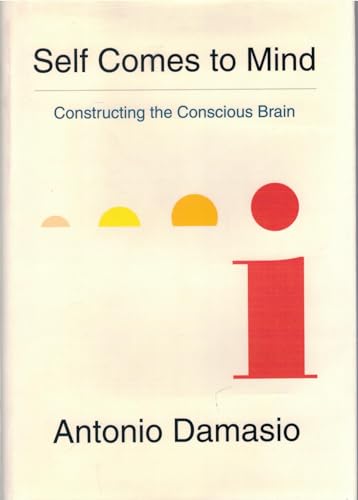
From one of the most significant neuroscientists at work today, a pathbreaking investigation of a question that has confounded philosophers, psychologists, and neuroscientists for centuries: how is consciousness created?
Antonio Damasio has spent the past thirty years studying and writing about how the brain operates, and his work has garnered acclaim for its singular melding of the scientific and the humanistic. In Self Comes to Mind, he goes against the long-standing idea that consciousness is somehow separate from the body, presenting compelling new scientific evidence that consciousness—what we think of as a mind with a self—is to begin with a biological process created by a living organism. Besides the three traditional perspectives used to study the mind (the introspective, the behavioral, and the neurological), Damasio introduces an evolutionary perspective that entails a radical change in the way the history of conscious minds is viewed and told. He also advances a radical hypothesis regarding the origins and varieties of feelings, which is central to his framework for the biological construction of consciousness: feelings are grounded in a near fusion of body and brain networks, and first emerge from the historically old and humble brain stem rather than from the modern cerebral cortex.
Damasio suggests that the brain’s development of a human self becomes a challenge to nature’s indifference and opens the way for the appearance of culture, a radical break in the course of evolution and the source of a new level of life regulation—sociocultural homeostasis. He leaves no doubt that the blueprint for the work-in-progress he calls sociocultural homeostasis is the genetically well-established basic homeostasis, the curator of value that has been present in simple life-forms for billions of years. Self Comes to Mind is a groundbreaking journey into the neurobiological foundations of mind and self.
Die Inhaltsangabe kann sich auf eine andere Ausgabe dieses Titels beziehen.
Über die Autorinnen und Autoren
Antonio Damasio is David Dornsife Professor of Neuroscience, Psychology, and Neurology, and director of the Brain and Creativity Institute at the University of Southern California. Damasio's books include Descartes' Error: Emotion, Reason, and the Human Brain; The Feeling of What Happens: Body and Emotion in the Making of Consciousness; and Looking for Spinoza: Joy, Sorrow, and the Feeling Brain. He has received the Pessoa, Signoret, and Cozzarelli prizes (shared with his wife, Hanna), and the Prince of Asturias Award for Technical and Scientific Research. Damasio is a fellow of the Institute of Medicine of the National Academy of Sciences, the American Academy of Arts and Sciences, and the European Academy of Sciences and Arts. He lives in Los Angeles.
Antonio Damasio is University Professor; David Dornsife Professor of Neuroscience, Neurology and Psychology; and director of the Brain and Creativity Institute at the University of Southern California [www.usc.edu/bci]. He is the author of numerous scientific articles and the recipient of many awards, including the Asturias Prize in Science and Technology; the Honda Prize; and the Pessoa and Signoret prizes. Damasio is a member of the Institute of Medicine of the National Academy of Sciences, and a Fellow of the American Academy of Arts and Sciences, the Bavarian Academy of Sciences, and the European Academy of Sciences and Arts. He holds honorary doctorates from several universities and is the author of Descartes’ Error, The Feeling of What Happens, Looking for Spinoza, and Self Comes to Mind, which have been translated and taught in universities throughout the world.
(For more information go to the Brain and Creativity Institute website at http://www.usc.edu/bci/)
Auszug. © Genehmigter Nachdruck. Alle Rechte vorbehalten.
1
Awakening
When I woke up, we were descending. I had been asleep long enough to miss the announcements about the landing and the weather. I had not been aware of myself or my surroundings. I had been unconscious.
Few things about our biology are as seemingly trivial as this commodity known as consciousness, the phenomenal ability that consists of having a mind equipped with an owner, a protagonist for one’s existence, a self inspecting the world inside and around, an agent seemingly ready for action.
Consciousness is not merely wakefulness. When I woke up, two brief paragraphs ago, I did not look around vacantly, taking in the sights and the sounds as if my awake mind belonged to no one. On the contrary, I knew, almost instantly, with little hesitation if any, without effort, that this was me, sitting on an airplane, my flying identity coming home to Los Angeles with a long to-do list before the day would be over, aware of an odd combination of travel fatigue and enthusiasm for what was ahead, curious about the runway we would be landing on, and attentive to the adjustments of engine power that were bringing us to earth. No doubt, being awake was indispensable to this state, but wakefulness was hardly its main feature. What was that main feature? The fact that the myriad contents displayed in my mind, regardless of how vivid or well ordered, connected with me, the proprietor of my mind, through invisible strings that brought those contents together in the forward-moving feast we call self; and, no less important, the fact that the connection was felt. There was a feelingness to the experience of the connected me.
Awakening meant having my temporarily absent mind returned, but with me in it, both property (the mind) and proprietor (me) accounted for. Awakening allowed me to reemerge and survey my mental domains, the sky-wide projection of a magic movie, part documentary and part fiction, otherwise known as the conscious human mind.
We all have free access to consciousness, bubbling so easily and abundantly in our minds that without hesitation or apprehension we let it be turned off every night when we go to sleep and allow it to return every morning when the alarm clock rings, at least 365 times a year, not counting naps. And yet few things about our beings are as remarkable, foundational, and seemingly mysterious as consciousness. Without consciousness—that is, a mind endowed with subjectivity—you would have no way of knowing that you exist, let alone know who you are and what you think. Had subjectivity not begun, even if very modestly at first, in living creatures far simpler than we are, memory and reasoning are not likely to have expanded in the prodigious way they did, and the evolutionary road for language and the elaborate human version of consciousness we now possess would not have been paved. Creativity would not have flourished. There would have been no song, no painting, and no literature. Love would never have been love, just sex. Friendship would have been mere cooperative convenience. Pain would never have become suffering—not a bad thing, come to think of it— but an equivocal advantage given that pleasure would not have become bliss either. Had subjectivity not made its radical appearance, there would have been no knowing and no one to take notice, and consequently there would have been no history of what creatures did through the ages, no culture at all.
Although I have not yet provided a working definition of consciousness, I hope I am leaving no doubt as to what it means not to have consciousness: in the absence of consciousness, the personal view is suspended; we do not know of our existence; and we do not know that anything else exists. If consciousness had not developed in the course of evolution and expanded to its human version, the humanity we are now familiar with, in all its frailty and strength, would never have developed either. One shudders to think that a simple turn not taken might have meant the loss of the biological alternatives that make us truly human. But then, how would we ever have found out that something was missing?
We take consciousness for granted because it is so available, so easy to use, so elegant in its daily disappearing and reappearing acts, and yet, when we think of it, scientists and nonscientists alike, we do puzzle. What is consciousness made of? Mind with a twist, it seems to me, since we cannot be conscious without having a mind to be conscious of. But what is mind made of? Does mind come from the air or from the body? Smart people say it comes from the brain, that it is in the brain, but that is not a satisfactory reply. How does the brain do mind?
The fact that no one sees the minds of others, conscious or not, is especially mysterious. We can observe their bodies and their actions, what they do or say or write, and we can make informed guesses about what they think. But we cannot observe their minds, and only we ourselves can observe ours, from the inside, and through a rather narrow window. The properties of minds, let alone conscious minds, appear to be so radically different from those of visible living matter that thoughtful folk wonder how one process (conscious minds working) meshes with the other process (physical cells living together in aggregates called tissues).
But to say that conscious minds are mysterious—and on the face of it they are—is different from saying that the mystery is insoluble. It is different from saying that we shall never be able to understand how a living organism endowed with a brain develops a conscious mind.
„Über diesen Titel“ kann sich auf eine andere Ausgabe dieses Titels beziehen.
Suchergebnisse für Self Comes to Mind: Constructing the Conscious Brain

Beispielbild für diese ISBN
Self Comes to Mind: Constructing the Conscious Brain
Anbieter: World of Books (was SecondSale), Montgomery, IL, USA
Verkäuferbewertung 5 von 5 Sternen

Zustand: Fair. The arrival of neurons and their unique ability to transmit and receive messages was the radical break in the course of the human brain's evolution. This led to the development of the self. Neurons organize themselves in complex circuits and networks. Networks that serve to represent events occurring in the body, influence the function of other cells, even their own function. In this framework, the distinction between body and brain is blurred--the neurons that make up the brain and eventually generate the mind are body cells and are perpetually connected to the body. Neurons are the producers of mind states. The increasing complexity of the patterns in which neurons organize themselves is once the mystery and the clues to the myriad ways in which the brain operates, manages life, and controls human behavior--in ways that we are only beginning to understand. The systems of neurons that govern life in the interior of a body--the process of homeostasis--are first assisted by reflex-like dispositions, eventually by images, which are the basic ingredient of minds. But the flexibility and creativity of the human mind do not emerge from images alone. They require images to create a protagonist; one's self that is capable of reflection. Once self comes to mind, the devices of reward and punishment, drives and motivations, and emotions, can be controlled by an autobiographical self. These devices, which have been present all along at earlier evolutionary stages, are now capable of personal reflection and deliberation. The reflective self uses expanded memory, language, and reasoning to create the very possibility of culture. Artikel-Nr. 00098031101
Gebraucht kaufen
EUR 4,00
Versand gratis
Versand innerhalb von USA
Versand innerhalb von USA
Anzahl: 1 verfügbar
Beispielbild für diese ISBN
Self Comes to Mind: Constructing the Conscious Brain
Anbieter: World of Books (was SecondSale), Montgomery, IL, USA
Verkäuferbewertung 5 von 5 Sternen
Zustand: Good. The arrival of neurons and their unique ability to transmit and receive messages was the radical break in the course of the human brain's evolution. This led to the development of the self. Neurons organize themselves in complex circuits and networks. Networks that serve to represent events occurring in the body, influence the function of other cells, even their own function. In this framework, the distinction between body and brain is blurred--the neurons that make up the brain and eventually generate the mind are body cells and are perpetually connected to the body. Neurons are the producers of mind states. The increasing complexity of the patterns in which neurons organize themselves is once the mystery and the clues to the myriad ways in which the brain operates, manages life, and controls human behavior--in ways that we are only beginning to understand. The systems of neurons that govern life in the interior of a body--the process of homeostasis--are first assisted by reflex-like dispositions, eventually by images, which are the basic ingredient of minds. But the flexibility and creativity of the human mind do not emerge from images alone. They require images to create a protagonist; one's self that is capable of reflection. Once self comes to mind, the devices of reward and punishment, drives and motivations, and emotions, can be controlled by an autobiographical self. These devices, which have been present all along at earlier evolutionary stages, are now capable of personal reflection and deliberation. The reflective self uses expanded memory, language, and reasoning to create the very possibility of culture. Artikel-Nr. 00107771758
Gebraucht kaufen
EUR 4,00
Versand gratis
Versand innerhalb von USA
Versand innerhalb von USA
Anzahl: 3 verfügbar
Foto des Verkäufers
Self Comes to Mind: Constructing the Conscious Brain
Anbieter: Dream Books Co., Denver, CO, USA
Verkäuferbewertung 5 von 5 Sternen
Zustand: acceptable. This copy has clearly been enjoyedâ"expect noticeable shelf wear and some minor creases to the cover. Binding is strong, and all pages are legible. May contain previous library markings or stamps. Artikel-Nr. DBV.0307378756.A
Gebraucht kaufen
EUR 4,01
Versand gratis
Versand innerhalb von USA
Versand innerhalb von USA
Anzahl: 2 verfügbar
Foto des Verkäufers
Self Comes to Mind: Constructing the Conscious Brain
Anbieter: Dream Books Co., Denver, CO, USA
Verkäuferbewertung 5 von 5 Sternen
Zustand: very_good. Pages are clean with no markings. May show minor signs of wear or cosmetic defects marks, cuts, bends, or scuffs on the cover, spine, pages, or dust jacket. May have remainder marks on edges. Artikel-Nr. DBV.0307378756.VG
Gebraucht kaufen
EUR 4,20
Versand gratis
Versand innerhalb von USA
Versand innerhalb von USA
Anzahl: 1 verfügbar
Beispielbild für diese ISBN
Self Comes to Mind: Constructing the Conscious Brain
Anbieter: ThriftBooks-Atlanta, AUSTELL, GA, USA
Verkäuferbewertung 5 von 5 Sternen
Hardcover. Zustand: Very Good. No Jacket. Missing dust jacket; May have limited writing in cover pages. Pages are unmarked. ~ ThriftBooks: Read More, Spend Less. Artikel-Nr. G0307378756I4N01
Gebraucht kaufen
EUR 6,07
Versand gratis
Versand innerhalb von USA
Versand innerhalb von USA
Anzahl: 1 verfügbar
Beispielbild für diese ISBN
Self Comes to Mind: Constructing the Conscious Brain
Anbieter: ThriftBooks-Phoenix, Phoenix, AZ, USA
Verkäuferbewertung 5 von 5 Sternen
Hardcover. Zustand: Good. No Jacket. Former library book; Pages can have notes/highlighting. Spine may show signs of wear. ~ ThriftBooks: Read More, Spend Less. Artikel-Nr. G0307378756I3N10
Gebraucht kaufen
EUR 6,07
Versand gratis
Versand innerhalb von USA
Versand innerhalb von USA
Anzahl: 1 verfügbar
Beispielbild für diese ISBN
Self Comes to Mind: Constructing the Conscious Brain
Anbieter: ThriftBooks-Phoenix, Phoenix, AZ, USA
Verkäuferbewertung 5 von 5 Sternen
Hardcover. Zustand: Very Good. No Jacket. Missing dust jacket; May have limited writing in cover pages. Pages are unmarked. ~ ThriftBooks: Read More, Spend Less. Artikel-Nr. G0307378756I4N01
Gebraucht kaufen
EUR 6,07
Versand gratis
Versand innerhalb von USA
Versand innerhalb von USA
Anzahl: 1 verfügbar
Beispielbild für diese ISBN
Self Comes to Mind: Constructing the Conscious Brain
Anbieter: ThriftBooks-Reno, Reno, NV, USA
Verkäuferbewertung 5 von 5 Sternen
Hardcover. Zustand: Good. No Jacket. Former library book; Pages can have notes/highlighting. Spine may show signs of wear. ~ ThriftBooks: Read More, Spend Less. Artikel-Nr. G0307378756I3N10
Gebraucht kaufen
EUR 6,07
Versand gratis
Versand innerhalb von USA
Versand innerhalb von USA
Anzahl: 1 verfügbar
Beispielbild für diese ISBN
Self Comes to Mind: Constructing the Conscious Brain
Anbieter: ThriftBooks-Atlanta, AUSTELL, GA, USA
Verkäuferbewertung 5 von 5 Sternen
Hardcover. Zustand: Good. No Jacket. Missing dust jacket; Pages can have notes/highlighting. Spine may show signs of wear. ~ ThriftBooks: Read More, Spend Less. Artikel-Nr. G0307378756I3N01
Gebraucht kaufen
EUR 6,07
Versand gratis
Versand innerhalb von USA
Versand innerhalb von USA
Anzahl: 1 verfügbar
Beispielbild für diese ISBN
Self Comes to Mind: Constructing the Conscious Brain
Anbieter: ThriftBooks-Dallas, Dallas, TX, USA
Verkäuferbewertung 5 von 5 Sternen
Hardcover. Zustand: Good. No Jacket. Pages can have notes/highlighting. Spine may show signs of wear. ~ ThriftBooks: Read More, Spend Less. Artikel-Nr. G0307378756I3N00
Gebraucht kaufen
EUR 6,07
Versand gratis
Versand innerhalb von USA
Versand innerhalb von USA
Anzahl: 1 verfügbar