
Verwandte Artikel zu Storm Kings: The Untold History of America's First...
Inhaltsangabe
With 16 pages of black-and-white illustrations
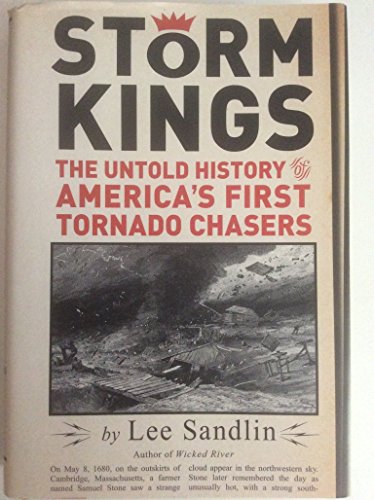
From the acclaimed author of Wicked River comes Storm Kings, a riveting tale of supercell tornadoes and the quirky, pioneering, weather-obsessed scientists whose discoveries created the science of modern meteorology.
While tornadoes have occasionally been spotted elsewhere, only the central plains of North America have the perfect conditions for their creation. For the early settlers the sight of a funnel cloud was an unearthly event. They called it the “Storm King,” and their descriptions bordered on the supernatural: it glowed green or red, it whistled or moaned or sang. In Storm Kings, Lee Sandlin explores America’s fascination with and unique relationship to tornadoes. From Ben Franklin’s early experiments to the “great storm war” of the nineteenth century to heartland life in the early twentieth century, Sandlin re-creates with vivid descriptions some of the most devastating storms in America’s history, including the Tri-state Tornado of 1925 and the Peshtigo “fire tornado,” whose deadly path of destruction was left encased in glass.
Drawing on memoirs, letters, eyewitness testimonies, and archives, Sandlin brings to life the forgotten characters and scientists who changed a nation—including James Espy, America’s first meteorologist, and Colonel John Park Finley, who helped place a network of weather “spotters” across the country. Along the way, Sandlin details the little-known but fascinating history of the National Weather Service, paints a vivid picture of the early Midwest, and shows how successive generations came to understand, and finally coexist with, the spiraling menace that could erase lives and whole towns in an instant.
Die Inhaltsangabe kann sich auf eine andere Ausgabe dieses Titels beziehen.
Über die Autorin bzw. den Autor
Lee Sandlin is the author of Wicked River, Storm Kings, and The Distancers. He was also an award-winning journalist, essayist, and book reviewer for The Wall Street Journal. Born in Wildwood, Illinois, he grew up in the suburbs of Chicago. He died in 2014.
Auszug. © Genehmigter Nachdruck. Alle Rechte vorbehalten.
Introduction
Ghost Riders
There is an old country-and-western song my father liked called “Ghost Riders in the Sky.” My father had been born and raised in rural Oklahoma during the Dust Bowl years and had spent his adolescence working at cattle ranches in Colorado and Wyoming; in his later life he was fond of saying that he had been one of the last of the old-fashioned cowboys, and he often recited scraps of cowboy poetry or retold the spooky folklore he’d heard from the other ranch hands. “Ghost Riders in the Sky” was a perfect example. It’s about a cowboy who has a terrifying vision: he sees the souls of damned cowboys riding through the night in an eternal chase after a stampede of supernatural cattle. One of these spectral cowboys breaks off the pursuit long enough to warn the singer to repent his evil ways, or else, after he dies, he will join them “trying to catch the Devil’s herd across these endless skies.”
I don’t remember my father ever connecting this stampede to tornadoes. But then, he didn’t have to. I made the connection myself the first time I heard him sing the song, and it’s stayed with me ever since. He was constantly telling me scary stories about tornadoes. He made them sound like a regular feature of his childhood landscape. The way he described it, anywhere on the Great Plains, if you raised your eyes to the horizon, you might somewhere in the vast flat distance see a funnel cloud beginning to form. He talked about all the different and bizarre shapes they took: grand swooping curves of impossible architecture, furious little whirlwinds like the clouds of dust above cartoon fistfights. He repeatedly told me about the closest call he’d ever had with a tornado—a blustery summer day when he and his friends had been playing baseball and a tornado had come roaring across the outfield; they’d had to hide in the dugout, clinging to the underside of the bench, to keep from being sucked into the funnel. But his favorite stories were about the nights he and his family had spent cowering in their snug lantern-lit storm cellar as the world outside had torn itself apart in the frenzy of a prairie thunderstorm: at some point his mother would raise a finger for silence, and they’d hear amid the roar of the wind and the crashes and bangs of thunder a sinister new sound, a deep throbbing and a high-pitched shriek like an airplane engine revving up. “And that,” my father would conclude with satisfaction, “was the tornado.”
I was spellbound by these stories, but I was also baffled by them. I never got that clear an idea of what a tornado really was. We lived then in northern Illinois, a place that was supposedly tornado heavy, but I had only seen one unmistakable tornado in my life, and that was in The Wizard of Oz. Few sights in any movie, or for that matter in the real world, have ever scared me as deeply as that. My father had no patience for it, though. He passed through the living room as my mother and brother and I were staring at the television screen in rapt horror, and he lingered only long enough to emit a snort of contempt. “Nah, that’s no tornado,” he said. “You should see a real tornado.”
###
Each spring the science class at my elementary school would spend a day on the subject of tornadoes. The teacher would show us a filmstrip that had a lot of cartoon images of spiral-shaped clouds looming over prairie farmhouses. There were also photographs of crew-cut men with white shirts, black ties, and horn-rimmed glasses, clustered in muddy fields around weather balloons. But only a few of the images were of actual tornadoes; in those days, the 1960s, a clear photograph of a tornado was as rare as one of a flying saucer.
The filmstrip’s narrator instructed us solemnly on the rules of tornado safety. There was one infallible warning sign that a tornado was coming, he said: the clouds took on a greenish glow. Tornadoes also caused an electrical disturbance that could be picked up by some TV sets, so if your TV screen grew mysteriously brighter during a storm, that was a clear signal a tornado was somewhere nearby. Then he explained why tornadoes were so destructive: there was a near vacuum at the heart of the funnel, so when it passed overhead, the air pressure trapped inside your house burst outward like an explosion. The most sensible precaution you could take, therefore, was to open your windows to equalize the air pressure. After you did so, only then should you take shelter, and the one safe place to hide was the southwest corner of the basement.
The viewing of this filmstrip turned me into a kind of amateur tornado warden. Whenever there was a storm, I kept my eyes peeled for the warning signs. But where were they? Spring after spring, tornado season after tornado season, I never saw a hint of a green glow in the sky. The closest I came to a tornado was one sultry April afternoon when I was twelve: a severe storm came through the Chicago suburbs, and a tornado touched down several miles away. The next day the newspapers ran an amateur photograph: it showed a blurry smear of buildings and streetlights, while against the horizon stood an indistinct gray cone of smoke towering up to the sky like a supervillain menacing a cartoon city. I tore it out of the paper and tacked it up on my bedroom wall, as though it were a wanted poster.
I did reports for school on tornadoes; I had all the key tornado facts memorized so that I could talk about wind speeds and air pressure with the least provocation. One afternoon in late spring when I was twelve, a storm built up in the west, and the sky around it turned a weird sickly yellow. My teacher, who knew about my obsession—pretty much everybody in the school did—asked me seriously whether that color sky meant a tornado was coming. I said authoritatively that yellow skies meant hail; green was the color of tornadoes. It was the proudest moment of my life.
I even had dreams about tornadoes. The dreams were all pretty much identical: they began with a feeling of horrible dread. I knew, with absolute certainty, that a tornado was approaching. I couldn’t see it; nothing about the scene looked sinister; but it was already too late to escape. Sometimes I’d be the only one who knew, and I’d try in vain to warn everybody of the imminence of disaster. It never did any good; nobody would pay any attention to me. The dream always ended the same way: I was standing at a window, looking out at the sky, all hope lost, and just as the tornado was about to appear, I’d wake up.
I think I was at the height of my tornado passion the summer I was twelve. That was when my family went to visit my father’s old home in Oklahoma, where my grandmother still lived. I spent the whole drive there staring at the clouds and expecting each one of them to transform before my eyes into a tornado. But somehow Oklahoma proved to be deficient in tornadoes. The skies were a ceaseless stampede of white cumulus, and some of them did occasionally puff up into thunderheads, but there were no funnel clouds reaching down to touch the earth. The tabletop flatness of the plains was broken by nothing out to the horizon except oil derricks.
I began to suspect that my father had been goosing his memories in order to scare me; he did always like scaring me. The night of our arrival, though, as we sat together on the front porch, a gigantic line of storms came rolling up over the southwestern sky. I had never seen anything in the world so large; it was like a tidal wave about to wash the plains clean. The sight inspired my father with something like nostalgia. This was just the kind of weather, he told...
„Über diesen Titel“ kann sich auf eine andere Ausgabe dieses Titels beziehen.
Suchergebnisse für Storm Kings: The Untold History of America's First...

Beispielbild für diese ISBN
Storm Kings: The Untold History of America's First Tornado Chasers
Verlag:
Pantheon (edition 37236th), 2013
ISBN 10: 0307378527
ISBN 13: 9780307378521
Gebraucht
Hardcover
Anbieter: BooksRun, Philadelphia, PA, USA
Verkäuferbewertung 5 von 5 Sternen

Hardcover. Zustand: Fair. 37236th. With dust jacket. The item might be beaten up but readable. May contain markings or highlighting, as well as stains, bent corners, or any other major defect, but the text is not obscured in any way. Artikel-Nr. 0307378527-7-1-29
Gebraucht kaufen
EUR 5,32
Versand gratis
Versand innerhalb von USA
Versand innerhalb von USA
Anzahl: 1 verfügbar
Beispielbild für diese ISBN
Storm Kings: The Untold History of America's First Tornado Chasers
Verlag:
Pantheon (edition 37236th), 2013
ISBN 10: 0307378527
ISBN 13: 9780307378521
Gebraucht
Hardcover
Anbieter: BooksRun, Philadelphia, PA, USA
Verkäuferbewertung 5 von 5 Sternen
Hardcover. Zustand: Very Good. 37236th. With dust jacket. It's a well-cared-for item that has seen limited use. The item may show minor signs of wear. All the text is legible, with all pages included. It may have slight markings and/or highlighting. Artikel-Nr. 0307378527-8-1-29
Gebraucht kaufen
EUR 6,11
Versand gratis
Versand innerhalb von USA
Versand innerhalb von USA
Anzahl: 1 verfügbar
Beispielbild für diese ISBN
Storm Kings : The Untold History of America's First Tornado Chasers
Verlag:
Knopf Doubleday Publishing Group, 2013
ISBN 10: 0307378527
ISBN 13: 9780307378521
Gebraucht
Hardcover
Erstausgabe
Anbieter: Better World Books, Mishawaka, IN, USA
Verkäuferbewertung 5 von 5 Sternen
Zustand: Good. First Edition. Former library copy. Pages intact with minimal writing/highlighting. The binding may be loose and creased. Dust jackets/supplements are not included. Includes library markings. Stock photo provided. Product includes identifying sticker. Better World Books: Buy Books. Do Good. Artikel-Nr. 388254-6
Gebraucht kaufen
EUR 7,20
Versand gratis
Versand innerhalb von USA
Versand innerhalb von USA
Anzahl: 1 verfügbar
Beispielbild für diese ISBN
Storm Kings : The Untold History of America's First Tornado Chasers
Verlag:
Knopf Doubleday Publishing Group, 2013
ISBN 10: 0307378527
ISBN 13: 9780307378521
Gebraucht
Hardcover
Erstausgabe
Anbieter: Better World Books, Mishawaka, IN, USA
Verkäuferbewertung 5 von 5 Sternen
Zustand: Very Good. First Edition. Former library copy. Pages intact with possible writing/highlighting. Binding strong with minor wear. Dust jackets/supplements may not be included. Includes library markings. Stock photo provided. Product includes identifying sticker. Better World Books: Buy Books. Do Good. Artikel-Nr. 388255-75
Gebraucht kaufen
EUR 7,20
Versand gratis
Versand innerhalb von USA
Versand innerhalb von USA
Anzahl: 2 verfügbar
Beispielbild für diese ISBN
Storm Kings : The Untold History of America's First Tornado Chasers
Verlag:
Knopf Doubleday Publishing Group, 2013
ISBN 10: 0307378527
ISBN 13: 9780307378521
Gebraucht
Hardcover
Erstausgabe
Anbieter: Better World Books, Mishawaka, IN, USA
Verkäuferbewertung 5 von 5 Sternen
Zustand: Good. First Edition. Pages intact with minimal writing/highlighting. The binding may be loose and creased. Dust jackets/supplements are not included. Stock photo provided. Product includes identifying sticker. Better World Books: Buy Books. Do Good. Artikel-Nr. 5380684-75
Gebraucht kaufen
EUR 7,20
Versand gratis
Versand innerhalb von USA
Versand innerhalb von USA
Anzahl: 1 verfügbar
Beispielbild für diese ISBN
Storm Kings: The Untold History of America's First Tornado Chasers
Anbieter: ThriftBooks-Dallas, Dallas, TX, USA
Verkäuferbewertung 5 von 5 Sternen
Hardcover. Zustand: Good. No Jacket. Former library book; Pages can have notes/highlighting. Spine may show signs of wear. ~ ThriftBooks: Read More, Spend Less. Artikel-Nr. G0307378527I3N10
Gebraucht kaufen
EUR 7,28
Versand gratis
Versand innerhalb von USA
Versand innerhalb von USA
Anzahl: 1 verfügbar
Beispielbild für diese ISBN
Storm Kings: The Untold History of America's First Tornado Chasers
Anbieter: ThriftBooks-Atlanta, AUSTELL, GA, USA
Verkäuferbewertung 5 von 5 Sternen
Hardcover. Zustand: Very Good. No Jacket. Former library book; May have limited writing in cover pages. Pages are unmarked. ~ ThriftBooks: Read More, Spend Less. Artikel-Nr. G0307378527I4N10
Gebraucht kaufen
EUR 7,29
Versand gratis
Versand innerhalb von USA
Versand innerhalb von USA
Anzahl: 1 verfügbar
Beispielbild für diese ISBN
Storm Kings: The Untold History of America's First Tornado Chasers
Anbieter: ThriftBooks-Atlanta, AUSTELL, GA, USA
Verkäuferbewertung 5 von 5 Sternen
Hardcover. Zustand: Very Good. No Jacket. May have limited writing in cover pages. Pages are unmarked. ~ ThriftBooks: Read More, Spend Less. Artikel-Nr. G0307378527I4N00
Gebraucht kaufen
EUR 7,29
Versand gratis
Versand innerhalb von USA
Versand innerhalb von USA
Anzahl: 1 verfügbar
Beispielbild für diese ISBN
Storm Kings: The Untold History of America's First Tornado Chasers
Anbieter: ThriftBooks-Atlanta, AUSTELL, GA, USA
Verkäuferbewertung 5 von 5 Sternen
Hardcover. Zustand: As New. No Jacket. Pages are clean and are not marred by notes or folds of any kind. ~ ThriftBooks: Read More, Spend Less. Artikel-Nr. G0307378527I2N00
Gebraucht kaufen
EUR 7,29
Versand gratis
Versand innerhalb von USA
Versand innerhalb von USA
Anzahl: 1 verfügbar