
Verwandte Artikel zu Everyday Crochet: Wearable Designs Just for You
Inhaltsangabe
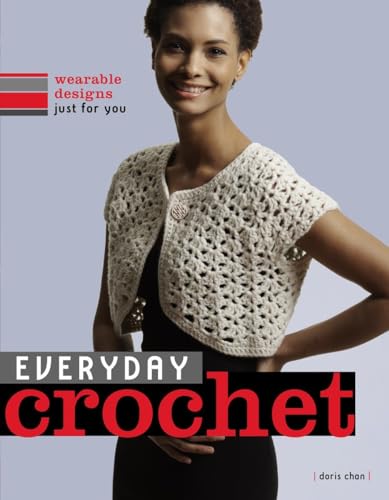
Everyday Crochet is your new must-have collection of crochet designs. Doris Chan, the author of Amazing Crochet Lace, presents 25 patterns for fresh and fashion-forward attire, this time with a variety of customizable options.
With basic crochet skills, you can crochet tops, dresses, jackets, layering pieces, and accessories—a wardrobe of versatile garments that can be mixed, matched, and layered with the clothes women already have in the closet.
Also included are techniques for shaping stitches in pattern and a special focus on shells of all kinds. Using a variety of closed and open stitches, yarns, and colorways, you can make wearable ensembles for any season and any mood. Many patterns offer simple fitting tips and options for adjusting length, sleeve, and neckline, as well as sizing for ample figures up to 3XL—52” bust or 54” hip—to help achieve a signature look.
Whether you’re a crochet newbie seeking inspiration or an old pro looking for a new take on this fun craft, Everyday Crochet is packed full of innovative designs for stylish, up-to-the-minute crochet clothing and accessories.
Die Inhaltsangabe kann sich auf eine andere Ausgabe dieses Titels beziehen.
Über die Autorin bzw. den Autor
Doris Chan’s crochet garments and accessories have appeared in publications such as Family Circle Easy Knitting and Michael’s Arts and Crafts magazines, and in several books, including the Lion Brand “Just” series. She lives in Pennsylvania.
Auszug. © Genehmigter Nachdruck. Alle Rechte vorbehalten.
1
Everyday Garments
Made it? Flaunt it! Crocheted clothes are not just for special occasions. If you crochet, then you can make garments to wear every day using the yarns you love. "Who would want to?" you ask. Well, think about it. You can't deny there's a great deal of pride and satisfaction in crocheting something, anything. To some extent we all seek the admiration, approval, and dumbstruck awe that skillfully crocheted objects inspire. But how many admirers can there be for pretty afghans and decorative items that stay at home? Or for those gorgeous but frivolous accessories you adore wearing, but that only come out during the holidays?
I see many possible reasons for not putting your yarn stash on your back more often. Never crocheted a garment before? We will fix that. Haven't met the right crochet design? Maybe we can fix that. Can't find patterns in your size? Ditto. Think you can't wear or don't look good in crochet? It's not you, it's the crocheted garment that's either too clunky and thick, isn't your size, or has no shape. We can fix that, too. Aren't sure how to mix crochet with your own clothes? I can't give you a makeover, but I hope the photos of crochet plus wardrobe staples will give you some ideas.
Extra Sizing Spoken Here
Nobody, no body is perfect. To be human-especially to be a human woman-is to have bulges. From birth we are told that some bulges are sexy and desirable, worthy of flaunting, while some other bulges are unsightly, best kept disguised. Who made those rules? How are we supposed to maintain any kind of self-esteem when our fashion icons are size 4 and the average American woman is size 14?
I am ashamed to admit that I totally bought into this worship of the slender. Until very recently I hadn't even considered sizing my designs larger than XL, with a finished bust around 44" (112cm). And for the most part, the editors and publishers for whom I designed were not much concerned about it. Today I am acutely aware of the need for good crochet design for other than tiny model figures. But, be assured, this book isn't for large sizes only. Every garment here is offered from small (to fit busts sized 32-34" [81-84cm]) through extra sizing (to fit busts up to 50" [127cm]), and some larger still. Many designs are Petite-able and Tall-able. If we aren't encouraged to rejoice in our various bulges, at least we can dress them in crochet.
This book is about options. Each of the following design chapters offers a basic clothing item, then runs through a gang of variations on the theme. Your perfect sweater probably won't be like any of the samples I have crocheted, because you are going to shop for the bits to do for yourself, sort of one from column A, one from column B. Add up the parts you want for the silhouette that works best for your body, whatever your size.
The Dreaded Raglan
Understand that I design garments from the neck down with raglan-type increases in pattern to shape the shoulders and arms. Many readers will appreciate my MO for the technical crochet aspects but will immediately dismiss the thought of raglans as intrinsically unattractive. And normally that'd be correct. Most real figures will look best in a shoulder that's more structured, with a defined shoulder line and set-in sleeves. But in order to hang properly and look good, structured garments require precise calculation of various slopes, perfect placement of the shoulder seam, and skillful seaming.
I never enjoyed crocheting garments this way because of the sewing. It's not that I dislike or disapprove of sewing or seaming in crochet; it's more that I've always been so lousy at it. And as for sewn raglan seams in crochet, they're the most horrible, unyielding, bulky, constricting, and restricting style imaginable. This raglan's different. This raglan is a gentle, almost invisible (or very pretty where perceptible) line of increasing stitch pattern. It creates a smooth, flexible, shapely shoulder that allows the fabric to stretch, drape, and mold to the wearer in ways a more structured garment could never hope to do.
Of course, there's no guarantee that it will look good on everyone. But I know for a fact that it is flattering on many who have worn my garments, and I hope you will at least give it a try.
What's Up with All the Shells?
Crocheted shells possess many unique qualities. The nature of a shell, consisting of multiple tall stitches all made in one spot, is that it wants to expand. I exploit this tendency by crocheting shell fabric from the top down. If allowed, the shells across any row tend toward maximum entropy by spilling out horizontally. Normally, each successive row or round of shell stitch pattern keeps this tendency in check, resulting in a straight, in-line piece of fabric.
However, if crocheted in a relaxed enough gauge, that room for expansion is always present-lurking. So, for instance, the shell may stay quietly in place, flat and perfect, going down the middle of the back. It may stretch out long and lean at the waistline, at the middle of your sleeve, or at the diagonal of a raglan shaping. Or it may give up its full potential for width around the top of the arm, across the bust and hip. Left unchecked, shells will make beautiful flares at the lower edges of your garment. Without much ado, you're creating a gentle bell at the bottom of your sleeve, a bit of room over the top of your hip where your sweater stops, and a bit of an A- line at the hem of your skirt or dress. This self-molding aspect of shells cannot truly manifest when you work from the bottom up.
Shaping shells is at times complex. There are the problems of how to fit them in, how to pick the pattern back up when the work has changed, and how to achieve the most elegant shaping within the amount of space available. Agonizingly, there is no magic formula-no brilliant algorithm that will give you the perfect number of increases and rows for every application. The more you mess around with your own pattern shaping, the more you come to realize how much variation there can be from stitch pattern to stitch pattern, from yarn to yarn, even from a yarn worked firmly to the same yarn worked loosely. No worries! Enabled by years of trial and error and a tiny bit of math, I have crunched the numbers for the designs in this book. Once you get the hang of increasing one flavor of shell, you should find shaping the shell variation in the next project much easier.
Substituting Yarns? Just Do It
Criticism of crocheted garments stems from outdated perceptions. It is true that once upon a time we were offered only pot holder fabric to wear-heavy, lifeless synthetic yarns worked with undersized hooks into clunky, frumpy garments. It is still assumed crocheters do not, will not, or cannot work with good yarns or luxury fibers, even when we can afford the cost. I was shocked and dismayed in a local yarn shop when I overheard a customer inquiring if she could crochet with a particularly lovely yarn labeled for knitting and being told no.
That customer should have been assured that any yarn that can be knitted can be crocheted. Anything you can wrap around your hook can be crocheted, including string, fabric, trash bags, wire, fishing line, or Twizzlers (don't ask!). Modern science has removed the stigma from synthetics. There are high-quality polyester and acrylic microfibers available. In a blend, microfiber adds strength, durability, softness, and sheen and takes away excess weight. The trendiest new yarns come from the fields, made from bamboo, soy, corn, and Tencel (derived from trees). The fineness, hand, and color properties of these alternative fibers rival those of silk, and can be found at a fraction of the cost.
Personally, I love messing with all kinds of yarns and fibers. I have my favorites as, I imagine, do you....
„Über diesen Titel“ kann sich auf eine andere Ausgabe dieses Titels beziehen.
Suchergebnisse für Everyday Crochet: Wearable Designs Just for You

Beispielbild für diese ISBN
Everyday Crochet: Wearable Designs Just for You
Verlag:
Potter Craft (edition Illustrated), 2007
ISBN 10: 0307353737
ISBN 13: 9780307353733
Gebraucht
Paperback
Anbieter: BooksRun, Philadelphia, PA, USA
Verkäuferbewertung 5 von 5 Sternen

Paperback. Zustand: Very Good. Illustrated. It's a well-cared-for item that has seen limited use. The item may show minor signs of wear. All the text is legible, with all pages included. It may have slight markings and/or highlighting. Artikel-Nr. 0307353737-11-1
Gebraucht kaufen
EUR 6,73
Versand gratis
Versand innerhalb von USA
Versand innerhalb von USA
Anzahl: 1 verfügbar
Beispielbild für diese ISBN
Everyday Crochet: Wearable Designs Just for You
Anbieter: ThriftBooks-Atlanta, AUSTELL, GA, USA
Verkäuferbewertung 5 von 5 Sternen
Paperback. Zustand: Good. No Jacket. Pages can have notes/highlighting. Spine may show signs of wear. ~ ThriftBooks: Read More, Spend Less. Artikel-Nr. G0307353737I3N00
Gebraucht kaufen
EUR 7,11
Versand gratis
Versand innerhalb von USA
Versand innerhalb von USA
Anzahl: 1 verfügbar
Beispielbild für diese ISBN
Everyday Crochet: Wearable Designs Just for You
Anbieter: ThriftBooks-Dallas, Dallas, TX, USA
Verkäuferbewertung 5 von 5 Sternen
Paperback. Zustand: Good. No Jacket. Pages can have notes/highlighting. Spine may show signs of wear. ~ ThriftBooks: Read More, Spend Less. Artikel-Nr. G0307353737I3N00
Gebraucht kaufen
EUR 7,11
Versand gratis
Versand innerhalb von USA
Versand innerhalb von USA
Anzahl: 1 verfügbar
Beispielbild für diese ISBN
Everyday Crochet: Wearable Designs Just for You
Anbieter: AwesomeBooks, Wallingford, Vereinigtes Königreich
Verkäuferbewertung 5 von 5 Sternen
Paperback. Zustand: Very Good. Everyday Crochet: Wearable Designs Just for You This book is in very good condition and will be shipped within 24 hours of ordering. The cover may have some limited signs of wear but the pages are clean, intact and the spine remains undamaged. This book has clearly been well maintained and looked after thus far. Money back guarantee if you are not satisfied. See all our books here, order more than 1 book and get discounted shipping. Artikel-Nr. 7719-9780307353733
Gebraucht kaufen
EUR 5,34
EUR 4,89 Versand
Versand von Vereinigtes Königreich nach USA
Versand von Vereinigtes Königreich nach USA
Anzahl: 2 verfügbar
Beispielbild für diese ISBN
Everyday Crochet : Wearable Designs Just for You
Verlag:
Potter/Ten Speed/Harmony/Rodale, 2007
ISBN 10: 0307353737
ISBN 13: 9780307353733
Gebraucht
Softcover
Anbieter: Better World Books Ltd, Dunfermline, Vereinigtes Königreich
Verkäuferbewertung 5 von 5 Sternen
Zustand: Good. Pages intact with minimal writing/highlighting. The binding may be loose and creased. Dust jackets/supplements are not included. Stock photo provided. Product includes identifying sticker. Better World Books: Buy Books. Do Good. Artikel-Nr. 4094746-6
Gebraucht kaufen
EUR 5,69
EUR 5,93 Versand
Versand von Vereinigtes Königreich nach USA
Versand von Vereinigtes Königreich nach USA
Anzahl: 1 verfügbar
Foto des Verkäufers
Everyday Crochet: Wearable Designs Just for You
Anbieter: WeBuyBooks, Rossendale, LANCS, Vereinigtes Königreich
Verkäuferbewertung 5 von 5 Sternen
paperback. Zustand: Very Good. Most items will be dispatched the same or the next working day. A copy that has been read, but is in excellent condition. Pages are intact and not marred by notes or highlighting. The spine remains undamaged. Artikel-Nr. rev7404783274
Gebraucht kaufen
EUR 3,32
EUR 8,79 Versand
Versand von Vereinigtes Königreich nach USA
Versand von Vereinigtes Königreich nach USA
Anzahl: 1 verfügbar
Beispielbild für diese ISBN
Everyday Crochet: Wearable Designs Just for You
Anbieter: Sell Books, Elland, YORKS, Vereinigtes Königreich
Verkäuferbewertung 5 von 5 Sternen
paperback. Zustand: Good. Our good condition books are generally good for reading but not for gifting or collecting. They could have imperfections such as creasing, fanning, inscriptions, margin notes, yellowing, staining on edge or cover or pages, bumps, scuffs, etc etc (sometimes multiple of these). It's a wide category that encompasses anything that isn't almost-new down to anything that is slightly better than poor. We would NOT recommend gifting Good books - these should be considered reading copies. Our books are dispatched from a Yorkshire former cotton mill. We list via barcode/ISBN so please note that the images are stock images and may not be the exact copy you receive, furthermore the details about edition and year might not be accurate as many publishers reuse the same ISBN for multiple editions and as we simply scan a barcode or enter an ISBN we do not check the validity of the edition data when listing. If you're looking for an exact edition please don't order (at least not without checking with us first, although we don't always have time to check). We aim to dispatch prompty, the service used will depend on order value and book size. We can ship to most countries, see our shipping policies. Payment is via Abe only. Artikel-Nr. SBAB-L-BKJ01288-RAG-20241024-VG
Gebraucht kaufen
EUR 3,43
EUR 9,20 Versand
Versand von Vereinigtes Königreich nach USA
Versand von Vereinigtes Königreich nach USA
Anzahl: 1 verfügbar
Beispielbild für diese ISBN
Everyday Crochet: Wearable Designs Just for You
Anbieter: Bahamut Media, Reading, Vereinigtes Königreich
Verkäuferbewertung 4 von 5 Sternen

Paperback. Zustand: Very Good. This book is in very good condition and will be shipped within 24 hours of ordering. The cover may have some limited signs of wear but the pages are clean, intact and the spine remains undamaged. This book has clearly been well maintained and looked after thus far. Money back guarantee if you are not satisfied. See all our books here, order more than 1 book and get discounted shipping. Artikel-Nr. 6545-9780307353733
Gebraucht kaufen
EUR 5,66
EUR 8,28 Versand
Versand von Vereinigtes Königreich nach USA
Versand von Vereinigtes Königreich nach USA
Anzahl: 2 verfügbar
Beispielbild für diese ISBN
Everyday Crochet: Wearable Designs Just for You
Anbieter: medimops, Berlin, Deutschland
Verkäuferbewertung 5 von 5 Sternen
Zustand: very good. Gut/Very good: Buch bzw. Schutzumschlag mit wenigen Gebrauchsspuren an Einband, Schutzumschlag oder Seiten. / Describes a book or dust jacket that does show some signs of wear on either the binding, dust jacket or pages. Artikel-Nr. M00307353737-V
Gebraucht kaufen
EUR 14,86
EUR 10,00 Versand
Versand von Deutschland nach USA
Versand von Deutschland nach USA
Anzahl: 1 verfügbar
Beispielbild für diese ISBN
Everyday Crochet: Wearable Designs Just for You
Anbieter: Revaluation Books, Exeter, Vereinigtes Königreich
Verkäuferbewertung 5 von 5 Sternen
Paperback. Zustand: Brand New. illustrated edition. 144 pages. 11.00x8.50x0.50 inches. In Stock. Artikel-Nr. 0307353737
Neu kaufen
EUR 43,75
EUR 14,82 Versand
Versand von Vereinigtes Königreich nach USA
Versand von Vereinigtes Königreich nach USA
Anzahl: 1 verfügbar