
Verwandte Artikel zu The Unthinkable: Who Survives When Disaster Strikes...
Inhaltsangabe
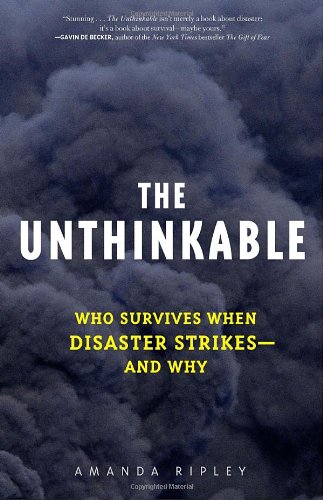
In a vivid blend of science, narrative, and journalistic insight, a prize-winning journalist offers a revealing glimpse of disasters and their aftermath, describing the three stages of disaster response, how we react--or do not react--in moments of catastrophe, and how we can train ourselves and other victims to survive in the event of a disaster. 125,000 first printing.
Die Inhaltsangabe kann sich auf eine andere Ausgabe dieses Titels beziehen.
Über die Autorin bzw. den Autor
A senior writer for Time magazine, AMANDA RIPLEY has been extensively involved in the magazine’s “Person of the Year” cover stories and now writes about homeland security and risk in Washington, D.C. Her disaster reporting recently helped Time win two National Magazine Awards. For more information about Amanda and this book, go to www.TheUnthinkable.com.
Auszug. © Genehmigter Nachdruck. Alle Rechte vorbehalten.
Chapter 1
Delay: Procrastinating in Tower 1
On February 26, 1993, when terrorists attacked the World Trade Center for the first time, Elia Zedeno was in an express elevator carrying a slice of Sbarro's pizza. She had taken a new temporary worker to the food court to show him around, and they were on their way back to their desks. When the bomb exploded, they heard a loud pop and the elevator stopped and began to descend. Then it stopped for good, trapping her and five other people. Smoke began to slowly coil in from below. Two men grappled with the door. A woman dropped to her knees and started praying, making Zedeno nervous. Then one of the men calmly directed everyone to get low and cover their faces. They all did as they were told.
Zedeno concentrated on keeping her breathing shallow and slow. But the more she tried to calm down, the harder her heart seemed to pound. Then they heard a man screaming in the elevator next to them. "I'm burning up!" he yelled as he banged on the metal box around him. But soon he was quiet. "I remember thinking, 'We're going to be next,'" Zedeno says. She visualized rescue workers finding them dead inside the elevator later. Just then, she thought she would lunge for the doors and start banging herself. But before she could, the temp had started doing it for her. He was screaming and banging. So Zedeno took charge of quieting him down. "Robert, calm down. You're going to inhale too much smoke," she told him. He started to cough and returned to the floor.
It was around then that Zedeno was filled with a wave of peace, inexplicably. "Regardless of the outcome, I knew everything was going to be OK," she remembers. "My breath became effortless. My mind no longer wandered. Suddenly, I wasn't there anymore. I was just watching. I could see the people lying in the elevator. The sounds were far away, and I was just hovering. I had no emotions."
When they'd been in the elevator for about an hour, a firefighter managed to rip open the door and pull them out. It turned out the car had returned to the lobby level, and that's where they'd been all along. Zedeno could not see the face of the firefighter who pulled her out; the smoke was too thick. She did as he instructed, grabbing onto a rope and following it out through the lobby and out the doors. She was stunned by the darkness in the lobby and the emptiness outside. She thought that once she had made it out of her own private catastrophe, everything would be normal, bustling and bright. She never imagined that a place could look so different.
In the basement below, a Ryder truck full of eleven hundred pounds of explosives had left a crater five stories deep. Six people had died. It was the largest full-building evacuation in U.S. history, and nothing had gone the way it was supposed to go. Smoke purled up the stairways. The power failed, rendering the emergency communications system useless and the stairways dark. People moved extraordinarily slowly. Ten hours after the explosion, firefighters were still finding people who had not yet evacuated in their offices.
After the bombing, glow-in-the-dark tape and backup power generators were installed in the Trade Center. Both helped save lives eight years later. But still no one fully answered the fundamental question: why did people move so slowly? And what did it mean about all of our assumptions about skyscrapers--and the Trade Center in particular? The 1993 bombing became a story about terrorism, as would the attacks on the same buildings eight years later, and rightly so. But they were also stories of procrastination and denial, the first phase of the human disaster experience.
A few days later, Zedeno was right back at work in a neighboring building. One month later, her office reopened on the seventy-third floor of Tower 1. She started riding the same elevator to work. But it was months before she could get the taste of soot out of her mouth. She thought about leaving the towers, but not with any conviction. "I remember saying, 'This could happen again.' And someone said, 'Lightning never strikes twice.'"
"Don't Worry. It's in Your Head!"
Zedeno has a small stature, round glasses, and Dizzy Gillespie cheeks when she smiles, which happens often. She came to America with her family from Cuba when she was eleven. Her parents had spent her entire childhood plotting to get away from Fidel Castro. When they finally got permission to leave in the early 1970s, they moved to West New York, New Jersey, where their daughter could see the brand-new Trade Center Towers sunning themselves almost everywhere she went.
When she was nineteen, Zedeno visited the Trade Center for the first time. She came to apply for a secretarial job with the Port Authority of New York/New Jersey. She had no idea what the Port Authority did--or even that it owned the Trade Center--but a girlfriend convinced her to fill out the application. When she returned for her second interview, her mother came with her. The boss hired her on the spot, and, on her lunch break, Zedeno ran to the plaza to tell her mother. "What will you do?" she asked her mother, who had no idea how to get home to New Jersey. "I will sit right here and wait for you," her mother announced. They took the train home together that evening.
Eventually, Zedeno got promoted to the finance section. Her office had regular fire drills, which consisted of gathering in the hallway to gossip. During a blackout in 1990, she and her office mates walked down the tower's stairs. That's how they learned that homeless people had been using the lower stairwells as bathrooms. "We were laughing and talking," she remembers. When Zedeno talks, her voice goes up at the end of her sentences, like a child telling you something outrageous. "The whole thing was a joke!"
Zedeno is a witness wherever she goes. She remembers life in surround-sound detail. When I ask her what it was like to leave Cuba as a little girl, she tells me about the day she left in April of 1971. Her mother was doing her hair when they heard the sound of a motorcycle. "Only one man in town had a motorcycle, and it didn't sound like that," she says. Suddenly, the sound stopped in front of their house. A soldier walked in the front door without knocking and told them to leave. Zedeno knew this was good news: they had finally won permission to go to America. Fifteen minutes later, they left their house forever. They were terrified the whole journey out, but they made it. When they arrived in Miami, Zedeno ran down the aisles of a supermarket yelling out descriptions of everything she saw.
By September 2001, Zedeno had worked in the towers for over twenty-one years. She was forty-one years old, and she managed five employees on the seventy-third floor of Tower 1. Her group oversaw the Port Authority's engineering consultants. On 9/11, Zedeno got to work a little after 8:00 A.M. She settled into her cubicle and listened to her voice-mail messages. In an hour, she would head up to the cafeteria to get some breakfast, as usual.
The Trade Center did not feel like a cluster of seven buildings; it felt like a city. Every day, fifty thousand people came to work there, and another two hundred thousand passed through. The plaza underneath held the largest shopping mall in Lower Manhattan. "You didn't need to leave for anything," Zedeno says. The complex had 103 elevators--and its own zip code (10048). Bomb threats and small fires were not uncommon. The engine company across the street sometimes got called to the Trade Center eight times a day. Zedeno got used to seeing firefighters in the elevators. Days later, she would hear that there had been smoke somewhere in the building. It might have been two...
„Über diesen Titel“ kann sich auf eine andere Ausgabe dieses Titels beziehen.
Suchergebnisse für The Unthinkable: Who Survives When Disaster Strikes...

Beispielbild für diese ISBN
The Unthinkable Who Survives W
Anbieter: World of Books (was SecondSale), Montgomery, IL, USA
Verkäuferbewertung 5 von 5 Sternen

Zustand: Acceptable. Item in acceptable condition! Textbooks may not include supplemental items i.e. CDs, access codes etc. Artikel-Nr. 00108581146
Gebraucht kaufen
EUR 4,90
Versand gratis
Versand innerhalb von USA
Versand innerhalb von USA
Anzahl: 1 verfügbar
Beispielbild für diese ISBN
The Unthinkable: Who Survives When Disaster Strikes - and Why
Anbieter: ThriftBooks-Phoenix, Phoenix, AZ, USA
Verkäuferbewertung 5 von 5 Sternen
Hardcover. Zustand: Fair. No Jacket. Readable copy. Pages may have considerable notes/highlighting. ~ ThriftBooks: Read More, Spend Less. Artikel-Nr. G0307352897I5N00
Gebraucht kaufen
EUR 5,91
Versand gratis
Versand innerhalb von USA
Versand innerhalb von USA
Anzahl: 2 verfügbar
Beispielbild für diese ISBN
The Unthinkable: Who Survives When Disaster Strikes - and Why
Anbieter: ThriftBooks-Reno, Reno, NV, USA
Verkäuferbewertung 5 von 5 Sternen
Hardcover. Zustand: Very Good. No Jacket. Missing dust jacket; May have limited writing in cover pages. Pages are unmarked. ~ ThriftBooks: Read More, Spend Less. Artikel-Nr. G0307352897I4N01
Gebraucht kaufen
EUR 5,91
Versand gratis
Versand innerhalb von USA
Versand innerhalb von USA
Anzahl: 1 verfügbar
Beispielbild für diese ISBN
The Unthinkable: Who Survives When Disaster Strikes - and Why
Anbieter: ThriftBooks-Phoenix, Phoenix, AZ, USA
Verkäuferbewertung 5 von 5 Sternen
Hardcover. Zustand: Good. No Jacket. Former library book; Pages can have notes/highlighting. Spine may show signs of wear. ~ ThriftBooks: Read More, Spend Less. Artikel-Nr. G0307352897I3N10
Gebraucht kaufen
EUR 5,91
Versand gratis
Versand innerhalb von USA
Versand innerhalb von USA
Anzahl: 1 verfügbar
Beispielbild für diese ISBN
The Unthinkable: Who Survives When Disaster Strikes - and Why
Anbieter: ThriftBooks-Dallas, Dallas, TX, USA
Verkäuferbewertung 5 von 5 Sternen
Hardcover. Zustand: Good. No Jacket. Missing dust jacket; Pages can have notes/highlighting. Spine may show signs of wear. ~ ThriftBooks: Read More, Spend Less. Artikel-Nr. G0307352897I3N01
Gebraucht kaufen
EUR 5,91
Versand gratis
Versand innerhalb von USA
Versand innerhalb von USA
Anzahl: 1 verfügbar
Beispielbild für diese ISBN
The Unthinkable: Who Survives When Disaster Strikes - and Why
Anbieter: ThriftBooks-Reno, Reno, NV, USA
Verkäuferbewertung 5 von 5 Sternen
Hardcover. Zustand: Fair. No Jacket. Missing dust jacket; Readable copy. Pages may have considerable notes/highlighting. ~ ThriftBooks: Read More, Spend Less. Artikel-Nr. G0307352897I5N01
Gebraucht kaufen
EUR 5,91
Versand gratis
Versand innerhalb von USA
Versand innerhalb von USA
Anzahl: 1 verfügbar
Beispielbild für diese ISBN
The Unthinkable: Who Survives When Disaster Strikes - and Why
Anbieter: ThriftBooks-Dallas, Dallas, TX, USA
Verkäuferbewertung 5 von 5 Sternen
Hardcover. Zustand: Good. No Jacket. Former library book; Pages can have notes/highlighting. Spine may show signs of wear. ~ ThriftBooks: Read More, Spend Less. Artikel-Nr. G0307352897I3N10
Gebraucht kaufen
EUR 5,91
Versand gratis
Versand innerhalb von USA
Versand innerhalb von USA
Anzahl: 1 verfügbar
Beispielbild für diese ISBN
The Unthinkable: Who Survives When Disaster Strikes - and Why
Anbieter: ThriftBooks-Dallas, Dallas, TX, USA
Verkäuferbewertung 5 von 5 Sternen
Hardcover. Zustand: Fair. No Jacket. Missing dust jacket; Readable copy. Pages may have considerable notes/highlighting. ~ ThriftBooks: Read More, Spend Less. Artikel-Nr. G0307352897I5N01
Gebraucht kaufen
EUR 5,91
Versand gratis
Versand innerhalb von USA
Versand innerhalb von USA
Anzahl: 1 verfügbar
Beispielbild für diese ISBN
The Unthinkable: Who Survives When Disaster Strikes - and Why
Anbieter: ThriftBooks-Reno, Reno, NV, USA
Verkäuferbewertung 5 von 5 Sternen
Hardcover. Zustand: Good. No Jacket. Pages can have notes/highlighting. Spine may show signs of wear. ~ ThriftBooks: Read More, Spend Less. Artikel-Nr. G0307352897I3N00
Gebraucht kaufen
EUR 5,91
Versand gratis
Versand innerhalb von USA
Versand innerhalb von USA
Anzahl: 1 verfügbar
Beispielbild für diese ISBN
The Unthinkable: Who Survives When Disaster Strikes - and Why
Anbieter: ThriftBooks-Atlanta, AUSTELL, GA, USA
Verkäuferbewertung 5 von 5 Sternen
Hardcover. Zustand: Very Good. No Jacket. May have limited writing in cover pages. Pages are unmarked. ~ ThriftBooks: Read More, Spend Less. Artikel-Nr. G0307352897I4N00
Gebraucht kaufen
EUR 5,91
Versand gratis
Versand innerhalb von USA
Versand innerhalb von USA
Anzahl: 1 verfügbar