
Verwandte Artikel zu First into Nagasaki: The Censored Eyewitness Dispatches...
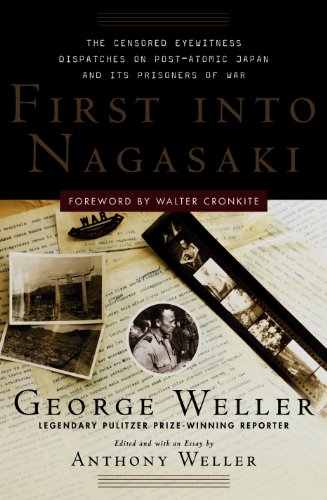
First into Nagasaki: The Censored Eyewitness Dispatches on Post-Atomic Japan and Its Prisoners of War - Hardcover
Inhaltsangabe
Censored in 1945 and unpublished for sixty years, a collection of dispatches by the Pulitzer Prize-winning journalist records the first eyewitness observations of the devasted Japanese city of Nagasaki, along with the accounts of Allied prisoners who recalled the dropping of the bomb and their years of torture and captivity in Japanese POW camps. 50,000 first printing.
Die Inhaltsangabe kann sich auf eine andere Ausgabe dieses Titels beziehen.
Über die Autorin bzw. den Autor
GEORGE WELLER was born in Boston and graduated from Harvard in 1929. As an admired but penniless young novelist, he began reporting on Greece and the Balkans for the New York Times in the 1930s, then made his name covering the war for the Chicago Daily News. He won a 1943 Pulitzer Prize for his story of an emergency appendectomy on a submarine in enemy waters. Throughout a long career Weller reported from five continents; he was a Nieman Fellow in 1947 and also won a 1954 George Polk Award. His work includes two highly praised WWII books, Singapore Is Silent and Bases Overseas. He died at his home in Italy, aged 95.
ANTHONY WELLER, George Weller’s son, is the author of three novels—The Garden of the Peacocks, The Polish Lover, and The Siege of Salt Cove—and a memoir of India and Pakistan called Days and Nights on the Grand Trunk Road. He has traveled widely for numerous magazines and is also a much-recorded jazz and classical guitarist.
Auszug. © Genehmigter Nachdruck. Alle Rechte vorbehalten.
I
First into Nagasaki
(1966)
Whenever I see the word "Nagasaki," a vision arises of the city when I entered it on September 6, 1945, as the first free westerner to do so after the end of the war. No other correspondent had yet evaded the authorities to reach either Hiroshima or Nagasaki. The effects of the atomic bombs were unknown except for the massive fact that they had terminated the war with two blows in three days. The world wanted to know what the bombs' work looked like from below.*
I had just escaped the surveillance of General MacArthur's censors, his public relations officers and his military police. MacArthur had placed all southern Japan off limits to the press. Slipping into forbidden Nagasaki, I felt like another Perry, entering a land where my presence itself was forbidden, a land that now had two Mikados, both omnipotent.
When I walked out of Nagasaki's roofless railroad station, I saw a city frizzled like a baked apple, crusted black at the open core where the searing sun born at Alamogordo had split open the blue sky of midday. I saw the long, crumpled skeleton of the Mitsubishi electrical motor and ship fitting plant, a framework blasted clean of its flesh by the lazy-falling missile floating under a parachute.
What irony, I thought, in a war of competing velocities, that this slowest-borne of all weapons, falling at a speed little greater than my own descent when I took training as a paratrooper, should in the end out-destroy all the fleetest of the winged killers. The bomb of Nagasaki reversed the rule of war, getting there last and slowest but with the most, a terminal blow riding under a silk handkerchief.
Even now I see the scorched hills ringing the bottleneck of the port. Along the blistered boulevards the shadows of fallen telegraph poles were branded upright on buildings, the signature of the ray stamped in huge ideograms. I can never forget the hospitals where I heard from X-ray specialists the devouring effects of the ray on the human bloodstream and viscera, analyzed as impassively by the little men in white coats as if it had happened to someone else, not themselves. In the battered corridors of these hospitals, already eroded by man's normal suffering, there was no sorrowful horde. The wards were filled. There was no private place left to die. Consequently the dying were sitting up crosslegged against the walls, holding sad little court with their families, answering their tender questions with the mild, consenting indifference of those whose future is cancelled.
I felt pity, but no remorse. The Japanese military had cured me of that. After years of unchallenged domination, they were bending a little under the first after-wind of the bombs, a national mistrust, almost contempt, for having led Japan into war. A few sought escape in hara-kiri. The majority blamed the enemy for using weapons that were "unfair."
Had Japan got these weapons first, would they have been unfair, I asked? Was Pearl Harbor an act of Japanese chivalry? The crafty eyes under the peaked brown caps turned unblinking and blank.
In the harbor, I remember, there still burned the last altar kindled by the fireball. A small freighter, crisped like dry bacon down to the waterline, still smoked, glowed and puffed. She was a floating lamp, untended, with all her mooring ropes burned outward till the ends fell in the water. But her hot pink hawsers still held. Bobbing there among the debris-littered dark waters, she spread a light that flickered in eerie unison with the candles and kerosene lamps and little flashlights ashore.
I felt I had a right to be in Nagasaki, closed or not. Four weeks after the two bombs, with no riots or resistance in Japan, it seemed reasonable that MacArthur should lift his snuffer from the two cities. There was a sort of reason for delay, but it had nothing to do with the public's right to know. As something to fall back upon in the event of the failure of the bombs, MacArthur's planners had arranged that the Japanese archipelago was to be invaded in one-two time, first the northern islands and the Tokyo-Yokohama area, and then the south, with the two atomic cities. Japan's surrender made little difference. An incredible six weeks was announced as the interval before the southern islands were to be occupied. MacArthur had fought a slow, cautious, methodical war, taking no chances with his postwar target, the presidency. His peacemaking was its twin, with censorship prolonged after victory long after the slightest pretext for it existed.
After submitting to the censors of the MacArthur command ever since I had escaped from Java in March, 1942, I felt I could not take much more. I remembered how his censors, perhaps eager not to offend or alarm the White House, killed a dispatch I wrote criticizing Roosevelt's defeat by Stalin at Yalta. With security no longer in question, I was not going to be stifled again. But I was not unaware that in planning to slip into an atomic city first, I was also risking repudiation by the conformists in my own profession. Four years earlier they had ceased bucking the communiqué-fed hamburger grinder, and they disliked-while perhaps secretly admiring-anybody who kept on trying to report the war, to make the public think as well as feel.
My plan of extrusion formed itself a few hours after we all sat on the gun turrets of the Missouri, watching Japan surrender to MacArthur and Nimitz. This measured rite over-almost wrecked by a Russian photographer in Lenin cap who was chased around like Harpo Marx-the correspondents were summoned ashore to a press conference. The war was ended, as we had reported, but the censorship was not. There was no chance, therefore, to ask from Tokyo why the Kurile Islands, regular patrol grounds of the U.S. Pacific Fleet, were to be handed to Russia. What the command wanted covered was the prison camps of northern Japan. The dam was to be opened to one last orgy of home town stories, more mindless and more alike than the slow molasses drippings of four years of sloppy, apolitical, dear-mom war. Everything had been arranged: destroyers and planes were to take the correspondents north. North, north, north, away from where the war had been decided a month before.
Once, in midwar, I had been able to escape the darkrooms of the four main theaters of war by going home and running off a book called Bases Overseas, claiming for the United States a worldwide network of small strong points where her men had died and her treasure been expended. I did not feel that the right way to end this war was to be herded north, away from Hiroshima and Nagasaki, to chew more fodder about what-beasts-the-Japs-are and Jimmy-looks-skinnier-today. Only a few days before, but after the Mikado's surrender, a Saturday Evening Post writer who wore colonel's leaves refused to pass my story about the 503rd Paratroops on Corregidor, my old outfit, that revealed there were still Japanese bodies unburied in the tunnels. "That's contrary to the Geneva Convention, and might make the Japs cancel their surrender," he said. . . . The American psychological grasp of the Japanese was shallow.
I listened as the chief conducting officer, rod in hand, pointed out on a map the prison camps where the newsmen were to be allowed to land and play savior. "Southern Japan remains closed. However, there is a little place down here"-he pointed to the southern end of Kyushu-"where their navy had a kamikaze base. Anybody interested in the divine wind?"
"Geisha schools next door?" asked a jaded voice.
"Nuh-uh. And the pilots are all in the stockade, I'm afraid." Ah, no interviews, then. Enemy personnel, minimize glorification of.
"What happened to their planes?" asked a hopeful photographer.
"Not much left...
„Über diesen Titel“ kann sich auf eine andere Ausgabe dieses Titels beziehen.
Suchergebnisse für First into Nagasaki: The Censored Eyewitness Dispatches...

Beispielbild für diese ISBN
First into Nagasaki: The Censo
Anbieter: World of Books (was SecondSale), Montgomery, IL, USA
Verkäuferbewertung 5 von 5 Sternen

Zustand: Good. Item in good condition. Textbooks may not include supplemental items i.e. CDs, access codes etc. Artikel-Nr. 00110135395
Gebraucht kaufen
EUR 4,57
Versand gratis
Versand innerhalb von USA
Versand innerhalb von USA
Anzahl: 1 verfügbar
Beispielbild für diese ISBN
First into Nagasaki: The Censo
Anbieter: World of Books (was SecondSale), Montgomery, IL, USA
Verkäuferbewertung 5 von 5 Sternen
Zustand: Very Good. Item in very good condition! Textbooks may not include supplemental items i.e. CDs, access codes etc. Artikel-Nr. 00106766198
Gebraucht kaufen
EUR 4,57
Versand gratis
Versand innerhalb von USA
Versand innerhalb von USA
Anzahl: 1 verfügbar
Beispielbild für diese ISBN
First into Nagasaki: The Censo
Anbieter: World of Books (was SecondSale), Montgomery, IL, USA
Verkäuferbewertung 5 von 5 Sternen
Zustand: Good. Good condition ex-library book with usual library markings and stickers. Artikel-Nr. 00109608463
Gebraucht kaufen
EUR 4,57
Versand gratis
Versand innerhalb von USA
Versand innerhalb von USA
Anzahl: 1 verfügbar
Beispielbild für diese ISBN
First into Nagasaki : The Censored Eyewitness Dispatches on Post-Atomic Japan and Its Prisoners of War
Verlag:
Crown Publishing Group, The, 2006
ISBN 10: 0307342018
ISBN 13: 9780307342010
Gebraucht
Hardcover
Anbieter: Better World Books, Mishawaka, IN, USA
Verkäuferbewertung 5 von 5 Sternen
Zustand: Good. Former library copy. Pages intact with minimal writing/highlighting. The binding may be loose and creased. Dust jackets/supplements are not included. Includes library markings. Stock photo provided. Product includes identifying sticker. Better World Books: Buy Books. Do Good. Artikel-Nr. GRP97972511
Gebraucht kaufen
EUR 6,20
Versand gratis
Versand innerhalb von USA
Versand innerhalb von USA
Anzahl: 2 verfügbar
Beispielbild für diese ISBN
First into Nagasaki : The Censored Eyewitness Dispatches on Post-Atomic Japan and Its Prisoners of War
Verlag:
Crown Publishing Group, The, 2006
ISBN 10: 0307342018
ISBN 13: 9780307342010
Gebraucht
Hardcover
Anbieter: Better World Books, Mishawaka, IN, USA
Verkäuferbewertung 5 von 5 Sternen
Zustand: Very Good. Former library copy. Pages intact with possible writing/highlighting. Binding strong with minor wear. Dust jackets/supplements may not be included. Includes library markings. Stock photo provided. Product includes identifying sticker. Better World Books: Buy Books. Do Good. Artikel-Nr. 3173020-6
Gebraucht kaufen
EUR 6,20
Versand gratis
Versand innerhalb von USA
Versand innerhalb von USA
Anzahl: 1 verfügbar
Beispielbild für diese ISBN
First Into Nagasaki: The Censored Eyewitness Dispatches on Post-Atomic Japan and Its Prisoners of War
Anbieter: Wonder Book, Frederick, MD, USA
Verkäuferbewertung 5 von 5 Sternen
Zustand: As New. Signed Copy . Very Good dust jacket. Signed by author on title page. In protective mylar cover. Artikel-Nr. J00C-02199
Gebraucht kaufen
EUR 6,27
Versand gratis
Versand innerhalb von USA
Versand innerhalb von USA
Anzahl: 1 verfügbar
Beispielbild für diese ISBN
First Into Nagasaki: The Censored Eyewitness Dispatches on Post-Atomic Japan and Its Prisoners of War
Anbieter: Wonder Book, Frederick, MD, USA
Verkäuferbewertung 5 von 5 Sternen
Zustand: Very Good. Very Good condition. Acceptable dust jacket. With remainder mark. A copy that may have a few cosmetic defects. May also contain light spine creasing or a few markings such as an owner's name, short gifter's inscription or light stamp. Artikel-Nr. E09A-02892
Gebraucht kaufen
EUR 6,27
Versand gratis
Versand innerhalb von USA
Versand innerhalb von USA
Anzahl: 1 verfügbar
Beispielbild für diese ISBN
First Into Nagasaki: The Censored Eyewitness Dispatches on Post-Atomic Japan and Its Prisoners of War
Anbieter: Wonder Book, Frederick, MD, USA
Verkäuferbewertung 5 von 5 Sternen
Zustand: As New. Like New condition. Very Good dust jacket. A near perfect copy that may have very minor cosmetic defects. Artikel-Nr. I17A-04006
Gebraucht kaufen
EUR 6,27
Versand gratis
Versand innerhalb von USA
Versand innerhalb von USA
Anzahl: 1 verfügbar
Beispielbild für diese ISBN
First Into Nagasaki: The Censored Eyewitness Dispatches on Post-Atomic Japan and Its Prisoners of War
Anbieter: Wonder Book, Frederick, MD, USA
Verkäuferbewertung 5 von 5 Sternen
Zustand: Good. Good condition. Good dust jacket. A copy that has been read but remains intact. May contain markings such as bookplates, stamps, limited notes and highlighting, or a few light stains. Artikel-Nr. V15A-05249
Gebraucht kaufen
EUR 6,27
Versand gratis
Versand innerhalb von USA
Versand innerhalb von USA
Anzahl: 1 verfügbar
Beispielbild für diese ISBN
First Into Nagasaki: The Censored Eyewitness Dispatches on Post-Atomic Japan and Its Prisoners of War
Anbieter: ThriftBooks-Atlanta, AUSTELL, GA, USA
Verkäuferbewertung 5 von 5 Sternen
Hardcover. Zustand: Very Good. No Jacket. Missing dust jacket; May have limited writing in cover pages. Pages are unmarked. ~ ThriftBooks: Read More, Spend Less. Artikel-Nr. G0307342018I4N01
Gebraucht kaufen
EUR 6,61
Versand gratis
Versand innerhalb von USA
Versand innerhalb von USA
Anzahl: 1 verfügbar