
Verwandte Artikel zu Free Ride: John McCain and the Media
Inhaltsangabe
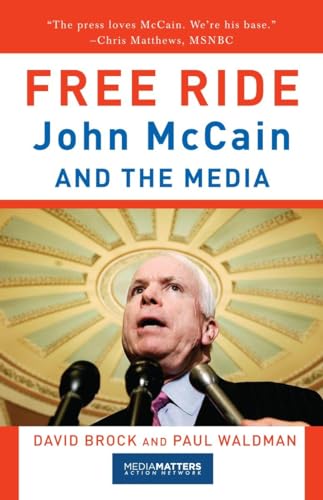
We live in a gotcha media culture that revels in exposing the foibles and hypocrisies of our politicians. But one politician manages to escape this treatment, getting the benefit of the doubt and a positive spin for nearly everything he does: John McCain. Indeed, even during his temporary decline in popularity in 2007, the media continued to support him by lamenting his fate rather than criticizing the flip flops and politicking that undermined his popular image as a maverick.David Brock and Paul Waldman show how the media has enabled McCain's rise from the Keating Five scandal to the underdog hero of the 2000 primaries to his roller-coaster run for the 2008 nomination. They illuminate how the press falls for McCain's “straight talk” and how the Arizona senator gets away with inconsistencies and misrepresentations for which the media skewers other politicians. This is a fascinating study of how the media shape the political debate, and an essential book for every political junkie.
Die Inhaltsangabe kann sich auf eine andere Ausgabe dieses Titels beziehen.
Über die Autorin bzw. den Autor
David Brock is the author of four political books, including The Republican Noise Machine: Right-Wing Media and How It Corrupts Democracy. In his preceding book, Blinded by the Right: The Conscience of an Ex-Conservative, a 2002 New York Times bestselling political memoir, he chronicled his years as a conservative media insider.Paul Waldman is the author or coauthor of three books on politics and media, including The Press Effect: Politicians, Journalists, and the Stories That Shape the Political World. His last book was Being Right Is Not Enough: What Progressives Must Learn From Conservative Success. He is also a columnist for The American Prospect.
Auszug. © Genehmigter Nachdruck. Alle Rechte vorbehalten.
Chapter 1How He Won Their HeartsSteve: My friend and I have this argument, and here it is. He says when you're at a place like this, you can't just be yourself, you need an act. So anyway, I saw you standing there, so I thought, A, I could just leave you alone; B, I could come up with an act; or C, I could just be myself. I chose C. What do you think?Linda: I think that A, you have an act, and that B, not having an act is your act.--Singles (1992)There's no doubt about it: John McCain is a popular guy. In an age of partisan rancor, he gets favorable ratings not just from members of his own party, but from plenty of independents and Democrats as well. He is considered both ideologically moderate and someone to whom the excesses of contemporary politics--artificiality, nastiness, preferential treatment for financial backers--don't seem to apply.But nowhere is McCain more popular than with the Washington, DC, journalistic establishment. Indeed, one struggles to recall a prominent political figure in recent decades who has received such sustained adulation from the ordinarily cynical press corps.How did he do it? How did John McCain manage to turn a pack of snarling beasts into obedient service animals, ready to do his bidding at every turn? As a starting point, it is important to keep in mind that it is, in fact, something McCain did, not something that happened by accident. While every politician seeks the best news coverage he or she can get, McCain employed a strategy that has been uniquely effective. And it is a strategy.The Three FoundationsThe press's affection for John McCain is built on three foundations: his Vietnam experience, his advocacy for campaign finance reform, and his style in dealing with reporters. McCain and his advisers display a deep understanding of how each functions, how to sustain their effectiveness, and how far they can be pushed. At first glance, these may seem like three very different matters: a factor of personal biography, a prosaic and often arcane policy issue, and a simple matter of personal relationships. But when it comes to McCain they actually have a great deal in common and add up to a portrait the press paints of the Arizona senator as not simply unlike other politicians, but the very antithesis of other politicians. Like a concave mirror, the prism through which the press views their subjects takes all that they dislike about politicians and inverts it to construct the figure of John McCain.In all three cases, McCain has become for the press the opposite of everything they think is wrong with things as they are, and so he comes to embody for them the hope of a better politics. They view politicians as craven; McCain's undeniable courage in Vietnam casts him as the bravest of politicians, whether such bravery is truly in evidence at a particular moment or not. They view politicians as shameless supplicants to their contributors; McCain's advocacy of campaign finance reform makes him in their eyes the premier "reformer" in American politics (despite the weaknesses of the legislation he advocates and his spotty record on reform). They view politicians as cynically manipulative, fundamentally artificial, and endlessly hostile when it comes to dealing with journalists; McCain's attentive courting makes him "genuine" and "authentic" in a way no other politician can seem to achieve.It is this last factor--the manner in which McCain has flattered, befriended, and courted reporters--that makes the other two factors meaningful. After all, there are other politicians who have heroic deeds in their past and have made efforts on behalf of reform. Like McCain, Ross Perot's 1992 running mate, James Stockdale, endured years in the Hanoi Hilton, but his Vietnam suffering didn't turn him into a press hero during his brief moment on the national stage; Republican congressman Sam Johnson of Texas was a prisoner of war in Vietnam for nearly seven years, but has never attracted any particular attention from the news media. Like McCain, Democrat Russell Feingold has spent much of his time in the Senate advocating political reform--indeed, Feingold's record on this front is superior to McCain's--but he is nowhere near the press favorite McCain is. In short, it is the combination of all three factors that produces McCain's unique status with the Washington press corps.The result is that when McCain runs for office, he is described as the "anti-candidate"1 (Christian Science Monitor) or "anti-politician" who runs an "anti-campaign"2 (New York Times) and "refuse[s] to be scripted"3 (St. Petersburg Times). The press uses McCain to define what it does not like about politicians and campaigns, a living rebuke to the shortcomings of modern politics.Foundation 1: VietnamJohn McCain endured terrible suffering during the five and a half years he spent as a prisoner of war in Vietnam, and in the course of that time he displayed admirable courage, even heroism. No one would contest those facts. But it does not necessarily follow that McCain's Vietnam history should function as a halo reducing all questions of character--a press obsession, particularly when it comes to presidential candidates--to the story of the Hanoi Hilton. To be sure, McCain's Vietnam experience is a key part of his character, but it is, after all, only a part.But that is not how the press sees it. It does not minimize McCain's courage and suffering in Vietnam to note that for no other politician does something that happened nearly forty years prior play such a prominent role in their own candidacy and in how the press discusses that candidacy. Other candidates--John F. Kennedy, George H. W. Bush, Bob Dole, and John Kerry, to name a few--have used their war records as selling points. Indeed, American politicians ever since George Washington have found political benefit in their military history. But war service was a part of the story those politicians told about themselves and the story the press told the public about them. For McCain, on the other hand, Vietnam is nearly the entirety of the character story we are told.Other politicians find features of their biographies mentioned when they are relevant to the story at hand. The fact that John Kerry is a Vietnam veteran might be brought up by a journalist doing a story about, say, a proposal Kerry made on veterans' benefits. Dick Cheney's tenure as CEO of Halliburton will be discussed in a story about the White House and military contracting. But McCain's POW experience is different. Journalists do not hesitate to mention it even when it has absolutely nothing to do with the story; instead, it is often tossed into stories by reporters almost in an offhand way, as though it were necessary to constantly remind readers of his trials. To take a typical example, a May 2006 Christian Science Monitor piece previewing the 2008 presidential race contained this sentence: "But conversation inevitably turns to Arizona's Sen. John McCain, whose directness sometimes disturbs his conservative colleagues, but whose valor while a prisoner of war in Vietnam enamors many voters."4 There have been literally hundreds of articles that include a line on the order of "McCain, who spent five and a half years as a prisoner of war . . . ," as though that were his middle name. And not just when it comes to topics like the treatment of prisoners in Iraq or Vietnam itself. Often it is offered as a simple description of who McCain is. When McCain endorsed Charlie Crist for the Florida governorship, the St. Petersburg Times wrote, "McCain called Crist a reformer who's right on the issues. McCain is a decorated Vietnam War veteran and former prisoner of war and a likely 2008 Republican presidential candidate."5 When he comes to town, local papers will make sure to remind readers who he is: "McCain, a Navy officer and former...
„Über diesen Titel“ kann sich auf eine andere Ausgabe dieses Titels beziehen.
Suchergebnisse für Free Ride: John McCain and the Media

Beispielbild für diese ISBN
Free Ride: John McCain and the Media
Verlag:
Knopf Doubleday Publishing Group (edition Illustrated), 2008
ISBN 10: 0307279405
ISBN 13: 9780307279408
Gebraucht
Paperback
Anbieter: BooksRun, Philadelphia, PA, USA
Verkäuferbewertung 5 von 5 Sternen

Paperback. Zustand: Very Good. Illustrated. It's a well-cared-for item that has seen limited use. The item may show minor signs of wear. All the text is legible, with all pages included. It may have slight markings and/or highlighting. Artikel-Nr. 0307279405-11-1
Gebraucht kaufen
EUR 4,62
Versand gratis
Versand innerhalb von USA
Versand innerhalb von USA
Anzahl: 1 verfügbar
Beispielbild für diese ISBN
Free Ride: John McCain and the
Verlag:
Knopf Doubleday Publishing Group, 2008
ISBN 10: 0307279405
ISBN 13: 9780307279408
Gebraucht
Softcover
Anbieter: World of Books (was SecondSale), Montgomery, IL, USA
Verkäuferbewertung 5 von 5 Sternen
Zustand: Very Good. Item in very good condition! Textbooks may not include supplemental items i.e. CDs, access codes etc. Artikel-Nr. 00098889265
Gebraucht kaufen
EUR 5,60
Versand gratis
Versand innerhalb von USA
Versand innerhalb von USA
Anzahl: 1 verfügbar
Beispielbild für diese ISBN
Free Ride: John McCain and the Media
Anbieter: World of Books (was SecondSale), Montgomery, IL, USA
Verkäuferbewertung 5 von 5 Sternen
Paperback. Zustand: Good. We live in a gotcha media culture that revels in exposing the foibles and hypocrisies of our politicians. But one politician manages to escape this treatment, getting the benefit of the doubt and a positive spin for nearly everything he does: John McCain. Indeed, even during his temporary decline in popularity in 2007, the media continued to support him by lamenting his fate rather than criticizing the flip flops and politicking that undermined his popular image as a maverick.David Brock and Paul Waldman show how the media has enabled McCain's rise from the Keating Five scandal to the underdog hero of the 2000 primaries to his roller-coaster run for the 2008 nomination. They illuminate how the press falls for McCain's "straight talk" and how the Arizona senator gets away with inconsistencies and misrepresentations for which the media skewers other politicians. This is a fascinating study of how the media shape the political debate, and an essential book for every political junkie. Artikel-Nr. 00110464207
Gebraucht kaufen
EUR 5,60
Versand gratis
Versand innerhalb von USA
Versand innerhalb von USA
Anzahl: 2 verfügbar
Beispielbild für diese ISBN
Free Ride: John McCain and the Media
Verlag:
Knopf Doubleday Publishing Group, 2008
ISBN 10: 0307279405
ISBN 13: 9780307279408
Gebraucht
Softcover
Anbieter: Wonder Book, Frederick, MD, USA
Verkäuferbewertung 5 von 5 Sternen
Zustand: Very Good. Very Good condition. A copy that may have a few cosmetic defects. May also contain light spine creasing or a few markings such as an owner's name, short gifter's inscription or light stamp. Artikel-Nr. F18B-04404
Gebraucht kaufen
EUR 6,42
Versand gratis
Versand innerhalb von USA
Versand innerhalb von USA
Anzahl: 2 verfügbar
Beispielbild für diese ISBN
Free Ride: John McCain and the Media
Verlag:
Knopf Doubleday Publishing Group, 2008
ISBN 10: 0307279405
ISBN 13: 9780307279408
Gebraucht
Paperback
Anbieter: ThriftBooks-Dallas, Dallas, TX, USA
Verkäuferbewertung 5 von 5 Sternen
Paperback. Zustand: Very Good. No Jacket. Former library book; May have limited writing in cover pages. Pages are unmarked. ~ ThriftBooks: Read More, Spend Less. Artikel-Nr. G0307279405I4N10
Gebraucht kaufen
EUR 6,53
Versand gratis
Versand innerhalb von USA
Versand innerhalb von USA
Anzahl: 1 verfügbar
Beispielbild für diese ISBN
Free Ride : John Mccain and the Media
Verlag:
Knopf Doubleday Publishing Group, 2008
ISBN 10: 0307279405
ISBN 13: 9780307279408
Gebraucht
Softcover
Anbieter: Better World Books: West, Reno, NV, USA
Verkäuferbewertung 5 von 5 Sternen
Zustand: Very Good. 1 Edition. Pages intact with possible writing/highlighting. Binding strong with minor wear. Dust jackets/supplements may not be included. Stock photo provided. Product includes identifying sticker. Better World Books: Buy Books. Do Good. Artikel-Nr. GRP75406523
Gebraucht kaufen
EUR 7,21
Versand gratis
Versand innerhalb von USA
Versand innerhalb von USA
Anzahl: 2 verfügbar
Beispielbild für diese ISBN
Free Ride: The Media and John Mccain
Anbieter: Revaluation Books, Exeter, Vereinigtes Königreich
Verkäuferbewertung 5 von 5 Sternen
Paperback. Zustand: Brand New. advanced reading copy edition. 240 pages. 8.25x5.25x0.50 inches. In Stock. Artikel-Nr. x-0307279405
Neu kaufen
EUR 25,90
EUR 11,84 Versand
Versand von Vereinigtes Königreich nach USA
Versand von Vereinigtes Königreich nach USA
Anzahl: 2 verfügbar
Beispielbild für diese ISBN
Free Ride: John McCain and the Media
Anbieter: Majestic Books, Hounslow, Vereinigtes Königreich
Verkäuferbewertung 4 von 5 Sternen

Zustand: New. pp. xviii + 218 Illus. Artikel-Nr. 8193182
Neu kaufen
EUR 38,54
EUR 7,69 Versand
Versand von Vereinigtes Königreich nach USA
Versand von Vereinigtes Königreich nach USA
Anzahl: 1 verfügbar